Short-Term Options Unlock Potential Profits: Here’s How to Hedge Your Portfolio in a Market Pullback
Wall Street is never at a loss when it comes to inventing new ways for retail investors to speculate – or let’s be honest, gamble – on the stock market.
Take options, for example. When the CBOE first introduced standardized options contracts back in 1973, the choices were incredibly limited. There were just 16 stocks with listed options, and get this: They were a one-way bet – call options only.
That’s right. When options arrived for retail use, you could only play the upside in just a handful of stocks. It wasn’t until four years later – that put options, a way to bet or hedge against a downside move, entered the picture!
But it didn’t take long for Wall Street brokers to expand the menu of options investors could choose from.
For a time, only standard monthly expirations were available for trading. But more recently, Wall Street introduced call and put options with weekly expirations.
And now, for those folks who just can’t enough option flavors, there’s a new game in town that has exploded in popularity – especially among retail traders: They’re called zero-days-to-expiration (0DTE) options. These low-priced contracts expire rapidly, and enable traders to enter options trades with durations as short as a few hours.
And in just two years, zero-day options have exploded in popularity, to about $1 trillion in daily trading volume, according to JPMorgan Chase. The chart below shows exactly how these ultra short-term options have taken Wall Street by storm, with option expirations on the SPDR S&P 500 ETF Trust (SPY) now available for every open trading day:

But it’s not just retail traders jumping into the zero-day pool with both feet.
As Jonathan Rose, lead analyst at our corporate partner Masters in Trading points out, hedge funds and other short-term traders often use 0DTE option contracts instead of the standard option expirations as an easy way to hedge their portfolios.
We’ll dive deeper into Jonathan’s new approach to 0DTE options later in this issue. For now, let’s take a step back and look at the bigger picture — whether it’s zero-day options or traditional plays, understanding the full range of tools is key to managing today’s volatile market.
And in today’s market, investors on all sides simply have more … options, if you’ll pardon the pun.
Now, for my money, I almost exclusively use options in just two ways:
First, I use options to earn steady, recurring income – by selling put options on high-quality stocks I’d like to own and selling covered-call options on stocks I already own.
Second, I believe put options and spreads are quite handy for protecting your portfolio against possible volatile market swings. And right now, you may want to consider the virtue of options as a hedge against potential downside risks.
Red Flags in Market Breadth
In recent news, the S&P 500 has exploded higher post-election, taking a quick upside pop that has pushed the Index up 24% already this year – and there’s still over a month to go before we hit the 2024 finish line.
But recently, stock market breadth has weakened, raising red flags that always get my attention:

The charts above display the S&P 500’s recent performance in the blue bars at the top. And beneath the price action, you can read two key measures of stock market breadth: the number of stocks advancing versus declining, and the number of stocks marking new highs versus new lows.
The chart on the left plots the S&P 500 alongside its advance/decline line (AD), which measures the number of index component stocks moving higher minus those moving lower.
The A/D line should confirm the overall uptrend in the S&P. But here’s the catch: notice how the recent gap higher in the index was accompanied by a lower low in the AD line (marked with a red arrow)?
That means fewer stocks are participating in the big post-election rally. The same pattern is showing in other indexes – including the Dow Jones Industrials, the Nasdaq, and the NYSE Composite. That’s the first red flag.
Meanwhile, the chart on the right highlights our second reliable breadth measure: the number of stocks making new highs minus those hitting new lows in the S&P 500. Right after the election results, you can see a big spike into new highs.
Yet just 10 trading days later, the high/low ratio has dropped back to zero. In other words, there’s not much upside follow-through happening for the S&P after that strong upside gap.
In fact, similar metrics for the Dow and the Nasdaq have moved into negative territory, meaning those indexes are seeing more new lows than highs!
Granted, this may simply be a brief pause as stocks catch their breath after the sharp post-election rally. But it also raises the possibility that stocks may need to cool off a bit from the upside – and that could mean a pullback.
If that’s the case, you have options to help hedge your portfolio.
One of the easiest tools at your disposal are short-term put options on major index ETFs – like the SPY or Invesco QQQ ETF (QQQ).
Let’s single out QQQ, which tracks the tech-centric Nasdaq 100 Index. I’ll show you how easy it is to search an option hedge using TradeSmith tools.
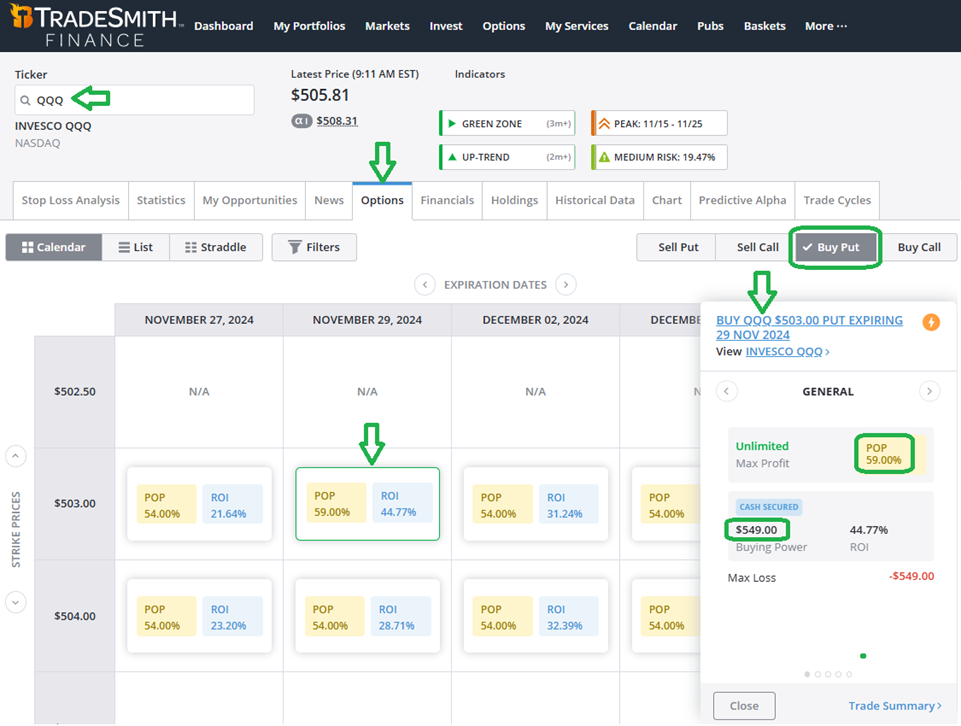
Start by logging into your TradeSmith Finance dashboard, and simply click on the bar labeled “Search for Ticker” on the top right of the screen. Enter the symbol QQQ and select it to view the ticker in our Stock Analyzer, then click on the Options tab near the middle of the menu bars.
From there, select Buy Put from the list of strategies on the upper right, which will bring you to the Options calendar view shown above.
Note that you can adjust the view settings to suit your preference. And if you don’t have access to the ticker search bar or Options tab in TradeSmith Finance – and would like to – please call our dedicated Customer Support team at 866-220-1107 to find out how to get access.
While looking through the options calendar, you’ll notice there are many options contracts available – these are organized by different strike prices along the left axis, and expiration dates along the top. From this menu, I can select the QQQ Nov. 29, 202 $503 Put – a decent choice for an out-of-the-money hedge in case a sharp correction develops.
If you click on that option tile you can see the details on the right of your screen.
Here, you’ll see that this put has a 59% Probability of Profit (POP) score – that means your chances of profit are slightly better than coin flip. It’s a speculative trade, but buying this put could prove useful as a hedge against your portfolio heavy in stocks.
The cost of this option is $549, as noted in the window marked Cash Secured Buying Power. Because we’re purchasing a long put in this example, the total cost is also the most you can lose on the trade. Meanwhile, your potential profit depends on how far QQQ falls during a market correction – and how soon that correction comes.
Mike Burnick’s Bottom Line: If recent red flags about weakening market breadth signal a potential pullback for stocks, now is the time to be ready – and one way to prepare is to hedge your portfolio using options strategies like the one shown above. Our Options360 platform can help guide you to the best options for hedging and keep your portfolio growing even in bearish market periods.
Good investing,
Mike Burnick
Senior Analyst, TradeSmith
P.S. Short-dated options are often priced at a fraction of their more traditional, longer-dated siblings. But these cheap options can skyrocket in value as quickly as they expire, which is why they’re so popular for speculation – with zero-day options especially favored by retail traders and Wall Street firms alike.
But as we discussed earlier, my colleague Jonathan Rose – lead analyst at our corporate partner Masters in Trading – can attest that these short-lived options aren’t just for gambling. They’re also incredibly effective tools for hedging your stock portfolio, especially when volatility spikes higher. As we’ve covered today, buying put options as a hedge can lead to short-term gains if markets take a downturn.
And that’s not all you can do with short-dated options. Next week, on Tuesday, Nov. 26 at 11:00 a.m. ET, Jonathan will be going live to reveal his newest strategy, and the tool he’s built to search out the best short-term opportunities on the market.
He’ll show you how to trade zero-day options – the explosive assets that have the potential to generate massive gains in hours, not days or weeks. In fact, by Jonathan’s research these options could have already helped you more than 100x your gains from the ongoing AI boom.
Don’t miss this opportunity to learn his strategy at the One-Day Winners Live Summit, starting at 11:00 a.m. ET.
Click here to reserve your spot and get ready to see how the Masters in Trading handle the market.