Top 10 Stocks to Ride the Mega Melt-Up
At its peak, the ocean wave reached a staggering 86 feet tall.
And where you or I might run for the hills at the notion of such a powerful force of nature, in October 2020, German surfer Sebastian Steudtner did not back down from this monumental challenge.
Along the shores of Nazaré, Portugal, the waves are famous for being fierce, massive, and supremely dangerous – but the fearless Steudtner saw this as an opportunity.
And he did it: He surfed this 86-foot-tall monster of a wave, pushing his physical and mental fortitude to their absolute limits – and he effectively crushed the previous world record held by Garrett McNamara, who surfed a 78-footer in that same location nine years earlier.
Both surfers solidified their place as legends in their sport for each of their records – and lived to tell the tale – and while their death-defying stunts have more than earned the amount of praise they’ve received, there is something else about their story that strikes me as particularly pertinent for us as traders:
Great surfers don’t paddle for every wave. They wait. They study the tides, the wind, the swell.
Then, when the rare, perfect wave begins to rise… they commit. There is no time for second guesses, for hesitation, for “maybe I shouldn’t”…
It’s do or die – and for Steudtner and McNamara, it was quite literally true.
For us as traders, the stakes are not quite as high, but adopting the same mentality is critical to building wealth and creating a better future for yourself and your loved ones.
And right now, in the markets, a similar opportunity to these Portuguese waves is building… a rare convergence of forces that could create a once-in-a-generation melt-up.
The only question is: Are you ready to ride it?
In this report, I’ll show you how I found 10 special stocks that are designed to help you maximize your gains from the next leg of the melt-up…
Now, there is one crucial thing to note: These stocks are not life savings-type stocks; they’re not growth stocks that you use to build your nest egg.
Rather, these stocks could see gains of 1,000%… or losses of 95%.
The term “moonshot” is key here: high risk with the potential for a huge reward.
Just like McNamara’s and Steudtner’s record-breaking waves, you have to calculate for yourself if the loss is worth the gain.
And before I reveal the list of stocks for you, I want to show you exactly how to do that.
Let’s talk about it…
Have a Plan… and Stick to It
Just for a moment, I want you to think of a bizarre situation:
You get in your car and head to the supermarket to pick up groceries for dinner.
After you get on the road and pick up speed, you suddenly notice there’s no brake pedal.
Like any normal person, you start to panic.
You have no ability to stop or slow the vehicle.
Then, you panic even more when your steering wheel locks up. You have no ability to steer the car.
Now, you’re in a car with no brakes and no functional steering wheel. You’re in motion and in danger.
It’s a vivid and terrifying picture – and thankfully, it would never happen in real life.
However…
This is the way many traders manage their portfolios. In fact, it’s how most people manage their stock and option trades.
They get into investment and trading positions with high hopes and a destination in mind, but no ability to manage the positions once they are active.
The way most people trade and invest is the equivalent of the driver with no ability to change direction or stop the car – no plan and pure panic.
Pure financial illiteracy.
That’s because most investors focus on investment entries. They focus on what to buy – stock picks.
However, the decision to enter an investment or trade is just one small part of that financial undertaking.
And arguably, that’s not the most important action you’ll take in your trading.
Managing your position is far more critical – and it’s where many traders slip up.
Position management is what you do with an investment or trade after you’ve gotten into it. It’s how you’ll steer the car and adjust its speed while it’s on the road.
For example…
- If you buy a stock that you think has the potential to triple in value… but it instead sinks 22%, what will you do?
- If you buy a stock that soars 50% right after you buy it but then declines back to your purchase price, what’s your next move?
- If you buy stock in a company with a highly respected CEO at the helm and that CEO steps down, will you sell the stock?
- If you buy a stock that rises 100%, what’s your plan to preserve that gain?
These are the questions a real investor asks before entering any investment. This is the kind of planning skilled investors and traders do as part of their process. They give exit planning a lot of thought.
Unskilled, undisciplined investors barely give this planning a moment of their time
They put large amounts of their hard-earned savings at great risk by entering investments and trades while having no exit plan…
- No exit plan in case the stock heads 20% lower after the purchase…
- No exit plan in case the stock rises 100% after purchase…
- And no exit plan in case the stock rises 20% and then drops back down to the purchase price.
It’s totally crazy – and it happens every day the stock market is open.
Yet, the world’s best investors and traders give exit planning a lot of thought.
They know in advance what they will do if a stock or a trade soars in value… or if it plummets.
Take it from the pro-athletes and record-breakers we talked about earlier, Garrett McNamara and Sebastian Steudtner.
Their names and reputations were on the line, sure, but so were their very lives as they took on waves the size of six-story buildings.
Every move they made was calculated… and yours should be, too.
Establish Stop-Loss Orders
Instead of acting like the financially illiterate investor that is flying down the road with no brakes and no steering, and no plan, smart investors create a plan in advance – and they stick to that plan.
For a lot of great investors and traders, a key part of that plan is a powerful financial tool called a stop-loss order.
A stop-loss is a predetermined price at which you will exit a position if it moves against you.
It’s your “say ‘uncle’” point.
It’s when you say, “Well, I’m wrong about this one, time to cut my losses and move on.”
Most people use stop-losses that are a certain percentage of their purchase price.
For example, if an investor purchases a stock at $10 per share, he could consider using a 20% stop-loss.
If the stock goes against him, he would exit the position at $8 per share, 20% lower than his purchase price.
If that same investor uses a stop-loss of 25%, he will sell his position if it declines to $7.50 per share, which is 25% less than $10.
Generally speaking, a stop-loss of 5% is considered a “tight stop-loss” – one that is close to your purchase price – and a 50% stop-loss is considered a “wide stop-loss” – one that is a long way from your purchase price.
Stop losses can work in conjunction with position sizing to significantly increase your odds of success in the markets.
Pick Your Risk Level
To get these two powerful tools working together, we need to get familiar with something we call the risk level.
Your risk level is the amount of money you will “risk” on any one given investment.
It can serve as the foundation of all your position sizing and exit strategies.
For example, let’s say there’s an investor with a $100,000 account. His name is Steve.
Steve believes Company ABC is a great investment and decides to buy it at $20 per share.
But how many shares should he buy? Let’s consider two scenarios:
- If he buys too many shares, he could suffer a sizable loss if an accounting scandal strikes the company.
- If he buys too few shares, he’s not capitalizing on his great idea.
Here’s where Steve must calculate his risk level, using two other numbers.
- One is the total account size; in this case, it’s $100,000.
- The other number is the percentage of the total account you’ll risk on any given position.
Let’s say Steve decides to risk 1% of his $100,000 account on the position.
In this case, his risk level is $1,000.
If he decided to dial up his risk to 2% of his entire account, his risk level would be $2,000.
If he were a novice or extremely conservative, he might go with 0.5%, or a risk level of $500.
Steve is going to place a 25% protective stop-loss on his Company ABC position.
With these two pieces of information, he can now work backward and determine how many shares he should buy.
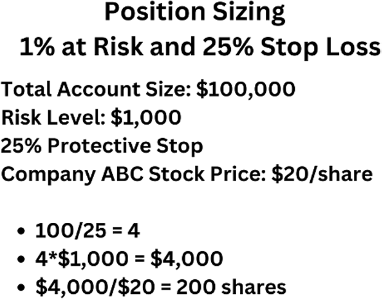
Remember, Steve’s risk level is $1,000, and he’s using a 25% stop-loss.
To calculate how large the position will be, the first step is to always divide 100 by his stop-loss.
In Steve’s case, 100 divided by 25 results in 4.
Now, he performs the next step in figuring his position size – he takes that number – 4 – and multiplies it by his risk level of $1,000 to get $4,000, which means Steve can buy $4,000 worth of Company ABC stock. That’s 200 shares at $20 per share.
If Company ABC declines 25%, he’ll lose $1,000 – 25% of his $4,000 initial investment – and exit the position.
That’s it.
That’s all it takes to combine stop-losses and intelligent position sizing to limit risk.
Now, what if Steve wants to use a tighter stop-loss – say 10% – on his Company ABC position?
Let’s do the math.
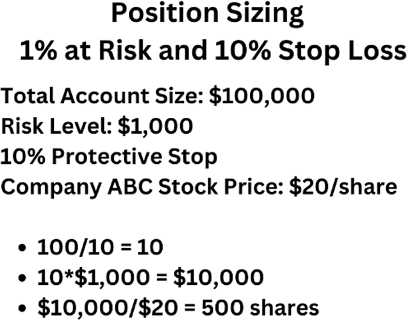
100 divided by 10 equals 10.
10 multiplied by $1,000 equals $10,000.
$10,000 divided by the same $20 share price equals 500 shares.
You can see that using a tighter stop-loss with the same risk level allows Steve to buy a larger number of shares, while risking the same amount of his total account: $1,000.
As you can see, you can use the concepts of position sizing and stop-losses to determine how much of any asset to buy – from shares of Apple to shares of Home Depot or a commodity like copper or crude oil.
If you’re investing in or trading a riskier, more volatile asset, the stop-loss percentage should typically increase, and the position size should decrease.
If you’re investing in a safer, less volatile asset, the stop-loss percentage should decrease and the position size should increase.
To be clear, you don’t have to use stop losses with your investments. You can simply use no stops but small position sizes.
If you put on a $5,000 position with no stop-loss, you’re taking on the same amount of risk as if you put on a $10,000 position with a $5,000 stop.
You’re risking $5,000 either way.
Many professionals combine no stops and small position sizes with riskier, more volatile investments, like private companies, microcap stocks, options, and cryptocurrencies.
We could spend a lot of time going over different kinds of exit plans for different kinds of investment outcomes.
But we want to keep things quick and simple for right now.
We want to focus on the core, foundational idea: Have an exit plan and stick to it.
Smart Traders Never Just “Wing It”
My favorite part about exit planning is that it leads to higher-quality decisions than “winging it” does.
Managing your money is stressful. After all, it’s your hard-earned savings and financial freedom on the line.
We all know the decisions we make under stress are likely to be of lower quality than the decisions we make when we are calm and not under stress.
When we are in a hurry, angry, or dealing with a traumatic event, the rational part of our brain doesn’t work as well. It can even seize up and put us in a frozen state.
Now throw in the stress of managing our money…
Do you really want to “just wing it” when it comes to these critical decisions?
Do you want to make up your plans on the fly when you’re rushed and under a lot of stress?
I didn’t think so.
It’s a no-brainer to have a preplanned exit strategy for every investment or trade.
I can’t state this emphatically enough: Creating an exit plan for every investment and trade you make is a major difference maker in your financial life.
It’s one of the major things that separates the financially literate from the financially illiterate.
The financially illiterate are very prone to “winging it.” Most of the time, they buy investments or enter trades with no exit plan. Their decision-making is pure chaos. There’s no plan, and there’s no rhyme or reason. They just make it up as they go along.
This leads to a lot of low-quality decisions made during times of stress.
Just think of one of the most stressful, high-pressure jobs on the planet: Being an NFL head coach.
Being an NFL head coach during a big game is one of the most stressful activities on the planet.
There are many millions of dollars on the line. There are a lot of people watching and scrutinizing every move you make. You’re working with extremely competitive, extremely aggressive people who are also under stress.
And during games, coaches must make big decisions with very little time to think about them.
It’s an intense mixture – a real “stress cocktail.”
Given the stress of coaching an NFL game and the complexities involved, it’s no surprise that head coaches are HUGE on pre-planned decision-making.
This is a massive thing every coach learns early on in their career:
- Have a plan for every kind of situation…
- Know in advance what you will do…
- And for goodness’ sake, don’t ever just wing it.
During every game, the coaching staff has big lists of potential situations they could face, plus their pre-planned moves they will make in those situations.
They know what they will do in a given situation before it even happens.
There’s too much on the line to act on impulse and hope for the best.
For example, if you’re down by four points and there’s 40 seconds left and you have the ball at the 50-yard line, what do you do?
Coaches have a plan for that. The team has practiced what it will do in that situation.
Or, if a team is up by one point after scoring a touchdown in the fourth quarter, do they kick an extra point or go for a two-point conversion?
Coaches have a plan for that.
They’ve done the math and created a strategy in advance. They don’t wing it. There’s too much on the line to wing it. Managing your money should be no different.
Your money is too important to “wing it” with your investments and trades.
You should give yourself the advantage of knowing what you’ll do in a given situation in advance. Give yourself the advantage of higher quality decisions – made with plenty of time to think and when you’re in a calm state.
I know exit planning isn’t as exciting as buying a small stock with major potential or making a bet on a new industry that could explode in size.
But this is the stuff masters spend their time and focus on.
This is the stuff that truly matters.
This is what the financially literate focus on.
This is what ensures your portfolio is built on a solid foundation.
If you don’t spend time on this part of your investing or trading, then you’re not serious about achieving success.
It’s that simple.
If you’re not ready to spend time and energy on exit planning, you’re not ready to win – and you’re choosing to be financially illiterate.
You’re choosing to put yourself in the position of driving that car with no brakes and no steering. The people who are serious and are willing to put in the work will eat you alive.
But that’s why you’ve read this far – you’re ready to change how you’ve done things and flip the narrative.
The Top 10 Stocks to Ride the Mega Melt-up
We’ve talked about a lot in this report, so I hope you feel prepared to take on this special list of stocks.
As I mentioned earlier, these are not “forever” stocks; they’re not stocks that you want to pad your nest egg with.
They are primed to soar to incredible heights for once-in-a-lifetime returns… but they also pose significant risk.
But as we talked about with surfers Garrett McNamara and Sebastian Steudtner, there may be great risk, but there could also be incredible reward.
Click the image below for your top 10 stocks to ride this mega melt-up wave.
