The Hidden Story Behind Buybacks from TradeSmith Money Movers
In July of this year alone, U.S. companies poured $166 billion into share buybacks — enough cash to buy Boeing, Ford, and General Motors outright (with some leftover).
According to Bloomberg, that’s the highest dollar value for any July on record, as you can see below:
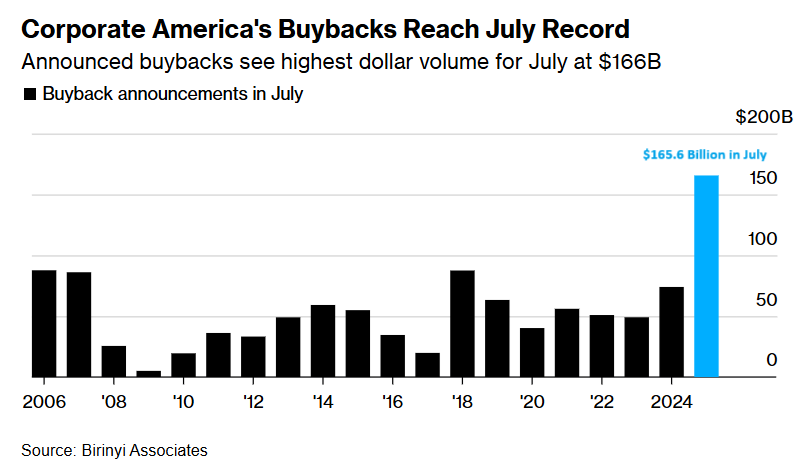
And so far in 2025, buybacks – when a company uses its own cash to buy its stock back from the market – are on track to set a new yearly record.
In fact, based on data from Birinyi Associates, buybacks are on track to beat the previous year-to-date record, set in 2022, by a cool $108 billion.
But does any of this really benefit investors?
As is so often the case with investing, the answer is… maybe. Today I’ll show you how to use TradeSmith to get a read on insider buying and selling. That way, you’ll know if management’s interests are well and truly aligned with your own.
The Buyback Balancing Act
It’s true that companies reducing their outstanding shares helps to boost earnings per share (EPS). But stock buybacks may not always be as beneficial as they seem.
It all depends on who benefits from the buybacks most.
Do investors benefit from a small boost in EPS? Or is it insiders who clean up by selling their own shares into company buybacks?
The ugly truth is that buybacks can – and often are – misused by companies in two ways.
First, it all depends on the timing of buybacks.
If a stock is trading well below its highs, buybacks – especially along with insider buying – can indeed be a bullish signal that the stock is a genuine bargain.
But when a company routinely buys back shares even when the price is at all-time highs, that can prove to be money not-so-well spent if the stock is overvalued.
Second, all too often, corporate insiders use buybacks as cover to unload shares of their own stock.
That is certainly is not aligned with the best interest of all shareholders – including you, the investor.
It’s an easy way for insiders to cash in at the expense of other stockholders.
And sure enough, while corporations declared a record number of stock buybacks last month, corporate insiders were busy selling billions of dollars’ worth of their own shares at the same time:
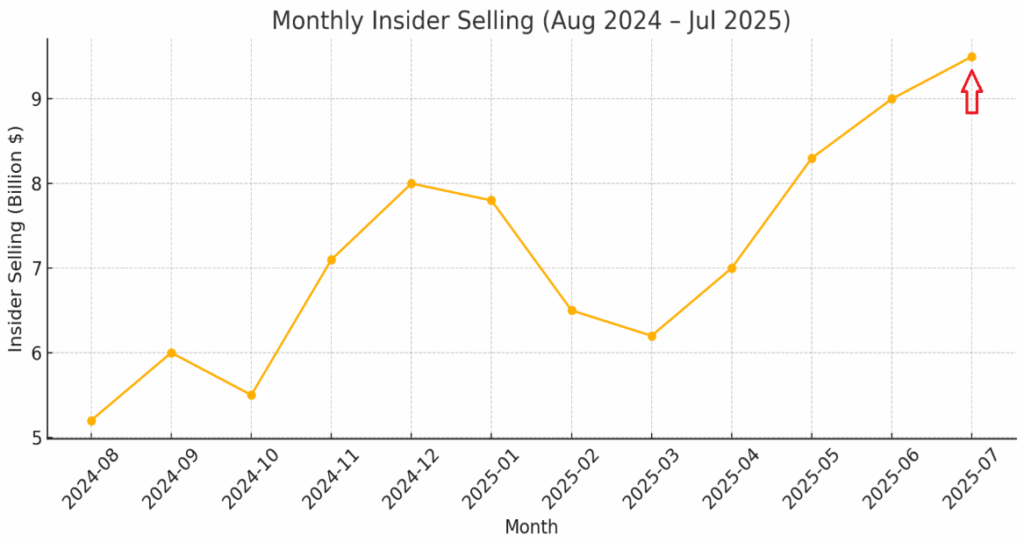
In July, insider selling reached its highest level since 2018, with far more insiders selling than buying. It’s the perfect caper for corporate insiders:
- Use endless buybacks to boost EPS
- Beat EPS estimates by a few cents and declare another buyback
- Sell shares into the resulting stock price strength
And this isn’t some wild conspiracy theory of mine. It’s the game described by the Securities & Exchange Commission (SEC) – the stock market’s own watchdog.
According to an SEC report, “many corporate executives sell significant amounts of their stock immediately following the announcement of stock buybacks.” Naturally, this is all perfectly legal under current SEC rules.
What’s more, companies where insiders cash out during buybacks routinely underperform other stocks by more than 8% in the 90-days after buybacks are declared.
But that’s why we built the TradeSmith Money Movers tools – to help you keep track of these corporate intrigues.
Simply log in to your TradeSmith Finance account. From the main menu, click on Invest, then select the Money Movers tab at far right of the submenu:
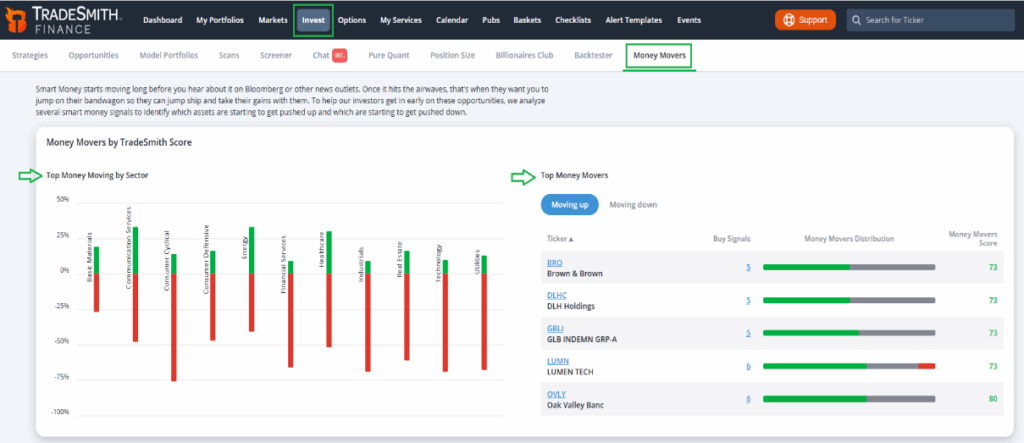
Here you’ll see where money is moving – by sector (top left) and for individual stocks ranked by our exclusive Money Movers Score (top right).
This metric ranks stocks from -100 to 100 and is based on a combination of insider and institutional buying or selling.
- Scores closer to 100 indicate a strong buy signal,
- Scores closer to -100 are considered strong sell.
You can view top money-mover stocks by toggling “Moving up” for inflows or “Moving down” for outflows.
Please Note: The TradeSmith Money Movers analytics are available to Money Movers and TradeSmith Platinum members.
If you don’t see this page on your platform, but would like to, simply call 888-623-0858 to speak with our Customer Care team and find out more about getting access.
Breaking Down Metrics That Matter
Alongside insider buying, there is also a wealth of additional Money Movers metrics you’ll find on this page including:
Institution & Insider Activity
- Insider Section: Tracks buying activity from company officers, directors, and others with inside information.
- Institution Section: Monitors TradeSmith Billionaires Club holdings, identifying stocks Moving Up (new buys) or Moving Down (fully sold off).
On Balance Volume (OBV)
- A momentum indicator measuring positive and negative volume flow to anticipate major market shifts.
Smart Money Index (SMI)
- Tracks investor sentiment based on price patterns indicating where smart money is moving intra-day.
Money Flow Index (MFI)
- A technical oscillator that detects overbought (≥80, sell signal) or oversold (≤20, buy signal) conditions, helping identify trend changes.
But for now, let’s stay focused on insider buying.
Just scroll down the page a bit further and you’ll see individual Money Movers signals, either showing insider and institutional buying or selling:
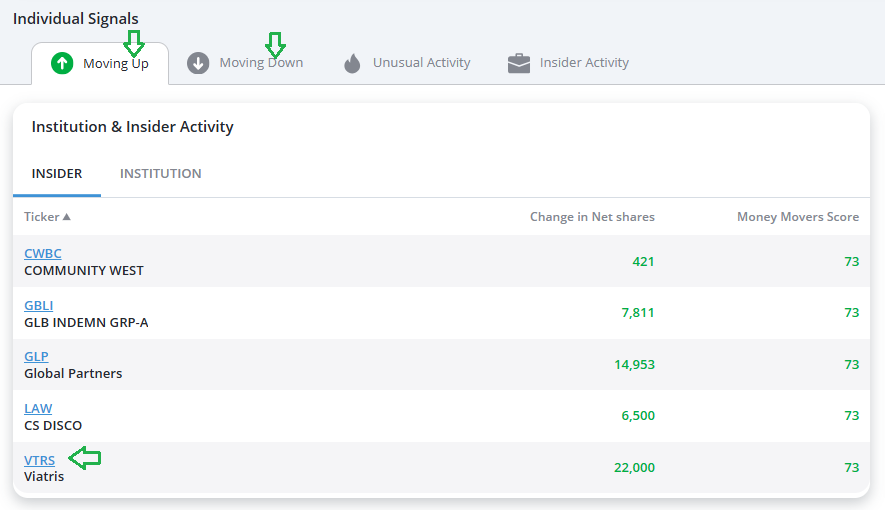
For example, Viatris (VTRS) insiders recently bought a net 22,000 shares, giving the stock a score of 73 out of 100 on our Money Movers scale. Simply click on the ticker to get more detailed stats shown below:
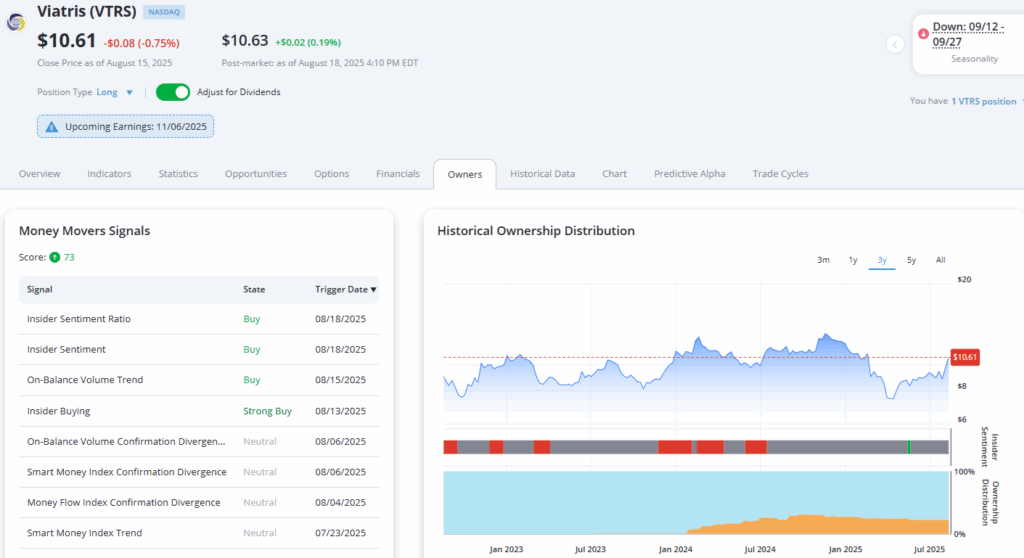
Here’ you’ll see the components that make up our Money Movers score. VTRS gets very high marks from insider sentiment, positive on-balance volume, and recent insider buying.
On the right, you can also view historical ownership distribution over time of both insider buys/sells and institutional activity.
Now scroll down a bit to see detailed insider and institutional buying and selling activity:
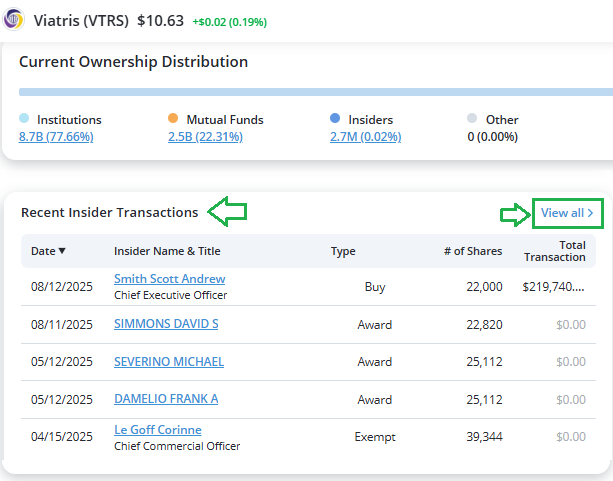
Here you’ll get a breakdown of the current ownership distribution, plus detailed activity broken down by institution, mutual fund, and recent insider transactions.
Simply click View All at the top right corner of the insider table to get a more detailed history of insider transactions.
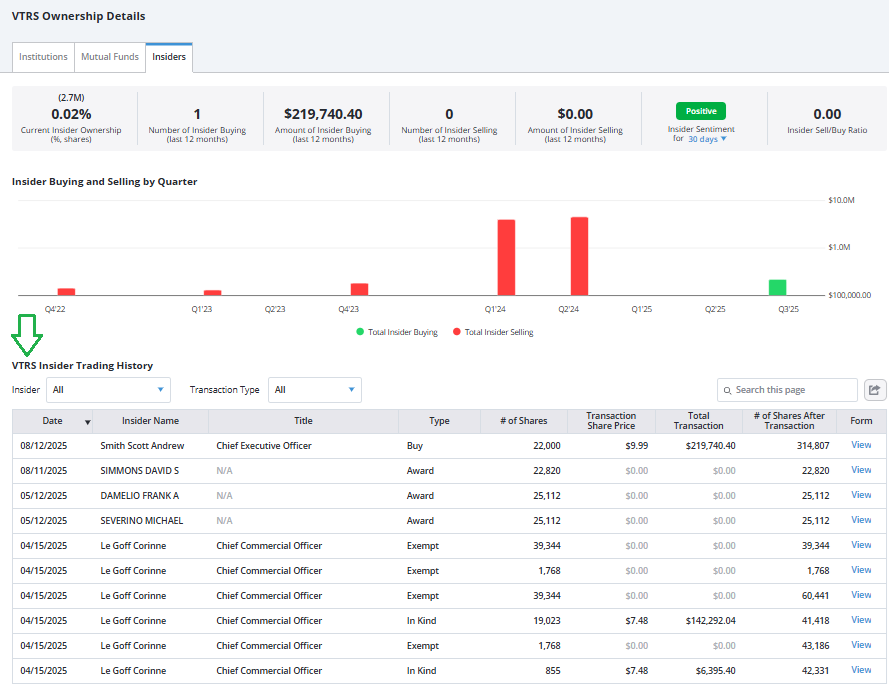
From this page, you can see which corporate insiders are buying (or selling), when, and how much!
If a company just announced a large stock buyback and insiders are buying, too, I’ll take notice. But if insiders are selling into a buyback announcement – watch out.
Mike Burnick’s Bottom Line: You can’t always take stock buybacks at face value. The key is to dig deeper: Are insiders buying the stock as well… or are they just unloading their own shares into the buyback? Our detailed TradeSmith Money Movers insider trading data can give you the answer. It can help you find out if your investment interests are truly aligned with managements’ interest, or only with their own self-interest.
Good investing,
Mike Burnick
Senior Analyst, TradeSmith
Buybacks may look good on the surface, but all too often they benefit insiders far more than everyday investors. So, the real question is: where’s the big money on Wall Street flowing?
That’s exactly the kind of edge you need in today’s market – because professional portfolio managers tend to be who really drive the market. And by the time headlines catch on, the biggest gains are already gone.
TradeSmith’s most powerful system was built to solve this – built by a Wall Street veteran who became a partner at Cantor Fitzgerald at just 26, after years of executing billion-dollar trades for the financial elite.
This breakthrough tracks massive money flows and uses quantitative analysis to spot explosive stock moves before they hit the news.
And backtests show it could have delivered 8,100% gains since 1990 – crushing the S&P 500 by more than 5-to-1.
Now, for the next 90 days, you can put this breakthrough system to the test yourself.
To learn more about how this quant system works – and start your 90-day test drive – clear here to watch.