Our Next Big AI Innovation
Listen to the audio version of this article (generated by AI).
In This Digest:
- Why we’re teaming up with the King of Quants on a new AI edge
- Software rallied hard off the lows, and this signal study says it isn’t done
- Our Predictive Alpha leaderboard confirms the AI chokepoint theme
The White House wants early access to new AI models…
On Monday, President Trump signed a new Executive Order, “Promoting Advanced Artificial Intelligence Innovation and Security.”
It directs federal agencies to build a framework to safely deploy frontier AI models. It’s also asking top AI developers to provide the government with early access to models for up to 30 days before releasing them.
Given what’s come to light about the AI threat to cybersecurity, it makes sense.
In April, Anthropic — the AI lab behind Claude — shared news that its new Mythos model could find and exploit hidden vulnerabilities in every major operating system and web browser.
Anthropic was so shaken by what it saw that it decided not to release the model to the public. Instead, it made Mythos available only to a small group of trusted organizations — including Amazon, Apple, Google, and Microsoft — to help them find and fix vulnerabilities in critical software before bad actors could exploit them.
In the wrong hands, a model like Mythos could bring critical infrastructure like hospitals, banks, and power grids to its knees.
So the U.S. government is getting ahead of any future weaknesses and strongly urging top AI developers to work with them.
It’s tempting to dismiss AI as just glorified chatbots. That’s certainly its most prominent use.
But if these new models are so advanced that the government wants a 30-day head start to assess the risks, you know there’s a lot more to it than that.
And if AI is capable of cracking the defenses of every major bank and power grid on the planet — what is it capable of when it comes to financial markets?
Here at TradeSmith, we haven’t been waiting around to find out. We’ve been putting the power of AI to work on behalf of our subscribers.
In 2023, just months after the launch of ChatGPT, we released our Predictive Alpha AI model. It forecasts stocks prices up to 21 trading days out.
And earlier this year, we launched our new Signals software — a new AI-powered system that finds signals that have preceded winning trades on thousands of individual stocks.
Now, we’re teaming up with the man who pioneered quant investing, Louis Navellier, for our next big AI innovation.
Forbes called Louis the “King of Quants”…
He pioneered quantitative investing as we know it back in the 1970s as a finance student at Cal State Hayward (now Cal State East Bay).
While working on a project for Wells Fargo with a professor, he was given access to a Wells Fargo mainframe computer – a technology most folks on Wall Street had never touched.
Louis’ job was to build a model portfolio that tracked the S&P 500 using just 320 of the 500 stocks in the index. But instead of tracking the index, Louis beat it.
In doing so, he discovered that some stocks have qualities that boost their potential to beat the market. And that discovery would define the next five decades of his career.
Louis’s Stock Grader system has identified 676 stocks that doubled or more. It recommended Microsoft in 1987, Nike and Apple in 1988, and Nvidia 17 years before most investors had heard of ChatGPT.
And for the past year, Louis has been working with us here at TradeSmith on something he says is the biggest edge he’s seen in his 47-year career.
The collaboration takes his Stock Grader system – five decades of quantitative research, 6,000 stocks screened and ranked by financial strength and momentum – and adds a layer Louis could only find from the TradeSmith Research Lab.
A precise, data-driven signal for when to get in and when to get out of the stocks he’s recommending.
And it goes one step further. We’re applying a proprietary machine-learning model on top of this two-check system to build an unstoppable portfolio of stocks.
Louis has been running quantitative models since before most of Wall Street knew what that meant. We’re proud to partner with him on this new effort.
Especially when he’s making a prediction that he says is the most urgent of his career… and has to do with an unignorable similarity between 2026 and 1999, the last year of the dot-com boom.
So I’d recommend you join Louis and our CEO, Keith Kaplan, on Wednesday, June 10, at 10 a.m. Eastern for their online event that covers all the details.
You can sign up for the event for free right here.
I’ll have more on the specifics once we’re closer to June 10. For now, mark your calendar and make sure to register here.
Our most recent experience with one of these collaborations – back in December with Wall Street legend Marc Chaikin – says it will be worth your time.
So far, folks who followed the recommendations from that combined system are up an average of 116% in just six months.
Software stocks are bouncing — these signal studies say there are more gains to come…
In February, the story on software stocks was grim.
The dominant narrative was that AI was going to kill the category.
After all, why pay for enterprise software when a large-language model can write code on demand, automate workflows, and replace the software-as-a-service (SaaS) tools companies had been paying big bucks for?
The iShares Expanded Tech-Software Sector ETF (IGV) – a basket including Microsoft, Oracle, ServiceNow, and most of the other big software stocks – had fallen nearly 20% in a month.
But on Feb. 11, our colleague Lucas Downey – editor of our AlphaSignals advisory – showed his subscribers why the panic was overdone.
He noted that IGV’s 14-day Relative Strength Index (RSI) – a measure of how overbought or oversold a stocks is – had dropped to 14, its lowest reading in over 20 years.
In the six prior instances where IGV’s RSI fell below 17, the ETF was up an average of 35.2% three months later.
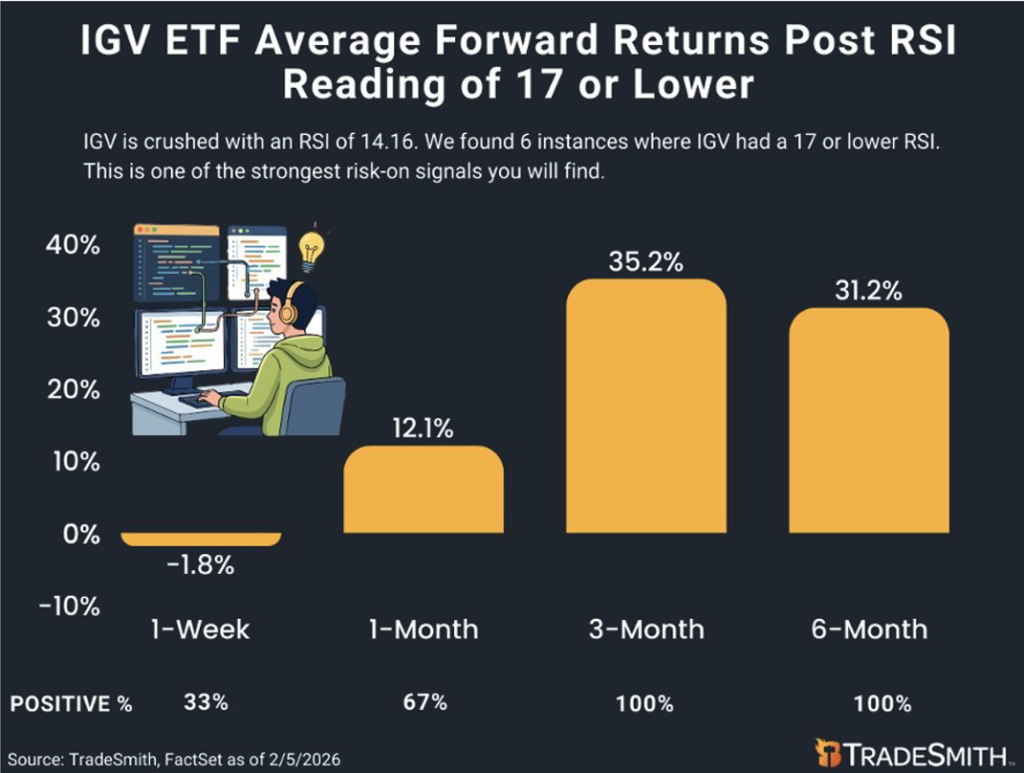
That’s not a gut call. That’s an evidence-rich idea with two decades of data behind it.
And sure enough, IGV is up roughly 20% in the three months since.
And software stocks have more room to run…
That’s according to Lucas’ latest signal study. It looks at what happens after software stocks rip more than 20% in a single month.
Since IGV launched in 2001, that’s happened only 35 times, about once a year on average. One month after that kind of surge, IGV has gained 7.1% on average, with an 82% win rate. Two months out: 12.6% on average, 85% win rate.
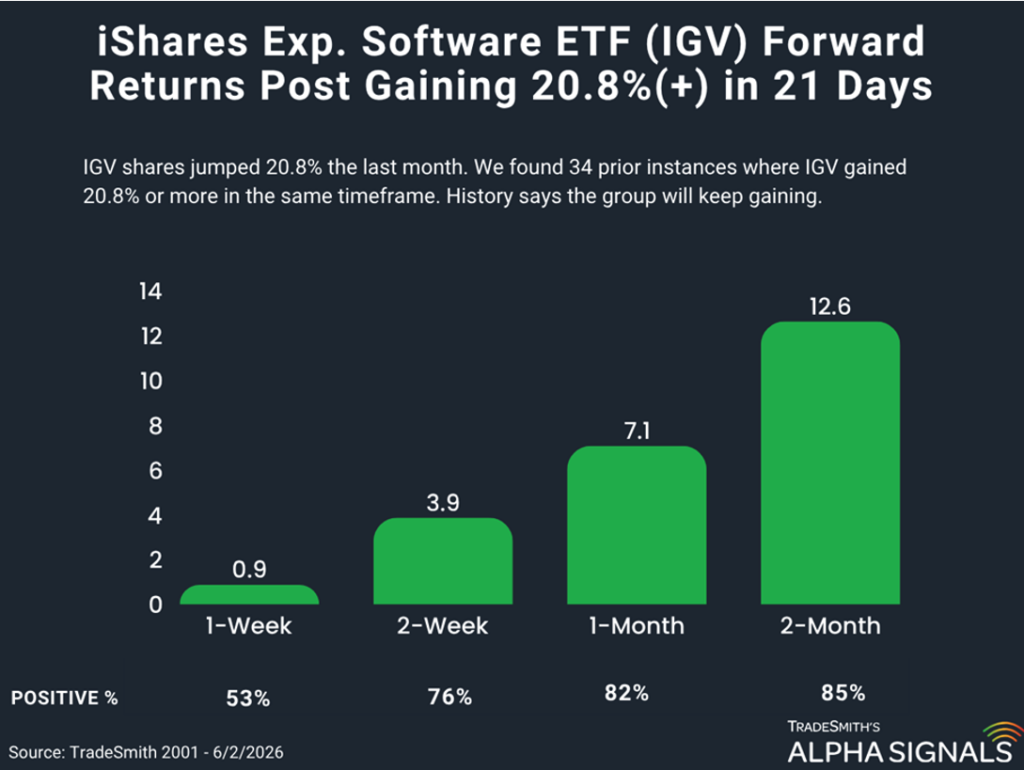
This suggests software stocks aren’t done. The sector that everyone wrote off in February as AI roadkill could be up even higher two months from now.
If you’re an AlphaSignals subscriber, you know where to look for Lucas’s specific trades. If not, the broader takeaway stands on its own: Software is not the dead category the February headlines said it was. The data said otherwise then. It still does.
Predictive Alpha is flagging the next layer of the chokepoints trade…
Over the past two weeks, Keith has been laying out the five supply-chain chokepoints this year’s $700 billion AI buildout is outrunning:
- High-bandwidth memory
- Silicon photonics
- Power conditioning
- Liquid cooling
- And grid construction.
If you want to profit from AI without trying to pick winners among tech stocks, you want to own the companies solving these chokepoints.
And our AI-powered forecasting algorithm, Predictive Alpha, agrees.
Predictive Alpha works like a large-language model — but instead of predicting the next word in a sentence based on vast amounts of text, it predicts where a stock is likely to go next based on hundreds of billions of market data points.
This morning, I ran Predictive Alpha across the market’s top bullish forecasts in our system by expected move.
Four of the top stocks on the list feed directly into the chokepoints framework:
Here’s the full list:
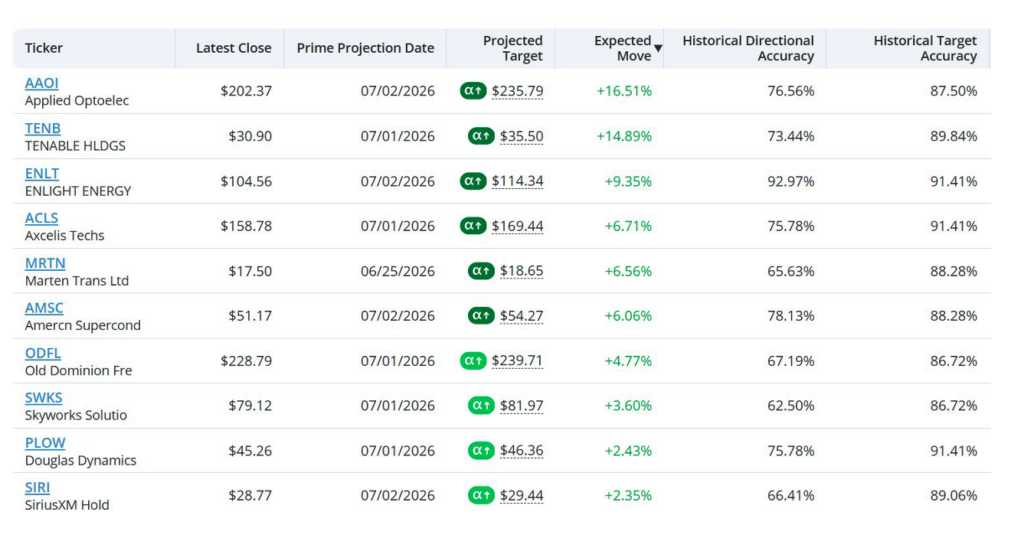
- Applied Optoelectronics (AAOI) makes the optical transceivers that move data inside hyperscale datacenters – fiber interconnects that sit at the heart of the silicon photonics chokepoint. Predictive Alpha sees it reaching $235.79 by July 2, up 16.5% from its close of $202.37. Historical target accuracy on this ticker: 87.5%.
- Axcelis Technologies (ACLS) builds semiconductor manufacturing and testing equipment for the chips going into every datacenter rack being built right now. Predictive Alpha has a target of $169.44 by July 1, a 6.7% move from $158.78. Historical target accuracy: 91.4%.
- American Superconductor (AMSC) makes power systems and grid management technology – directly in the power conditioning chokepoint. As datacenter operators race to secure electricity, the companies helping them condition and control that power are seeing demand spike. Predictive Alpha’s target: $54.27 by July 2, up 6.1% from $51.17. Historical target accuracy: 88.3%.
- Enlight Renewable Energy (ENLT) is a renewable energy developer – part of the power grid construction layer that’s been signing long-term power purchase agreements with hyperscalers. Predictive Alpha sees $114.34 by July 2, a 9.4% move from $104.56. Historical target accuracy: 91.4%.
If you’re a TradeSmith subscriber and you want to dig deeper, check their Short-Term Health status before acting.
The Predictive Alpha forecast tells you where the model sees the stock going. Short-Term Health is a second confirmation layer that shows you when the short-term trend is working in your favor.
Otherwise, keep an eye on stocks in this AI Chokepoints theme, and stay tuned to TradeSmith Daily for more ideas. The recent bout of volatility might offer a good entry point.
To building wealth beyond measure,
Michael Salvatore
Editor, TradeSmith Daily