How to Tell What’s Next for the AI Memory Trade
Listen to the audio version of this article (generated by AI).
OpenAI is reportedly in talks to buy up to five exabytes of data storage. Which sounds abstract until you translate it into everyday terms.
Apple’s top iPhone holds a terabyte. That’s enough for about 250 high-definition movies. Multiply that 5 million times over, and you’re getting near what OpenAI is buying. In one order.
And it isn’t the only AI company scooping up storage. An estimated seven out of every 10 memory chips are going to Microsoft, Google, Amazon, and the other companies building AI data centers.
That’s because AI models like OpenAI’s ChatGPT are memory hogs.
Training an AI model like that starts with feeding it a meaningful slice of everything humanity has ever written, photographed, and filmed. All of it has to sit on a hard drive, inside one of those buildings, before the model can start learning.
And the amount of data these models are training on is growing exponentially.
Training GPT-2, one of OpenAI’s earliest language models, took about as much text as you’d find on 2,800 shelves of library books. Two years later, GPT-3 needed the equivalent of 30,000 shelves. By 2024, Meta’s Llama 3 trained on the equivalent of 1 million shelves of books.
This surge in demand sent stocks in memory and storage companies like Western Digital (WDC) and Micron Technology (MU) soaring. Western Digital is up roughly 250% over the past year. Micron has done even better – up more than 700% – after revealing it had sold out its most important product, high-bandwidth memory for AI chips, all the way through 2026.
But this month, investors started taking profits. Western Digital dropped nearly 10% in a day. And Micron fell roughly 22% from the record high it hit in June.
This has triggered a lot of questions. Is the AI bull market still intact? Was that the top? Or is this a healthy pause and nothing more?
But guessing without some kind of edge – a plan, a pattern, something more solid than a hunch – is how most people lose money chasing a good story.
One way to find that edge is to stop trying to answer those questions at all and look at something else entirely – seasonality.
Every Stock Has Its Green Days
Seasonality is the study of how stocks trade across different calendar windows, year after year – through bull and bear markets, manias and panics, wars, pandemics, and more.
I didn’t come to TradeSmith from Wall Street. I’m a software engineer by training. So when my team went looking for an edge for investors, we didn’t start by asking what should move a stock. We started by asking what the data already showed.
By crunching years of stock market history, we’ve found seasonally bullish days for thousands of stocks.
We call these “green days.” Once you know them, you don’t need to know whether the AI story holds up, or whether this correction has further to run. You just need to know the dates when those windows occur.
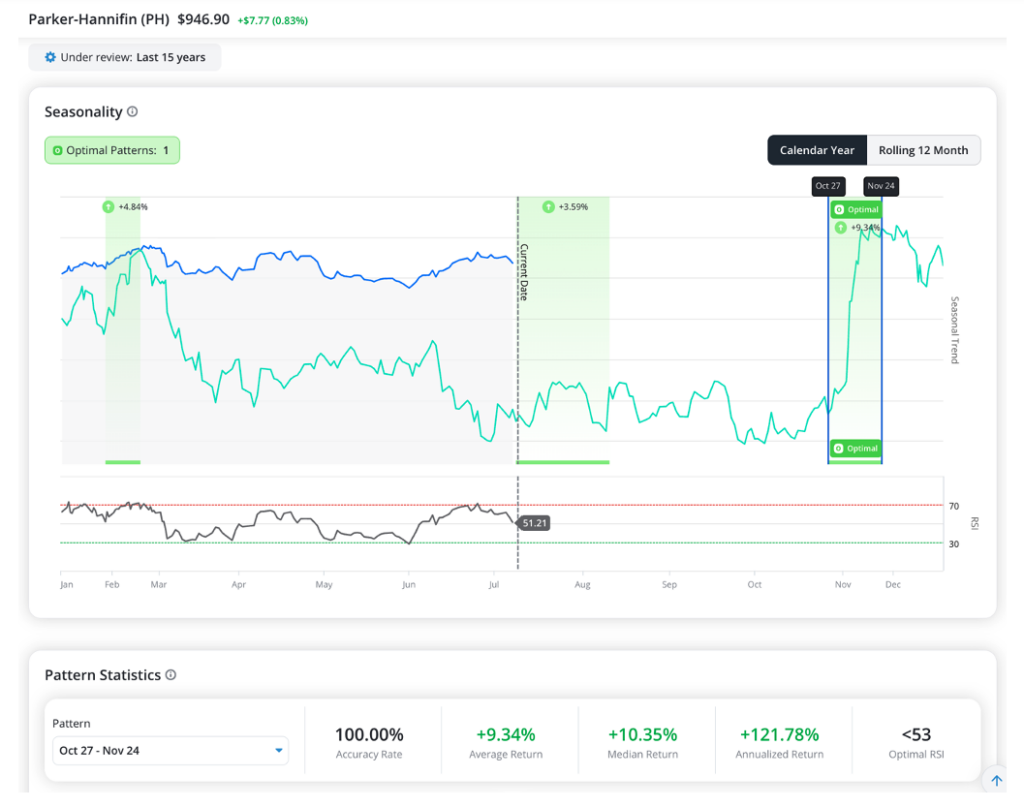
Take Parker-Hannifin (PH), an aerospace and industrial company. For the past 15 years, the stock has gone up starting on Oct. 27 – not most years, every year. A 100% historical accuracy rate, through bull markets and bear markets both:
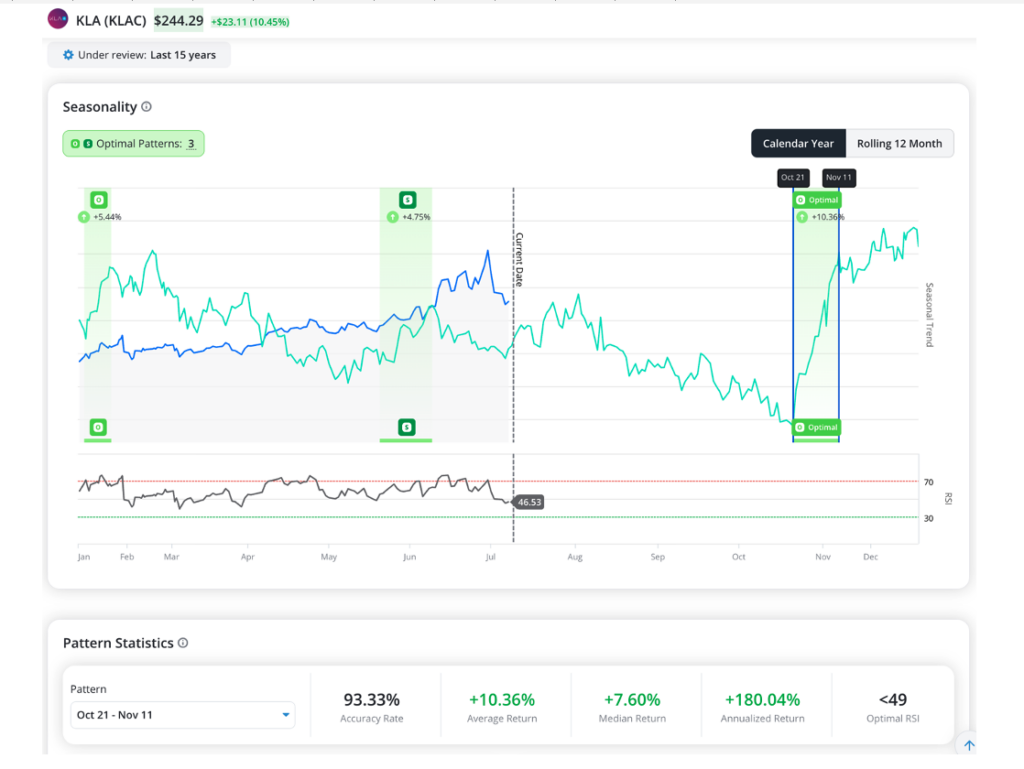
That same time of year is also bullish for KLA Corp (KLAC), which makes equipment for semiconductor manufacturers. Its stock has risen beginning Oct. 21 in 93.3% of the last 15 years:
Parker-Hannifin and KLA Corp have nothing in common. They’re different businesses in different industries with different customers. What they share are windows of time during the calendar year that tend to be bullish for their stock prices.
TradeSmith’s research team has now found seasonality patterns across roughly 5,000 stocks.
So what does that analysis say about the two companies at the center of the memory story?
A Better AI Memory Trade Than Micron in July
The company most directly in the crosshairs of the AI chip shortage is Micron Technology (MU). It makes the high-bandwidth memory that sits right next to the chip in an AI system, feeding it data in real time.
If you’re looking for a stock that’s emblematic of the AI memory trade, Micron is it.
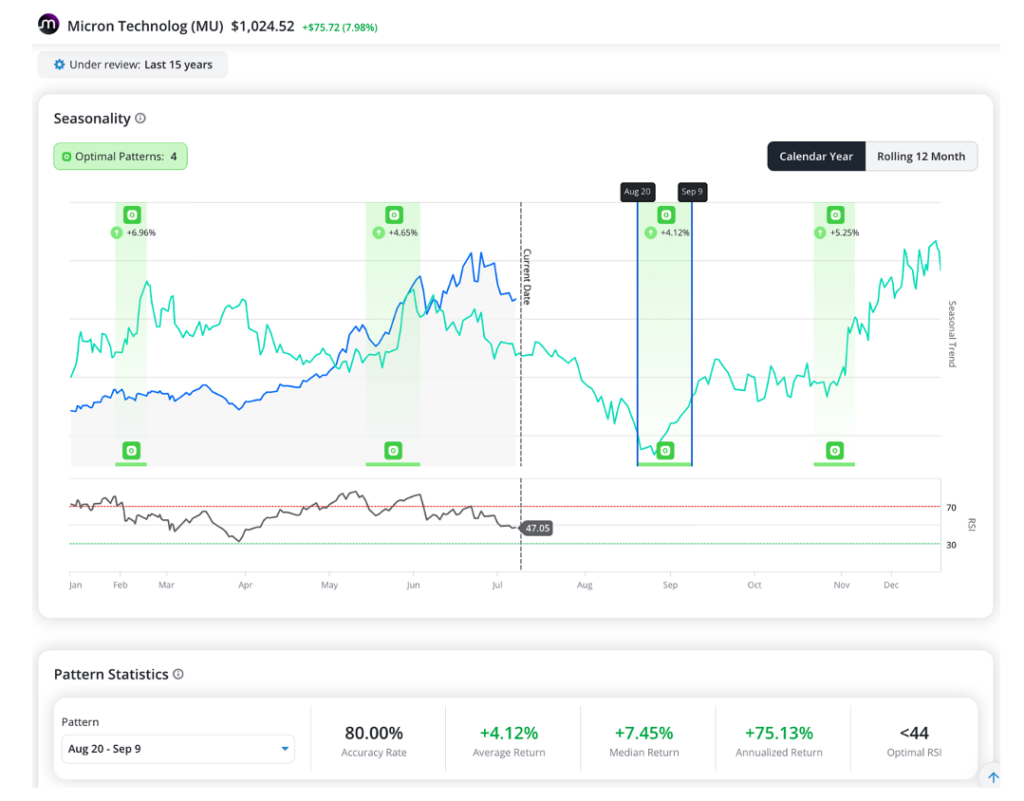
But right now, Micron isn’t in one of its green windows. Its next one doesn’t open until Aug. 20. Through Sept. 9, it’s been up on average 4.1% during this window 80% of the time:
For a memory stock with a window open right now, look at Western Digital (WDC) instead. It’s one of the oldest names in computer storage, making the hard drives that data centers – including the ones being built for AI right now – depend on to hold everything we’ve been talking about.
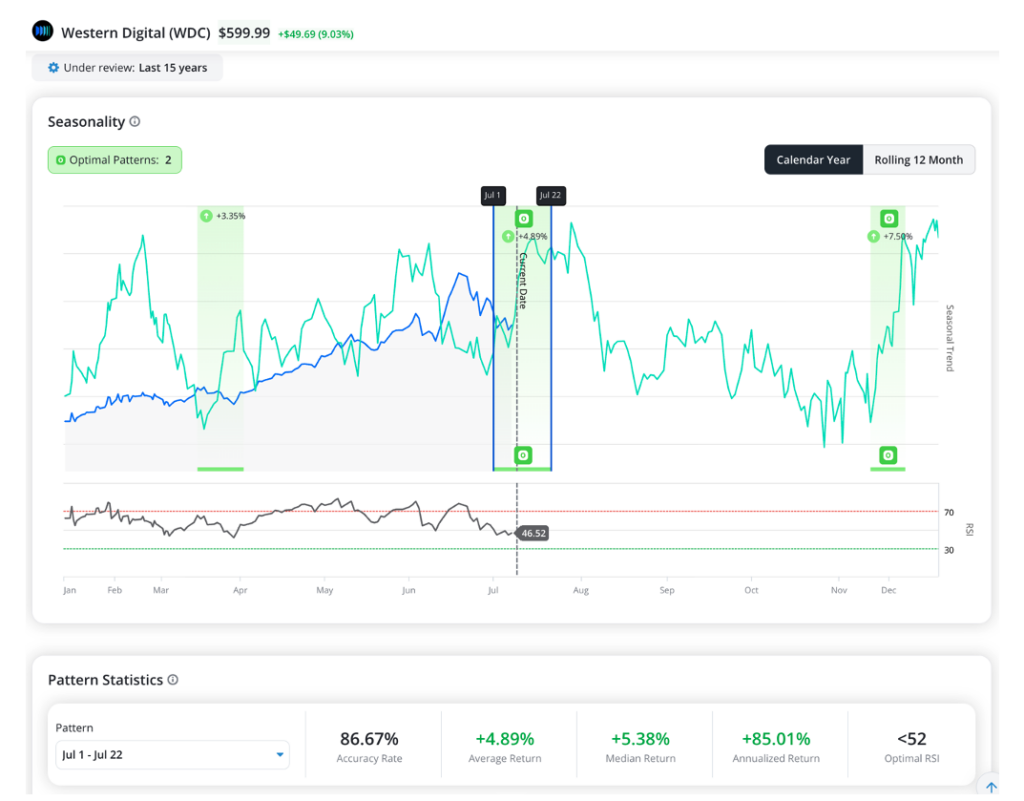
And its green days run from July 1 to July 22. Over the past 15 years, the stock has gone up during that stretch 86.7% of the time.
You don’t have to just take my word for it.
I’ve asked my team to make a free trial of our Seasonality tool available so you can try it out for yourself.
Test Drive Our Seasonality Software Today
You can try out our software on the stocks you own with this free, limited-time trial version.
We’re making it available ahead of our Breakthrough 2026 event. It’s all about the seasonal patterns you need to be aware of in this critical year.
We’ve unlocked access so you can see the seasonal “green days” for thousands of stocks ahead of our Breakthrough 2026 event.
It kicks off Thursday, July 16, at 10 a.m. ET. And it’s urgent that you attend.
I’ll walk you through how we uncovered these patterns, why they persist even in chaotic markets, and how you can use them to guide real-world trading decisions.
More important, I’ll be getting into detail about the fast-approaching seasonality patterns you need to be aware of.
Knowing when the windows are opening and closing likely matters more to your wealth than any single decision you’ve made.
The first date you’ll want to circle on your calendar is July 16. If seasonality patterns hold this year, it could open up a lucrative trading opportunity in one of the market’s hottest AI stocks.
All the best,

Keith Kaplan
CEO, TradeSmith