Most Investors Are Missing These “AI Cash Machines”
Listen to the audio version of this article (generated by AI).
In the 3,000-year history of the insurance industry, nothing had ever moved this fast.
On Dec. 23, 2016, at 5:47 p.m. in New York, a man named Brandon Pham hit “submit” on an insurance claim after his Canada Goose parka – worth $979 – was stolen.
Three seconds later, it was settled.
The insurance company, Lemonade (LMND), says this was the fastest claim ever settled, thanks to its use of artificial intelligence.
Lemonade’s claims bot – AI Jim – reviewed the claim, cross-referenced it against Pham’s policy, ran through dozens of anti-fraud checks, approved it, and wired the money to his bank.
Without any need for an insurance adjuster, paperwork, or hold music.
And Lemonade isn’t the only company putting AI at the center of its decision-making.
Right now, a company called Upstart (UPST) can approve someone for a loan in about the time it takes to pour a cup of coffee – weighing a person’s credit score, income, job history, and the rhythm of money moving in and out of their bank account.
Most people still think of AI as a chatbot – something you type a question into and wait for an answer. But across a widening slice of the economy, AI isn’t just answering questions. It’s making the critical decisions businesses run on – like which claim gets paid and who gets a loan.
I call these companies AI Cash Machines. They’re businesses where specialist AI models have taken over work that used to require a payroll of people. And because these models scale without adding headcount, the profits show up faster and stick around longer than they would at a company still doing things the old way.
I want to make something clear upfront. The stocks I’ll be talking about today are NOT stocks to go all-in on right now.
Last Friday, I wrote to you about how important it is to avoid overconcentrating your portfolio in a handful of AI plays. That goes for these stocks, too.
Treat them as watchlist stocks until they turn Short-Term Health Green – meaning the momentum is swinging bullish again.
I’ll get into more in a moment. First, it’s important to know that this won’t be the first time companies that take a brand-new technology and build on it have captured the lion’s share of the profits in a boom.
This Pattern Keeps Repeating
This part of the AI story isn’t getting the headlines right now.
Most of the attention is still on the companies building the chips and the data centers… the physical backbone AI models need to scale.
But history shows the biggest fortunes rarely go to the companies that build the infrastructure. They go to the people who build on top of it.
Take the late 1990s. I’m old enough to remember it well. An enormous amount of money went into building the internet’s plumbing, including the routers, the switches, and the fiber cable strung across the ocean floor.
Cisco Systems was the poster child for the infrastructure buildout. For a brief moment in 2000, it became the most valuable company on Earth. Then the dot-com bubble burst, and it took Cisco a quarter of a century to reach a new high.
The fortunes that lasted went to companies that never laid a foot of cable: companies like Amazon, Netflix, and Google. They built businesses that ran on top of the new technology, after it already existed.
That pattern goes back further still.
In 1869, workers drove a ceremonial gold spike into the ground at Promontory Summit, Utah, marking the moment two railroads joined into one line running clear across America.
For the first time, goods could travel coast to coast by rail. A few years later, a Chicago salesman named Montgomery Ward looked at that same railroad and noticed something the railroad companies hadn’t. If a train could reach nearly every town in the country, a store didn’t need a building anymore. It could be a catalog.
He mailed out the first one in 1872. A rival named Richard Sears copied him soon after. Between them, the catalogs made those two retailers the biggest in the country. Neither man laid a single mile of track.
That same pattern is playing out again right now, with AI.
Ask This Simple Question
You don’t need an entire research team to spot these companies yourself. Just ask: Is revenue growing while headcount stays flat?
If a business is doing more without hiring more people to keep up, the extra revenue doesn’t get eaten by extra payroll. It drops straight to the bottom line.
Lemonade is one of the cleanest examples I’ve found. Its gross profit has grown roughly tenfold over the last three years, while its headcount has moderately declined. And on a recent earnings call, the company attributed this efficiency to the heavy workload absorbed by its AI systems.
Upstart is worth a closer look, too. It doesn’t lend its own money, like a bank. Instead, it sits behind banks and credit unions, plugging its AI into their lending process so they can say yes to more borrowers without taking on more risk.
The bank keeps the customer relationship. Upstart keeps a fee every time its model makes the call on a loan.
Both these stocks are in Short-Term Health Red Zones, meaning bearish momentum is still in charge. So now is not the time to buy. Wait until they’re back in a Green Zone first.
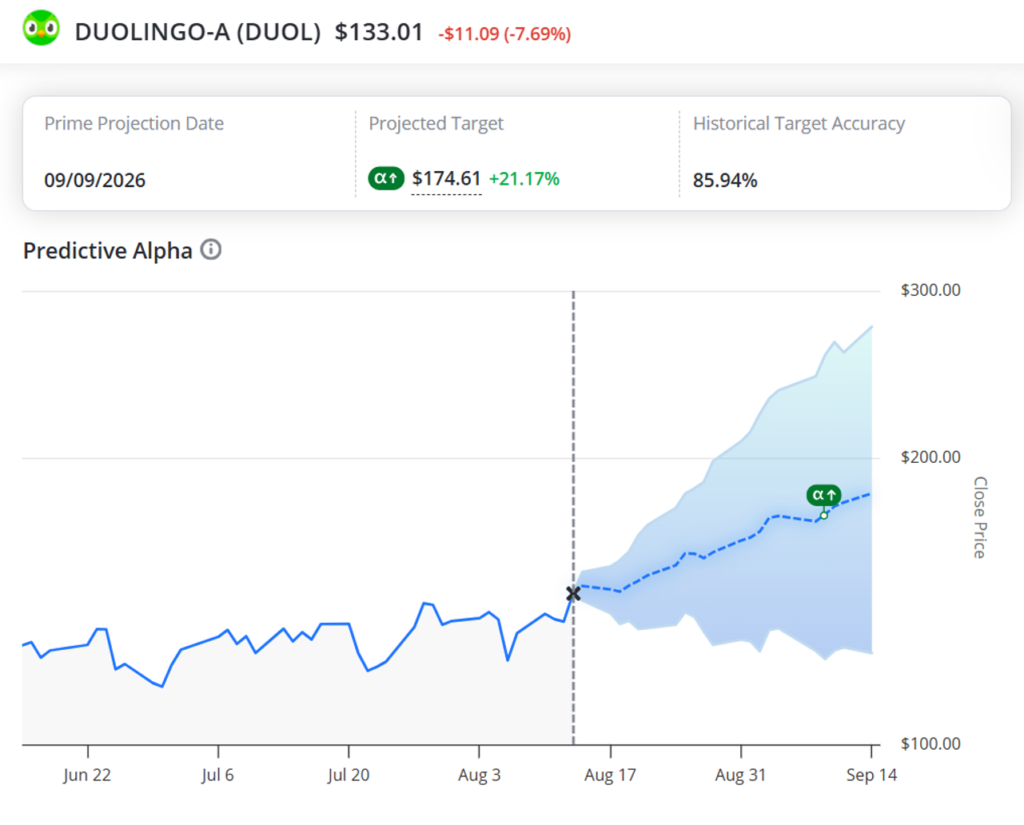
Meantime, take a look at Duolingo (DUOL). It uses AI to write, translate, and voice entire language lessons at a scale no team of human teachers could match. That same engine has let it expand well beyond languages, into math, music, and even chess courses. It’s profitable, with a large and growing user base. And it’s been in a Green Zone since the end of June.
Even more encouraging, our Predictive Alpha AI trading model projects a rise by 21.2% by Sept. 9 – an 18-day projection that’s been right 86% of the time.
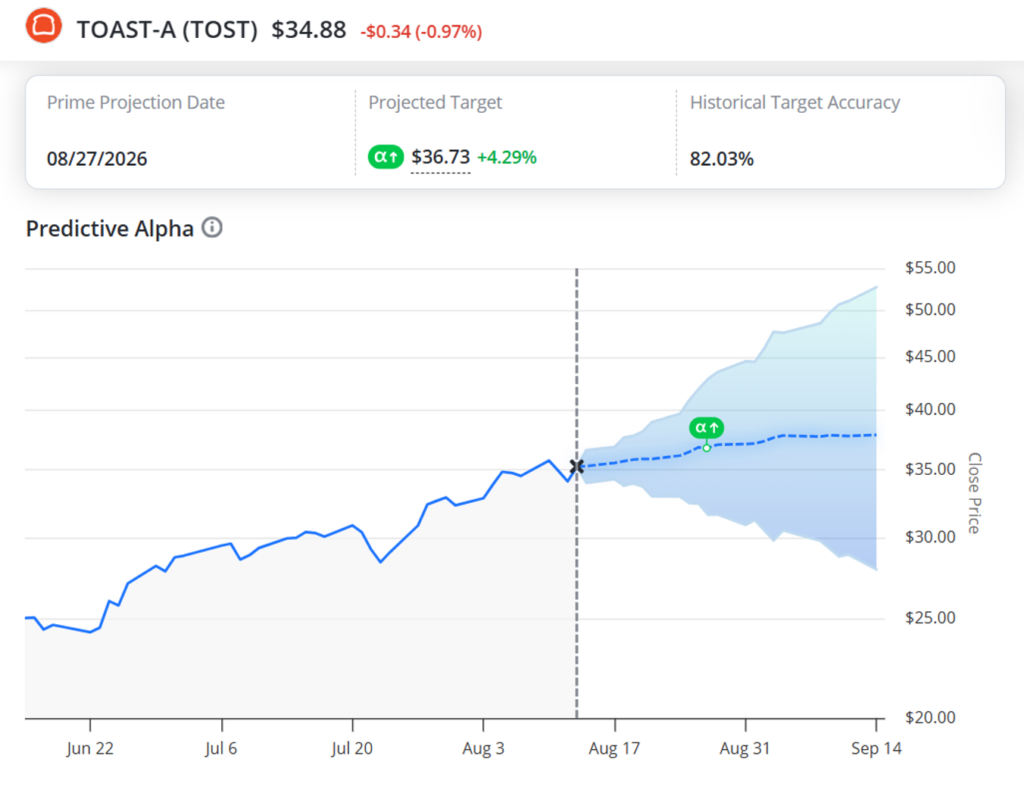
Another Green Zone stock to look at in this category is Toast (TOST). It runs the back office for more than 100,000 restaurants. And its AI layer turns live sales and staffing data into plain instructions a busy owner can act on. It’s profitable today, in an industry most investors wouldn’t think to look at for AI exposure at all.
Its Predictive Alpha forecast isn’t as bullish as Duolingo’s. (A 21% forecast is rare.) But our model projects a 4.3% gain by Aug. 27 with a historical accuracy rate of 82%.
If you’re looking for where Wall Street is headed for the next round of AI profits, I expect all four of these stocks to be in its crosshairs. Just make sure to buy only when their Short-Term Health is green.
This market is still capable of taking a bite out of you. So start with small position sizes, and expect some bumps along the way. Then get positioned for the next leg of the AI boom.
All the best,

Keith Kaplan
CEO, TradeSmith