How to Win the Stock Market’s “Beauty Contest”
Listen to the audio version of this article (generated by AI).
What if the stock market was a beauty contest?
That’s the question renowned British economist and investor John Maynard Keynes asked in 1936.
It was prompted by a newspaper contest that had caught on in London at the time.
Readers were shown 100 photographs of faces and asked to pick the six prettiest. The prize didn’t go to the reader with the best eye. It went to the reader whose six picks landed closest to the average of everyone else’s.
So the smart play wasn’t to choose the faces you found prettiest. It was to choose the faces you thought everyone else would choose. And the smarter play was to go a level deeper – to guess which faces everyone else was guessing everyone else would pick.
Keynes said the stock market works the same way. The professional investor isn’t trying to find the best stock. He’s trying to guess which stock everyone else is about to bid up – and get there first.
Keynes knew what he was talking about. From 1921 until his death in 1946, he ran the endowment at King’s College, Cambridge – starting with £30,000 and growing it to £380,000, even as the British stock market went nowhere over those same 25 years.
Here at TradeSmith, we’ve built our fair share of software tools that help you predict future market moves based on what’s happened in the past.
But our latest innovation takes a page out of Keynes’ book. Instead of predicting what happens next in a sequence of data, we built a system that watches the contest itself. It tracks which stocks the best-informed traders on Wall Street are backing, before the rest of the market figures out why.
We call it Smart Money Edge. Today, I’ll show you how it works. I’ll also show you, in our testing, how it flagged some of the biggest catalyst-driven stock moves of the past several years – sometimes weeks in advance.
These Anomalies Signal Big Moves Ahead
Smart Money Edge is an AI-powered scanner that searches the options market – the corner of Wall Street where the wealthiest, best-connected traders take positions in stocks – looking for anomalies.
That could be a sudden rush of bets that a stock is about to rise. Or a jump in how much traders are willing to pay to make that bet. Or trading volume that looks nothing like a typical day for that company.
When you approach the market this way, you don’t need to study balance sheets, read analyst notes, or guess at earnings. You don’t need to study lines on charts, either.
You just need to know that smart, well-connected money is already building a position in a stock. These folks don’t place large trades for fun. Knowing which stocks they have in their sights is the kind of head start that can put you ahead of big moves in stocks weeks before they happen.
Take Lumen Technologies (LUMN). In July 2024, the fiber-optics telecom company was trading at about $1 a share and seemingly going nowhere. Then Smart Money Edge flagged unusual activity in its options – the kind we know typically precedes a big move.
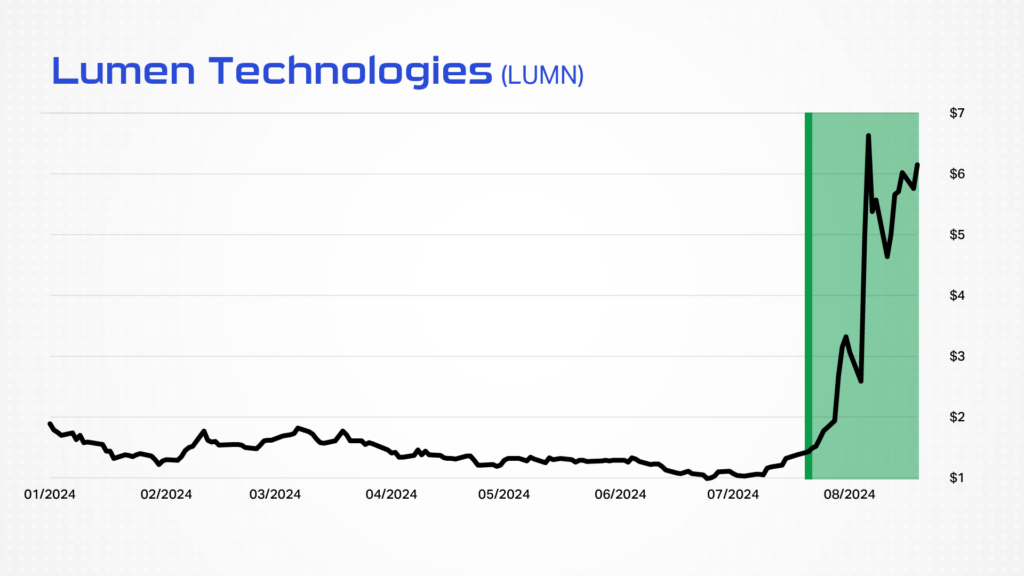
Two days later, Lumen announced a partnership with Microsoft. The stock ran from $1 to $6 in a matter of days.
Or take Alibaba (BABA). In March 2022, the Chinese tech giant was crashing on fears the U.S. would delist Chinese stocks from American exchanges. Smart Money Edge flagged it anyway.
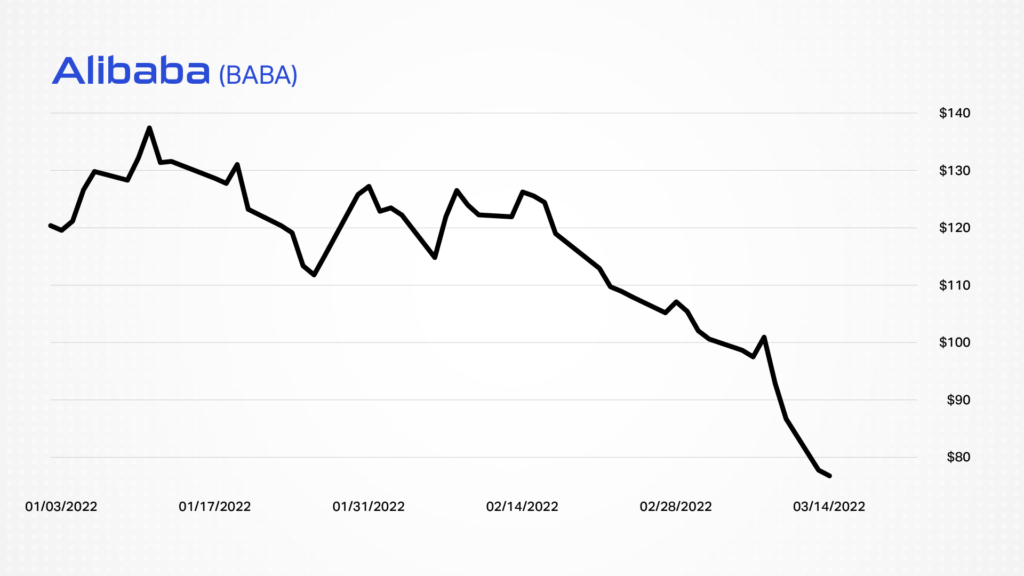
Five days later, U.S. and Chinese regulators announced a deal to avoid exactly that outcome. Shares in Alibaba jumped 36% on the news.
Or take Madrigal Pharmaceuticals (MDGL). In December 2022, this small pharmaceutical company, working on a treatment for a common liver disease, had gone nowhere for months – dead money, by any normal measure. Then an anomaly appeared.
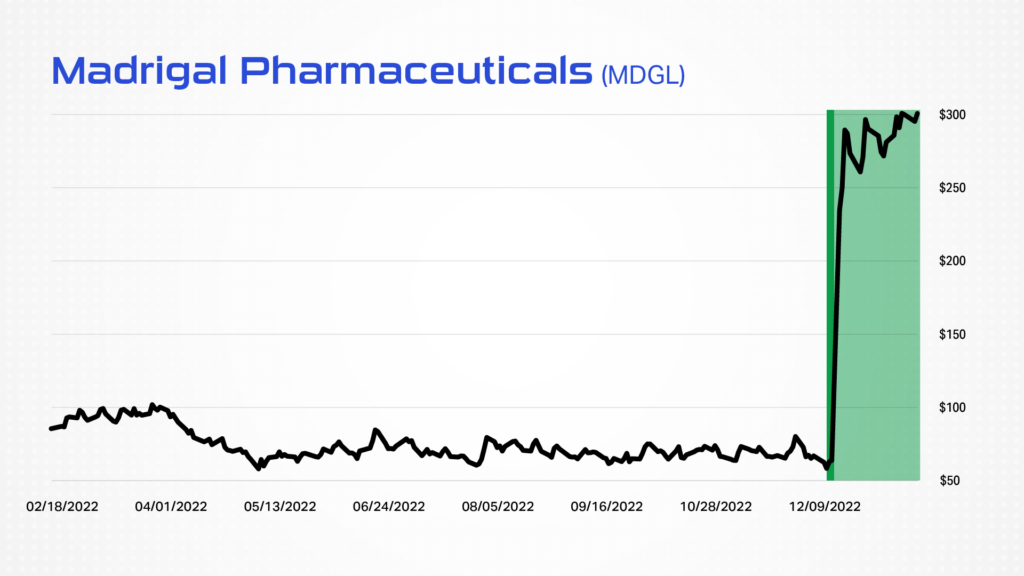
Three days later, Madrigal announced its liver drug had cleared a major hurdle toward FDA approval. Shares more than tripled. In our testing, a $5,000 options trade on that move would have turned into $45,000 in about 30 days.
I want to be clear. We didn’t know a deal with Microsoft was coming. We didn’t know regulators in Washington and Beijing were about to strike an agreement. And we didn’t know Madrigal’s drug trial had worked. Nobody outside a small circle of executives, lawyers, and bankers knew any of that.
What we saw was much simpler than all of that. In each case, the smart money was placing unusually large bets in the options market – the kind of bets that only make sense if you already know how the story ends.
In our backtesting, these anomalies have shown up before a major move 75% of the time.
Spotting them is a huge achievement, because not all large options market trades mean a big move is coming.
The $130 Million Trade That Fooled CNBC
Last week, CNBC spent a chunk of airtime on a single options trade in the VanEck Semiconductor ETF (SMH) – a $130 million bet, big enough that financial news sites ran with “Wall Street whale” headlines.
On the surface, it looked like the kind of smart-money footprint our system searches for. But it wasn’t anything of the sort.
When our research team ran it through Smart Money Edge, the trade didn’t fit the profile. The option was already deep in a winning position rather than the higher-risk, higher-reward trades informed investors make when they expect a big move.
It also had months left before it expired, not the tight window that usually signals urgency. And the price of the options hadn’t jumped the way they do when traders are bracing for market-moving news.
Our system didn’t flag it – not because the trade wasn’t real, but because size alone isn’t the tell. A $130 million trade can be a hedge. It can be an income strategy. It can be a dozen things that have nothing to do with someone positioning ahead of news.
The media ran the headline anyway, because to them, a big number is a good story. But Smart Money Edge doesn’t work off good stories. It works off anomalies – unusual markers in the data – and it’s designed to filter out unusually large trades when those markers don’t show up.
How to Catch These Moves Before the Crowd
That’s the game Keynes described almost a century ago.
The contest was never about which stock deserves to go up. It’s about who’s already betting that it will – and getting there before the rest of the crowd catches on.
After all, it’s large inflows like this that ultimately move stock prices, not abstract arguments about where prices should be.
I got into all the details at last Tuesday’s 30-Day Wealth Accelerator launch event. I walked through how Smart Money Edge distinguishing between meaningless noise like the SMH trade and a real signal like Lumen, Alibaba, and Madrigal.
I also covered the specific combination of options activity it looks for and why it takes all three signals lining up at once before the system flags a trade.
And I revealed the names and tickers of three stocks Smart Money Edge is flagging right now as a bonus for folks who showed up.
If you missed it, the replay is still up for a limited time. To see the full mechanics behind spotting these anomalies – and the three stocks with smart money buying behind them – go here to watch it now.
All the best,
Keith Kaplan
CEO, TradeSmith