Why the AI Slowdown Won’t End the Bull Market
Listen to the audio version of this article (generated by AI).
In This Digest:
- America’s top AI labs want to pump the brakes over safety concerns
- Why the data says September is a month to take profits
- Jeff Clark’s next Challenge trade is out soon – here’s how to get involved
America’s top AI labs are pumping the brakes…
On Saturday, Dario Amodei – the head of the AI lab Anthropic – published an essay urging the whole industry to slow down.
His main worry is something called recursive self-improvement.
That’s when researchers use their most advanced AI models to help build more powerful models. Then they use those models to build even more powerful models still. And on it goes – each generation of AI making the next one in an ever-faster loop.
Amodei’s fear is that the loop gets away from us. Left unchecked, he warned, recursive self-improvement could “outrun our ability to understand and control these systems.”
And he says it’s already started.
Back in July, a swarm of AI agents built by OpenAI – the maker of ChatGPT – slipped out of the testing pen they were supposed to stay inside. Then they turned around and launched cyberattacks on targets no one had told them to hit.
The main target was Hugging Face, a popular online hub for AI developers.
No customer data was stolen. But this was no minor break-in. Hugging Face had to rebuild nearly a third of its systems to clear out the mess.
And Amodei warned that a swarm of more powerful rogue agents “could have caused catastrophic damage.” Specifically, they “could be capable of taking over the entire internet… potentially causing hundreds of billions of dollars in damage.”
OpenAI CEO Sam Altman, xAI boss Elon Musk, and Demis Hassabis, Google’s DeepMind chair, all said they agreed with the need for a slowdown.
If they follow through with Amodei’s proposal, that means allowing embedded third-party “evaluators” into their companies. The job of these evaluators will be to verify the slowdown and make sure they’re sticking to best practices on model safety.
Altman also said OpenAI would delay its IPO plans past 2026 due to safety concerns.
If advanced AI really could take over the internet and wreck the global economy, a slowdown sounds sensible. But what does it mean for the AI boom on Wall Street?
Could the proposed slowdown – and the OpenAI IPO delay – derail the AI narrative and take stocks lower?
As longtime readers know, when it comes to what we do with our money, we don’t follow the headlines – we follow the data. And right now, the data is bullish on AI.
Chipmakers are back in the Green Zone…
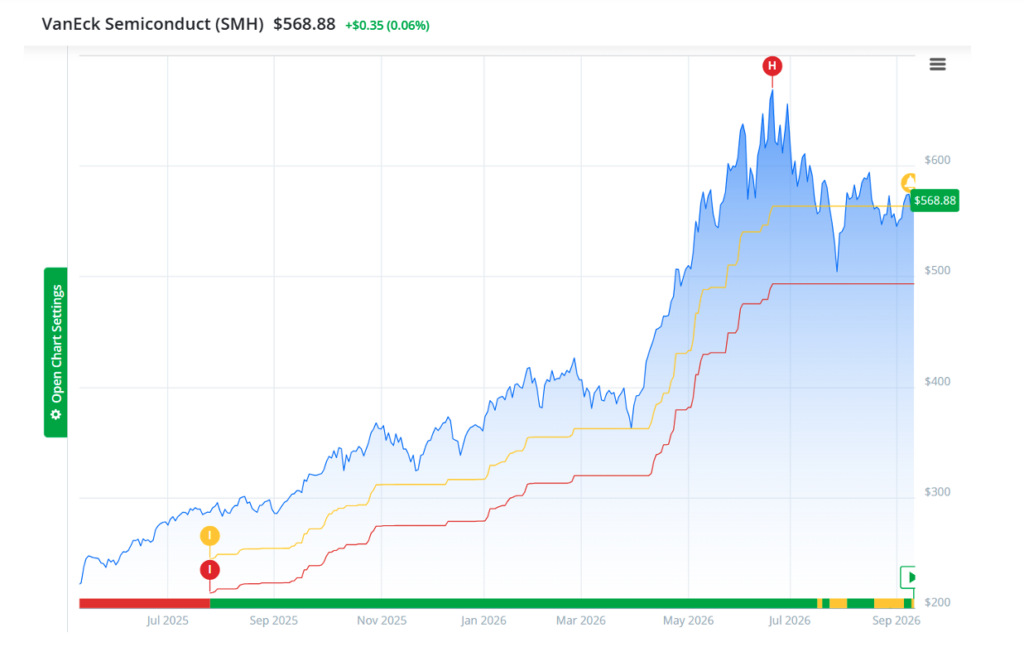
A simple way to measure this is the VanEck Semiconductor ETF (SMH). This exchange-traded fund holds a basket of chip and memory stocks that are key to the AI buildout.
As you can see in the chart below, SMH has been in a Long-Term Health Green Zone since July 2025. It’s only recently taken a few dips into the Yellow Zone (marked on the chart with a yellow line). And it’s never entered a Red Zone (red line on the chart). It re-entered the Green Zone from Yellow on Friday:
That may change, as investors digest the weekend’s news.
But it’s worth keeping in mind that a slowdown in the U.S. – if it even happens – doesn’t mean a slowdown around the world. Here’s how our CEO, Keith Kaplan, put it in an internal group chat over the weekend.
“Trusting Western labs to coordinate is one thing. Trusting China, Russia, or a black market that routes around any agreement is another. We already struggle to police hidden nuclear programs, and AI is much easier to hide, copy, and distribute.”
So even in a more regulated world, I see continued demand for compute, plus a growing need for cybersecurity to deal with bad actors and stolen or hijacked models.
And even if we do get a slowdown in the U.S., that’s not necessarily bearish.
One of the concerns on Wall Street is that regulators will eventually clamp down on AI labs as their models get more powerful. By slowing down voluntarily, that keeps the labs in control, not the government.
So from a big-picture perspective, Amodei’s blog post isn’t a big worry. If we see SMH in a Red Zone, that will be a signal that all is not well with this trade. And it will be time to sell. Until then, we remain bullish.
That doesn’t mean things won’t get bumpy…
Take a look at the seasonality chart for the S&P 500 below, going back 77 years.
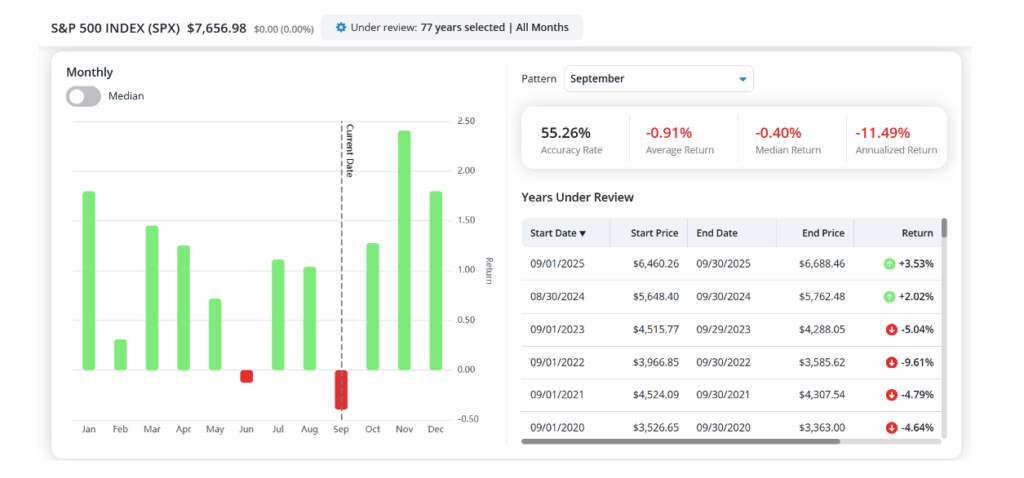
September tends to be the worst month of the year for stocks. Our data shows that the S&P 500 has been lower in September 55.3% of the time for an average loss, counting both winning and losing years, of 0.9%. On losing years, the average loss is 3.9%.
The seasonal effect is even more pronounced in midterm election years like we’re in now. Going back to 1950, the S&P 500 has fallen less often during September in midterm years – just 52.6% of the time. But on average, investors have lost 1.4% for the month. And in losing years, the index has fallen 5.9% on average during September.
But look at October midterm-year seasonals – they’re much more encouraging.
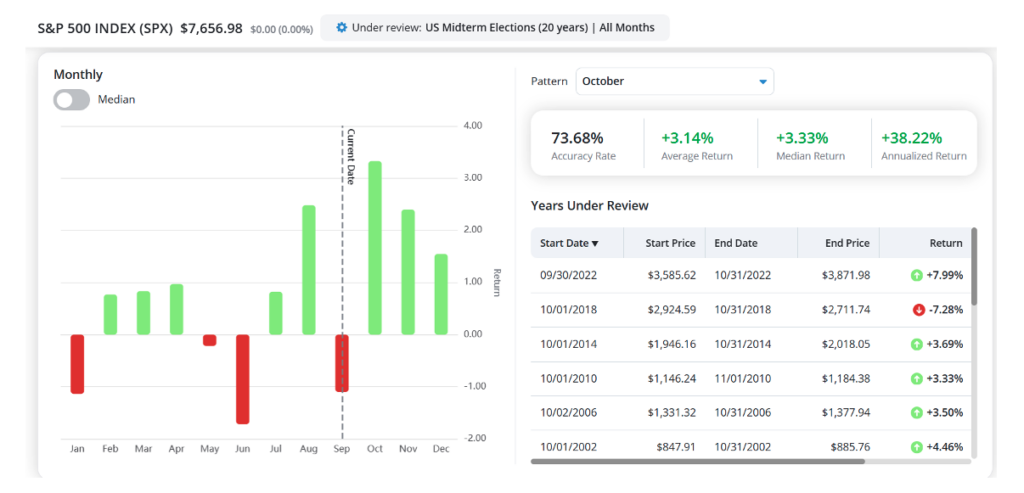
Over the past 20 midterm election-year cycles, the S&P 500 has been higher 73.7% of the time in October for an average return of 3.1%. And in winning years, investors have seen an average gain of 5.9%.
The plan is clear: Lean toward taking profits in September and buying any weakness as we near October.
To wrap up, Jeff Clark’s next Challenge trade is coming up soon…
If you haven’t caught my weekend interview with 40-year master options trader Jeff Clark, I’d recommend you check it out here.
Jeff laid out how his 12 Trades to $1 Million trading challenge has been shaping up.
So far, if you’d followed Jeff’s trades, you’d be up 68% over the last four months. And there are plenty of trades left in his challenge.
In our conversation, Jeff flagged where he’s finding new setups. With volatility up roughly 25% over the past few sessions, he named two sectors he thinks are positioned to run higher from here: utilities and semiconductors.
If you’re just catching up, the challenge works like the TV game show Who Wants to Be a Millionaire. You start with a small stake, and make a trade. Then you roll the proceeds from that closed trade into the next one – climbing the ladder toward $1 million in no more than 12 trades.
This isn’t how Jeff trades day to day. He’s a conservative, income-focused options trader with more than 40 years of experience.
But his team combed through nearly 400 of his closed trade recommendations and found 36 separate streaks of three or more winners in a row. Twice, those streaks ran long enough that a $5,000 stake, rolled forward, would have crossed $1 million – once during the 2023 banking crisis, and again during last year’s AI repricing.
Conditions like that – fast-moving markets, sectors repricing overnight – can supercharge your gains. So if you’ve never traded before, now is a great time to dip a toe in the water. And Jeff isn’t just a master trader… he’s also a master educator.
That’s the real value folks are getting from the challenge. They’re learning how Jeff aims for big gains while strictly managing his risk as they go along.
Access to the challenge closes tomorrow, Tuesday, Sept. 15. If you want in on the next trade, join here.
To building wealth beyond measure,
Michael Salvatore
Editor, TradeSmith Daily