
Listen to the audio version of this article (generated by AI).
In This Digest:
- High energy prices aren’t just about disruptions to supply
- This memory maker is down 20%+ despite record profits, and our data says there’s a big gap between
- Jeff Clark’s latest “Rip Van Winkle” trade for the next few months…
The U.S. and Iran are talking peace again…
As Americans vote in the midterms, Iranian diplomats met with Qatari officials in Doha for three days last weekend. Qatar is passing peace proposals back and forth between Tehran and Washington.
And Vice President JD Vance says the administration has made some progress.
Of course, we’ve heard talk of progress before. And big sticking points remain.
Iran still refuses to negotiate over its nuclear program, Washington’s top demand. And President Trump says he’s in “no rush” to decide whether to restart strikes.
If they strike a deal… and ships can move through the Strait of Hormuz again… that’s good news. But it won’t make high energy prices go away overnight.
The International Energy Agency says global energy production dropped by 3% this year. Even if there’s a peace deal, the damage done to natural gas and oil production is estimated to take years to repair.
And as our CEO Keith Kaplan covered in these pages in September, high energy prices aren’t just about supply disruptions. They’re also about rising AI demand.
Data centers, the giant warehouses of computers that power AI, already use about 1.5% of the world’s electricity. And by 2030, that’s set to more than double.
Less supply and more demand – that’s a recipe for higher energy prices. That’s why Energy is one of the healthiest sectors on our dashboard right now, with more than 71% of stocks in the sector in Short-Term Health Green Zones.
And our AI trading model sees it, too.
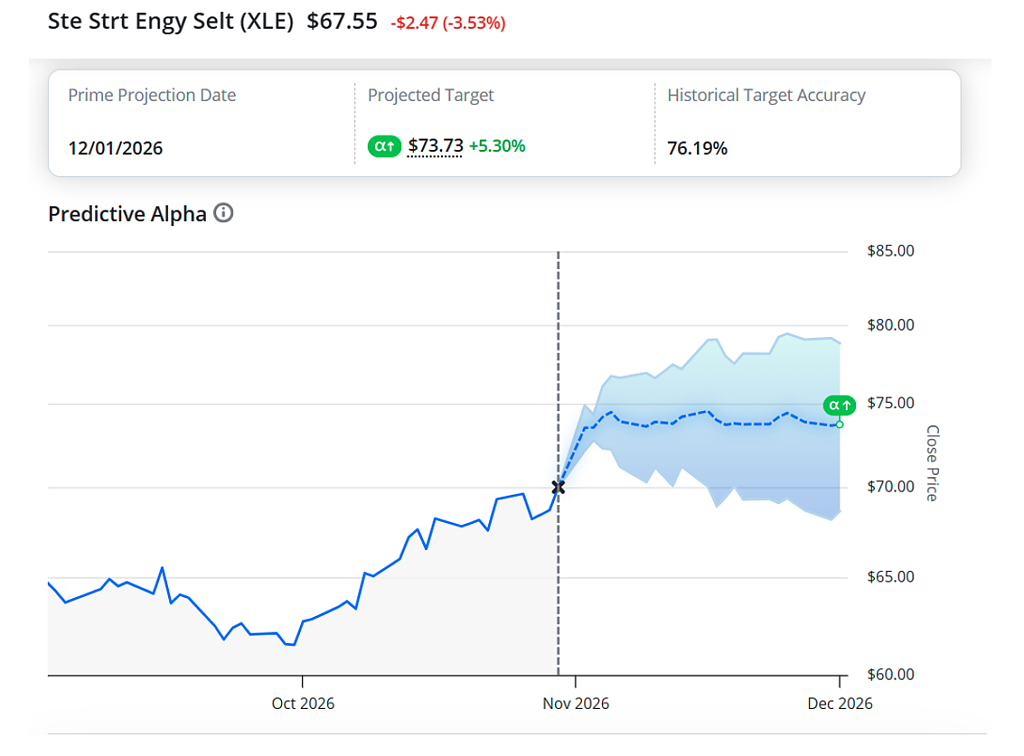
Predictive Alpha was trained on more than 100 billion stock market data points. It uses what it learned to forecast where stocks and ETFs are likely to trade up to 21 trading days out.
It’s forecasting that the Energy Select Sector SPDR Fund (XLE), which holds America’s biggest energy companies, will be 5.3% higher by Dec. 1.
You could try to guess what happens next in the Middle East with global oil and gas supplies and with the AI data center boom. Good luck with that. Or you could let the math do the heavy lifting.
Here’s what gives us confidence. Looking back, when Predictive Alpha made forecasts like this one on XLE, the price landed in its target range 76% of the time. That’s roughly three out of every four calls.
No forecast is a sure thing. But when the odds look this good, it pays to listen.
Power isn’t the only AI chokepoint worth having on your radar…
On Monday, Anthropic, the company behind the Claude AI models, filed updated IPO paperwork.
It showed $33.2 billion in revenue over the first nine months of this year – up from $2.5 billion in the same stretch of 2025.
And Anthropic has committed $895.4 billion to computing power and the infrastructure behind it – about 27 times its 2026 revenue so far.
Anthropic doesn’t build most of its own data centers. It rents computing power from companies like Google, Amazon, and Microsoft. But that money doesn’t stop there. Those companies turn around and spend it on the things AI can’t run without… AI chips, memory chips, the turbines and transformers that generate and carry power, and the cooling systems that keep it all from overheating.
And demand is outpacing supply. That’s why companies that make this equipment are sitting on backlogs that stretch out for years.
Memory is one of the tightest chokepoints. That’s why U.S.-based AI memory maker Micron Technology (MU) has been such a popular trade. Since the launch of ChatGPT in November 2022, it’s climbed as much as 1,835% – with a big chunk of those gains coming over the last year.
Micron makes the memory chips AI systems use to hold and move data while they work. In its Sept. 30 earnings report, it showed quarterly revenue jumped to $54.2 billion from $11.3 billion a year earlier. And it said the company expected to bring in about $61.5 billion this quarter.
But since that report, MU’s stock is down about 22%.
You can see that disconnect in its Quantum Score.
As regular readers know, it ranks thousands of stocks against two criteria: the business’s strength and the strength of the stock’s momentum… in other words, whether big investors are buying the shares or backing away.
It rolls both into a single score from 0 to 100 – the higher, the better.
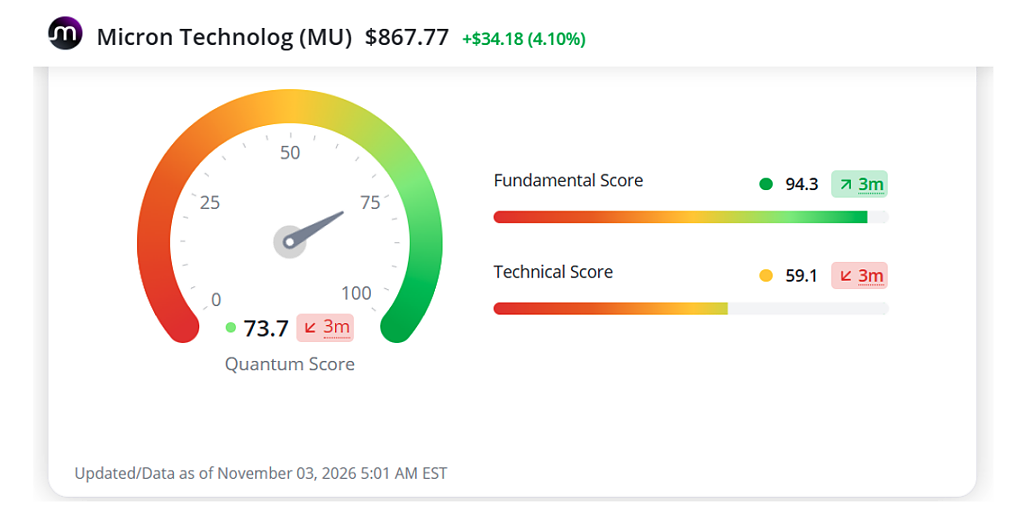
Right now, Micron’s Fundamental Score is 94.3 and has climbed over the past three months, meaning its business is strong and growing.
But it has a Technical Score of 68.2. That tells us the stock’s momentum has cooled. Big investors aren’t buying the shares with the same urgency they were a few months ago.
There’s a real disconnect with the fundamental picture of MU and its price action right now. Consider buying it while that gap is open.
Finally, if the midterms knock stocks lower, Jeff Clark plans to buy…
Have you noticed that everything in the market has become a short-term trade?
AI stocks go from hot to not in a day… and back again.
That’s how former Bloomberg anchor Adam Johnson opened the newest episode of TradeSmith Unfiltered. And his guest, our 40-year trading veteran Jeff Clark, explained what’s driving it.
All year, big investors have been pulling money out of one sector and pushing it into another. That rotation has kept the S&P 500 near its highs.
But underneath, one sector after another has gone through its own correction.
And it’s happening faster than ever. Jeff used to call these “Rip Van Winkle trades.” You’d buy a beaten-down sector, take a long nap, and wake up six months or a year later to a nice profit. Now, he says, those moves play out “within days or weeks,” thanks in part to the AI and trading algorithms big institutions use.
That’s why, in Jeff’s view, buying and holding an index fund has been “dead money” since June. The gains have gone to traders who got ahead of the money moving between sectors.
Jeff’s approach comes down to one simple concept. Think of a stock or sector like a rubber band. Stretch it too far from its normal range, and it tends to snap back.
So Jeff buys groups that have fallen furthest below their recent average price and takes profits on the ones that have run furthest above it.
That’s what led his subscribers into financial stocks in early October, when they’d fallen far below their normal range and chipmakers were running hot. On Oct. 12, Jeff recommended call options on payments processor Fiserv (FISV), a stock that had lost 80% of its value. His subscribers sold half for a 100% gain 10 days later, and the rest on Monday for about 150%.
He’s caught quick moves like that across the market this year. In August, his Delta Report subscribers doubled their money on half of a bitcoin trade in nine days. And a trade on gold-mining stocks more than doubled in five.
With the midterms today, his plan is clear. If the vote sends stocks lower, he’ll treat it as a buying opportunity.
In the episode, Jeff pulls up his charts and walks through:
- The beaten-down sector he’d buy now and hold for months – even though the headlines say it should be thriving
- The group he expects to lead stocks higher into year-end
- Why gold stocks could be getting close to a buy
- His one hard rule for buying IPOs – worth knowing before Anthropic goes public
If you’re a TradeSmith subscriber, the full conversation is in TradeSmith Finance, under the Unfiltered tab on the Publications home screen.
Be sure to watch it before the election results come in.
And if you’re not yet a subscriber, we’ve unlocked this episode for all readers. You can watch it here.
To building wealth beyond measure,

Michael Salvatore
Editor, TradeSmith Daily