
Listen to the audio version of this article (generated by AI).
In This Digest:
- Chip stocks flashed Red on Monday, the first warning signal since March 2025
- How Elon Musk can dodge a Texas data center freeze
- The healthiest sector we track holds a “bio-intelligence” stock with the calendar on its side
A painful day for chips – but not a broken market…
Yesterday, most of Wall Street celebrated the election. The Dow jumped 1,569 points, its best day after a midterm since 1982.
But the party didn’t last long.
As I write, the Dow is down 2.6%, giving back nearly all of yesterday’s gains. The S&P 500 is down 3.5%, and the tech-focused Nasdaq 100 is down 5.2%.
I know how today feels. I’m feeling it in my own portfolio, too.
And when the screen is this red, the urge to sell everything and head for the hills is hard to fight.
But before you act on that urge, look at what our Long-Term Health indicators are saying.
Those are TradeSmith’s bedrock trend indicators, built to separate a painful pullback from a real change in the market’s direction.
Right now, the S&P 500 and the Dow are still in Long-Term Health Green Zones and set to remain there after today’s close. That means the long-term trend for these two key benchmarks is still intact.
The Nasdaq 100 is likely to slip into a Yellow Zone. But Yellow is a caution flag. It isn’t a sell signal.
We’ve been here before… and not even that long ago.
In March, the Nasdaq fell into a correction – a drop of 10% or more from its high – as the war with Iran sent oil prices soaring. It came close to another one in late July.
During that March correction, the Nasdaq dipped briefly into the Yellow Zone. In July, it stayed in Green.
And both times, it went on to set new records.
Each of those felt like the start of something worse. Each one turned out to be a bump in a long road, not the start of a bear market.
So even as every bone in your body is screaming at you to sell, don’t make big decisions on a day like this.
Stick with your plan, and let our data tell you when something has changed.
But if you have to sell something, this is the best candidate…
Chipmakers, both today and yesterday, are the sore spot. Once the most profitable trend of the year, the VanEck Semiconductor ETF (SMH) is down 10% as I write and is now down by a third from its June all-time highs.
Investors read the midterm results – especially in Texas, home to about a quarter of planned U.S. data center capacity – as a threat to the AI buildout.
These data centers are the biggest source of new demand for AI chips. So the decline in SMH is no big surprise.
Especially because this selling started before the votes were counted.
At Monday’s close, SMH entered a Short-Term Health Red Zone.
That indicator, part of our Trade360 suite of tools, tells us its uptrend has broken down – and it’s the first Red signal for chip stocks since March 2025.
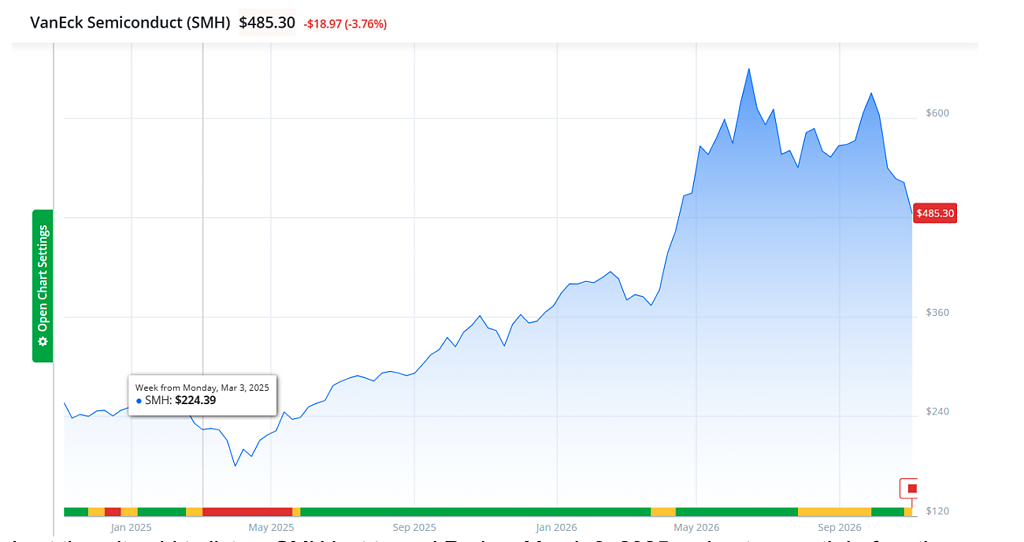
Last time, it paid to listen. SMH last turned Red on March 3, 2025 – about a month before the tariff-induced Liberation Day crash.
It fell another 19% before it bottomed on April 4. And it didn’t turn Green again until May 28. Since then, it has been Green or Yellow every day – until Monday.
On Monday, I told you to use market dips to add to your favorite AI stocks while the major indexes stayed Green and to stick with the ones that were Green on Short-Term Health themselves. Chip stocks as a group just failed that second test.
So don’t run out to try to catch this falling knife in the semiconductor sector.
I discussed the fundamental strength in Micron on Tuesday and a broader bull case for Teradyne on Oct. 1.
Both are now in Red Zones. And when the data changes, so does the call.
Hold off on new chip positions until SMH flashes Green again. And if you already own chip stocks, keep your stop-losses tight.
Musk lost Texas – but he has an escape hatch in orbit…
Elon Musk had a rough election night, too.
He spent at least $474 million on the midterms, a record for a single donor. Almost half of that went into Texas.
It didn’t work. Texas elected Democrat Gina Hinojosa as governor. She’s called for a moratorium on new data centers until lawmakers put stronger protections in place for the state’s power, water, and communities.
She’s also gone after Musk directly. On the campaign trail, she sued current Texas Gov. Greg Abbott’s office for its emails with Musk’s companies and said Texans deserve a say in Terafab, the giant chip plant and compute complex SpaceX (SPCX) and Tesla (TSLA) are building in Grimes County.
Early Wednesday morning, Musk posted his solution on X:

It sounds like a joke… but was it?
SpaceX has asked federal regulators for permission to launch up to 1 million satellites that would work as data centers in orbit. Up there, the sun never sets on the solar panels. There’s no land to permit, no water to fight over, and no governor to win over.
And this is closer to reality than it sounds. On Sept. 28, SpaceX’s Starship rocket reached orbit for the first time, carrying the next generation of Starlink satellites.
Days before the election, Musk predicted that by around the end of 2028, more computing power will go into orbit each month than gets built on the ground.
Wall Street isn’t buying it yet. SpaceX fell 3.8% yesterday as investors treated the Texas result as one more blow to the AI trade.
But Main Street sees it differently.
A few weeks back on Oct. 13, I showed you that SpaceX’s customers and its investors see the company very differently. And we measure that gap with Andy and Landon Swan’s Social Heat Score.
Social Heat tracks:
- How excited consumers and business customers are about a company’s products online (its Main Street Score)
- How bullish Wall Street analysts and investors are (its Wall Street Score).
SpaceX’s Main Street Score is 70, about where it was a month ago. Its Wall Street Score has dropped from 56 to 35:
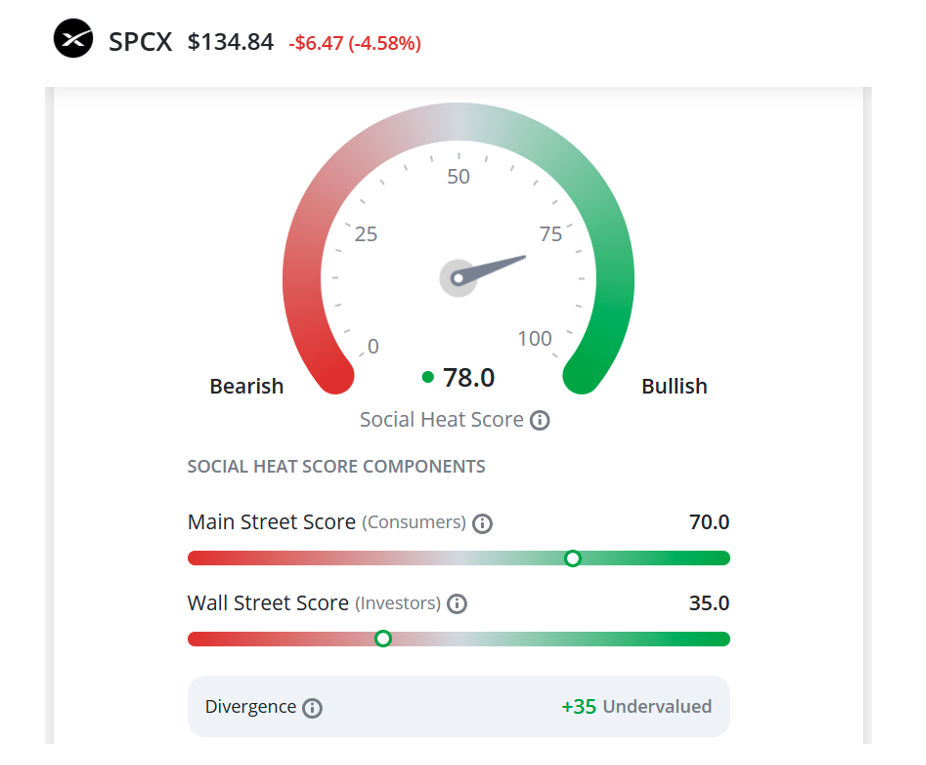
So the customers buying Starlink haven’t changed their minds. Only the investors have.
That gap has more than doubled since we last covered it, from 15 points to 35. And SpaceX’s overall Social Heat Score of 78 keeps it in buy range.
Wall Street is pricing in a setback. SpaceX’s customers aren’t.
SPCX may have further to fall in this sell-off. But down the road, that could prove to be an early buying opportunity to take advantage of while the crowd runs the other way.
Tech is stumbling, but healthcare keeps climbing…
While chip stocks fell yesterday, the State Street Health Care Select Sector SPDR ETF (XLV) jumped another 2.8%.
It’s getting beat up a little in today’s sell-off, down 1.5%. But it’s holding up better than most other sectors aside from Consumer Staples (XLP, down 0.4%), Energy (XLE, down 0.65%), Utilities (XLU, down 0.7%), and Communications (XLC, down 0.7%).
That’s not surprising. XLV is currently the healthiest sector we track, with 80% of its stocks in the Long-Term Health Green Zone:
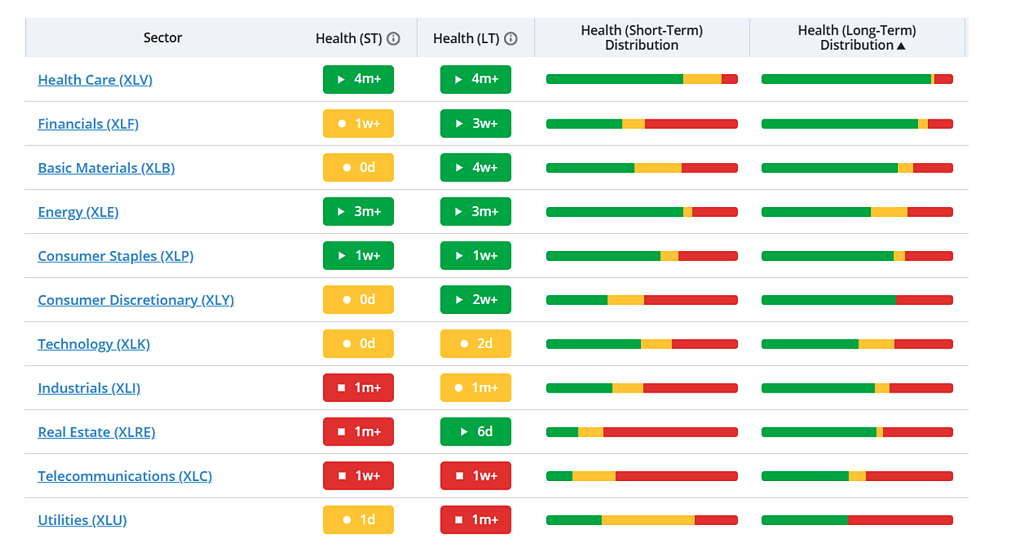
It’s just further evidence of a powerful trend we’ve been covering extensively in these pages: bio-intelligence.
As our CEO, Keith Kaplan, has laid out here and here, it’s the emerging trend of using AI to read our bodies to cure diseases and slow aging.
Keith breaks the trend into three kinds of companies: those that read what’s happening in our bodies, those that fix it, and those that sell the tools. On Monday, I showed you a fixer, Vertex Pharmaceuticals (VRTX).
Today, let’s look at a reader.
Abbott Laboratories (ABT) is best known for its FreeStyle Libre, a small sensor worn on the arm that tracks blood sugar around the clock. It’s the flagship of Abbott’s diabetes care business, which brought in $2.2 billion in sales last quarter.
And Abbott is reading more of the body every year.
In August, the Food and Drug Administration approved Libre Duo, the first wearable sensor that tracks both blood sugar and ketones – an early warning sign of a dangerous diabetes complication.
And back in March, Abbott bought Exact Sciences, the maker of the Cologuard colon cancer test. Abbott’s cancer testing sales grew 13.8% last quarter on a comparable basis.
Abbott’s medical portfolio is in good shape. And the calendar is on its side.
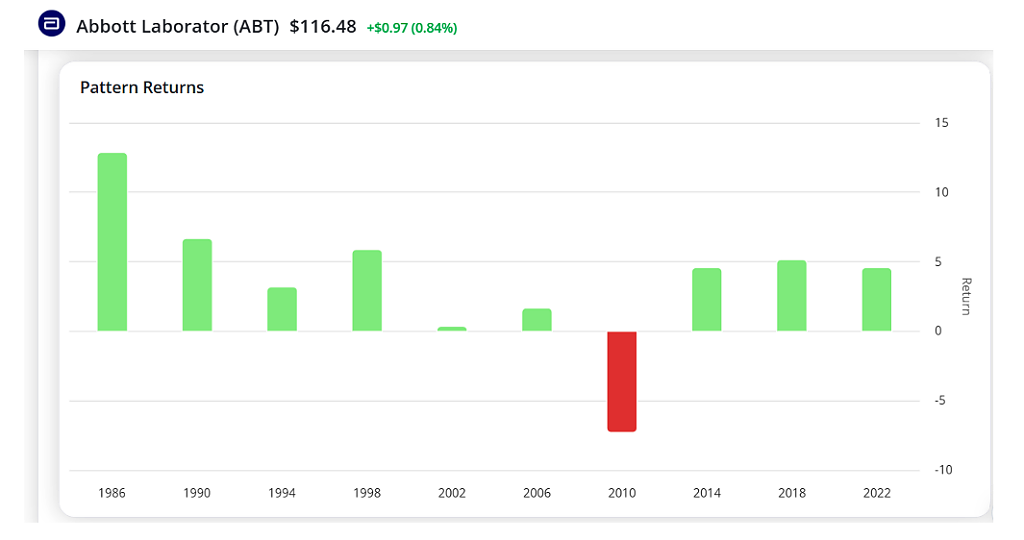
Our Seasonality tool shows when stocks have tended to rise or fall over a stretch of the calendar.
And in midterm election years going back to 1986, Abbott has risen from Nov. 2 to Dec. 7 in nine out of 10 cycles. Its average gain was 3.8%.
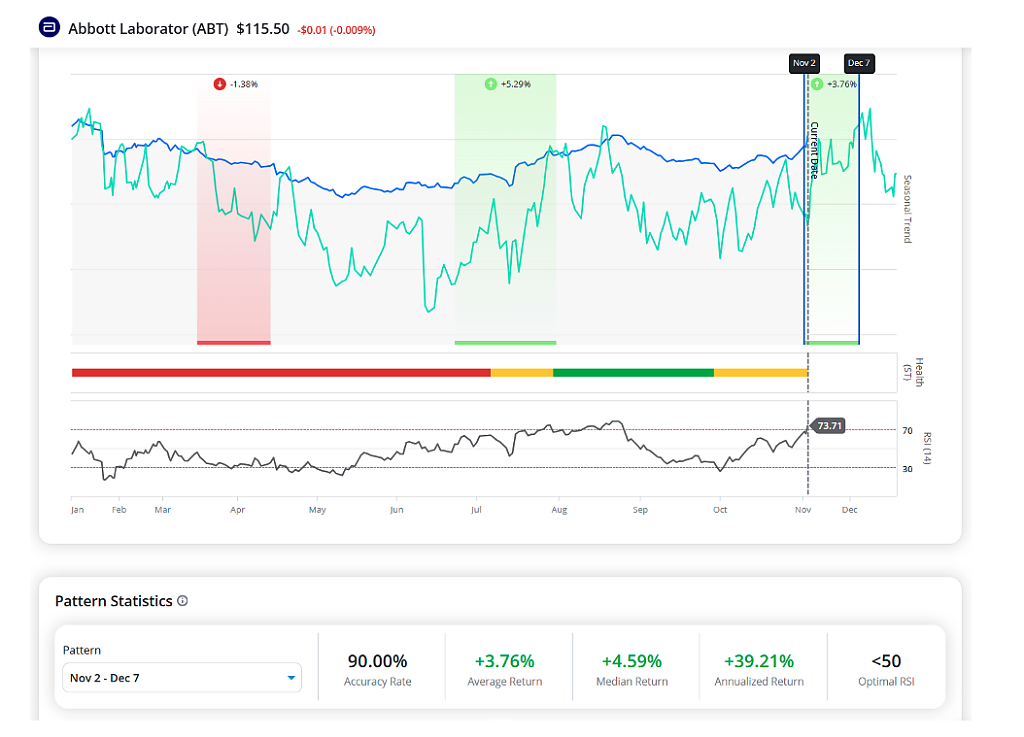
The only losing year was 2010, when it fell 7.3%.
Abbott’s Short-Term Health has been Yellow since Sept. 30, after a stretch in the Green.
I read that as a pause in the uptrend, not the end of one.
Abbott fell about 17% from its August high through September, but it never entered a Red Zone. That’s how our Health Indicator is built: it gives a stock room to swing without shaking you out of a healthy trend. Since Oct. 1, the stock has climbed 20.2%, from $96.10 to $115.50.
If you don’t own a bio-intelligence reader yet, buy Abbott while this seasonal window is open.
To building wealth beyond measure,

Michael Salvatore
Editor, TradeSmith Daily
Disclaimer: Michael Salvatore owned shares of SPCX at the time of this writing.