Listen to the audio version of this article (generated by AI).
Michael’s note: Today, a special message from our CEO, Keith Kaplan.
As investors, we’re bombarded with apocalyptic forecasts, video clips, X posts, biased news, propaganda, and useless information. And it’s easy to do the wrong thing when you’re being spun around by it all.
But there’s a way to tune out everything you hear in the media – all the bias… all the conflicting opinions… and focus only on the forces that move stocks. It’s an AI-powered software we developed at TradeSmith that takes a completely different approach.
It looks for certain “tells” in a stock’s trading data to spot when big moves are coming.
Keith recorded a video message about this breakthrough just for TradeSmith Daily readers… plus how you can access a trial version of this software, free of charge.
Watch Keith’s video and unlock your free trial.
Then read on for more from Keith on why the headlines always arrive after markets move… and how to stay ahead as an investor without them.
On December 13, 2003, American soldiers in Ad-Dawr, Iraq, pulled Saddam Hussein out of a coffin-sized hole in the ground.
He had been in hiding for nearly a year, since the day Baghdad fell amid the U.S. invasion of Iraq.
The Monday after, a Bloomberg News headline said U.S. government bond prices were rising because of Saddam’s capture. Supposedly, investors were fleeing to the safety of bonds because catching him might not stop terrorism.
Half an hour later, bonds were falling. And the new headline gave Saddam’s capture as the reason for that, too. This time, his capture had supposedly made investors brave enough to dump their bonds for riskier bets in the stock market.
Nobody had learned anything new about Saddam’s capture in that half hour. But bond prices had moved in a new direction, so the story moved with them.
Last week, the same thing happened with the midterm results… only this time it took a day.
On Wednesday, the morning after Democrats won the House and the Senate, the Dow climbed more than 1,500 points. Supposedly, investors were relieved. The election was over, and Wall Street finally knew who would be running Congress.
On Thursday, the Dow gave the whole rally back and then some. The tech-heavy Nasdaq 100 had its worst day since the COVID crash in March 2020. The new explanation was that a Democratic Congress would crack down on artificial intelligence and slow the rush to build data centers.
Nothing about the election had changed overnight. Prices had simply moved the other way… so the press had to create a new narrative to match.
The press will always find a reason for prices to move. The problem is they always show up after the money has been made… or lost.
So why waste your time?
The sooner you stop listening to them, the clearer your decisions get… and the better you’ll sleep.
So today, let me show you how to make smart decisions about your money without reading a single headline…
And how to use the hidden signals that show up in stocks before they make big moves. (One of them involves the Netflix show Squid Game. I’ll explain.)
Every Stock Has Its Tell
So if you’re not watching the news, what do you watch instead?
The stock itself.
Like a poker player, every stock has its “tells” – small clues that hint at what it might do next.
They’re hidden in the stock’s trading data… in how its price moves, and in what the rest of the market is doing at the same time.
Most days, those tells don’t add up to much. But every so often, they line up the way they did right before one of the stock’s past big moves.
They don’t guarantee the stock will jump again… but they put the odds on your side.
We call them signals.
Our Chief Quantitative Strategist, Mike Carr, spent 40 years designing, developing, and testing hundreds of these signals across thousands of stocks.
Mike is a Chartered Market Technician who has co-managed mutual funds and private accounts worth up to $200 million. He spent his career hunting for patterns that held up in bull markets, bear markets, and everything in between.
We trained an AI model on Mike’s collection and asked it to find more like them. It found thousands, including some no human would ever have thought to look for.
Today, the system runs more than 4,000 calculations on every one of 2,467 stocks. Each morning, it weighs 10.4 million possible trades.
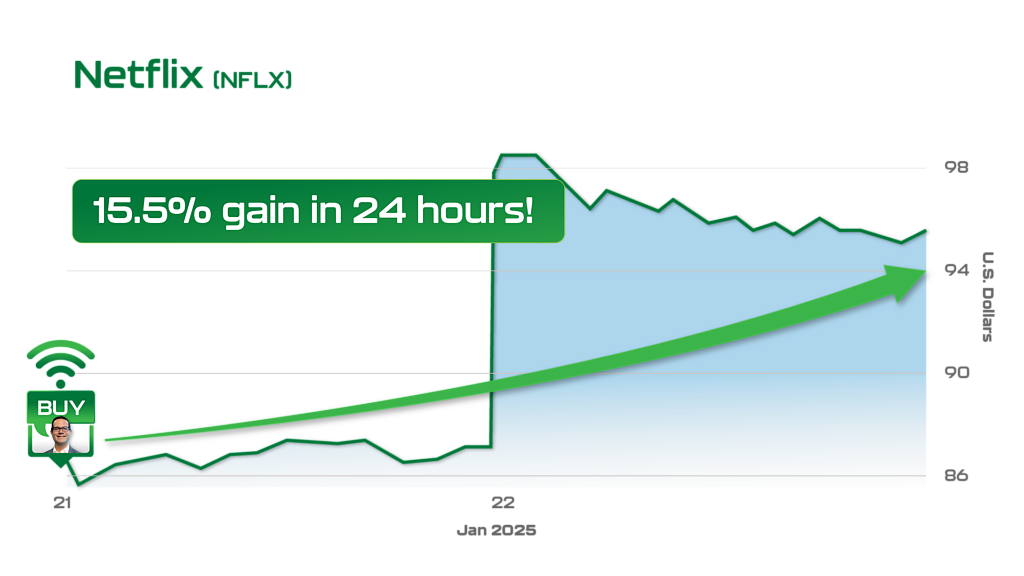
One signal for Netflix (NFLX), for instance, involves a particular kind of price swing and how many people were watching Squid Game.
You may be wondering what a TV show has to do with Netflix’s share price.
Quite a lot, as it turns out. Netflix lives and dies by how many people are watching. And Squid Game is one of the most-watched shows it has ever made. When viewing jumps, Netflix’s business feels it, and so does its stock.
Our system isn’t watching Netflix… or anything like that. It picks up the imprints events like these leave behind in the trading data.
The last time that pattern turned up, Netflix rose 15.5% in 24 hours.
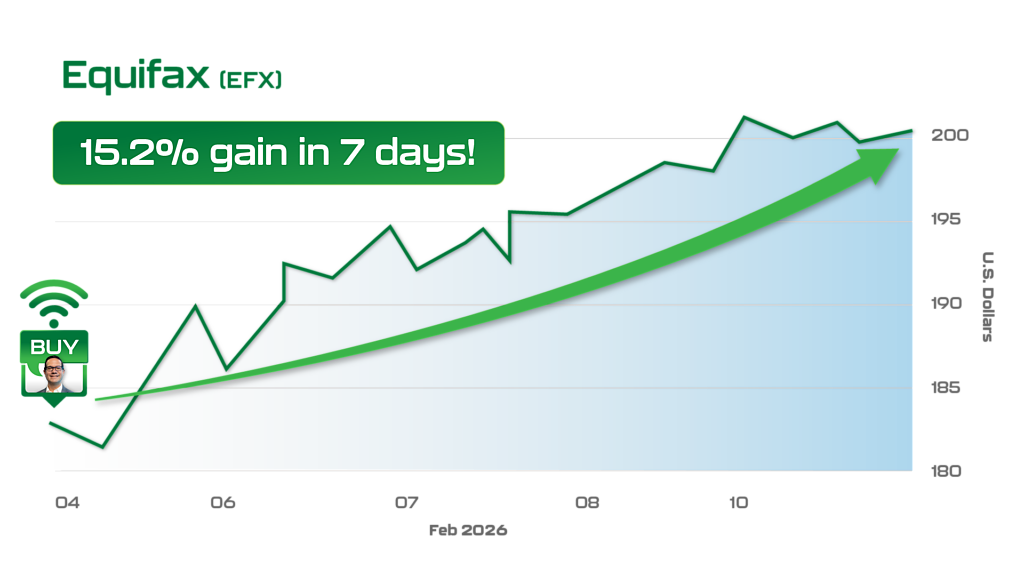
Equifax (EFX), the credit-reporting company, has a pattern of its own. When its stock falls four days in a row, and market volatility is running above its 10-day average, the stock has gone on to rise over the next two weeks 91% of the time. During our test run this year, that pattern delivered a 15.2% gain in seven days.
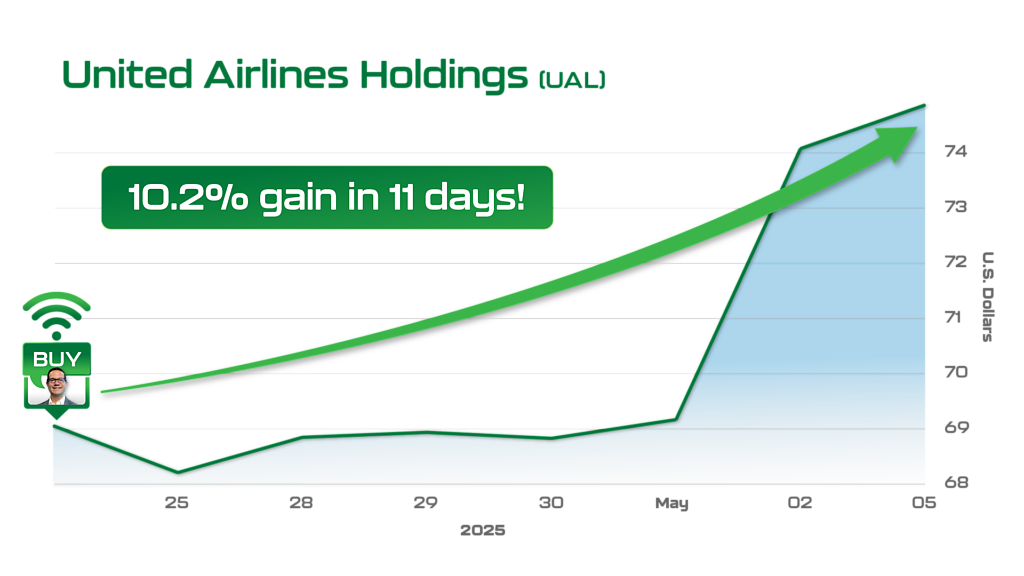
And on April 24, 2025, the market was in the middle of a sell-off that had wiped $1.8 trillion off the biggest tech stocks earlier in the month. The headlines were grim, and most investors weren’t buying anything. Our system flagged United Airlines (UAL) on a pattern with a 94% historical success rate. United rose 10.2% in 11 days.
None of those trades depended on a news story or an earnings report. And the AI doesn’t care what the company does. It only cares whether certain conditions have lined up before and what happened next.
We put the whole system through a live test in January. Of the top 100 trades it posted, the average gain was 11.6% in seven days.
That’s what can happen when you stop reading the headlines and start reading the data.
And right now, you can see which signals are firing for yourself. I’ve opened the system free to TradeSmith Daily readers for the next week. Go here to get access.
The Market Makes the News
Think back again to last Thursday.
The selling came first… but the explanation about AI regulation came after, once the reporters needed a new angle.
The market made the news… the news didn’t make the market.
That’s how it works every time. The price moves, and then someone finds a reason for that move. It was true of Saddam and bonds in 2003, and it was true of the midterms last week. It’s just the way we’re wired.
Every day, we’re bombarded with apocalyptic forecasts… X posts… and biased news. We love having a story for why prices move… so we lap it all up.
Just don’t expect a story that shows up after a market move to tell you what happens next.
Signals work the other way around. They show up in the data before a stock moves. And our AI doesn’t need to know why a pattern works. It just knows which patterns have come before which moves, stock by stock. It leaves the “why” to the folks on TV.
That’s what I love about signals. They don’t care who won the midterms or what’s trending on X. They only care what a stock did the last time conditions lined up like this.
With Signals, you can replace noise, bias, and information overload with probabilities, evidence, clarity, and efficiency.
Everything that can possibly move a stock up or down is factored into the behavioral profile of that stock. When those forces align in such a way that there’s a high probability of the stock moving in one direction, we act.
And that kind of system is now more important than ever.
Prepare for a Bumpier Ride
The past few weeks have been rough. Stocks that looked unbeatable a month ago have plunged. And last week’s sell-off was the worst second day after a midterm election in the Dow’s 130-year history.
That’s hard on buy-and-hold investors. But signals don’t need a bull market to work. Our system is built to find opportunities when buy-and-hold is struggling.
Take 2022. The S&P 500 had its worst year since 2008, falling nearly 20%.
When we backtested a portfolio built on these signals over that same year, it didn’t just hold up. It nearly matched the S&P 500’s 16.4% gain in all of the 2025 bull market.
That’s because the system isn’t betting on which way the market goes. It’s only asking whether a stock’s conditions have lined up the way they did before its past moves.
That doesn’t mean every individual signal will work out. Some won’t. But across the whole test period, the odds held.
And when markets get choppy, those rare combinations show up more often, not less. Calm markets are predictable. Rough ones throw off the odd patterns the AI was built to catch.
That’s important, because I think things are about to get choppier – and soon.
Our seasonal research shows the S&P 500’s strongest stretch of the year ends right before Thanksgiving, on Nov. 25.
That seasonal trend has held 93% of the time over the past 15 years. After that, I expect the kind of whipsaw market we saw in the late 1990s, with sharp drops inside a longer climb.
I don’t think that’s a reason to sell your long-term holdings. I think it’s a reason to change how you trade.
Next Wednesday, Nov. 18, at 10:00 a.m. ET, I’m holding an online event to show you how this system works – and the patterns it’s flagging right now.
I’ll give away two recommendations. The first is the stock with the strongest bullish pattern in our system today. The second is a popular stock our system says to stay away from. If it’s in your portfolio, you’ll want to hear why before Thanksgiving.
You’ll also watch Mike Carr put his own money into a stock he knew nothing about, using nothing but one of these signals.
But you don’t have to wait until Wednesday to try the system yourself.
Here’s that link again to get access to our trial version of Signals for a week.
By making Signals a big part of your investment process, you can cut out the noise, slash information overload to zero, and focus on things that are proven to make you money.
You let the math and the probabilities do the heavy lifting… and tell the news to take a hike.
All the best,
Keith Kaplan
CEO, TradeSmith