Listen to the audio version of this article (generated by AI).
In This Digest:
- Wall Street is fixated on Nvidia’s earnings, but the world’s greatest trader would have ignored them
- Every GLP-1 passes through a hidden middleman – and this one is a top 10%-er
- Fearful markets are this company’s payday, and our AI sees more upside ahead
Wall Street is glued to the Nvidia soap opera…
Tomorrow after the close, AI chipmaker Nvidia (NVDA) will report earnings for the first time in 33 years without its ousted CEO, Jensen Huang, running the company.
Huang resigned last Thursday over a scandal that involves three extramarital affairs – including one with an alleged Chinese intelligence asset – and backchanneling AI chips to China, despite export controls.
CFO Colette Kress is filling in. But on Sunday, the Financial Times reported that Huang has talked with confidants about a plan to return to the CEO role.
So investors are trying to price a lot at once…
Like, who will run the world’s most important chip company next month?
Will Nvidia face tough regulations if it’s found to have sold AI chips illegally to China?
And why was it using accounting tricks to cover up sales to Malaysia, where one of Huang’s lovers ran a data center operation linked to China?
Most investors handle weeks like this the same way. They read the news, guess what the earnings call will bring, and hope for the best.
But by the time a headline reaches you, the big money has usually traded on it already.
That’s why the greatest trader who ever lived didn’t bother with any of it…
In 1978, a math genius named Jim Simons walked away from running the math department at Stony Brook University. He set up a small trading firm in a Long Island strip mall and later renamed it Renaissance Technologies.
Simons didn’t care about earnings reports, analyst forecasts, or CEO drama.
Instead, he wanted signals – small, repeatable patterns buried in market data that came before predictable moves.
That data wasn’t easy to get. His team went to the Federal Reserve and copied interest rate histories by hand, because they didn’t exist in digital form yet.
They dug through newspaper archives, government records, and exchange data until they had a bigger dataset than any competitor.
It paid off like nothing else on Wall Street. From 1988 to 2018, Renaissance’s flagship Medallion Fund averaged 66% a year before fees. Even after its hefty fees, investors kept 39% a year.
A dollar invested in Medallion in 1988 was worth about $27,000 by 2018. The same dollar in Warren Buffett’s Berkshire Hathaway grew to about $107. All told, Medallion made more than $100 billion in trading profits.
But for decades, that kind of signals trading stayed locked inside a handful of elite hedge funds. Everyone else was left reading headlines.
So our team at TradeSmith spent more than a year building a system on the same principle Simons followed.
We trained an AI model on signals studies our Chief Quantitative Strategist, Mike Carr, had collected and asked it to find more like them. It found thousands, including some no human would ever have thought to look for.
Today, the system runs more than 4,000 calculations on every one of 2,467 stocks. Each morning, it weighs 10.4 million possible trades.
And it’s found more than 30,000 signals, some with historical accuracy of 90% or more.
Take Nvidia’s rival, Advanced Micro Devices (AMD). On a recent signal, our system forecast an 8.4% move in 14 days, based on a pattern with 95% historical accuracy. AMD gained 8.1% in 48 hours.
As for how Simons would trade Nvidia now, we like to think it might look something like this.
Right now, there’s a Bullish Pivot signal firing on Nvidia in our Signals software (you can access it for free from now until Nov. 18 if you sign up here).
This signal fires when Nvidia trades in a narrow range amid a downtrend, then breaks out to a higher high from the previous day.
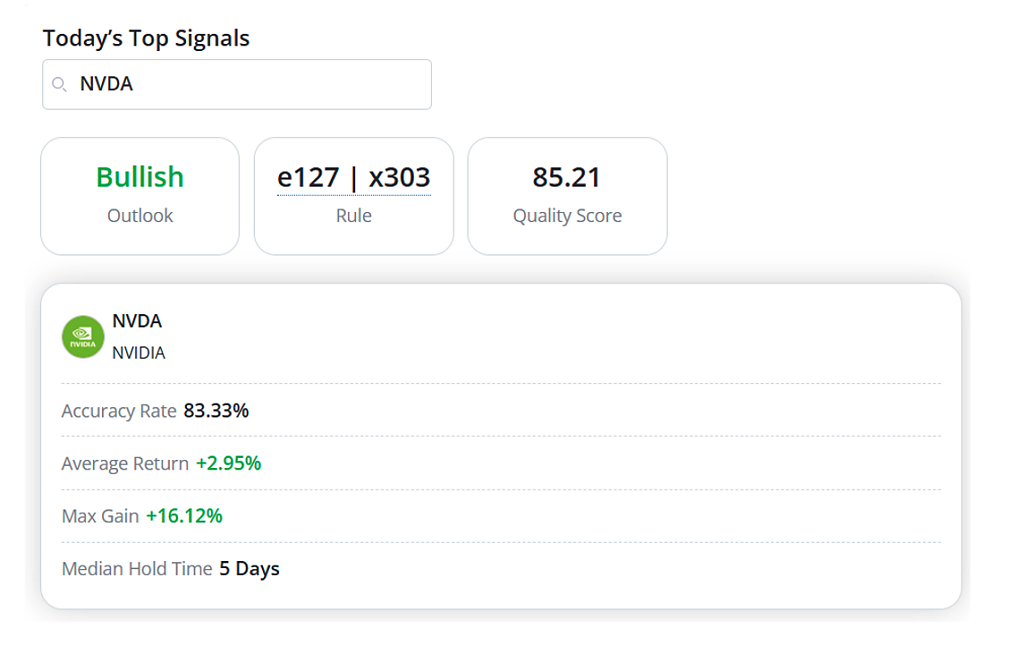
On average, this signal has been accurate 83.3% of the time, firing 17 times over the past year and 102 times over the past 10 years. And it’s returned an average gain of 3% over a median hold time of five days.
This is a solid signal – but it’s not one of our top 5 for today.
You can see those – and check which ones are firing on thousands of other stocks – before Keith Kaplan walks through the whole system at his AI Signals Trading Event on Wednesday, Nov. 18, at 10 a.m. Eastern.
I’d urge you to try it now, while Wall Street is still busy guessing about Nvidia. Register here, and you’ll get immediate access to test drive the software ahead of the event.
The weight-loss boom runs through this middleman…
You probably know someone taking a GLP-1 drug – the weight-loss and diabetes medicines sold as Ozempic, Wegovy, Mounjaro, and Zepbound. Maybe you’re taking one yourself.
If so, I wouldn’t be surprised. Because demand for GLP-1s doesn’t appear to be slowing down.
Novo Nordisk’s new Wegovy pill brought in about $810 million last quarter, up 53% from the quarter before. And since July, a new Medicare program has been helping more seniors get these drugs covered.
That’s made Eli Lilly (LLY) and Novo Nordisk (NVO) two of the most-watched stocks in healthcare.
Most investors stop there, but there’s another way to play it that you might not know about.
Every single dose of GLP-1 has to get from the factory to the patient. And most of them pass through one of three drug distributors.
The biggest of those is McKesson (MCK). It buys medicines from drugmakers and delivers them to pharmacies, hospitals, and doctors’ offices across the country. So it’s in the unique position of not having to compete for having the best GLP-1 like LLY and NVO do. It gets paid on the trend itself… and the more competition, the better.
Distribution has a reputation as a sleepy, thin-profit business. GLP-1s especially carry low margins for the middlemen. But the volume is so large that it’s adding up.
In its latest quarter, McKesson’s revenue from distributing GLP-1 drugs hit $16 billion. That’s up about 26% from a year earlier. And profit in its main drug-distribution business climbed 22% – nearly four times as fast as that segment’s 6% sales growth.
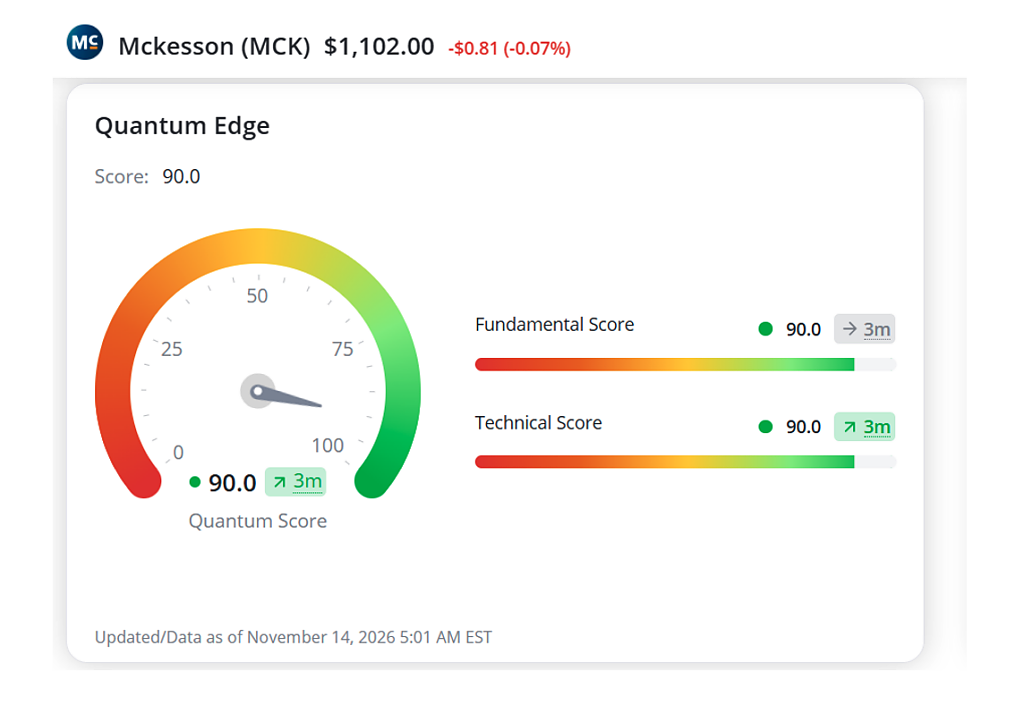
Better yet, our Quantum Score flags it as a buy.
The Quantum Score ranks thousands of stocks on two things: the strength of the underlying business and how the stock is trading – including whether big investors are buying. It rolls them into one score from 0 to 100.
McKesson scores 90 on both. A 90 on the Fundamental Score means growth and profits are among the best in the market. A 90 on the Technical Score means large buyers are firmly in control.
That neatly puts its overall Quantum Score at 90 – near the top of everything we track.
If you want to own the weight-loss boom without betting on which drugmaker wins, McKesson is the way to do it. Consider buying it while the volume keeps pouring in.
Wall Street’s jitters are this exchange operator’s payday…
The market hasn’t been a calm place lately.
On Nov. 5, the tech-heavy Nasdaq 100 plummeted 6.4% in a day – its worst one-day drop since the pandemic crash of 2020. Chip stocks fell twice as hard.
And that’s just the latest episode in a tech market plagued by volatility over the past month and change. The Nasdaq 100 is now down more than 10% from its Oct. 6 high, comfortably in correction territory. And as I write Monday morning, the Nasdaq is set to open 1.2% lower.
When markets swing like this, investors don’t sit still. They rush to protect what they own, and traders rush to profit from the moves.
Much of that activity runs through options – contracts that let investors bet on, or hedge against, a stock or index moving.
And every one of those trades pays a small fee to the exchange where it happens.
That’s great news for Cboe Global Markets (CBOE).
Cboe runs some of the busiest options exchanges in the world. It owns trading in S&P 500 index options, one of the most popular ways for big investors to hedge the whole market. It also runs the VIX, Wall Street’s so-called “fear gauge.”
So when fear goes up, so does Cboe’s business. October was a record month for its options and futures business. Trading in its index options hit a record average 6.9 million contracts a day, led by record volume in S&P 500 options.
Investors have noticed. The stock is up about 22% in the past month alone.
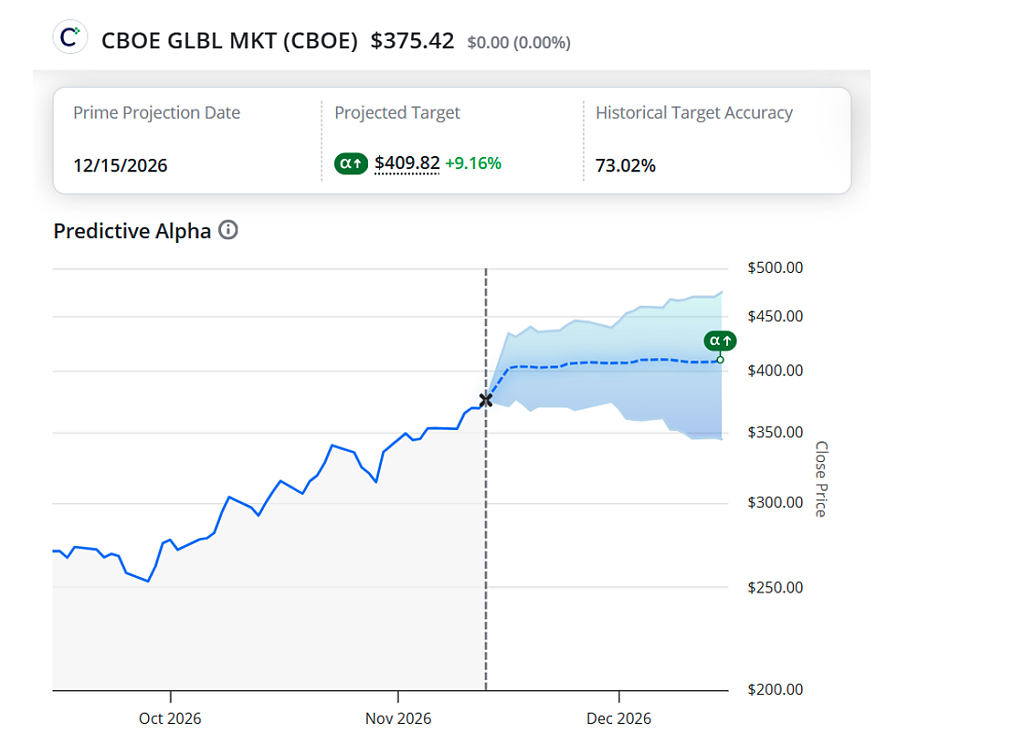
And our Predictive Alpha AI forecasting model says the run isn’t over.
It’s calling for Cboe to climb 9.2% by Dec. 15. On this stock, its forecasts have hit their target 73% of the time in the past. That’s nearly three out of every four calls.
You can’t control the market’s swings. But you can own a piece of the business that collects a fee on every one of them. Consider adding Cboe while the market stays jumpy.
To building wealth beyond measure,
Michael Salvatore
Editor, TradeSmith Daily
Disclaimer: At the time of this writing, Michael Salvatore owned shares of CBOE and NVDA.