


Listen to the audio version of this article (generated by AI).
In This Digest:
- This market is testing all of us, but let the data be your guide
- Three studies of past sell-offs – and what they say about buying now
- AI agents are the new weak link in cybersecurity, and this all-in-one cyber stock is still a buy
Don’t get caught up in the market whiplash…
Last week was the kind of week that makes you want to check your retirement account… and then wish you hadn’t.
The Nasdaq 100 – an index packed with high-flying tech stocks – fell every day, ending the week down 10.3%.
That took it down 19.9% from its Oct. 6 record high… a smidge short of the 20% drop that marks a bear market.
Then yesterday, it leapt about 7% after Nvidia’s board did a full 180 and brought back Jensen Huang as CEO.
And it’s down 3.4% from yesterday’s high as I write.
Whiplash like this makes it hard to keep your emotions in check and stick to your investing plan. When that much uncertainty strikes that fast, it’s tempting to throw the rules out the window.
But here at TradeSmith, our mission is to empower you with world-class data analytics so you have a clearer picture of where you stand.
And today, I have some data about last week’s sell-off you’ll want to see.
Over the weekend, two of our analysts came at this from three different angles. All three angles aligned with where stocks are likely headed.
Let’s start with the tech stocks that led the plunge…
Signals editor Lucas Downey went back through every major Nasdaq 100 sell-off since the 2008 financial crisis – 17 in all, including the COVID crash and the 2025 tariff scare.
What happened next? Here’s Lucas:
Each time, the setup looked a lot like this one: fear spiked, money rushed out of stocks, and the indexes broke down. The Nasdaq 100 was down 6.3% over the prior week, 11.3% over the prior month, and 15.6% over the prior three months.
And each time, those gut-wrenching drops were followed by a V-shaped recovery – a sharp fall then a fast climb back up. The Nasdaq 100 was up every time over different periods with eye-popping gains…
What kind of gains can we expect? Here are the historical gains after past drops of this magnitude:
- 13.4% on average one month later.
- 20.5% three months later.
- 29.3% six months later.
- 45.9% one year later.
- And 78.5% two years later.
What does that mean you should do now? Lucas says the lesson from history is clear:
The lows in those sell-offs usually came when the news felt worst and the headlines were loudest. Anyone who sold at that point locked in losses and probably missed at least some of the rebound.
And that’s not the only bullish signal in the data.
This Health indicator study shows why a rally is likely…
Our chief “quant” Mike Carr did a separate study based on our Long-Term Health indicator. It turns Green when a stock enters a healthy long-term uptrend… and Red when that trend breaks down.
Last week, the share of S&P 500 stocks rated Green fell from 63.6% to 46.9%. Only about 1% of weeks since 2003 have seen a drop that big.
In the 12 earlier cases that happened, the S&P 500 was higher three months later 11 times, with an average gain of 7.1%.
And this aligns with what TradeSmith’s Fear & Greed gauge is telling us.
It runs from 0 (extreme fear) to 100 (extreme greed). Last week, it fell from 57 to 42 – one of only nine drops that steep since December 2015.
Six months later, the S&P 500 was higher all nine times, up 14.6% on average.
Every one of these studies points the same way. There’s a chance sell-offs like these mean a bear market is coming. But they’ve historically been better times to buy rather than sell.
Don’t let one awful week – or one great day – talk you into a move you’ll regret.
Instead, use the rough patches to buy stocks you’d like to own for when the recovery takes hold.
Just make sure to always honor your stop losses. Even if a recovery is the most likely outcome, there are times when market drops like we’ve seen recently signal even steeper drops.
Our Signals system is built for weeks like this one…
When stocks fall that hard, most folks sell first and ask questions later.
Our Signals system does the opposite. It looks back at every time a stock was beaten down like this… and checks what happened next.
One thing it looks for are how stocks behave after they get beaten down – like the bullish signal it flagged in Nvidia on Friday morning, before yesterday’s rebound.
At last week’s AI Signals Trading Event, our CEO, Keith Kaplan, showed how the system works, named the stock with the strongest bullish signal in our system at the time, and named a popular stock to avoid heading into Thanksgiving.
Today is your last chance to watch. The replay comes down at midnight ET tonight. Here’s your link.
Want to play the AI revolution? Buy these cybersecurity stocks…
Yesterday, CrowdStrike (CRWD) agreed to buy fellow cybersecurity company Zscaler (ZS) in an all-stock deal that values ZS at about $43.9 billion.
CrowdStrike is paying a premium of about 34% over Zscaler’s Friday close. And it’s doing it right after the Nasdaq 100 had its worst week since March 2020.
Why pay up now? The heads of both companies gave the same answer: AI.
“Security used to be about keeping the adversary out,” CrowdStrike CEO George Kurtz said. “Today, safety is required to let AI in.”
Zscaler founder Jay Chaudhry put it more bluntly: “AI agents are rapidly becoming the new weakest link.”
AI agents are programs that do work on their own – answering customers, moving money, and writing and running code.
To do their jobs, they need access to a company’s data. So every agent a company puts to work is another door a hacker can try to open.
The more agents companies deploy, the more they’ll have to spend locking those doors. Kurtz says he sees “a path to become the largest AI safety and security company the world has ever seen.”
But you don’t need to wait for this deal to close – it’s expected to take many months – to own the trend.
Palo Alto Networks (PANW) already sells the kind of all-in-one security platform CrowdStrike is building. Its software protects companies’ networks, cloud systems, employee logins, and AI tools, and it counts more than 75,000 customers.
And demand is surging. In the quarter that ended Oct. 31, its yearly recurring revenue from its newest security products jumped 66% to $9.73 billion. CEO Nikesh Arora says the job now is to help customers “adopt AI securely.”
We’ve been bullish on cybersecurity since the spring. On May 18, we called Palo Alto an “easy buy” after it broke out to an all-time high and moved into Short-Term and Long-Term Health Green Zones. It closed that day at $247.55. It now trades at $356.35 – a gain of 44%.
And our data says it’s still a buy.
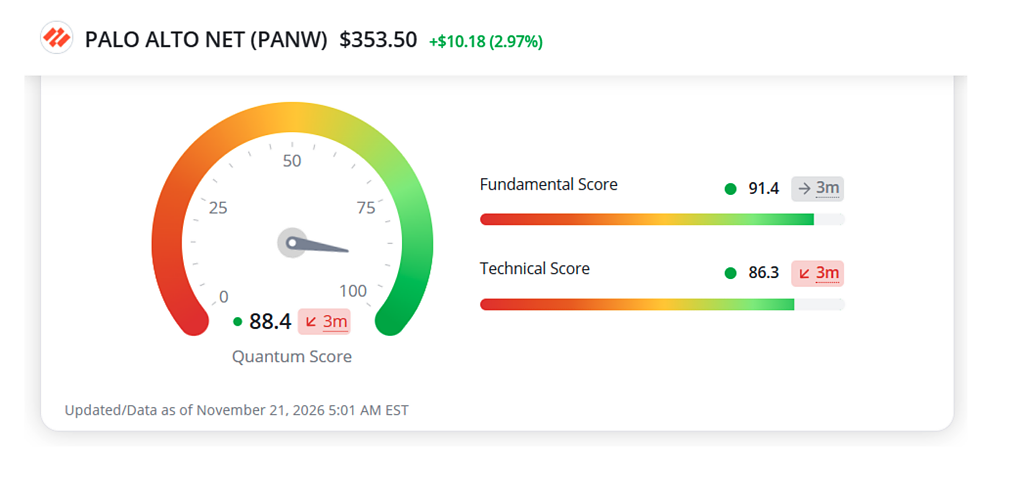
Our Quantum Score rates stocks from 0 to 100 on two things: how healthy the business is and how hard big investors are buying the stock. Anything above 75 is a buy.
Palo Alto scores 88.4. Its business scores 91.4, and the buying side scores 86.3 – even as the rest of tech sold off.
If you don’t own a cybersecurity stock yet, Palo Alto is the one I’d buy now. And if you’re a paid-up subscriber, you can track its Quantum Score in TradeSmith Finance.
To building wealth beyond measure,
Michael Salvatore
Editor, TradeSmith Daily
Disclaimer: At the time of this writing, Michael Salvatore held shares of NVDA.

