AI Beat PhDs on Graduate Science Exams — Now It’s Picking Stocks
Editor’s Note: Good evening – Mike Burnick here.
A lot of people still picture AI as a chatbot that writes emails – neat tricks that save a little time. But while no one was watching, AI crossed a threshold the experts swore was decades away, outscoring human PhDs on graduate-level exams and solving problems the smartest minds on the planet couldn’t touch.
For years, only the giant quant funds could turn that kind of power into market gains: the Medallions of the world, run by mathematicians with fortunes to spend. Everyone else was locked out.
TradeSmith CEO Keith Kaplan set out to change that. He’s applied a breakthrough “Super AI” to the markets – and this year alone, it’s already beaten the 2026 bull market by 218% as of August.
Below, Keith breaks down how it works – and why this may be the biggest edge everyday investors have ever had.
When most people hear “artificial intelligence,” they think about ChatGPT writing school essays, business emails, or even bedtime stories.
Or AI making lifelike photos and videos.
Neat features that make us a bit more productive.
What they don’t think of are world-changing leaps that alter how we work, learn, and live.
But they should.
AI is the fastest-evolving technology in history. And it just passed a huge milestone that tells me our world is about to be transformed.
The mainstream press barely covered it. But it shows we’re on the cusp of a profound technological, economic, and social revolution.
Today, I want to share this incredible story with you. I’ll also reveal details of our latest breakthrough at TradeSmith – an investment system that uses advanced AI forecasting to potentially quadruple a model portfolio over the next year.
It projects future prices of 2,334 stocks up to 21 trading days out – to the day and even the penny — with 85% backtested accuracy.
And in a seven-year study that included the pandemic, the 2022 crash, swings in interest rates, this year’s tariff tantrum, and two wars, this five-position strategy returned an average annual gain of 239%.
From Fast Typist to True Problem Solver
At the end of 2024, OpenAI released its o3 reasoning model — a major step forward in AI capability that quickly set off a wave of competition across the entire industry.
A reasoning model is different from older AIs. Instead of just predicting the next word, it can work through complex problems step by step, explain its logic, and refine its answers. Think of it as going from a fast typist to a true problem-solver.
And o3 shocked the experts almost immediately.
It scored 25% on the FrontierMath benchmark — a test of extremely difficult math problems. Before o3, the best AI score was just 2%. The mathematician Terence Tao — often called the “Mozart of Math” — had said he expected these problems to resist AI “for several years at least.” AI cracked them years ahead of schedule.
But that was just the beginning.
In the months that followed, the pace of progress accelerated dramatically. By 2025, coding agents using the latest large language models were routinely completing more than 80% of the same software engineering tasks that had stumped earlier systems. On SWE-bench — a benchmark measuring AI’s ability to resolve real-world software issues — AI systems could solve just 4.4% of problems in 2023. By 2024, that figure jumped to 71.7%.
The math story is just as striking. Students scoring in the top tier on AMC-level math contests now face AI that routinely performs near the top of the field. GPT-5, released in 2025, set a new bar — scoring over 94% on the AIME, one of the hardest high school math competitions in the world.
Competition has also exploded beyond OpenAI. The top reasoning models now include Google’s Gemini 2.5 Pro, xAI’s Grok 3, Anthropic’s Claude, and China’s DeepSeek-R1 — with the gap between the top and tenth-ranked model narrowing sharply. DeepSeek-V3.2, a Chinese open-source model, scored 99.2% on advanced math tests — and did it at a fraction of the cost of leading proprietary models.
It’s a watershed moment.
Reasoning dramatically improves AI performance — and developers have embraced increasingly sophisticated agentic frameworks that let models plan, use tools, search the web, and manipulate entire codebases autonomously. What began as a single impressive model has become an industry-wide race, moving faster than almost anyone predicted.
This kind of leap is what biologists call a Cambrian Explosion – when life on Earth suddenly diversified into thousands of new species.
The same thing happened during the dot-com boom, when the arrival of the internet spawned a new online economy and thousands of new companies to service it. Some failed. Some changed the world. Investors who caught the wave made fortunes.
AI is about to trigger the same kind of explosion – only bigger, faster, and far more profitable.
The Age of Super Genius Is Here
Another benchmark shows just how fast this is moving.
In late 2024, the o3 model beat human PhDs on the GPQA Diamond benchmark – a brutal set of graduate-level questions in physics, biology, and chemistry.
AI was already solving problems in math and science better than the smartest experts on the planet.
This table says it all:
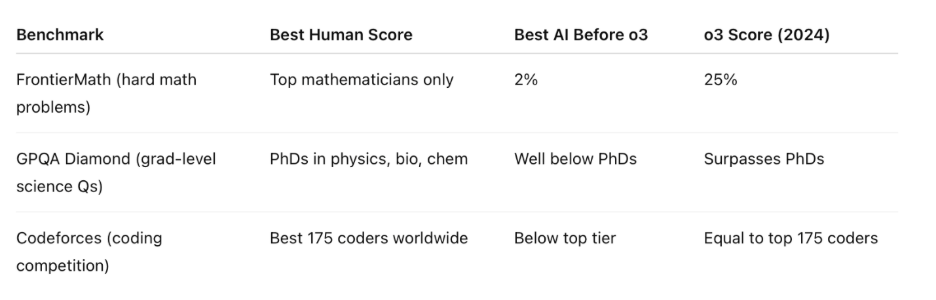
And that was just the starting gun. Within months, competitors across the U.S., Europe, and China were racing to match and surpass o3 — pushing these numbers even further.
Put simply, AI has achieved “super genius” level IQ in math and science — something even leading researchers thought was decades away.
And thanks to new training techniques, bigger datasets, and falling costs, many insiders believe we’re on the brink of runaway growth.
Soon, AI systems will train their successors, which will train their successors… kicking off a cascade of ever-smarter machines.
The implications of this are hard to get your head around. But let me paint a picture for you…
Everything Is About to Change
In just 12 months…
- Doctors will rely on AI for diagnosis and treatment options. Not using it will be malpractice.
- Universities will roll out AI professors who are smarter than any human educator.
- Lawyers and accountants will lose ground to AI advisors that work faster, cheaper, and with deeper expertise.
And the same thing is happening in investing.
The world is about to be flooded with AI systems that are 100 times smarter than the best human analysts.
They never sleep. They crunch numbers 24 hours a day, 7 days a week. And markets are nothing but numbers: GDP changes, interest rates, company revenues, stock prices, options data.
It’s no accident that the most successful hedge fund in history – Jim Simons’ Medallion Fund – was run by mathematicians. Medallion averaged about 66% a year since 1988. It was so profitable, he eventually returned all outside investor money and kept the fund for employees only.
How did he do it? By building massive datasets — on stock prices, bond yields, currencies, options, commodities, and more — and using powerful computers to spot patterns hidden from the human eye.
And compared to what’s coming with super genius AI, even Medallion will look quaint.
The Next Leap — and How You Can Profit
Instead of trying to outsmart these new machines, I’ve hired them.
I’ve spent the past nine months applying “super genius” number-crunching AI to create a breakthrough new trading system. And in our backtests, the results have been unlike anything we’ve seen before.
As I mentioned, we’ve shown it could have made an average annual gain of 239% over the last seven years. And that’s just the average gain.
That’s more than three times the return of Nvidia (NVDA) over the same time. And it’s more than 30 times the return of the S&P 500.
Even better, this strategy is simple to follow.
There’s a lot of complex math going on under the hood, but you won’t notice it’s there. You simply buy the AI’s best five trades and sell when they hit their projection.
That’s it… You’ll have to check in on the portfolio, on average, once a week and follow basic instructions.
I showed you exactly how it works – and how you can use it – in our Super AI Trading Event earlier this week. If you missed it, it’s not too late to catch the replay.
In it, I walk through the technology behind our Super AI and the gains its flagging. I also show why our five-stock strategy works, and how you can build your own AI portfolio to try to quadruple your money over the next 12 months.
I even share two of our AI’s top stock trades as a thank you for tuning in.
Click here to watch the replay before it’s too late.
Sincerely,
Keith Kaplan
CEO, TradeSmith