Big Money Is Flowing – Even in These Dull Market Months
It’s been a minute since we last sat down with Jason Bodner, the mind behind the Quantum Edge system, which pinpoints where the “Big Money” is flowing in and out of markets. Jason has a storied background in trading stocks and options and as the former Head of Equity Derivatives North America at Cantor Fitzgerald.
He’s also one of the clearest voices out there when it comes to cutting through the noise and helping investors understand not just what’s happening… but why it matters.
So, I was glad to sit down with him again for a deep dive into what the markets are signaling right now – and what he sees in his data that most investors may be missing.
And as we press forward into a decidedly risk-off market, even though we’ve been in a staunchly risk-on one for the past few months, Jason’s insight shows where the Big Money is flowing – and how investors and traders should follow suit.
Let’s get into it.
Watch my full interview with Jason below:
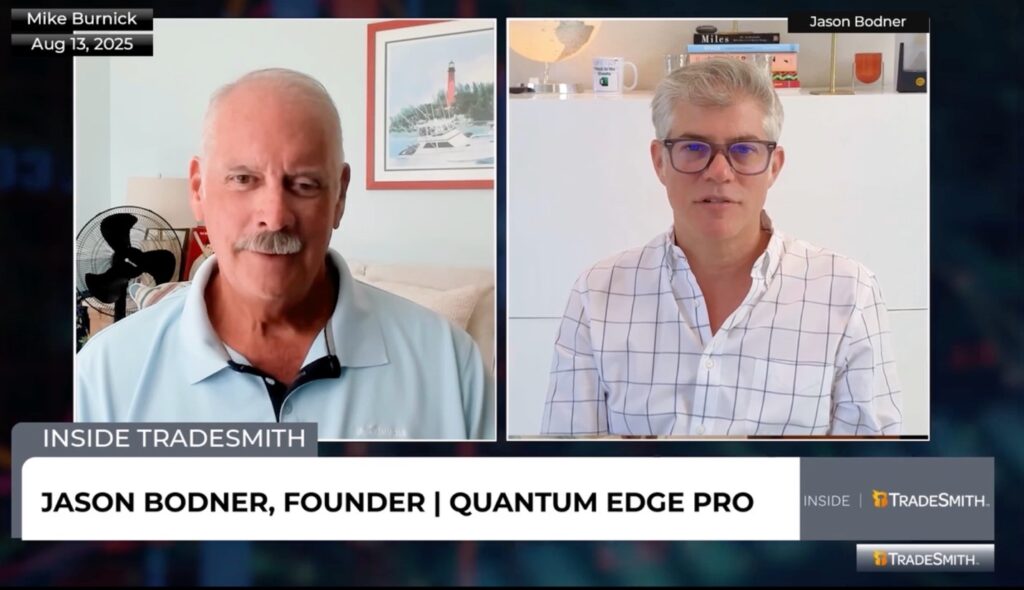
Click Here to Watch (12:16 min. watch)
As the market shifts sentiment, stocks that used to be big moneymakers might fall out of favor. And it pays to have real, data-driven, unbiased readings on some of your favorite stocks.
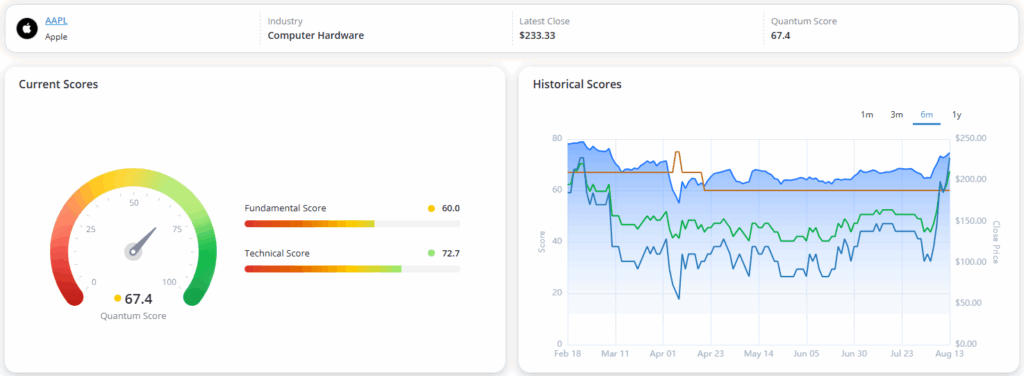
Enter the Quantum Score: It combines the key fundamental factors such as sales, earnings, and profit margin growth… with the telltale signs of institutional order flow… and the price momentum that comes as a result.
TradeSmith has given the Quantum Score a major upgrade, including a score that’s as easy to read as your kid’s report card. 100 is perfect, and zero is an unquestionable dud (though scores of 100 or 0 are rare).
Check out what the Quantum Score has to say about Apple…
And today, TradeSmith CEO Keith Kaplan is going over this unique tool in depth… even giving out a free recommendation at the end.
And keep in mind, as we talked about earlier with Jason, his readers have had the chance to see a 70% win rate with his Quantum Edge system…
Good investing,
Mike Burnick
Senior Analyst, TradeSmith
Please see transcript below.
Mike Burnick, Senior Analyst, Inside TradeSmith: Hi, everybody. I’m Mike Burnick from Inside TradeSmith.
And joining me today, my friend and colleague Jason Bodner of Quantum Edge Pro.
Jason, welcome. Nice to see you again.
Jason Bodner, Founder, Quantum Edge Pro: Thank you very much for having me. Always great to see you, Mr. B.
Mike: Yeah, I love talking markets with you.
We’re of the same mind and, you know, markets, of course, we’re chugging along really well to the upside, even if stocks maybe got a little overbought this summer, but now we suddenly turned a bit yippy last week – to borrow a phrase there.
And sure enough, you know, we talked about seasonality before, and as you’ve pointed out recently. Seasonality for stocks just turned negative. August and September are traditionally the worst months.
But Jason, you’ve been kind of expecting this coming because of how overbought the market was.
So, tell us what your big money signals are telling you right now about the markets.
Jason: What we see and the data that I look at and I share with my readers is we look at unique, unusual money flows.
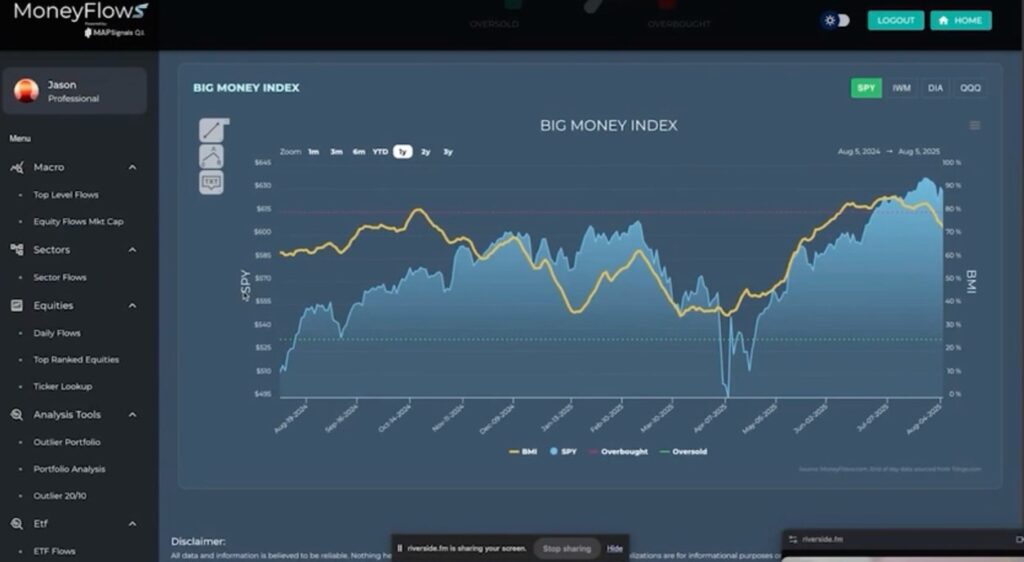
So, when money flows are moving in, we’re looking at a metric here my research firm publishes called the Big Money Index, and that’s this amber line.
This amber line reflects all the buying and selling that’s going on unusual.
Let’s call those inflows and outflows, unusually large inflows and outflows over a 25-day moving average.
The blue area is the SPY, so that is the S&P 500 tracking ETF and as you can see, we went overbought above this red line on June 10th.
Now, at that point, I was saying, hey, everybody, this market is overbought.
It’s not gonna stay that way, but it can stay that way for a while.
So, what we need to do is focus on when it falls from overbought, which is right here on July 11th.
And we need to focus on when that falls from overbought coupled with a pickup in outflows, which we started to see.
Now, this is right on schedule, as you mentioned.
Seasonality has a real trend that we’ve observed, so I’ve studied this trend going back since 1990.
And what we see is every August since 1990, if you average them out, we have about a 59% chance of being positive. Now, that sounds like pretty good odds, but when you compare with the rest of the months of the year, that’s low.
Every other month is 60% or above, and the news unfortunately gets worse because September only has a 40% chance of being positive. This is data for all four major indices going back since 1990.
Now, the negative months, if we average all of those for August, we get a -4%.
Which wouldn’t be horribly surprising after this massive equity bull run we’ve seen since April, and the data is very similar, -4.25% for September for the negative months only.
Now, I’m not suggesting we’re going to see an 8.25% drawdown in the S&P between now and the end of September, but it does point to exactly what you’re saying, Mike.
We expected this seasonal volatility. In fact, for my readers, we’ve been consolidating positions, doing housekeeping, rebalancing the portfolio, raising cash in anticipation of a weak August and September.
Now if that doesn’t happen and the market continues to melt up, which is always a possibility, we’re still in top stocks and outperforming, so I’m happy about that.
But yeah, it’s in the data. It tells us what to expect in terms of being overbought, but more importantly, how to handle it – gives us a playbook.
Mike: Right, right, exactly. Like you said, not unexpected. You had 80%-plus of your big money signals were all buys since early June.
So, you know, we’re bound to see a pullback, sooner or later.
But the interesting thing I think is what comes next.
Of course, your Quantum Edge system focuses on those flows into and out of individual stocks, and of course, your win rate speaks for itself, 70%-plus since you started in 1990.
So recently you mentioned a pickup in money flows coming into smaller-cap stocks.
Do you think that is a good opportunity to sort of buy the dip here?
Jason: Oh yeah, well, you know, everything depends on how long you expect the dip to be or how people define a dip, right?
But I would say any volatility on the downside that we see in small- and mid-cap stocks with great growth metrics.
And again, I only look at stocks that grow their sales and earnings over one and three years that are profitable, make a double-digit profit margin and don’t carry a huge load of debt.
I love those growth metrics.
So, you know, I’ll share my screen once again to answer your question, what we see here:
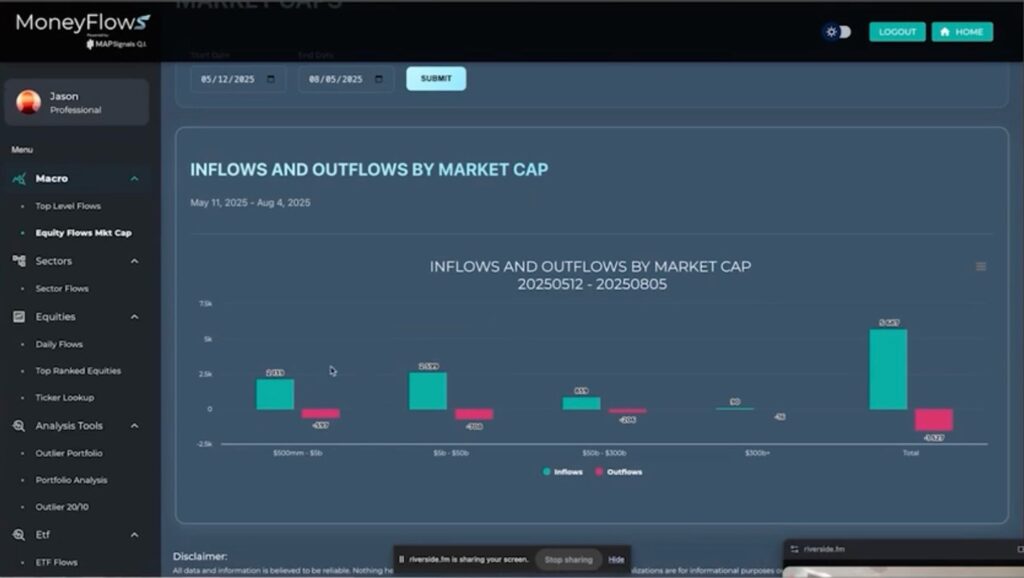
Since May 12th, when President Trump announced a stay on the tariffs, you can see these are all the inflows and outflows that we’ve measured.
There’s a problem with the date format here. It doesn’t look so pretty. I got to correct that.
But the key here is companies under five billion and companies under 50 billion.
So that’s kind of the small- and mid-cap range.
To your point, I think it’s like 82% of all the unusual inflows since May 12th have been in these small- and mid-cap areas.
So, I think, you know, stopping with the data side just for a second, looking at things a little qualitatively too.
We know a rate cut is coming eventually, right? Other countries in the world are in recession. There are rate cuts happening around the world.
We know CPI has been dropping, the latest reading, even though it ticked up, was 2.7% vs. 4.33%.
On the Fed funds average rate – effective Fed funds rate, that’s the word I was looking for.
So that spread doesn’t last very long. We know a rate cut’s going to come, and we know the big, beautiful bills, great tax favor, you know, it favors small and mid-sized businesses.
So you could get a one-two punch here with lower taxes and lower interest rates on these companies that require, you know, debt and leverage to grow their business in a standstill world where they’re not growing or selling more product or making more money, their bottom line expands, and I think that’s why smart and fast money have been moving into the small- and mid-cap areas since May.
So, to your point, I expect those because they’ve risen far and fast, there’s going to be a reversion when there’s weakness in August or September.
Those things are going to get ground down and that would be an opportunity to buy the dip. Yes.
Mike: Yeah, OK, yeah, you know, it’s interesting you make that point about interest rates coming down and I mean, you know, if you look at market rates like the 2-year Treasury bill, I mean, they’re already clearly signaling that rates are going down.
It’s just a matter of when. I agree with you there.
Let’s talk one final question for you about sectors that have maybe the best opportunities after this dip.
Now, over the last few months, I know you said you’ve seen consistent Big Money flows in technology, of course.
The usual suspects, right, plus consumer discretionary, industrials, financials, picking up really Big Money flows.
Do you think those are still some of the best bets going forward after any kind of a pullback here in the market?
Jason: Oh, absolutely, and again, small and mid-cap tech.
So yes, we’ve seen huge leadership by the monsters, right? Nvidia, Arista Networks, one of our holdings reported today.
I think it’s up 14% pre-market. I haven’t looked at it since these large and mega caps have been seeing lots of inflows and because the S&P 500 is a weighted index, that’s sort of lifting it up.
However, to your point, all those signals that I’m seeing, a lot of that is small- and mid-cap stocks in the tech sector, it’s been software and semiconductors, and you know, software is a really unique sector because they don’t require tons of debt.
They do R&D for a specific software product. They sync all their investment and then they sell a million copies, and their margins just keep expanding.
So usually these are lower debt companies. So, like I said, software, semiconductors, when it comes to discretionary, we’re seeing restaurants, we’re seeing cruise ships, we’re seeing discretionary spending.
And despite the media hammering home, you know, inflation and it’s affecting the consumer –financials are getting positioned because they are about to presumably resume a lot of M&A activity, and they’re going to be financing businesses with a little bit of easing,
And then on the industrial side, its infrastructure, it’s cloud infrastructure.
All these sectors that I just talked about are growth heavy sectors.
And the sectors that have been lagging have been, you know, staples, real estate, utilities to a certain degree.
They’ve been strong, but they’ve been buoyed by that whole nuclear narrative for AI, but typically that’s a defensive sector.
But what we’re seeing is the money’s flowing into risk-on growth sectors, and it’s really not favoring the defensive ones.
So even if we get a short-term bout of volatility, which history tells us we will, I would be focusing heavily on those sectors because, historically speaking, the good footnote is the fourth quarter of the year, and I know you know this too, Mike, is the strongest quarter of the year, October through December, and I put a little asterisk in October because it’s usually the first two weeks or a little hangover volatility.
But then it’s just this big, beautiful run into the end of the year.
Historically speaking, we’re talking about 73% of the time since 1990.
So, if this pattern holds true and we get bumpiness in September and these sectors that you just talked about go on sale, those are the ones where I’m going to be targeting to deploy capital to.
Mike: All right, so in other words, stick with the girl you brought to the dance is what you’re saying when we come out of the other side of this.
Jason: Always a good idea.
Mike: Yeah, and definitely seasonality does show a very strong impression for a 4th quarter, you know, year-end rally from October into December.
So, here’s looking forward to that.
Well, Jason, thanks for joining me today, as editor of Quantum Edge Pro and, all of our readers on Inside Tradesmith are keenly aware of what you do and love to hear your insights.
So, thanks for joining me and we’ll see you again soon.
Jason: Thanks for having me, Mike. Always a pleasure. Look forward to your next time.