
Earnings Season Reality Check: Why Margins and Revisions Matter Most
In recent TradeSmith Insider columns, I covered how to spot earnings season winners using our Market Calendar and Screener tools.
Well as of this week, we’re just past the halfway point for quarterly reporting season. So now is a good time to recap the action so far and take a closer look at the earnings trends already emerging:
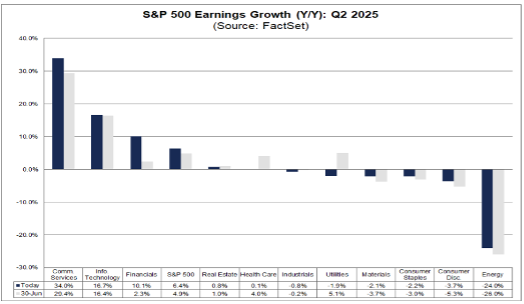
As you can see in the FactSet chart above, the best profit gains are coming from the usual suspects – Communications (+34%) and Technology (+16.7%) – which are both dominated by the Magnificent 7.
Financial sector stocks have also posted well-above-average profit growth (+10.1%) so far, a nice positive surprise over estimated growth of just 2.3%.
Of the S&P 500 stocks that have reported so far, 80% have beaten expectations – a strong showing. And by the end of this week we will have more to go on.
This week another 162 index stocks are due to report. That puts us just past the half-way mark, with 330 of the S&P 500 posting results.
Collectively, the S&P 500 has delivered 6.4% year-over-year profit growth so far. This is good, but it is still on track to be the lowest growth rate since the first quarter of 2024.
Also the margin by which companies are beating Wall Street estimates – known as the all-import “beat rate”– is 6.1%. That’s also respectable, but it is below the average beat rate of 9.1% over the last five years.
In other words, the rate of change for S&P 500 earnings appears to be slowing down. That’s true for some sectors more than others.
Take a closer look at the chart above, you’ll see that only five of the 11 S&P sectors are reporting any year -over-year growth. And two of those five sectors, Real Estate and Health Care, are posting less than 1% profit growth.
Meanwhile, six of 11 sectors are seeing declining year-over-year profit growth, with the Energy sector the worst offender.
So again, Communications and Technology – with an assist this quarter from financials – are doing all the heavy lifting for the index.
The concern now is that we may be near or even beyond the point of peak earnings growth. And that means the path of least resistance for profits may be down from here.
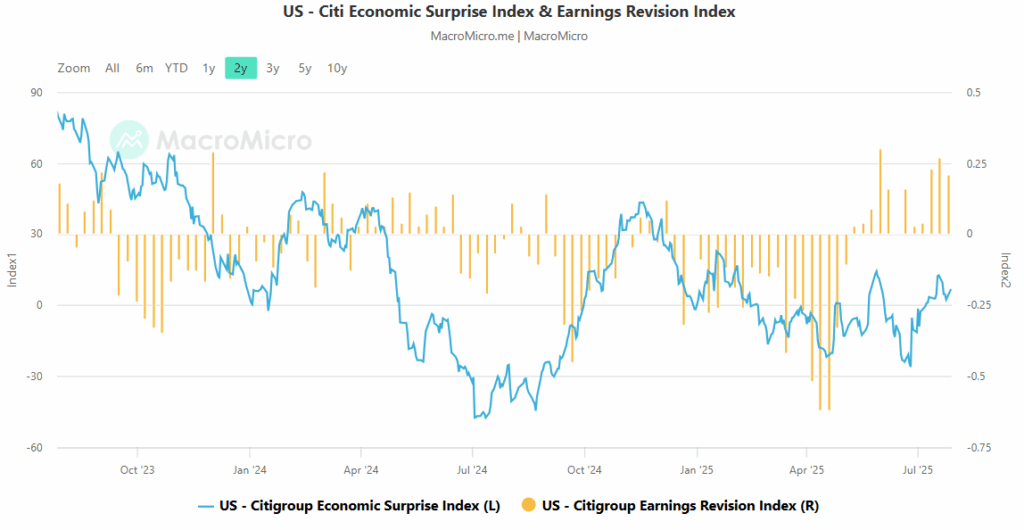
In the chart above is the Citigroup Earnings Revision Index (bars) superimposed with the Citigroup Economic Surprise Index (line).
Earnings revisions took a big hit at the start of this year, first on the expectation of tariffs. Then when tariffs became reality, profit estimates took an even deeper dive.
While the positive bars on the far right tell us we’re back to positive earnings revisions in recent weeks, the damage to profitability may already be done.
Notice, too, that the Economic Surprise Index (blue line) remains below zero, meaning more negative than positive surprises in the economic data.
This points to still high levels of uncertainty, which is a drag on growth. And that puts more pressure on profit margins.
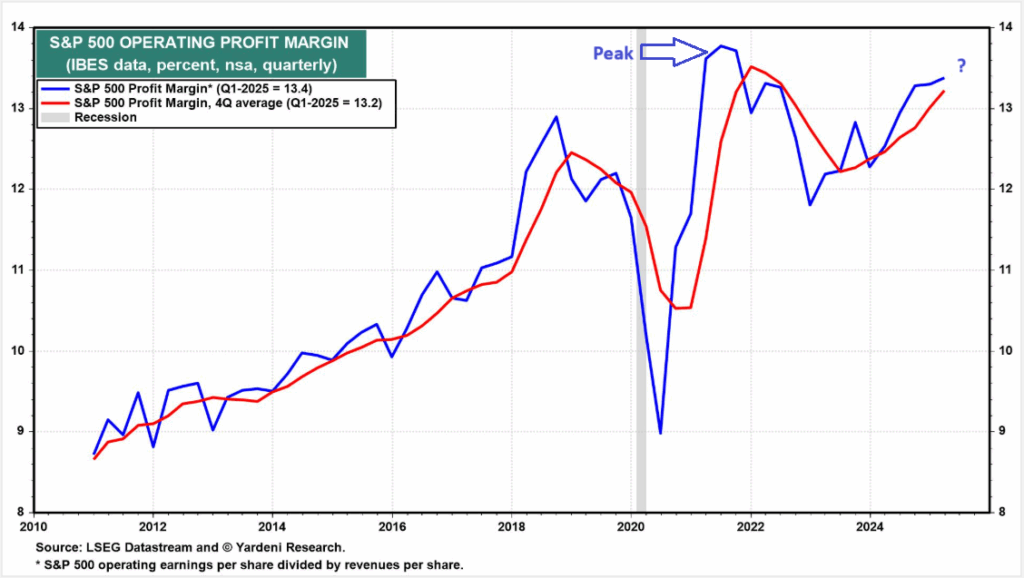
So, where S&P 500 profit margins (shown above) go from here is of vital importance to where stock prices head next. That’s especially true considering today’s sky-high market valuation.
The last time earnings revisions went negative as steeply as they did earlier this year, S&P 500 profit margins also peaked in 2021. What followed was a -26% bear market decline in 2022.
Mike Burnick’s Bottom Line: It’s important to keep tabs on the individual stocks that are winners or losers this earnings season. But also keep a watchful eye on S&P 500 results overall, especially the trend in profit margins and, above all, earnings revisions.
Good investing,
Mike Burnick
Senior Analyst, TradeSmith
P.S. With the outlook for S&P profit margins growing increasingly uncertain, it’s more important than ever to look beyond the obvious for opportunity.
That’s exactly what my colleague Jason Bodner at Quantum Edge Pro is doing right now.
Jason has uncovered a rare market signal he called the “Accelerator Line” – and every time this indicator peaks, it has consistently pointed to massive rallies in a small, often-overlooked segment of the market.
And the line just hit a peak for the first time in nearly six years.
According to Jason, this sets the stage for what he’s calling a “Retirement Accelerator Window” – a powerful convergence of Fed action and market conditions that has only occurred three other times in the past 35 years.
If history is any guide, we could be on the verge of a surge in small-cap stocks that delivers triple-digit returns. In fact, Jason believes some stocks could rise as much as 500% over the next two years.
Click here to watch Jason’s broadcast before this window of opportunity closes.