In a Euphoric Stock Market, I’ll Take Cheap, Hated, and Uptrending
A mentor in this business and longtime editor of the True Wealth letter, Steve Sjuggerud, always looks for markets that are “cheap, hated, and in an uptrend.”
That has been his litmus test for a winning investment strategy over many years, as True Wealth readers can attest. As a natural-born value investor myself, I totally buy into this philosophy:
- Cheap: The asset class has plenty of upside potential.
- Hated: Everyone has given up, so who’s left to sell it at this point?
- Uptrend: That’s the heart of the matter: the bullish catalyst.
Steve can explain this way better than me, but just think about it for a minute.
Plenty of asset classes are cheap and hated. Right now, that’s just about everything outside of the Magnificent 7. Well, everything else may not be “hated,” but certainly is unloved compared to the 7.
This means that even if you have an asset class with factors 1 and 2 pulling in your favor, you could still wind up sitting on dead money – or worse. Even cheap and hated assets can fall to an even steeper discount and get more despised.
So, even if factors 1 and 2 are present, you must be patient enough to wait for factor 3 to be in the mix for a true green light buy signal.
A simple rule of thumb I’ve always lived by in this business is: The most bullish thing an asset can do is go up.
And taking that to the next level: If a cheap and hated asset goes up – despite all the negative news and bearish sentiment – that’s especially bullish.
An uptrend means all the bad news and bearish sentiment has most likely been fully discounted in the price, so there is no one left who’s likely to sell now, which translates to low risk, big upside reward.
I bring this up because there is one asset class today that fits the bill: stocks in China.
I know what you’re thinking: “No way, Mike.” But don’t touch that dial until you hear the rest of the story about this cheap and hated asset class that is, yes, in an uptrend.
After a domestic housing crisis that mirrors our housing and financial bust from 2008, regulatory crackdowns, and a trade war with the United States and now Europe, analysts have labeled China “un-investable.”
Well, apparently someone is investing money there now.
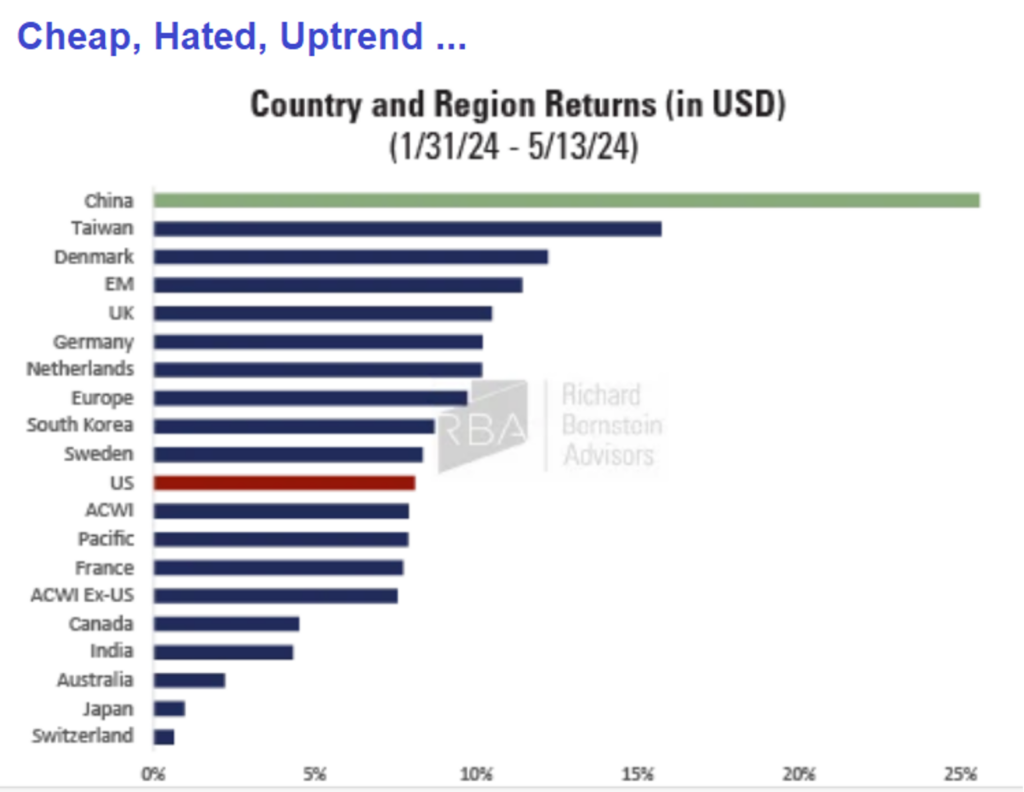
One of the biggest fear factors keeping investors away may soon ease. Beijing has finally taken key policy steps to help shore up the housing market.
From the end of January through mid-May, Chinese stocks soared 25% year-to-date, about three times the gain of the S&P 500. Since then, Chinese stocks have taken a breather and pulled back a bit.
Some say the spring rally for China may have been a false start. But I believe there is staying power to the rally. And the recent pullback is a golden opportunity to buy. Because the truth is, Chinese stocks have a lot going for them right now.
- China’s recent economic data including GDP growth and exports have come in better than expected.
Meanwhile, data on the U.S. economy has been missing expectations recently.
- Beijing has been easing China’s monetary policy and cutting interest rates.
Meanwhile, the Federal Reserve seems reluctant to cut rates soon.
- Chinese stocks also have a more significant edge: valuation. The price-to-earnings (P/E) ratio for China’s stock market is just 10x today.
Meanwhile, U.S. stocks are much pricier, with nearly a 26x P/E ratio.
And not only are Chinese stocks less than HALF as pricey as our stock market, but their earnings are also growing faster.
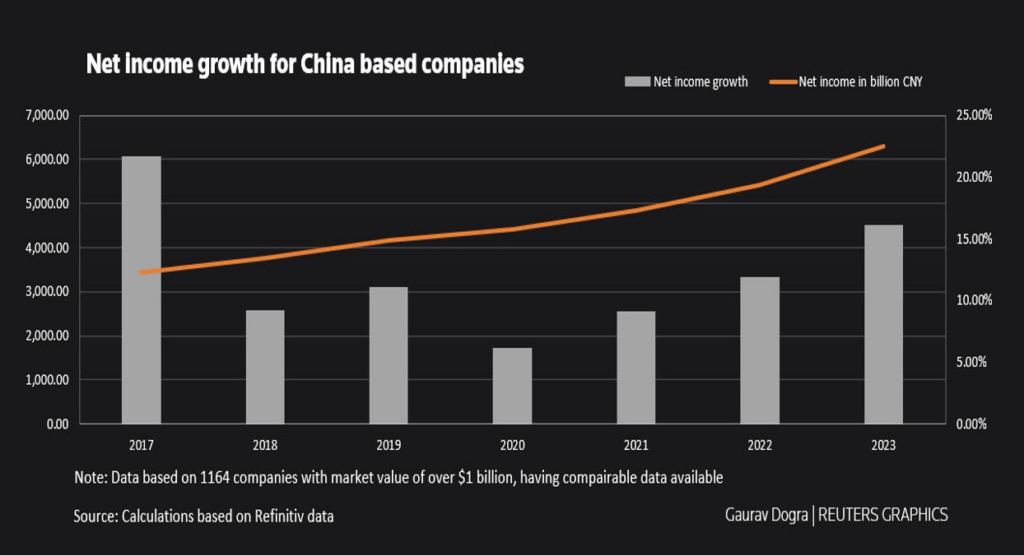
Net income for China-based companies surged 17% higher last year. And profit estimates look even more bullish this year.
There is one ETF that looks especially intriguing to me right now: Invesco Golden Dragon China ETF (PGJ). This fund is a great way to cash in on the potential upside in Chinese stocks with a single mouse click.
Unlike many China-stock ETFs, PGJ holds only U.S. exchange-listed American Depository Receipts (ADRs) of companies based in China. So, there are no Hong Kong-listed stocks here. They all trade on the New York Stock Exchange or Nasdaq.
In my last column, I showed you how to take a deeper dive into the stock holdings of any ETF. I won’t repeat the whole process, but here is the result.
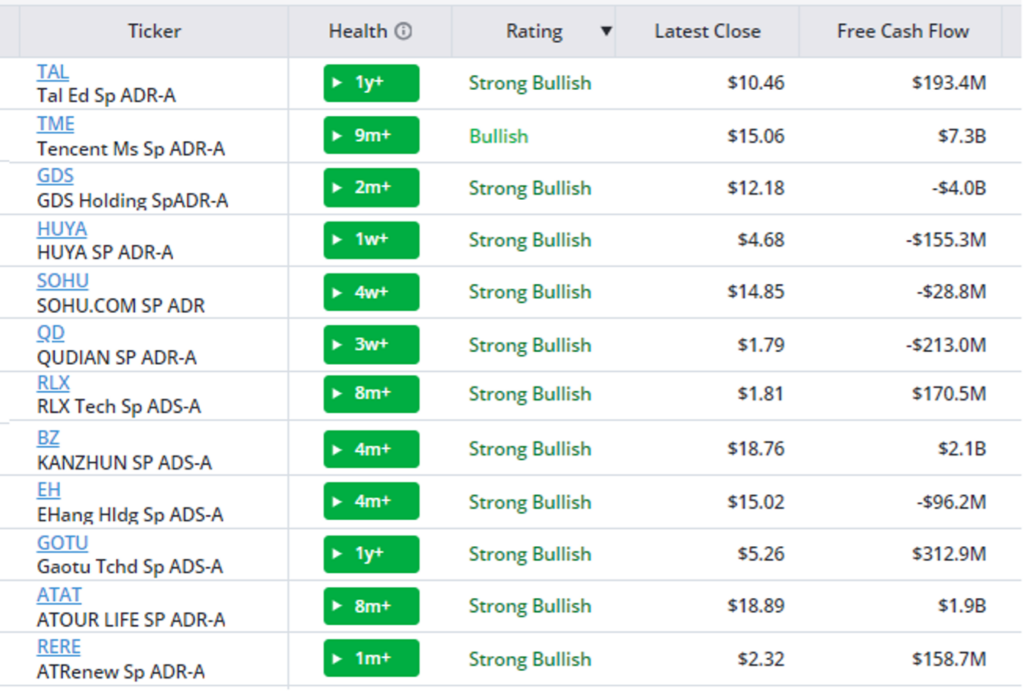
For space reasons, I’ve included only PGJ component stocks that are:
- Strong Bullish rated by TradeSmith, and
- In our Health Indicator Green Zone.
You can easily repeat this process the way I showed you on Tuesday to get a closer look at all the stocks that make up PGJ. Interestingly, the most recognized mega-cap stocks in China, like Alibaba (BABA) and Baidu (BIDU), are still in the Red Zone.
But there are plenty of other leading Chinese stocks in the list above that are worthy of more research. One that caught my eye (because I own it) is Tencent Music (TME), which is considered the iTunes and Spotify of China all rolled into one.
Mike Burnick’s Bottom Line: The China dragon appears to be waking after a long slumber. China’s stock market is incredibly cheap and widely hated, but it’s also been in a solid uptrend since January. And these dragon stocks look like they’re about to break out to the upside for another run higher.
Good investing,

Mike Burnick
Senior Analyst, TradeSmith