March 19, 2026: Interview with Jeff Clark (full transcript)
Click HERE to return to the full Inside TradeSmith Issue.
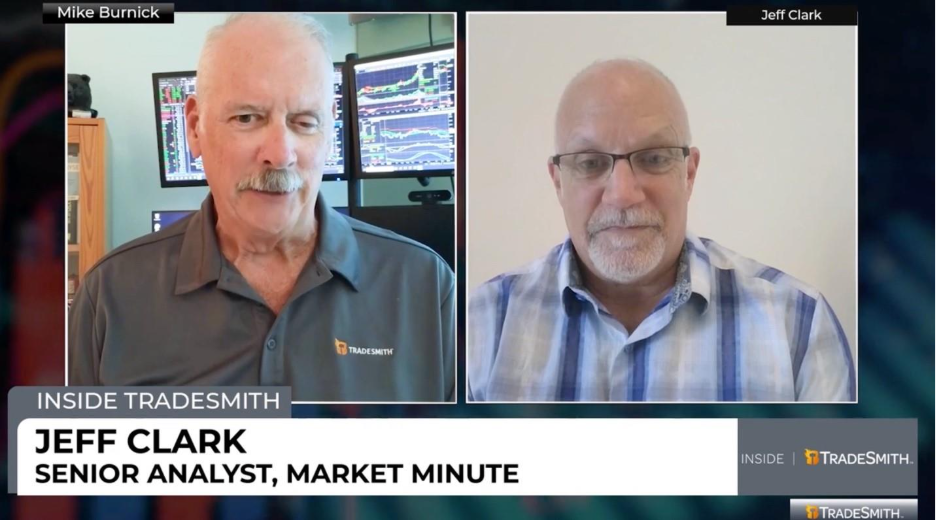
Mike Burnick, Inside TradeSmith: Hello, everyone, and thanks for joining me today on this special edition of Inside TradeSmith.
Today, I couldn’t be happier to welcome Jeff Clark, a veteran investor and trader for many decades, and a master options trader as well. Jeff, thanks for joining me today.
It’s good to see you again, my friend.
Jeff Clark, Senior Analyst, Market Minute: Same here, Mike. Thanks for having me on board.
Mike: You bet. Of course, you’ve seen it all, Jeff, in your career, same as I have—the COVID crash, the 2008 housing bust and financial crisis that followed, and we’ve even been around long enough to remember the dot-com bust in 2000, and even the ’87 crash.
Jeff: The fact that you think I might not be old enough to remember that is flattering. But yes, I am definitely old enough for that.
Mike: I still have painful memories of it myself, come on. So, with everything going on in the market today, what’s your take on today’s volatile markets?
Jeff: Well, a lot of it depends on what your timeframe is, right? If we’re talking about what I think is going to happen tomorrow, it’s going to be a little different than what I think is going to happen over the next year or so.
Longer term—and I don’t say this to freak anybody out—I think the market has some fundamental issues. The S&P is trading 23, 24 times forward earnings, which historically is an expensive stock market.
Having said that, there are a lot of things it has going for it. We basically have an economy that’s doing quite well. We have relatively low interest rates. We have relatively few competitive investments other than the stock market to generate large returns.
So, there are some good things, but overall, when you have a situation where the S&P is trading at such a large multiple, generally speaking, the next five to seven years tend not to be that good. It doesn’t mean we have to fall or crater, but it means you’re probably not going to see the double-digit gains that we’ve seen the last few years.
Now, if you ask me where I think we’re headed over the next six months, I also have some issues. But if you said where we’re headed over the next six days, I think the markets at the moment are oversold enough to justify a pretty decent bounce.
My philosophy—or maybe it’s just a habit—is not to sell into oversold conditions or buy into overbought conditions. I’m a big fan of reversion to the mean, which basically means when things get super overbought, you take some off the table. You sell a little bit. When things are super oversold, that’s when you want to step up and buy.
So given where we are at the moment, things are significantly oversold. I think we’re probably closer to a bottom of this particular decline phase than we are to the start of a major catastrophe.
Mike: Yeah, that’s a great point. Several market breadth indicators I follow—percentage of stocks below the 10-day moving average, for instance—are sending an oversold signal, which could be a good opportunity.
But longer term, Jeff, with all the anxiety we’re seeing in markets—maybe AI is going to eliminate jobs or entire industries, and of course now the war with Iran, which has triggered sharply higher oil prices—do you personally see any similarities between what’s happening today and what we’ve seen in past market crises or tense periods?
Jeff: Well, the similarities are that humans behave the same way all the time in crises. We’re emotional beings, and our two biggest emotions are fear and greed.
Anytime everybody is very excited and very greedy, it’s usually a time to get a little more conservative. And anytime everybody’s very concerned and fearful, that’s usually a time where you step up and start buying, or at least you have opportunities to do that.
At the moment, I’m seeing more opportunities from the long side than I am from the short side, at least for the very short term.
I’ve had conversations with folks over the past week, and we look back at last April—the whole tariff tantrums. From mid-March to early April, the market lost 20%. It was a very bearish situation, and people were throwing in the towel, which is the exact opposite of what you should have been doing if you wanted to make money.
Maybe you slept better getting out of your positions on April 2nd, but you didn’t feel so well three, four, or five months later when prices had rebounded.
That goes back to not selling into oversold conditions. We’re now at that oversold level. As much as we might feel fearful about what’s going on in Iran, or about potential high unemployment due to AI, or entire industries being displaced, much of that is probably already reflected in stock prices.
The market has already taken the pain. Look at a lot of stocks—many in the software sector are down 30%, 40%, 50% from their highs. They’ve already taken a big hit.
And it’s not limited to software. You can look at payment processing companies, transportation companies, the airline industry, the hotel industry. All of these sectors are down significantly –double digits. They’re already reflecting a good deal of fear in the market.
So what I would tell folks is: don’t let fear compromise your intellect. If you know it’s not a good idea to sell into panic-induced oversold conditions, then don’t do it. If you want to sell, wait for that inevitable bounce and sell into that. That would be my take on it.
Mike: Yeah, great advice. And of course, Jeff, you’re more of a short-term trader, which is always exciting when markets get this volatile. There’s never a dull moment in markets like this when you’re trading.
But where are you seeing some of the best opportunities right now? Any particular sectors or stocks you’re keen on?
Jeff: For the past several weeks, I’ve talked about opportunities in the software sector. Not that those stocks are dirt cheap—they’re not. They’re trading at 18, 19, 20 times earnings, and those P/E ratios may have to contract over time if AI does what people expect.
But at the same time, any time you get significantly far away from key moving averages—like the 50-day moving average, which I use as a long-term reference—stocks tend to be somewhat magnetic to that line.
They don’t go too far above or below it without eventually coming back. So, if a stock like Microsoft, which rarely moves more than 5% to 7% away from its 50-day moving average, suddenly falls 10%, 12%, or 15% below it, that’s probably an opportunity.
A lot of stocks in the software sector have that setup. The same is true for cybersecurity stocks.
Months ago, I thought airlines were incredibly overpriced. Now, because they’ve come down so much, they look like there might be some opportunities there.
What I’m looking for are sectors that have taken a big hit over the past several weeks. It might be because of AI, a spike in oil prices, or any number of reasons. But if they’re trading far below their historical ranges, that usually presents an opportunity.
Then as an investor, you do a little more homework and dig in. You ask, “Is this a stock I’d be interested in owning at this price?”
Mike: Yeah, exactly. When you mention airline stocks, it’s fascinating to see how they’ve responded. They went from overbought territory to oversold territory in record time. I don’t think I’ve ever seen anything like it.
Jeff: That’s what happens in this type of environment. When markets are driven by emotion, things move all over the place. That’s why I enjoy trading volatile markets—moves happen much faster than normal.
If you can time it well—buy into oversold conditions or sell into overbought conditions—you can make a year’s worth of gains in a matter of days.
Mike: That’s very true. And I’m glad you mentioned that, because it ties into your expertise—using options. You use call and put options very effectively to limit risk while still profiting as much as if you had bought the stock or ETF.
You’ve also had a terrific winning streak recently—seven or eight winning trades in a row, averaging over 80% gains.
Tell us a little about your approach to options and how you make them work effectively.
Jeff: Sure. I am a conservative options trader, which might sound like an oxymoron because people view options as incredibly risky.
But I use options for what they were intended to do. Options were created as vehicles designed to reduce risk.
And the way they do that is, let’s say Microsoft is trading around $400 a share.
So I could put up $40,000 and buy 100 shares, or I could put up $400 and control 100 shares. I’d much rather do that.
By purchasing options, you put up far less than what you would to own the stock. So if an average investor buys Microsoft at $400 a share and says, “I’m willing to give it a 10% move before I admit that I’m wrong on the trade,” then they’re willing to lose 40 points.
What does that work out to? $4,000.
I can take far less than that into the options market and create a trade where I can actually make more money if I’m right and Microsoft goes up or lose a whole lot less if I’m wrong and Microsoft falls in that particular situation.
Where many people make the mistake is they look at it as, “I could buy 100 shares of Microsoft for $40,000, or I can take that entire $40,000 over to the options market, leverage it heavily, and if I’m right, make an absolute killing.” Which is true, if they’re right.
But if you’re wrong, they lose that entire $40,000. Right. So that’s not reducing risk.
So I like the idea of using options to reduce risk. Rather than just buying one call option, I might use a little bit of leverage and buy two or three call options. But most people, if they do what I just said—take the entire amount they would’ve put in the stock and throw it into an option trade—they’re going to end up in a very uncomfortable situation.
Meaning they’re going to lose money, and nobody wants to be in that kind of situation.
Most people who’ve lost money in the options market did exactly that, and most people who’ve sworn off ever trading options again did exactly that, or they heard about people doing exactly that.
I’m telling you, I’ve been doing this for 42 years now. Early on, I had my experience blowing up my account once or twice.
Everybody has, right? But over the decades, I’ve developed a very conservative approach to options trading that allows me to take any stock you like—whatever your favorite stock is—and create an option strategy that will reduce the risk and increase the potential reward. That’s what I focus on.
Mike: Yeah. And it’s interesting with options, too, because the same thing works even better in reverse.
You started the conversation by making the point that the markets have already become pretty oversold very quickly. So, there’s not a lot of short selling you’d want to do in individual stocks or even ETFs right now with so many of them oversold.
But buying put options is a tool you use quite effectively as well, again, to limit your risk but also to profit in case the market does sink lower.
Jeff: Sure. In any market, there are going to be sectors that have gotten overbought or where enthusiasm has gotten ahead of the reality of the situation.
Look at oil right now. Oil was at $103 a barrel or something this morning. You have USO, the exchange-traded fund that tracks the price of oil, hitting 120, maybe 121 this morning. It was at $60 two weeks ago. So, you have a very overbought situation.
But if you were to sell short that particular fund, you’d be shorting oil while there’s a war going on in the Middle East. That’s probably not the most intelligent thing you can do.
If you sell USO at $120 a share, yes, you profit as it goes down, but you lose money as it goes up. There is no ceiling, so in theory, you could lose everything. So. selling stocks short by itself doesn’t make a whole lot of sense to me.
Put options, however, give you the same position as a short trade. If you wanted to speculate on oil falling in value, you could buy a put option on USO. And if it falls in value, you could profit off that put option just as you would profit off the stock.
So yes, you’re right. When things get a little overheated, there’s always an opportunity using options. And preferably, if you’re going to take the short side, you’re going to do much better—or at least take a lot less risk—by using put options rather than shorting the actual stocks themselves.
Mike: Yeah, that’s very true. It’s a lesson a lot of people have to learn the hard way. But once you finally get it through your head that it’s limited risk and virtually unlimited upside potential with put or call options, then you learn to use it the right way.
Jeff: Yeah. It doesn’t take too long. You get a couple of trades that go against you and you learn fast.
Mike: Sure, that’s the case.
And you’re right about energy stocks. They’ve just gone through the roof lately. Some of the oil field service stocks have almost doubled in price.
But one other sector that really caught my attention recently is the weakness in financial stocks. You talk about tech stocks and software—the tech sector index for the S&P is down about 5%, which is more than the S&P itself, but financial stocks are already down more than 10%.
Jeff: In some cases, much more than that. Yeah, absolutely.
Mike: What do you make of the weakness in financial stocks personally? Do you see any deeper meaning behind that with credit problems and private credit? And do you see good opportunities to buy some of these stocks when they’re oversold?
Jeff: Well, I don’t know that the opportunity is there to buy them just yet.
The issue with the financials is they got really quite overbought toward the end of last year. You had a situation where a lot of the banks—the average banks—were trading at 120% to 150% of book value.
Old-school folks like you and me know banks typically trade around book value. So if you’re paying more than book value for banks, you’re paying a premium valuation.
There has to be some other fundamental reason to justify it, like earnings or growth ramping up, or a favorable interest-rate environment. That didn’t really exist. It was just more money chasing bank stocks.
So they got phenomenally overbought, to the point where they were well above their moving averages, especially their 50-day moving average. Now they’re trading quite significantly below that 50-day moving average.
You can make an argument now that if they’re trading just below book value, there might be a buying opportunity for a quick snap-back rally, but they’re not quite in what I would consider bargain mode. Bargain mode to me is 80% to 85% of book. So, we’re still quite a ways from that.
The underlying situation in the banks, though, is that a lot of them obviously have some bad debt on the books. They have car loans that aren’t performing as well. They have real estate loans that are possibly not performing as well. In private credit markets, we’re starting to hear little rumblings in that area.
To me, the banks have been engaged in business that is maybe not quite as conservative as we used to think banks were. They’ve taken on a little more risk than they should have.
And so, when the banks are acting the way they’ve been acting, that’s usually a barometer for the broad stock market and the broader economy. I think it does send a bit of a warning sign.
So as I sit here now and say, for the next six days to a couple of weeks we’re probably in for a pretty good bounce in the stock market, banks are one of the reasons I look further out—three, four, five, six months or longer—and think the market might be in a little trouble because of the way the banks are acting and what we can extrapolate from that.
Mike: Yeah, exactly. It could be more pain ahead, that’s for sure.
Because like you said, it was so much easy money and low interest rates for so many years before recently that, like Warren Buffett used to say, you never know who is swimming naked until the tide goes out. And now the tide’s going out.
Jeff: Exactly.
And one of the things I should say, if we’re talking about being bearish in the future, is that when you have a situation like the banks—short-term oversold, but you think they can fall even more later—then when they do bounce, when you get that rally off the bottom that looks like it’s about to form what we call a lower high, where it doesn’t quite take out where it was back in December or January, then starts to roll over again, that’s the time to put on those downside positions.
That’s where you would be looking to buy puts in the banking sector: on the oversold bounce, not now, because things are too oversold.
They can drop further, and maybe you get lucky and profit off a put trade, but I would not consider that an easy-money or even a fair-money trade. We’re so oversold that we’re probably going to bounce.
I would wait for that bounce, wait for the momentum in that bounce to start to wane a little bit, and then put on that trade.
Mike: Yeah. And I’m glad you mentioned that—the momentum changing.
You have a very simple approach, and a very effective one. As I said, seven straight winning trades here. You’ve rattled off average gains of about 87%.
But what are the key indicators? Without giving up the secret sauce or the Colonel’s original recipe here, can you tell us what type of momentum indicators you pay attention to the most in your approach?
Jeff: I have my set of indicators, and most people who pay attention to technical analysis have their favorites as well.
I look at things like the Moving Average Convergence Divergence, (MACD). I won’t get into what it means, but basically, it’s a momentum indicator that tells you whether momentum is building or waning.
What I like to see when I’m looking to buy a stock is the stock falling while the MACD starts to rise. We call that positive divergence, meaning the stock is falling, but the momentum behind that decline is waning. That’s usually an indication that there’s a rally, or potential rally, on the way.
I also use the Relative Strength Index (RSI). I use a 14-day RSI for the same purpose. If the stock is falling but the 14-day RSI is rising, that’s a positive.
Then I use something called the Commodity Channel Index, or CCI, again for the same reason. It’s the same idea: if momentum for the stock is down, but those indicators are moving higher, that’s a good sign.
Conversely, if you have a situation where stocks are rallying—and you can look at any oil and gas stock right now and see it in the charts—the stocks are rallying, which is fantastic, but those momentum indicators I just mentioned are all falling, that is a warning sign that we’re probably approaching a turn in that rally and likely heading into a decline phase.
It doesn’t guarantee it’s going to happen, but I’d say probably about 80% of the time, when you have a sustained downturn in the momentum indicators while the stock is rallying, that stock is probably headed for at least a modest pullback.
Mike: Yeah. That’s the hidden red flag in some of those technical indicators. It can tell you when the stock price might be saying something very different from what the momentum indicators are telling you.
All right. Well, Jeff, thanks so much for joining me today. It’s always a pleasure talking shop with you. We’ll have to get together again and do it soon here in South Florida when you’re in town.
Jeff: Absolutely my pleasure, Mike. Thanks for having me on.
Mike: Okay. And folks, if you’d like to learn more about Jeff’s unique approach to options or short-term trading, all you have to do is click on the link you see below (located in today’s Inside TradeSmith column).
And for Jeff Clark, I’m Mike Burnick for Inside TradeSmith. Thanks for watching today, and as always, good investing.