Stagflation, Anyone? Prepare Your Portfolio with This Screener
Federal Reserve officials got a double dose of bad news last week.
It’s well known that the Fed has a “dual mandate” guiding its actions and policy decisions: It is tasked with maintaining both price stability across the U.S. economy and robust employment levels.
But it turns both wards of the Fed’s dual mandate are moving in the wrong direction – at exactly the same time.
Last Friday’s employment numbers were, by almost any measure, an absolute disaster. There’s no need to cover the report in full here, since the details are online. But here’s a quick summary, if you’d like to review the ugly CliffsNotes:
- The U.S. Bureau of Labor Statistics (BLS) reported that just 73,000 new jobs were added to the economy last month – in a major miss from the 109,000 economists expected.
- The BLS also revised the number of job gains reported in the May and June reports – bringing the final totals down by a whopping 258,000 jobs.
- The low July numbers and extreme downward revisions sent President Trump into a rage… and the Commissioner of the BLS heard his old catchphrase: “You’re fired!”
Now, in previous issues of Inside TradeSmith I’ve commented on how flawed (bordering on useless) the BLS’s monthly jobs report is. It’s based on a monthly survey of sampled households and employers, and the nature of the survey process means that data is often heavily revised after the fact.
But this latest revision was a doozy, as you can see below:
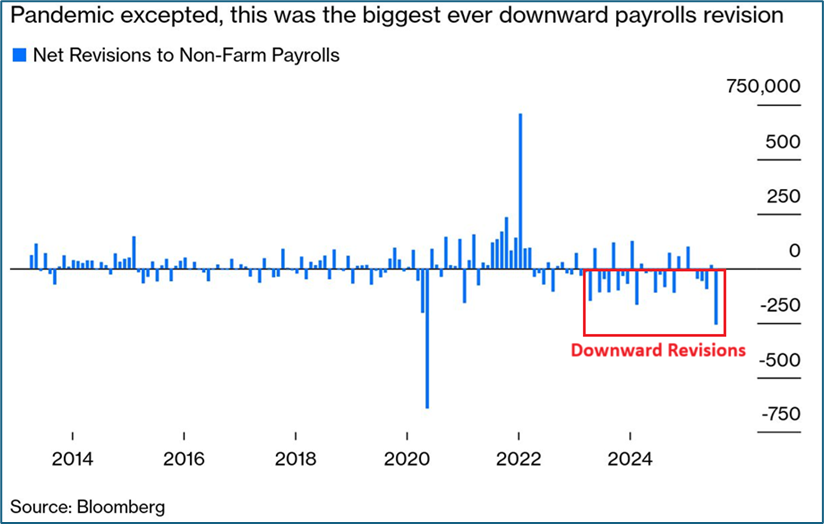
In fact, Friday’s downward revision was the most extreme since the COVID-19 pandemic. And it continues a notable trend in downward revisions to the employment data released by the government each month.
The White House is now trying to remedy it with a management change at the top. But the bottom line is that the U.S. economy added a total of just 33,000 jobs over the last few months. That’s the weakest job growth the nation has seen since 2011!
So, that “solid labor market” – as Fed Chief Jerome Powell called it recently – is suddenly looking rather… soft.
And just to add insult to injury, additional government data released last week said the Fed’s favorite inflation gauge moved up more than expected, as shown below:
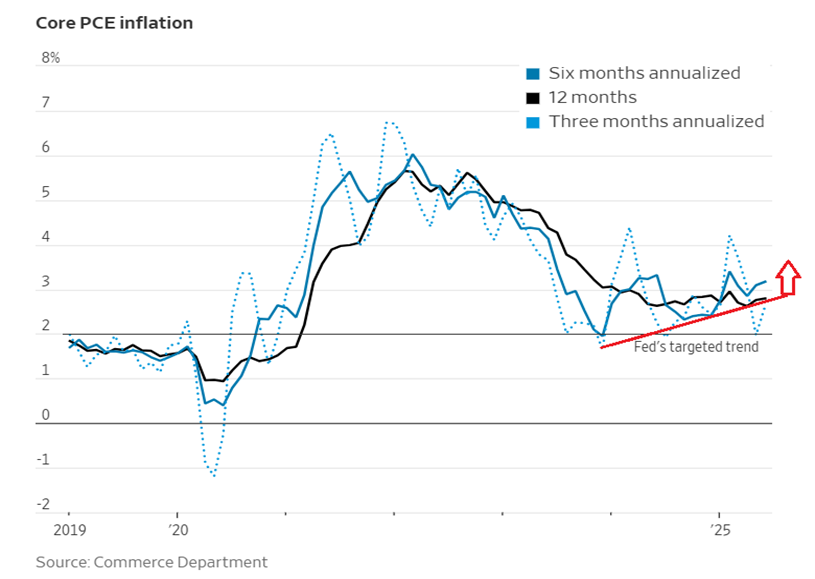
The Personal Consumption Expenditures (PCE) price index rose 2.8% last month. That’s the biggest rise seen in four months, and it clocks in well above the Fed’s 2% comfort zone.
And the six-month rate of change in the PCE price index is carving out a “solid” uptrend now, since it was last at the Fed’s 2% target over a year ago.
Tariffs have been pushing up the prices paid by businesses for a while now. It’s finally beginning to trickle down into the consumer price inflation data, too.
Now, after several rounds of increased tariffs this year (with a few periods of backtracking in between), the average tariff rate on American imports is now close to 18% – the highest level of duties since 1934:
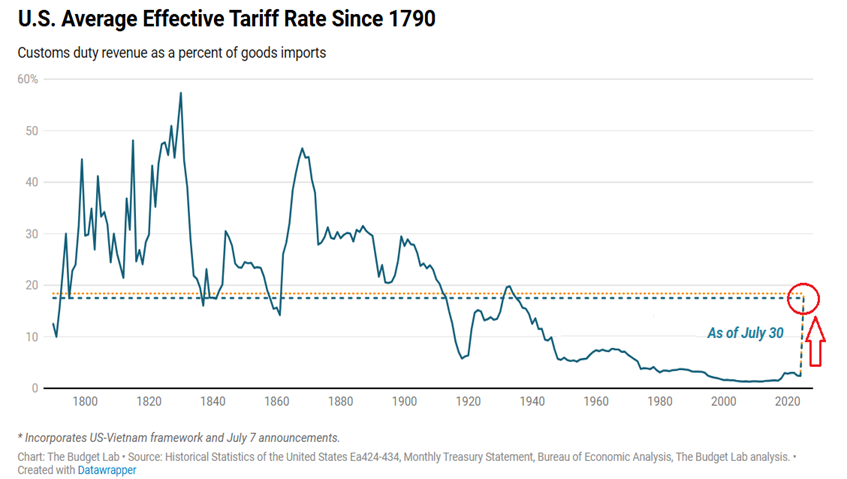
But today, the U.S. imports about three times as much as it did in the 1930s. So, the economic stakes are much higher this time around.
And tariffs aren’t just sending prices up (and job numbers down). As the latest round of quarterly earnings reports roll in, many S&P 500 component companies reported weaker profit margins – due to these same tariffs.
As a result, Wall Street analysts have been reducing earnings estimates. Year-over-year profit growth expectations for 2025 have been cut by 30% since January.
This means the U.S. economy could see a profit recession, even if we do manage to avoid an economic recession.
That’s why I’m putting this on the record: “Stagflation” is the next big issue for investors.
That’s a combination of slow economic growth, stagnant or falling profit margins, and higher price inflation to tie it all together.
And now the already embattled Federal Reserve finds itself in quite a pickle: With labor market weakness, rising prices, and White House criticisms boxing it in, the Fed has its work cut out for it over the next few months if it’s going to keep stagflation at bay.
But we don’t have to leave it all up to the Fed. As I’ve always said, there is a good antidote for stagflation, and investors can prescribe it to themselves: You can hold stagflation at bay by picking up high quality stocks with financial strength and pricing power – the same kind of stocks which I’ve championed all year.
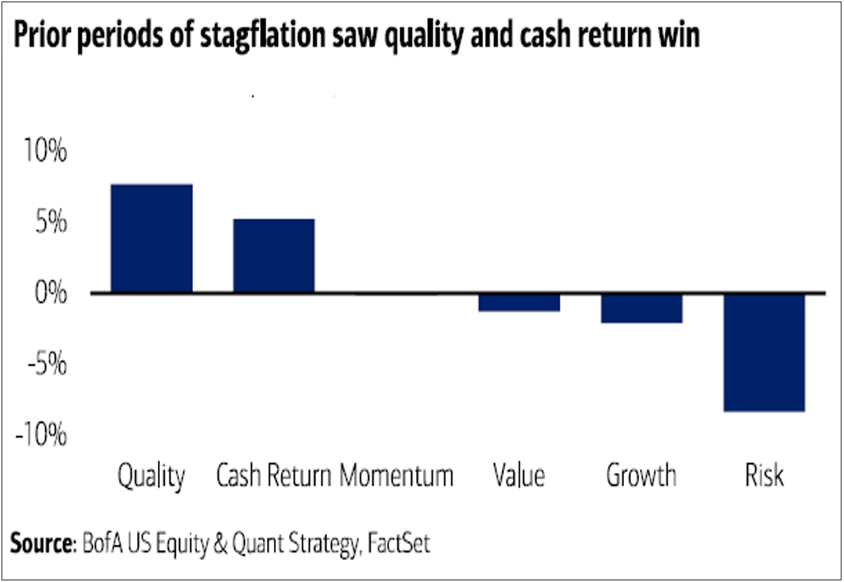
As you can see below, quality stocks – and stocks with generous cash return policies (in the form of dividends and share buybacks) – have outperformed all other investment strategies during prior stagflation scenarios:
And if you want to add these stagflation-beating stocks to your own portfolio, our TradeSmith tools can help point you in the right direction. Our Screener tool’s filters can uncover stocks with high Business Quality Scores and strong Free Cash Flow Yield generation with just a few clicks.
I shared the details of my Stagflation Screener with TradeSmith Insiders earlier this summer. And now is an appropriate time to revisit this strategy.
Simply log into your TradeSmith Finance account to get started, then click on Invest from the main menu – then click on the Screener tab on the next page.
If you are already a TradeSmith Platinum member, then you have full access to the Stagflation Screener already, in your list of pre-built “TradeSmith Screeners”. To find it, just click the drop-down box at the far right, labeled Select your pre-saved screener:
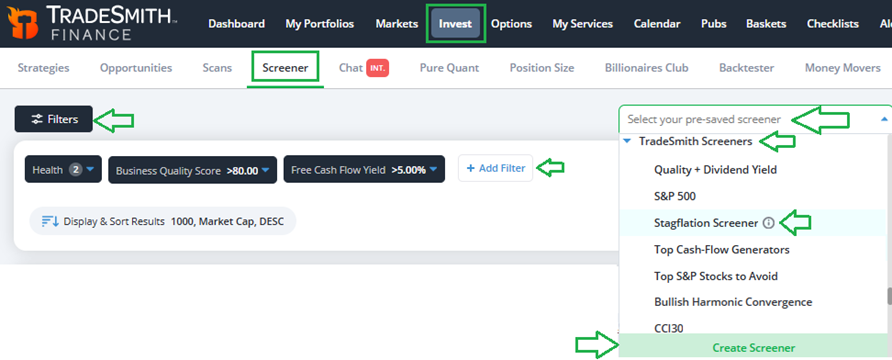
If you aren’t a Platinum member, you can build your own stagflation screener – just by following these simple steps. From the Screener page, just click the + Add Filter button, then use the checkboxes to add or remove filters as needed.
This screener relies on just three simple filters:
- Health Indicator: Select the Green and Yellow Zones to find healthy stocks,
- Business Quality Score: Set to “more than 80” to find the top 20% of stocks, ranked by our proprietary quality metrics,
- And Free Cash Flow Yield: Set to “more than 5%,” to pick stocks sitting above the S&P 500 FCF average of 3.2%.
High-quality, cash-rich stocks that are resistant to stagflation are those that typically enjoy dominant market share with pricing power. They possess wide moats to insulate themselves from rising costs and slower growth: That’s why these three filters are all you need to find potential winning stocks primed to thrive despite a stagflation scenario.
But you don’t have to limit yourself to just these three filters. Just click on + Add Filter again, and you can add more of our proprietary TradeSmith indicators to further tune your search. Plus, you can include more fundamental, valuation, market classification filters – to make this screener your own.
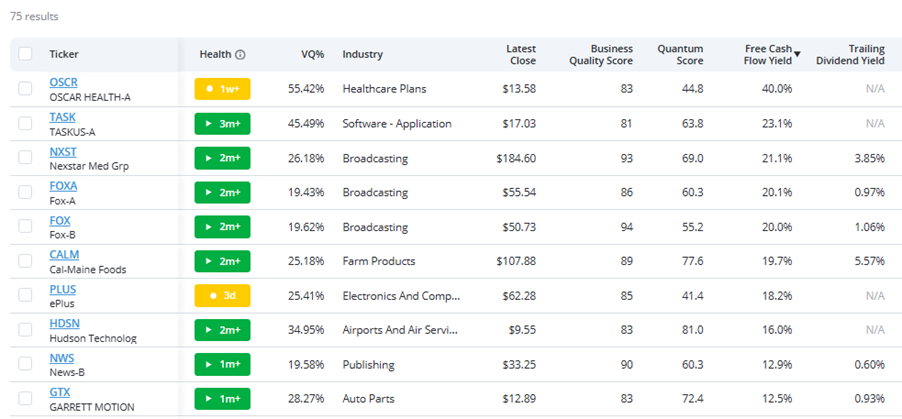
When I ran this screener yesterday with just the three filters above, I got 75 results. That’s a good starter list for additional research.
Due to space limits, the top 10 results are shown below:
Bottom Line: Nobody knows exactly what twists and turns the economy and stock market will face as we move forward. But stubborn inflation and high tariffs are a potential recipe for stagflation – meaning stalling growth and still high prices.
If that’s the outcome, this Stagflation Screener can point you in the direction of quality stocks with strong cash flows that have the ability to rise above stagflation… and protect your portfolio while they’re at it.
Good investing,
Mike Burnick
Senior Analyst, TradeSmith
P.S. In a stagflation scenario, high-quality stocks with strong free cash flow yields can offer shelter and stability. But as economic pressures mount, you can’t just keep playing defense.
It’s just as important to keep an eye on opportunities as they arrive… and we may be right on the cusp of a major paradigm shift in the market you won’t want to miss.
Here at TradeSmith, we’ve covered the AI trade extensively over the past few years – along with the developments coming from the crown jewel of the sector, NVIDIA Corp. (NVDA).
Since the initial release of ChatGPT, AI tools have improved by leaps and bounds and revolutionized businesses… but according to Luke Lango, Eric Fry, and Louis Navellier, three of my favorite analysts at our corporate partner InvestorPlace, AI is about to make another major leap – off the screen and into the real world. And there’s not much time to capitalize on it.
According to these three brilliant minds, NVIDIA is on the cusp of releasing a groundbreaking new chip that will open the door to “physical AI:” a new form of AI that can drive, build, think on its feet, and impact the real world you and I live in.
That new form of AI could build generational wealth… at least for those attentive enough to position themselves before physical AI triggers a $20 trillion economic wave. That’s why Eric, Louis, and Luke have come together for the AI Day Zero event: In this online briefing, these analysts are doing everything they can to keep you informed and prepared ahead of physical AI’s debut.
They’ve even identified one stock that could sit at the forefront of this new market shift… and they’re eager to share.
There’s only so much time before Nvidia makes its move, and it’s too late to prepare. Click here to check out the AI Day Zero briefing – and get all the crucial details.