Tariff Trouble Upsets the Market: But Let’s Focus on the Data
“Worse than the worst-case scenario.”
– Wall Street analyst Dan Ives, Wedbush Securities
That’s one way to neatly sum up Trump’s “Liberation Day” tariff announcement.
But it seems to me the only thing that got liberated yesterday… was investors – from their money!
Still, even in this worse than worst-case scenario for new tariffs, we’re following the hard data here at TradeSmith – and it doesn’t look so bad.
At the very least, Trump Tariff War 2.0 is now a somewhat better-known unknown. And believe it or not, that brings some clarity into the picture for investors, even if the pain is widespread today.
That said, the ultimate impact of these new tariffs on the financial markets remains very difficult to forecast at this point. And we won’t be trying to do that today.
At TradeSmith, we’re not Wall Street economists peddling constantly-changing macro forecasts. Thank heavens for that. Instead, we look at the hard data – to inform our investment decisions from an objective view.
And after a market correction that’s already cost stocks more than 10% of their value – and with the unpredictability of what impact tariffs may have moving forward – there has never been a better time to stick to the basics: the data!
And right now, the data suggests that markets are not at a “worst-case scenario” despite the sharp declines – instead, it’s surprisingly neutral:
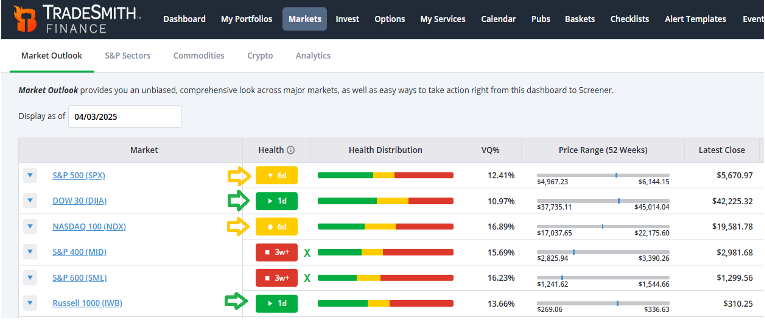
As shown on our TradeSmith Market Outlook page above, the S&P 500 (SPX) and Nasdaq 100 (NDX) Indexes have slipped into the Health Indicator Yellow Zone this week – that’s a caution flag to keep an eye on, but not a cause for panic.
Meanwhile, the Dow Jones Industrials (DJIA) and Russell 2000 (IWM) Indexes both remain in the Health Indicator Green Zone, So, I’d call that a split-decision so far. The S&P 400 (MID) and, as I’ve previously reported, the S&P 600 (SML), are the only indexes currently in the Red Zone.
As of right now, no confirmed downtrend or bear signals have been triggered for the S&P 500, Nasdaq 100, or the Dow Jones Indexes. In fact, the Dow is still riding a market melt-up signal from last March.
And in more good news, taking a closer look at the S&P Sector breakdown on our outlook page below shows even better overall market health:
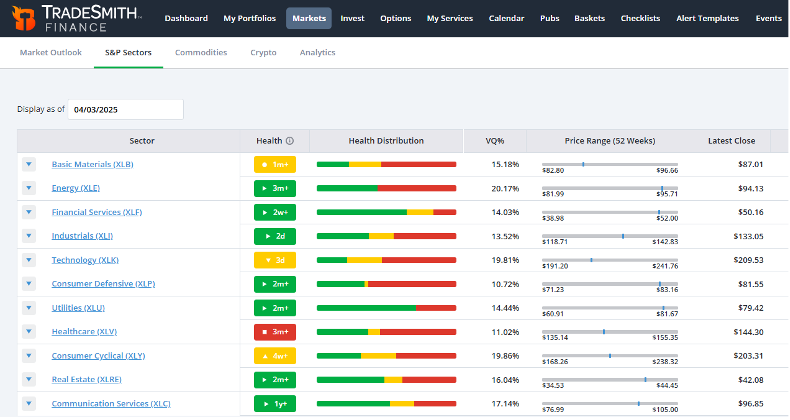
As you can see, seven of the 11 S&P 500 component sectors remain in the Health Indicator Green Zone. Three sectors have entered the Yellow (caution) Zone, while only one sector – Healthcare – has fallen into the Red Zone.
In addition, several reliable market indicators – ranging from market breadth measures to investor sentiment readings – suggest that the stock market could be at or near a significant market bottom as I write this.
Given how oversold stocks already were before today’s drop, history suggests that we could easily see a reversal higher again in the coming days or weeks.
But that’s just an educated guess, and it’s far better to rely on the facts found in our hard data.
On that note, I should also point out that two major indexes – the tech-heavy Nasdaq 100 and the small-cap Russell 2000 – are inching dangerously close to the Red Zone. Even a day or two of additional heavy selling pressure could end up pushing them into an unhealthy state.
And as longtime Inside TradeSmith readers may know, this is just one of two necessary criteria required to trigger our “Bearseye” sell signal. The second requires 40% or more of an index’s component stocks to trade in the Red Zone.
Looking closely at the “Health Distribution” columns of our Market Outlook tool shown above, you’ll see that the Nasdaq 100 and Russell 2000 already qualify there – with 42.6% of NDX stocks and 51.8% of IWM stocks in the Red Zone now.
IWM is the index closest to hitting the Red Zone, while the DJIA remains the healthiest index – furthest from stopping out – by far, with 43.3% of its stocks in the Green Zone and only 33.3% in the red.
So, more selling pressure in the days ahead could put these indexes in the Red Zone as well… but it’s just too soon to say right now.
At this point, it’s anyone’s guess which scenario will play out.
Now, if you could get me an advance copy of next week’s Wall Street Journal, I’d be indebted to you. Or, if you could let tell me know how my Florida Gators will do in the Final Four this weekend, that would be just as appreciated.
But absent a gift from the future, we’ll find out together soon enough – guided by the hard data.
Stay tuned for more coverage from Inside TradeSmith and the rest of our newsletters: I’ll be watching the markets closely as always, as will my colleagues, and we will all be sure to let you know immediately if conditions change dramatically.
In the meantime, you can always reach me directly with questions or comments through our dedicated email inbox. Send your message to [email protected], and my team and I will be sure to see it.
Mike Burnick’s Bottom Line: Based on the objective data compiled by TradeSmith, and my decades of hard experience in this business, I can tell you this is not the time to hit the panic button and sell everything.
As always, it’s a market of stocks – not the other way around. Our historical research indicates that stocks that hit the Red Zone should be sold, because our analysis shows they’re likely to keep underperforming in the aftermath. But you should also consider holding on to Green Zone stocks that are performing well, even as news rocks Wall Street.
Make sure your portfolio is synced with TradeSmith Finance and keep your TradeStops in place for all of your holdings, just in case. Things may be stressful – but remember that you aren’t alone.
Good investing,
Mike Burnick
Senior Analyst, TradeSmith
P.S. As we just discussed, the current tariff uncertainty weighing on stocks may be dramatic… but it is not a reason to panic. Keeping an eye on market data and keeping a clear head can help you weather the storm – but it is clear that traditional approaches may not give investors the edge they need to make the most of the market in the coming weeks.
And with earnings season just around the corner, I wanted to share an approach that could completely change how you trade, just in time to help with today’s volatility.
Landon Swan, one of my newest TradeSmith colleagues over at Derby City, has just revealed a few hard-won insights that could offer you a game-changing perspective on how the markets move. Instead of relying on the typical Wall Street predictions – which, as we’ve just seen, can often miss the mark when it counts – Landon and his brother Andy have developed a powerful system that analyzes social media to gauge what consumers are actually spending money on… before the effects are revealed in earnings reports.
Their system distills millions of data points from across the web into an “Earnings Score,” used to forecast company performance well ahead of time. And the power of Earnings Scores speaks for itself: The Swans’ system detected declining interest in Advance Auto Parts (AAP) based on social media signals that led to a 72% gain when the company missed earnings – and taking a similar signal with On Holdings (ONON) resulted in 104% returns in just a few days.
As earnings season kicks off next week, the Swan brothers’ AI-driven insights could give you a major advantage in turbulent times – so I highly recommend tuning in to Landon’s talk.
He not only shares his top pick for the quarter, but also reveals how AI-driven earnings surprises are starting to shape the market in unexpected ways. So, if you’re looking for a fresh, data-backed approach to earnings season – you won’t want to miss this.
Click HERE to check out what Landon and Derby City have to say ahead of the latest reports.