The Market Is Pulling Back– Inside TradeSmith’s Dip-Buying Playbook
After gangbuster gains last year, the stock market has now stalled out.
In fact, the S&P 500 Index has made no upside progress since Jan. 1. Even worse, the tech-heavy Nasdaq 100 Index is down 4%.
And this weakness is starting to produce cracks in the market’s foundation.
That’s a warning sign of potentially more downside ahead…
But it’s not all doom and gloom.
This kind of turbulence can feel uncomfortable – but pullbacks like this are normal in every market cycle.
And it could also be an opportunity to buy stocks for a rebound. TradeSmith has you covered either way.
Now is the time to keep a watchful eye on our Market Outlook page for a real-time gauge on the stock market’s health.
And it’s also a great time to visit our Strategies page to find new buying opportunities in stocks likely to snap back from market weakness.
Today, let’s take a closer look at both.
How to Get Your Daily Pulse Check on the Market
The TradeSmith Market Outlook page is my go-to destination for gauging the stock market’s health.
I visit it every day to keep tabs on the major stock indexes and sectors – and you should too.
From your TradeSmith Finance main menu bar, simply click on Markets, then Market Outlook in the submenu.

At the top of the page, you can select the “Display as of” date – the default is the current date.
And you can choose between Tile or List view, which present the data in different formats.
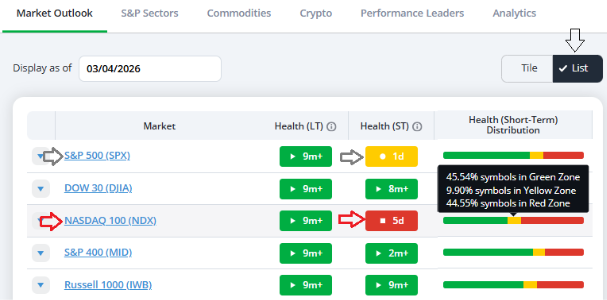
Click on the List view as shown above, and you’ll see what I mean by deteriorating market health.
The List View gives you a high-level overview of all our tracked markets. Each data row provides key metrics to monitor, including:
- Health Status – The market’s current condition.
- Health Distribution – The percentage of underlying stocks in the Green, Yellow, or Red Zones.
- Risk Level – Our proprietary risk metric, the volatility quotient (VQ%).
- 52-Week Price Range – Current prices within the last 12 months’ high-low range.
- Latest Close & Current Price – For tracking recent movement.
The List view is valuable because you can see at a glance how the markets are performing.
As you can see above in the Health (Short-Term) Distribution column above, the tech-leading Nasdaq 100 Index fell into the Health Indicator Red Zone last week.
And earlier this week, the benchmark S&P 500 Index fell into the yellow zone, signaling caution.
By hovering over the multi-colored Health Distribution bars, you’ll see what percentage of underlying stocks are in the Green, Yellow, or Red Zones.

There are almost as many Nasdaq stocks in the Red Zone (45.5%) right now as in the Green (45.5%) – which is a red flag.
Also note these are both short-term Health Indicator signals.
This tells you where each index stands relative to our proprietary algorithm, which is designed to measure changes in volatility and trend strength over the near term – roughly in the next few months.
To the left of the Health (Short-Term) column, you’ll notice another column labeled Health (Long-Term) Distribution.
This is our original TradeSmith market health indicator, and it takes a lengthier view of volatility and trend strength over a year or more.
Currently, long-term Health remains green for all the major indexes, signaling that a longer-term uptrend is still in place.
But with a few short-term Health indicators slipping, you’ll want to watch for any changes in long-term Health.
Understanding where the market stands is valuable – but what really matters is having a strategy to act on it.
A Strategy to Find Stocks with Snapback Potential
When the stock market trend – long or short term – turns up or down, it’s difficult to say how long it will last without the benefit of 20-20 hindsight.
But a market pullback could also prove to be a great buy-the-dip opportunity. And if that’s the case, we’ve got you covered.
Our TradeSmith Strategies page is chock full of proven, short- and long-term trading systems, several of which are geared for buying the dip.
Case in point: our Snapback Strategy. It’s a rules-based approach specifically designed to capitalize on volatile market conditions like the ones we’re seeing now.
We analyze short-term moving average divergences, along with historical price comparisons, to help pinpoint oversold stocks that are likely to deliver a quick rebound in price.
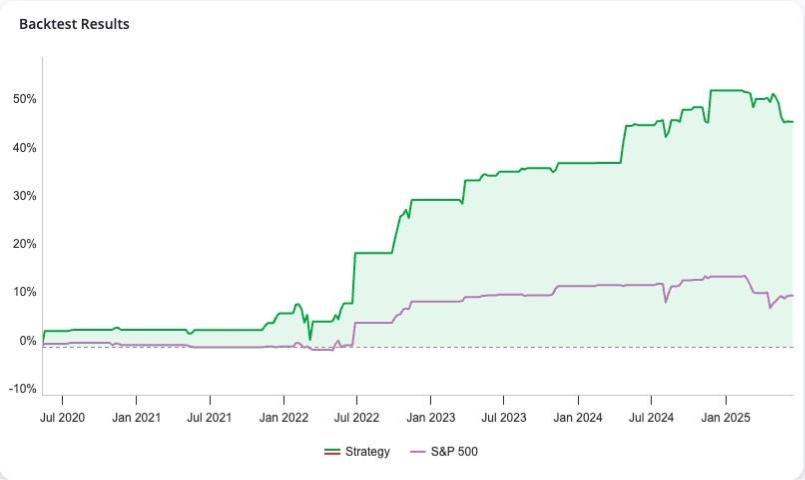
We backtested the Snapback strategy on the S&P 500 going back 10 years. Snapback outperformed the S&P by more than 4-to-1 over five years, as you can see above. Plus, the average return – counting both wins and losses – was about 16%!
To see what that looks like in practice: when markets pulled back sharply last spring, our TradeSmith system triggered a snapback buy signal on April 14, 2025 in oil and gas giant Devon Energy (DVN).
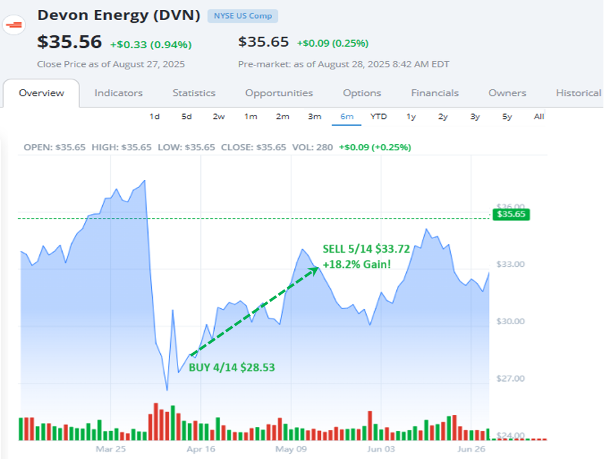
Just over 20 trading days later, members who acted on that signal grabbed gains of roughly 18%. That’s exactly the kind of opportunity these volatile market conditions are designed to produce.
And the easiest way to access our Snapback Strategy signals within TradeSmith is to click on Invest, then select Strategies from the sub menu as shown below.
Next, simply scroll down through our exclusive lineup of TradeSmith strategies to find Snapback.
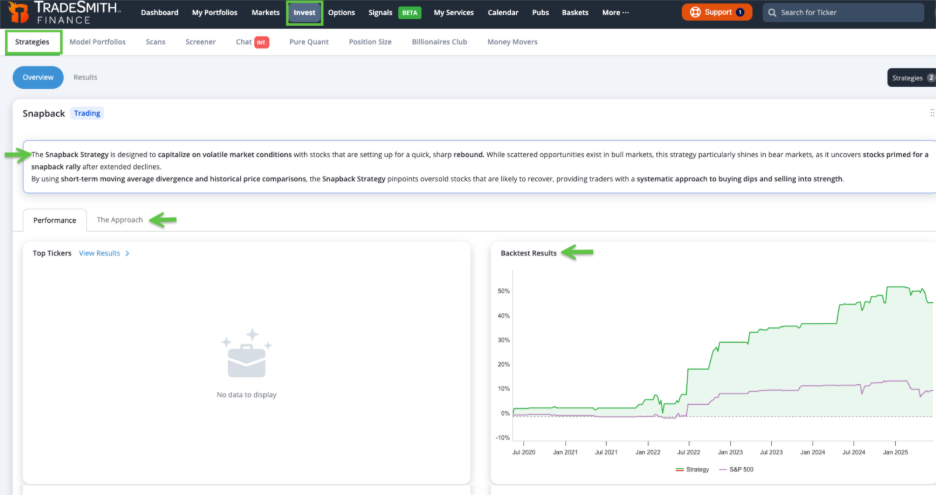
The strategy backtest results are displayed at right, and the top current results are shown on the left.
You can also click on View Results at the top left to see more details on stocks that qualify for the strategy in our Screener view.
As you can see, there is currently no data to display, because no stocks qualify for the Snapback strategy today.
That’s actually the strategy working as it should – waiting for the right setup so you don’t chase trades that aren’t ready.
But be sure to check the Strategies page frequently – I do every trading day. That’s because if the stock market deteriorates further, new Snapback results could show up on any given day.
This – and our other TradeSmith Strategies – can deliver a powerful tactical edge for your trading and investing, especially in volatile markets.
Mike Burnick’s Bottom Line: Markets can deteriorate quickly and rebound just as fast these days. That’s why you should check in on our Market Outlook page every day. Snapback trades can also come quickly when market conditions shift, so aim to capitalize on these pullbacks by revisiting the Strategies page frequently for new buy-the-dip ideas.
Good investing,
Mike Burnick
Senior Analyst, TradeSmith