These Seasonal Trends Take the Guesswork Out of Buying and Selling
Editor’s Note: Good evening! Mike Burnick here.
Ask ten investors how the market moves, and you’ll get ten different answers. Some call it random. Others call it rigged. Most just throw up their hands and admit they’ve stopped trying to make sense of it.
Here’s the thing, though – the market isn’t as random as it looks. Not even close.
Strip away the headlines and the noise, and you’ll find plenty of moves that repeat on a predictable schedule – year after year.
That’s the discovery our research team has been chasing for years now, digging through decades of price history, running the numbers, and isolating the patterns strong enough to actually trade on.
It’s what led us to build the Trade Cycles Seasonality Calendar last year. And it’s what our team has kept refining ever since, right up until earlier today, when CEO Keith Kaplan hosted our Breakthrough 2026 Event to unveil what they’ve been working on.
In the issue below, Keith makes his case for why “the market is unpredictable” is the wrong lesson to draw from a chaotic-looking chart. It’s a sharp way into a simple idea: The data usually knows more than your gut does, if you’re willing to listen to it.
I’ll let him take it from here.
Take it away, Keith!
In June 1944, as the Allies prepared to invade Normandy, their plans hinged on one man, Group Captain James Stagg.
And he was telling General Dwight D. Eisenhower, “Don’t do it!”1
Turns out, he was right.
Everyone knows the Allies stormed the beaches on June 6, 1944. What you may not know is that D-Day was supposed to happen a day earlier – on June 5.
And if Eisenhower had ignored Stagg’s warning… and went ahead with the invasion a day earlier… the Allies could have failed.
Could one day have made that much difference?
Absolutely. Because Stagg’s warning came down to the most fundamental element of planning a seaborne invasion: the weather.
You see, Stagg’s path to the Allied Command was different than the more conventional officers in the war-room.
He was a meteorologist best known for leading an Arctic expedition in 1932. And when the war began, he was the superintendent of Kew Observatory — Britain’s weather forecasting headquarters.2
Now, Eisenhower was asking Stagg for the most crucial observations of his career: conditions in the English Channel ahead of the largest amphibious assault in history. And Stagg’s network of Royal Air Force weathermen had told him that a massive storm was rolling in.3
Luckily for Britain, the U.S., Canada, France, and the world, Eisenhower listened to Stagg. The landings took place on June 6, 1944, after the storm had passed. Eleven months later, the Allies were celebrating victory in Europe.4
Timing is important for us as investors, too. It’s tempting to leave buying and selling decisions to gut feel. But at TradeSmith, we believe — like Stagg did — in following the data.
One of those signals is what we call “seasonality” — recurring patterns that repeat year in, year out with remarkable consistency.
I’ll show you how it works today… plus how seasonal trades generated 857% total growth in an 18-year backtest.
Buy on These “Green Days”
I didn’t come to TradeSmith from Wall Street. I’m a software engineer by training.
So, when my team and I went looking for an edge for investors, we didn’t start by asking what should move a stock. We started by asking what the data already showed.
We built software that scans more than 5,000 stocks — decades of price history — and asks a simple question. Does this stock behave differently at certain times of the year than others?
The answer, again and again, was yes.
We’ve found historically reliable windows across thousands of stocks – specific times of the year when they tended to rise or fall.
We call the bullish windows “green days.” And we built a trading system around them that spots these seasonal patterns with an 83% historical accuracy rate.
In other words, they’ve shown up in about eight years out of every 10. That’s not a guarantee they’ll show up again. But it’s a statistical edge you can use to stack the odds of success in your favor.
Seasonality isn’t new:
- Commodity traders have always tracked planting and harvesting cycles.
- Energy markets move with heating and cooling demand.
- Gold has long shown seasonal strength tied to jewelry demand and annual buying patterns in India and China.
- And stock investors track seasonal patterns like the January Effect and the Santa Claus Rally.
What’s new is that we can now measure it precisely – across thousands of stocks, over decades of data, and down to specific days.
Target (TGT), for example, has climbed during the same 29-day window — late June into late July — in 15 straight years, gaining an average of 5.2%:

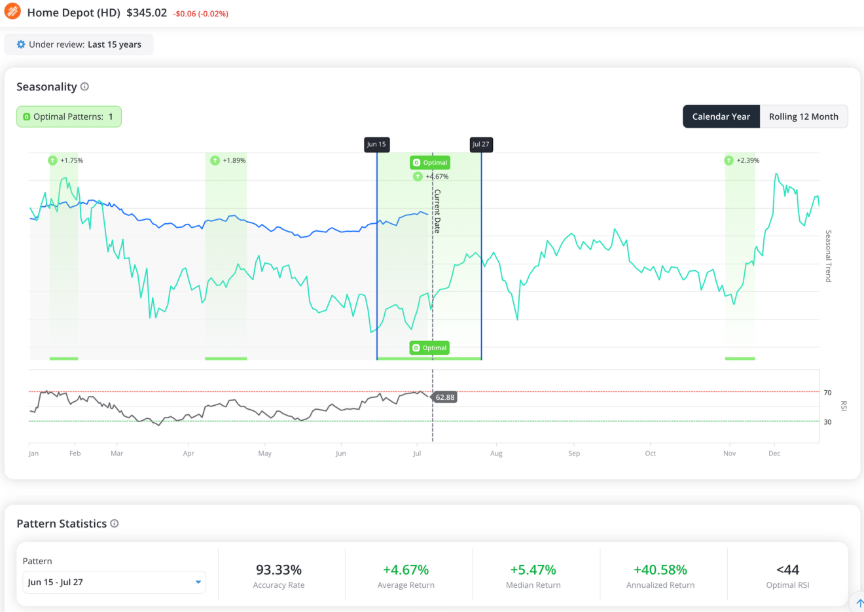
Home Depot (HD) has done the same between mid-June and late July, rising 93.3% of the time over 15 years with an average gain of 4.7%:
But rival home improvement store Lowe’s (LOW) optimal window comes nearly two months later.
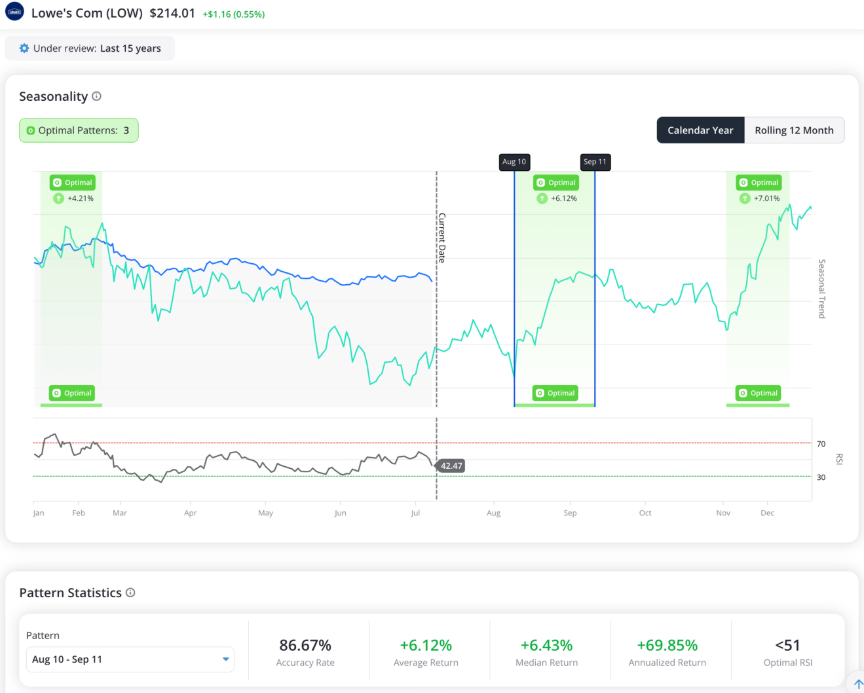
LOW has gone up 86.7% of the time from Aug. 10 to Sept. 11 during the past 15 years, with an average return of 6.1%:
Over an 18-year backtest, these seasonal trades produced 857% in total growth — more than double the S&P 500 over the same stretch. Even in 2007, the worst year in the test, the strategy still came out ahead.
Numbers like that are exactly why we decided it was time to go deeper into this strategy.
So earlier today, we hosted our Breakthrough 2026 Event. It’s all about the seasonal patterns you need to be aware of in this critical year.
It kicked off at 10 a.m. ET. And it’s urgent that you check out what was covered.
I walked you through how we uncovered these patterns, why they persist even in chaotic markets, and how you can use them to guide real-world trading decisions.
More important, I got into detail about the fast-approaching seasonality patterns you need to be aware of.
Knowing when the windows are opening and closing likely matters more to your wealth than any single decision you’ve made.
The first date you’ll want to circle on your calendar is today, July 16. If seasonality patterns hold this year, it could open up a lucrative trading opportunity in one of the market’s hottest AI stocks.
I hope you’ll join us.
All the best,
Keith Kaplan
CEO, TradeSmith