Two TradeSmith Strategies for a Stock Market Partying Like it’s 1999
With apologies to the late, great artist Prince for my paraphrasing, the fact is that in recent years, our stock market has decided to party like it’s 1999 – and the high valuations prove it.
As Dow Jones MarketWatch recently pointed out, U.S. large-cap stocks are trading at the highest – or near the highest – premium to fundamentals ratios since the end of the dot-com era. And that’s confirmed by multiple measures, as you can see below:
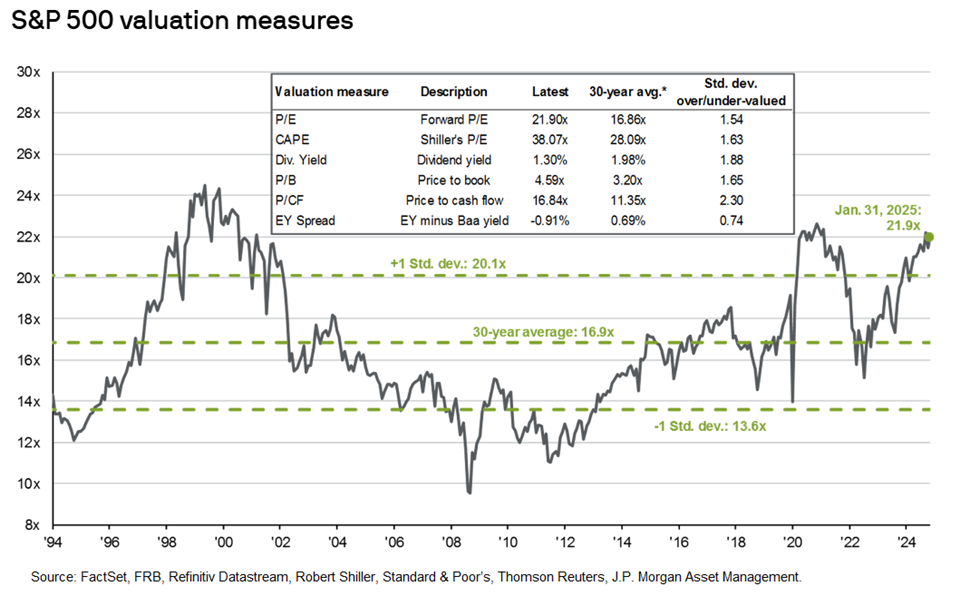
The MarketWatch report goes on to point out that the cyclically adjusted price-to-earnings ratio for the S&P 500 Index reached 38.5x last week – its highest reading since late 2021.
Before that, the last time it was at or above this level was 2000, as the dot-com bust began.
Prefer a different flavor of valuation? How about the time-honored price-to-sales ratio: At just over 3x sales today, the S&P 500 is on par with levels last seen during the summer of 2000.
Pick a measure, any measure, of stock-market valuation, and it’s probably at or above the most extreme levels of the past three decades.
And history shows that when stock valuations are this high, future market returns tend to fall below long-term averages.
That said, I’ll freely admit that valuation measures alone are not very good market-timing tools. I’ve experienced that first-hand.
In the late 1990s, for example, valuations didn’t work well at all for timing the market – not back when stocks were soaring.
I was already a veteran money manager back then, 12 years into my career, and I can tell you without a doubt that stocks started getting expensive in 1996… four years before the peak!
Yet the S&P 500 still climbed another 150% at its final peak in 2000. But that’s nothing compared to the Nasdaq 100 soaring 600% between mid-1996 and the 2000 peak.
In fact, the tech-heavy index more than doubled in 1999 alone.
So, the recent rally in technology stocks – especially the “Magnificent 7” mega-caps – is nowhere close to the kind of dance-party euphoria seen in 1999!
But clearly, we can see a vague resemblance to the dot-com days in the recent AI-market mania that’s taken the stock market for an upside ride these past few years.
That’s why it’s important to consider sticking with investments likely to work today – while also knowing when and where to shift your investments in the future, when the Prince-style party music eventually stops. You have to know when to switch from growth investing to value investing… and vice-versa.
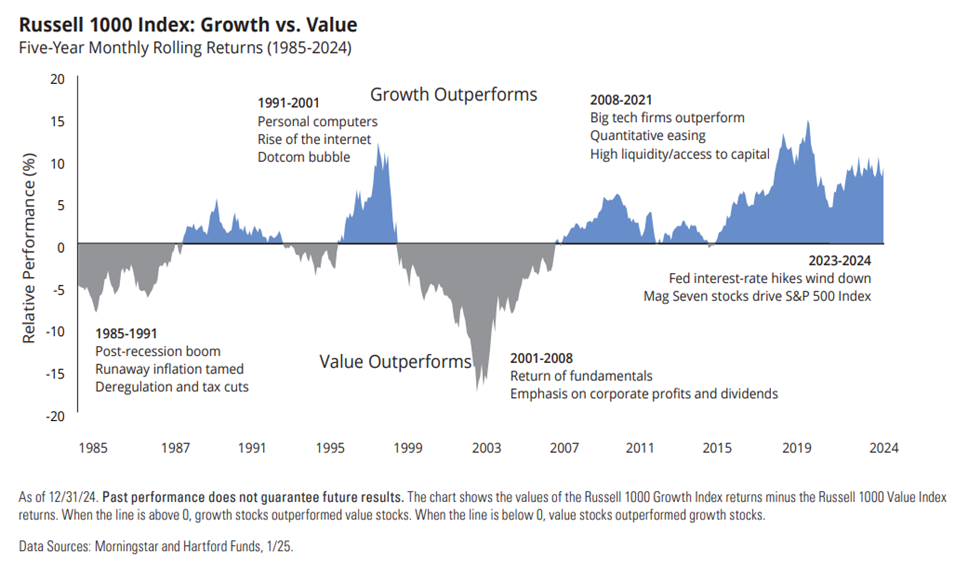
As you can see below, growth and value names take dominance in a cyclical pattern, with plenty of ups and downs for each. And as history shows, these investment styles often trade places over longer timeframes:
Growth Now, Value Later
Back in 1999, I was a portfolio manager for an investment advisory firm – one that had the dubious distinction of following a value-investment style when growth stocks were red hot.
It was the absolute worst time to be a value investor.
You see, value stocks peaked in mid-1999 as everyone was chasing growth stocks in the tech sector. Value was already down more than 25% by the time the rest of the stock market “caught down” in 2001.
After that, the entire stock market went down for two long years. Growth stocks, value stocks, dividend stocks, you name it: There was no place to hide.
In the end, the market’s favorite growth stocks of the 1990s crashed and burned in the 2000s.
Intel (INTC), for instance, lost 80% of its value in just two years after the 2000 peak – and even now, 25 years later, investors still haven’t broken even on INTC.
Many other high-quality growth stocks shared similar fates, languishing for a decade or more after the bust.
But that’s when value stocks not only turned around but really began to shine. Between 2003 and 2006, they soared 160%, then went on to outperform growth stocks for the next seven years.
The lesson learned is that growth and value stocks are two sides of the same coin, taking turns leading the stock market in performance. And in recent years, growth has been the place to be – as you can see in this TradeSmith Comparison chart below:
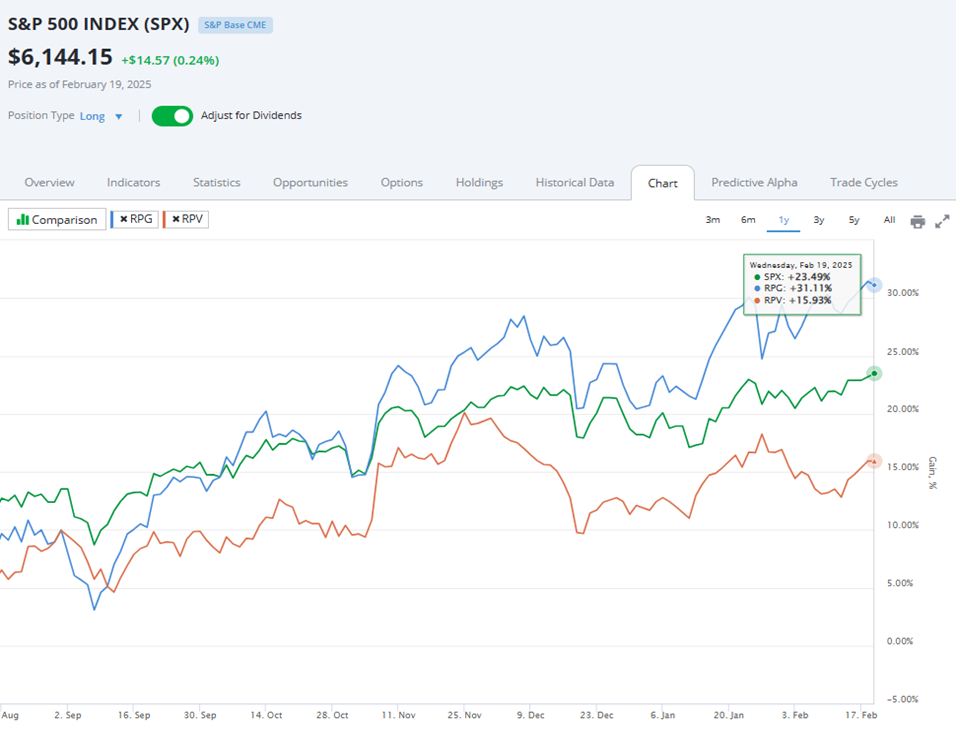
Growth, represented by the Invesco S&P 500 Pure Growth ETF (RPG) in blue, is up 31.11% over the past year, outperforming the S&P 500 Index (SPX) in green… and easily outpacing the Invesco S&P 500 Pure Value ETF (RPV) in orange, which gained 15.93% over the same period.
But that leadership could shift at any time, especially if economic and earnings growth slows. If stocks continue higher from here into a full-blown mania (à la 1999), then growth stocks should hold their leadership position for some time yet.
However, history shows that value generally beats growth in the six months following the last cut of a Fed rate-cutting cycle. And since the Fed apparently just went on an extended hold, that could give value stocks the upper hand in the coming months.
Fortunately, TradeSmith Ideas Lab strategies can guide your investments, whether growth or value stocks lead the market going forward into the warmer months.
The Best of Growth & Value Strategies
You can access both our Growth and Value Strategy stock baskets on the TradeSmith Finance platform by clicking on Invest from the main menu, then selecting Opportunities in the sub menu, as shown below:
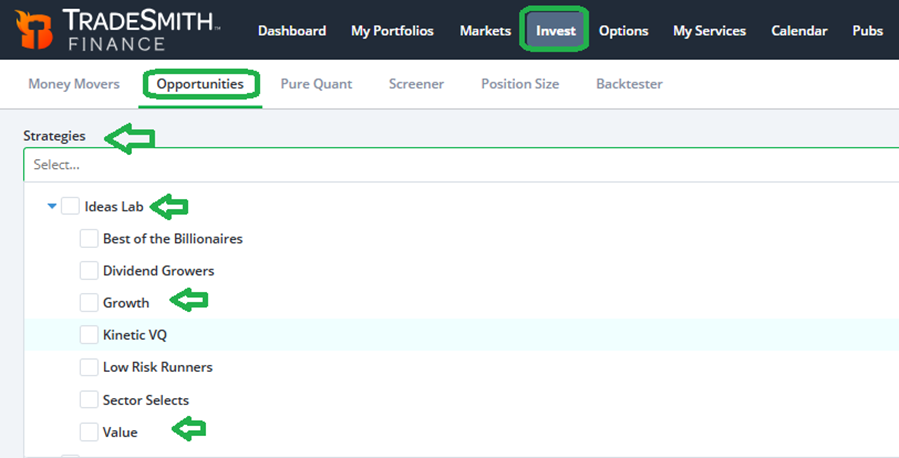
Next, use the drop-down box labeled Strategies to scroll down to Ideas Lab and click on the arrow to expand the options. Then, simply scroll down to select Growth, Value, or any of our other TradeSmith strategies.
For each strategy selected, you’ll see the top 20 results displayed, selected from the stocks that match the strategy. Below are the top 10 stocks for Growth:

This list gives you a great jumping off point for further analysis into each stock.
You can also access the Growth or Value strategy while using our TradeSmith Screener. Simply click on Invest, then Screener, and click the green button labeled + Create new screener, as shown below:

You can add a wide variety of screener filters to complement our Growth and Value stock strategies by simply clicking on the green + Manage Filters option. Be sure to add the filter for TradeSmith Strategies, as shown above. Then, select Ideas Lab and choose either Growth and/or Value to search for stocks that are well-suited to that – or any other – strategy.
Mike Burnick’s Bottom Line: Growth and value investing styles change leadership positions over time and take turns outperforming the market. Our TradeSmith Ideas Lab Strategies can help you find potential winning stocks that fit either investment style – along with many other strategies.
Good investing,
Mike Burnick
Senior Analyst, TradeSmith
P.S. Growth and value stocks take turns leading the market – just as they have for decades. But regardless of the dominant investment style, timing your investments correctly can be just as important as knowing what to invest in.
That’s where TradeSmith’s powerfulTrade Cycles Seasonality tools come in, harnessing decades of historical market data to pinpoint historically bullish andbearish periods in the market – for over 5,000 stocks.
Last month, TradeSmith CEO Keith Kaplan unveiled Seasonal Edge: a powerful new trading system built from our proprietary seasonality tools. Seasonal Edge automatically scans the market for the strongest bullish seasonality periods of the year and delivers real-time trade notifications straight to your inbox as they play out.
The strategy our team of researchers developed for the Seasonal Edge system boasts an 83% accuracy rate over 18 years of backtesting… and the results of those backtests suggest a $10,000 investment could have turned into $85,700 – outperforming the S&P 500 by 99% in the process. And now, you can put that system to work for you.
Whether growth stocks to continue to lead, or if value takes command of the market in the coming months, Seasonal Edge can help you leverage that with confidence. And with seasonality indicators flashing green for dozens of stocks, now is the time to position yourself for success.
If you missed last month’s Breakthrough 2025 event, where Keith debuted this groundbreaking system, don’t fret – you can still catch the replay now.
Click here to secure your Seasonal Edge and confidently navigate the opportunities ahead in 2025.