AI in Space: 10 Stocks to Buy for the Orbital Compute Revolution
Most investors have it wrong about the market’s biggest profit trend.
If you follow the AI conversation in the mainstream media, you’d be forgiven for thinking that the entire future hinges on chips.
- Who gets the next shipment of Nvidia graphics processing units (GPUs)?
- Might Google’s alternative tensor processing unit (TPU) design be more suitable?
- How fast can these chips be produced?
That’s the debate most folks are having. But it misses the real problem.
AI doesn’t hit a ceiling because it runs out of silicon. It hits a ceiling because it runs out of electricity, water, and land.
Despite all the talk of “cloud computing,” a data center is an industrial facility. It’s closer to a steel mill than a software app.
And modern AI models require far more compute than traditional cloud applications. A single advanced AI model requires tens of thousands of high-performance chips running continuously. They often consume 5 to 10 times more power per rack than older enterprise workloads like email servers or databases.
As a result, what used to be a steady rise in computing demand has turned into a near-vertical spike.
A single large AI data center can draw 100 to 300 megawatts of power—on par with the electricity demand of a city of roughly 80,000 to 250,000 people.
And the heat its servers, processors, and networking equipment produce can’t be ignored or throttled back. Cooling systems run around the clock, using enormous amounts of energy and water just to keep machines operating safely.
A hyperscale data center can consume as much as 5 million gallons of water a day for cooling. That’s roughly the same daily water usage as a town of about 30,000 to 50,000 people.
That water has to be piped into the data center, circulated, treated, and often cooled again using more electricity. When dozens of these facilities cluster in the same area, the strain on local infrastructure and natural resources becomes impossible to ignore.
That’s why suitable land is a constraint, too.
You can’t build a data center just anywhere. You need access to high-capacity power lines, reliable water supplies, dense networking infrastructure, and permits that can take years to secure.
Communities push back. Utilities impose limits. Projects stall.
For a long time, those frictions were manageable. AI changed that… and the cracks are starting to show.
The World’s Biggest Data Center Hub Has Hit a Wall
Nowhere is this clearer than in Northern Virginia.
Inside the industry, the region is known as Data Center Alley. About 70% of the world’s internet traffic flows through the clusters of football-field-sized, windowless buildings spread across Loudoun County and the surrounding area.
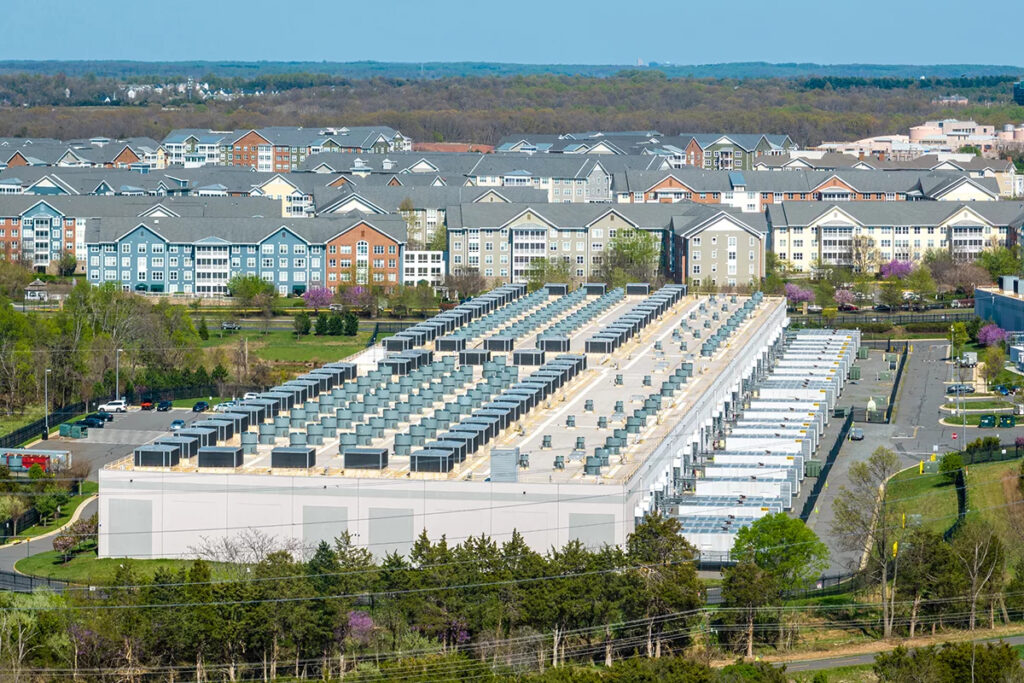
For years, it was the perfect location thanks to:
- Cheap land
- Dense fiber networks
- Reliable power
Then AI models like the ones behind ChatGPT, Gemini, and Grok arrived —and the workload profile of its data centers changed completely.
Traditional cloud computing involves intermittent workloads—think email servers, website traffic, file storage, and business software that spike during the day and idle overnight. AI workloads are different. They are continuous, power-dense, and always on… with thousands of chips running at full capacity for days or weeks at a time.
That shift dramatically increased electricity demand per square foot.
By 2023, utilities in Northern Virginia began warning that new data-center projects were arriving faster than the grid could support them. Several large developments were delayed—not because of funding or customer demand, but because there simply wasn’t enough electricity available to connect them.
In response, local utilities proposed emergency gas turbines to stabilize supply. Local governments began debating water-usage limits. Residents raised concerns about noise, heat, and the strain on public infrastructure. In some cases, approvals that once took months stretched into years.
And Northern Virginia isn’t unique. Overseas, AI demand is colliding with the same physical limits in data-center hubs in Dublin, Amsterdam, and Singapore.
That’s a huge issue.
Without expanded data-center capacity, everyday services slow down or become more expensive—from cloud software and streaming to navigation, logistics, and digital payments.
It also limits how quickly AI models can improve. Larger models require more computing power to train, test, and deploy. When infrastructure hits a wall progress slows—not because the ideas stop improving, but because there’s nowhere left to run them.
And on the national security side, the implications are even more serious. Modern defense systems, intelligence analysis, and autonomous platforms all depend on reliable, scalable compute. When cloud infrastructure becomes a bottleneck, it can threaten national defense.
That’s even more important now than ever with China rushing to develop class-leading military AI capabilities. There is documented interest within the Chinese military in using AI for decision-making, autonomous systems, targeting, and reducing the “fog of war” with advanced analytics.
For decades, the underlying assumption was simple: When demand for compute rises, you build more data centers. And that assumption held true when workloads grew gradually. But AI doesn’t grow gradually. It concentrates massive amounts of compute into dense clusters of machines that pull enormous power, generate relentless heat, and can’t tolerate downtime.
At the scale now required, even the best-funded technology companies can’t brute-force their way around power grids, water rights, permitting regimes, and local opposition.
Once you accept that reality, the question for investors changes.
It’s no longer: How much compute can we build here on Earth?
It becomes: Where else could that compute exist?
The Next Frontier for AI Compute
To answer that, let’s start with the basics. We need to set aside how things have always been done and start with the most fundamental requirements of the system.
Strip a data center down to its essentials and two needs dominate everything else: power and cooling.
On Earth, both are constrained.
First, electricity has to be generated, transmitted, and regulated. Then water access must be secured for complex cooling systems. Then even more energy is required to run those systems.
In large hyperscale facilities, cooling can account for 30% to 40% of total energy consumption, often adding tens of millions of dollars a year in operating costs for a single site.
Here on Earth, every workaround adds cost, friction, and delay. But above Earth, those constraints disappear.
In orbit, solar energy is continuous and stronger than on the ground. Outside Earth’s atmosphere, solar irradiance is about 1,360 watts per square meter—roughly 30% stronger than peak sunlight at the Earth’s surface. And depending on its orbit, a satellite can stay in sunlight nearly 24/7.
In orbit, satellites convert this constant, high-intensity sunlight directly into electricity using high-efficiency solar arrays—without clouds, night cycles, or grid losses to contend with. Power flows straight from Sun to silicon.
Space is also a more natural choice when it comes to cooling.
On Earth, data centers rely on air, water, and evaporative cooling to keep systems from melting down. Those methods are already running into limits—from water shortages to local opposition to new builds.
In space, the environment is different.
There’s no surrounding air to trap heat—and space provides an open backdrop where heat can be radiated away continuously. From a physics standpoint, that’s an ideal heat sink.
This is one of the core reasons why space-based computing is so promising. Heat can be rejected directly into the vacuum of space, without competing with cities for water or power.
There are networking advantages to orbital compute—but they’re workload-specific.
Inside terrestrial data centers, machines communicate through fiber-optic cables, with signals traveling through glass and often passing through congested metropolitan hubs. In space, laser links travel through a vacuum, where there’s less interference, lower signal loss, and fewer physical choke points.
For certain workloads—for example, traffic that would otherwise cross oceans or continents—orbital laser links can move data as fast or faster than terrestrial routes.
And when orbital compute is paired with systems like Starlink and other satellite networks, it creates a more distributed computing layer. Instead of routing every request through a handful of overloaded cities, some processing can happen closer to where data is produced—in orbit, at the edge of the network.
Space networking isn’t always faster. But for the right workloads, orbital compute changes the shape of the network—and relieves pressure where Earth-based systems are already strained.
And there’s also an overlooked bonus.
A growing share of global data is generated by satellites, sensors, and space-based systems—from Earth-imaging satellites that track weather and crops to communication constellations that relay data globally.
Today, much of that data is sent down to Earth for processing, then sent back into orbit. Processing it closer to where it’s created reduces bandwidth needs, cuts network delays, and slashes costs.
While space-generated data still represents a small share of total global compute today, it’s growing rapidly as Earth-observation, communications, and defense systems expand. Think of it as moving the factory closer to the raw materials.
Of course, all this speculation is pointless unless the technology exists to put data centers in orbit.
And until recently, it didn’t.
Escaping Our Earthbound Limits
Launching heavy equipment into space was prohibitively expensive, keeping ideas like orbital compute firmly in the realm of theory.
But that’s changing.
Reusable rockets, larger payload capacities, falling launch costs, advances in satellite manufacturing, and breakthroughs in optical communications have converged at the same moment.
For the first time, it’s now economically possible to place substantial computing infrastructure above the planet—not as a science experiment, but as a practical response to Earth-bound limits.
This doesn’t mean running all AI tasks in orbit. Training large AI models will still mostly happen on Earth, where massive facilities already exist.
But the everyday work of AI—answering questions, recognizing images, and responding to commands—is a different story. That kind of computing benefits less from giant data center hubs and more from being available when and where it’s needed.
That makes it well-suited to orbital compute. Models can be trained on Earth, then deployed above it—where power is continuous, cooling is easy, and compute can be positioned globally without negotiating land, water, or grid access in every new market.
Once you see that power, cooling, and geography have become binding limits that orbital computing solves, the direction of travel becomes hard to ignore. The next phase of AI scaling won’t be driven by smarter code alone. It will be driven by where computing can physically exist.
The Foundations for Orbital Compute Are Already Being Laid
Before new infrastructure is built, it has to be tested.
All this might work in theory. But does it work in practice?
That’s what some of the world’s most powerful tech execs are finding out.
In 2024, Google CEO Sundar Pichai greenlit a small startup called Starcloud to test whether modern AI models could actually run in orbit— using real hardware, real software, and real data.
It launched an experimental satellite carrying an Nvidia GPU and successfully ran real AI models in orbit—including Google’s own open-source Gemma model.
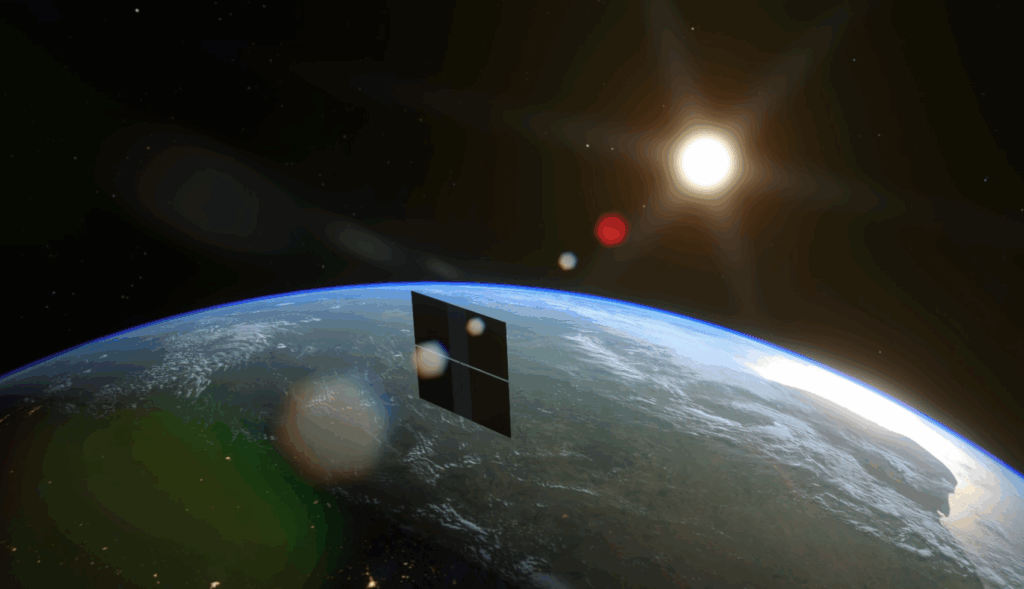
Can modern AI hardware survive a launch? Can it operate in orbit? Can it process data, update models, and send results back to Earth without routing everything through terrestrial data centers?
Starcloud showed the answer was yes.
Google is a giant in the field of AI. It pioneered large-scale deep learning, built the Tensor Processing Unit (TPU) to run AI at scale, and developed some of the foundational techniques behind modern neural networks.
Validating that models can run, update, and return results in space turns orbital compute from a theory into an engineering problem—the kind Google knows how to solve.
Nvidia is also running orbital tests.
In 2024, Nvidia-backed teams flew H100-class GPUs into orbit and demonstrated live AI workloads running on real silicon in space, processing data above the planet.
This is huge for the company.
Nvidia’s CEO Jensen Huang knows that land-based compute has a ceiling. If it’s to keep growing, its GPUs have to run in orbit.
For Nvidia, this matters because AI demand doesn’t stop just because Earth does. If future compute has to move off-planet to keep scaling, Nvidia wants its chips to be the default engines running there—just as they are in today’s data centers.
Then there’s Elon Musk.
SpaceX is the closest thing there is to an existing orbital compute firm.
Starlink satellites perform onboard processing today—handling routing, traffic management, and latency optimization across a massive constellation.
That’s compute in orbit, even if most folks think of Starlink as a communications network. The roadmap is incremental: more power per satellite, heavier payloads, more processing capability alongside communications hardware.
SpaceX already launches more mass to orbit than the rest of the world combined. As launch costs keep falling and Starship comes online, adding compute payloads becomes an economic decision, not a technological leap.
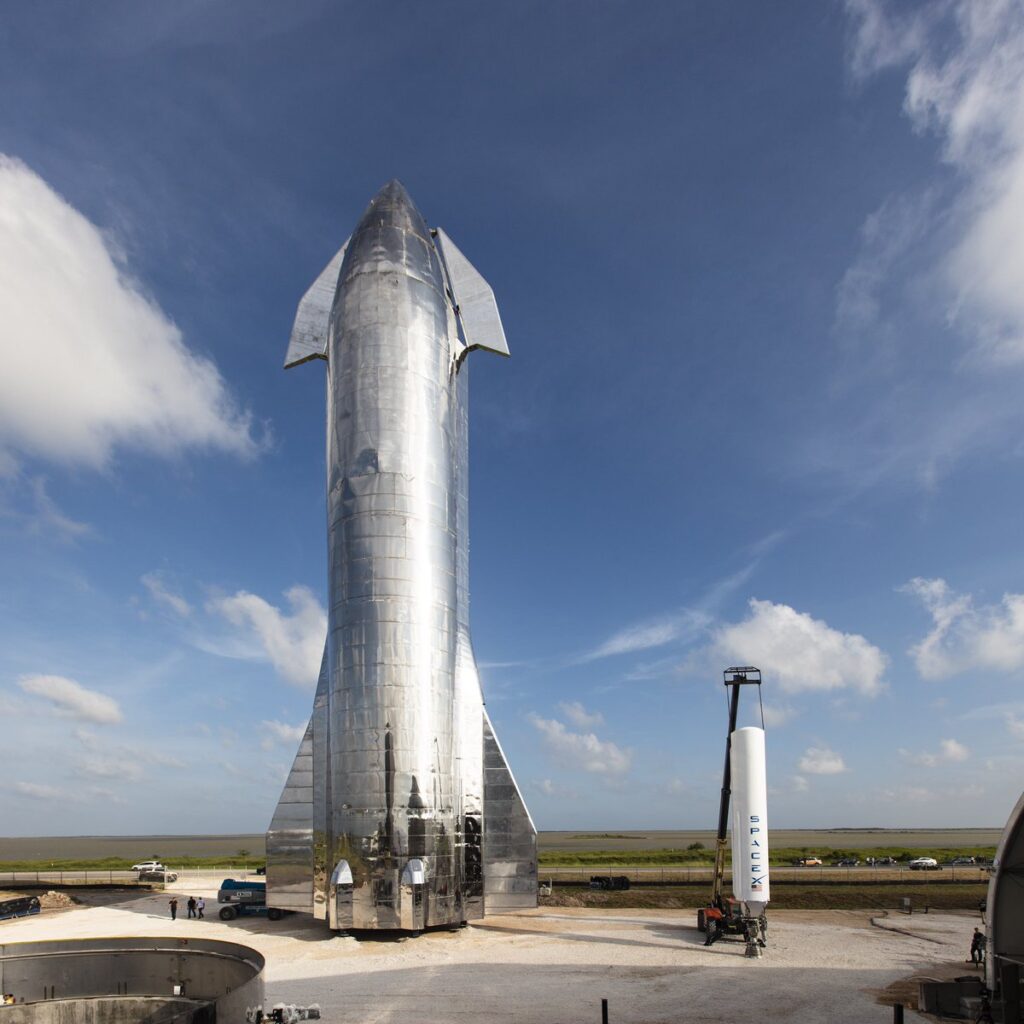
Starship is SpaceX’s next-generation, fully reusable heavy-lift rocket, designed to carry far larger payloads to orbit at a fraction of today’s launch costs.
And Amazon founder Jeff Bezos also has his eyes on space.
His space company, Blue Origin, is known today for space tourism. But for Bezos it’s ultimately about heavy-lift launch, orbital construction, and space-based power—the prerequisites for permanent, energy-intensive infrastructure off Earth.
You don’t invest in that infrastructure unless you believe large systems—including data centers—will need to live somewhere other than the planet’s surface.
To be clear, we’re not in the revenue phase of orbital compute. We’re not even in the scaling phase. We’re in the first real build-out phase:
- Experimental satellites
- Hardware testing
- Running test AI workloads in orbit
- Early demand from defense, intelligence, and satellite operators
This is exactly how every major computing platform has started.
At first, cloud computing looked like glorified web hosting. Hyperscale data centers started as oversized server rooms. Today, nearly all the world’s compute still happens on Earth. But as we reach physical limits here, the next stop is space.
And that means more and more money flowing into the firms leading the buildout.
The Biggest Infrastructure Spending Wave in Tech History
In the last three months of 2025, four companies—Amazon, Microsoft, Google, and Meta—poured nearly $120 billion into capital expenditures.
That’s roughly equal to the combined market value of Target, Chipotle, and Dollar Tree burned in a single quarter.
And this wasn’t spending on office buildings or corporate perks. The bulk of it went into data centers, power infrastructure, networking equipment, and AI-specific hardware.
Step back and look at the full year, and the picture gets even starker.
Big Tech spent in the region of $400 billion on AI-related infrastructure in 2025. That figure is already larger than the annual GDP of many developed countries—and it’s still climbing.
This is not optional spending.
These companies are locked in an arms race to secure computing capacity before their competitors do. Miss a build cycle, and you don’t just lose efficiency—you lose relevance.
You can see the impact across the market. The sectors most exposed to AI infrastructure—semiconductors, networking, power equipment, construction, and launch services—have been among the strongest performers.
And there’s no sign of this slowing down.
If anything, the pressure increases in 2026. AI models are getting larger. Inference demand is exploding. And the easiest places to build on Earth are already spoken for.
That’s what makes orbital compute so compelling as an investment theme—it’s the pressure release valve in a system already straining at its limits.
That doesn’t mean it’s easy.
Some Major Challenges Still Ahead
Orbital compute is compelling because Earth is running out of room and resources.
But moving computing infrastructure off the planet doesn’t magically remove all constraints.
Space data centers might solve the power and cooling problems. But they create new ones we haven’t cracked yet.
1. Cooling Isn’t Free in Space
It’s true that space is cold. But that doesn’t mean cooling is easy.
On Earth, data centers rely on air, water, and evaporative cooling to move heat away from chips. In space, there’s no air to carry heat away. The only way to cool hardware is through radiation.
The heat is carried away from chips through solid materials and fluids inside the system, then radiated outward through large external panels into the vacuum of space.
That creates a trade-off. The more compute you add, the more heat you generate. The more heat you generate, the more radiator mass and surface area you need.
Those radiators add weight, complexity, and cost. They also create design constraints that don’t exist in terrestrial data centers. Cooling in space works—but right now it doesn’t scale effortlessly.
This is why early systems focus on modest, task-specific workloads rather than brute-force AI training.
2. Radiation Breaks Hardware
Space is a hostile environment for electronics.
Because there is no atmosphere to blunt their impact, cosmic rays and solar radiation routinely flip bits in memory and processors—so-called “soft errors” that can corrupt data or crash systems. Over time, radiation also degrades hardware permanently, shortening useful lifespans.
There are ways to mitigate this: redundancy, error correction, radiation-hardened components. But all of them also add cost, weight, and complexity.
That means orbital compute won’t use the same economics as consumer GPUs in a warehouse. Hardware cycles are shorter. Systems must be fault-tolerant by design. And not every workload is worth protecting. That means only the most valuable or time-sensitive tasks justify the extra protection and cost of running in orbit.
Again, this favors focused tasks like sorting data, analyzing images, or making fast decisions—not the massive, always-on training runs used to build new AI models.
3. Latency Limits What Makes Sense
Distance matters.
Signals traveling between orbit and Earth introduce latency–or delay—that can’t be eliminated.
For some tasks, latency improves—especially when data is generated in orbit and processed there instead of being sent down to Earth and back again.
But for many AI workloads—especially large, synchronized training runs— latency is a deal-breaker.
But that’s okay. Orbital compute isn’t a universal replacement for terrestrial data centers. It’s a complement.
The workloads that make sense are those where:
- Data is generated in orbit
- Immediate local processing adds value
- Only results, not raw data, need to be sent back down
That’s why early demand comes from satellites, intelligence systems, and real-time monitoring—not consumer AI apps or cloud-based training clusters.
4. Debris, Security, and Survivability
Once you put infrastructure in orbit, you have to protect it.
Space debris is a real and growing problem. Collisions can destroy satellites outright or create cascading hazards that threaten entire orbital regions. Any long-lived compute system must account for collision avoidance, shielding, and end-of-life disposal.
There’s also security. These systems handle sensitive data. They can’t be rebooted by a technician or guarded by a fence. They must be designed to operate autonomously, withstand interference, resist cyber intrusion, and remain functional even when individual components fail.
How We Can Profit as Investors
Taken together, these challenges show why orbital compute won’t arrive as a single, monolithic leap.
It will emerge gradually—first in environments where uninterrupted operation matters more than convenience or cost. In practice, that means defense, intelligence, communications, and critical infrastructure long before consumer or commercial AI workloads move off Earth.
Which brings us to the question of how we can profit as investors.
Rather than placing all our chips on one company or technological breakthrough, we’ve organized our stock picks around the roles companies play in a future orbital compute system.
That’s why we’ve grouped our recommendations into five distinct categories, based on what each company does within the orbital compute stack.
Some of our recommendations sit at the base of that stack—what we call Core Compute & Cloud Platforms. These companies design the chips, software, and large-scale computing systems that make modern AI possible anywhere. If compute moves to orbit, they don’t need to reinvent themselves. They extend capabilities they already operate on Earth into a new physical location.
The next group of companies, Orbital Infrastructure & Launch Backbone, builds and launches the hardware that allows anything to function in space at all. These firms don’t care what workloads run on orbit. They benefit from one simple fact: More infrastructure is being deployed above Earth.
Our third group, Defense-Led Space Systems, sits closer to government and defense, where resilience, speed, and autonomy matter more than short-term economics. Historically, this is where new space architectures tend to appear first.
Finally, there are smaller, more speculative companies whose data, analytics, or specialized capabilities become more valuable if computation moves closer to where satellite data is generated. These recommendations fall into two categories: Data & Edge-Compute Beneficiaries and Speculative Frontier & Adjacent Plays. They offer asymmetric upside—but they also carry higher risk and volatility.
Organizing our picks this way lets you build exposure to the orbital compute theme across a spectrum—from large, established technology companies to smaller, higher-risk opportunities.
With that framework in mind, here are the 10 companies we believe are best positioned to benefit as orbital compute develops.
I. Core Compute & Cloud Platforms
Alphabet (GOOGL) and NVIDIA (NVDA)
Before you think about rockets, solar panels, or orbital platforms, you have to start with a simpler question: What actually does the computing?
Modern AI workloads are intensely physical. They involve moving enormous amounts of data through tightly packed processors, turning raw inputs into predictions, classifications, and decisions.
On Earth, that work happens inside hyperscale data centers—massive facilities filled with specialized AI chips, high-capacity power systems, industrial cooling equipment, and fiber-optic networks.
Orbital compute doesn’t change the nature of that work. It changes where it happens.
This is why the largest AI and cloud players on Earth still matter if computing moves into space.
Any serious effort to run AI workloads in orbit will still rely on the same core ingredients: purpose-built AI chips, software that coordinates work across thousands of machines, and cloud platforms that decide where each task runs.
Google parent company Alphabet (GOOGL) sits at this layer as a full-stack operator. It designs its own AI chips, operates one of the world’s largest cloud computing platforms, and runs services—such as mapping, imaging, communications, and large-scale AI inference—that naturally benefit from proximity to space-based data.
If computing migrates upward, Alphabet doesn’t need a new business model. It extends an existing one beyond Earth.
Nvidia (NVDA) occupies a different but equally central role. It doesn’t operate data centers, in space or on the ground. Instead, it supplies the graphics processing units (GPUs) that power modern AI.
Whether a GPU is installed in a server rack on Earth or integrated into a satellite platform, the requirement is the same: chips designed to perform many calculations at once, which is essential for training and running neural networks.
For us as investors, this group represents foundational exposure. These companies don’t depend on orbital compute to succeed. Their businesses already operate at global scale. Orbital compute simply creates another place where their technology can be deployed—making this layer lower risk, lower drama, and central to the entire theme.
II. Orbital Infrastructure & Launch Backbone
Rocket Lab (RKLB) and Redwire (RDW)
Before any computing can happen in orbit, something more basic has to occur. Hardware has to get there, deploy correctly, and keep working.
Orbital compute is not software. It’s physical infrastructure—platforms, power systems, structural frames, thermal management, and communications hardware operating hundreds of miles above Earth.
None of that appears by accident. It has to be designed, assembled, launched, and maintained in an environment where repairs are difficult and mistakes are unforgiving.
This is where infrastructure and launch providers come into play.
Rocket Lab (RKLB) sits at the gateway. It builds spacecraft platforms, integrates satellite systems, and provides launch services that place payloads into precise orbits.
Whether the payload is a communications satellite, an Earth-observation platform, or a future compute node, the mechanics are the same: reliable access to orbit, repeatable deployment, and mission operations that keep hardware functioning once it’s there.
If more infrastructure is sent into space, Rocket Lab benefits simply from increased activity—regardless of what that infrastructure is used for.
Redwire operates one layer deeper into the hardware stack. It focuses on the components and systems that make large, complex structures viable in orbit—deployable panels, power systems, in-space manufacturing, and integration capabilities that allow satellites and platforms to unfold, expand, and operate at scale.
Orbital compute concepts often hinge on size: large surface areas for power generation, thermal control, and communications. Redwire’s role is enabling those physical realities.
This category represents infrastructure exposure. These companies don’t need orbital compute to succeed as an idea. They benefit from a simpler trend: more equipment is being built and deployed beyond Earth. That makes this layer higher risk than mega-cap tech, but grounded in tangible activity rather than speculation.
III. Defense-Led Space Systems
Northrop Grumman (NOC) and CACI International (CACI)
Long before orbital compute makes sense for commercial AI, it makes sense for governments.
Defense and intelligence systems operate under a different set of rules than consumer technology. They value resilience over efficiency, autonomy over convenience, and continuity over cost.
These systems are expected to function in contested environments, under electronic interference, and without constant human oversight. That makes them natural early adopters of computing architectures that don’t rely entirely on congested, Earth-bound infrastructure.
This is where defense-focused space companies enter the picture.
Northrop Grumman (NOC) sits at the center of U.S. military and national security space programs. It designs and builds satellites, space-based sensors, communications systems, and integrated architectures that already operate far from Earth.
As missions become more data-intensive, the logic shifts toward processing information closer to where it’s collected—rather than transmitting everything back to ground stations.
That naturally pulls compute upward, into orbit, as part of broader space-based defense systems.
CACI International (CACI) operates one layer down, on the software and mission-systems side. It specializes in secure communications, cyber operations, intelligence systems, and the digital infrastructure that allows distributed assets to work together as a single network.
Orbital compute isn’t useful on its own. It only matters if data can be moved, processed, secured, and acted upon in real time. That orchestration—especially in classified or hostile environments—is CACI’s domain.
For us as investors, this category represents early-stage realism. These companies are not betting on futuristic consumer use cases. They’re aligned with how new space capabilities have historically emerged: quietly, through defense and intelligence programs, with long timelines and durable funding.
Growth here is slower and less visible—but it’s grounded in mission-critical demand rather than commercial experimentation.
IV. Data & Edge-Compute Beneficiaries
Planet Labs (PL) and BlackSky (BKSY)
Not every beneficiary of orbital compute will build hardware or launch satellites. Some will benefit because their data becomes more valuable when it can be processed faster and closer to where it’s collected.
Earth-observation systems generate enormous volumes of raw imagery. High-resolution pictures of cities, ports, farms, roads, and military assets are captured continuously from orbit.
Today, much of that data is sent back to Earth before it’s processed, analyzed, and turned into usable intelligence. That adds time, cost, and bottlenecks.
Orbital compute changes that equation.
By allowing some processing to happen in orbit—filtering images, detecting changes, flagging anomalies—these systems can reduce how much data needs to be sent to the ground and speed up how quickly insights reach end users. Instead of shipping terabytes of raw imagery, satellites can transmit smaller, more meaningful outputs.
Planet Labs (PL) sits squarely in this model. It operates a large constellation of Earth-imaging satellites designed to capture frequent, wide-area coverage of the planet.
The value of that data increases as it becomes easier to process, analyze, and distribute at scale. Orbital compute doesn’t replace Planet Labs’ business. It enhances it by making its imagery more actionable and efficient to use.
BlackSky (BKSY) focuses on a narrower but more time-sensitive slice of the same problem. Its systems are built around delivering insights quickly— often in near real time—for applications such as monitoring infrastructure, economic activity, or security developments.
For this kind of use case, latency (aka delay) matters. Processing data closer to where it’s generated can materially improve responsiveness.
This group represents indirect exposure. These companies don’t need orbital compute to exist. But if computing moves closer to orbit, their data products become faster, leaner, and more valuable.
V. Speculative Frontier & Adjacent Plays
Intuitive Machines (LUNR) and Hewlett Packard Enterprise (HPE)
Not every company exposed to orbital compute sits neatly inside today’s infrastructure stack. Some operate at the edges of where computing might go next—or where adjacent capabilities could become relevant if the architecture evolves.
Intuitive Machines (LUNR) is best known for helping deliver equipment to the Moon. Its core business involves transporting payloads, operating spacecraft, and supporting missions that work far beyond Earth’s immediate orbit.
While the company is not building data centers in space, its experience matters because it operates in places where systems must function with very little support from Earth.
To understand why that matters, it helps to look at how most space systems work today.
Satellites in Earth orbit may be physically above the planet, but they are not independent. They rely on constant communication with ground stations on Earth, which in turn depend on power grids, networks, and human operators. If those Earth-based systems fail, the satellite may still be intact—but its ability to deliver data or receive instructions can be severely limited.
Some early space-based data storage concepts take a different approach. Instead of keeping systems tightly connected to Earth at all times, they are designed to operate farther out near the Moon, using low-power hardware that stores information and remains disconnected most of the time.
These systems aren’t meant for speed or daily use. They function more like off-site backups—accessed only occasionally, or in extreme situations when Earth-based systems are unavailable.
This is where companies like Intuitive Machines enter the picture. If computing and data storage move beyond Earth, even in limited or specialized forms, experience operating spacecraft in distant, low-support environments becomes valuable.
The opportunities here are narrower and more speculative than orbital AI computing, but they may also arrive earlier, as governments and institutions look for new ways to safeguard critical information.
Hewlett Packard Enterprise (HPE) sits at the opposite end of the spectrum. It is a mature enterprise technology provider, not a space company. So, its relevance here is indirect, but nevertheless promising.
Large-scale computing systems—whether on Earth or elsewhere—require tightly integrated hardware, software, and orchestration. As experimental compute environments emerge, especially in government or research settings, firms with experience designing and managing complex computing systems may participate at the margins. That makes HPE an adjacent exposure, not a pure play.
For us as investors, this category is best viewed as optional. These companies are not core beneficiaries of orbital compute, and they should not be treated as such.
Instead, they represent higher uncertainty—and in some cases, higher volatility—with outcomes that depend heavily on how and where off-Earth computing develops.
A Word on Risk
Now that we’ve laid out our 10 recommendations, it’s important to add a word on risk.
To make the risk profile of each pick clearer, here’s how the companies in this report generally break down by size and volatility.
Large-Cap Companies (Lower Volatility, Indirect Exposure)
- Alphabet (GOOGL)
- NVIDIA (NVDA)
- Northrop Grumman (NOC)
- Hewlett Packard Enterprise (HPE)
These are large, diversified businesses with established revenue streams.
None of them need orbital compute to work as investments. Their exposure to the theme is real, but it sits alongside many other existing revenue drivers.
As a result, these stocks are harder to knock off course. Even if you buy at an awkward moment, time has a way of smoothing out the bumps.
For most investors—especially those new to thematic investing—these stocks are the lowest-risk way to gain exposure to this investment theme.
Mid-Cap Companies (More Direct Exposure, Higher Swings)
- Rocket Lab (RKLB)
- Redwire (RDW)
- CACI International (CACI)
These companies are more tightly focused on space infrastructure, systems, and services.
Their fortunes are more closely tied to how activity in orbit expands over time. That gives them more direct leverage to the orbital compute theme. But it also means their stocks can move more sharply based on contracts, launches, or shifts in expectations.
This is the middle of the risk spectrum: more potential upside, paired with more volatility.
Small-Cap Companies (Speculative, High Volatility)
- Planet Labs (PL)
- BlackSky (BKSY)
- Intuitive Machines (LUNR)
These companies operate in narrower niches and have fewer levers to pull if conditions change. Their share prices can be highly sensitive to news, funding developments, or shifts in investor sentiment. If orbital compute accelerates quickly, they may benefit disproportionately. If it doesn’t, drawdowns can be severe.
These are not “set it and forget it” stocks. They’re speculations and should be treated as such.
Practical Risk Management for Newer Investors
A few simple principles can help manage risk when investing in emerging themes like this one:
- Start with the large caps
They provide exposure without requiring the theme to play out perfectly. - Size small with speculative names.
Smaller companies should typically represent smaller positions in a portfolio, not the core. - Expect volatility—and don’t react to it.
Sharp price moves are normal in emerging technology sectors. Volatility is the “price of admission” you pay to be in with the chance to make fortune-making gains. - You don’t need to own everything.
This report is a menu, not a checklist. Even one or two well-chosen positions can provide meaningful exposure.
Orbital compute is a long-term development, not a short-term trade.
Matching your position sizing and volatility expectations to the level of uncertainty associated with each risk category is just as important as picking the right companies.
From AI Data Centers in Space to AI-Powered Returns
The AI revolution isn’t just changing how the world works. It’s also changing how we invest.
At TradeSmith, we’ve built our own AI model – not for processing satellite images, but for predicting short-term stock moves.
We call it Predictive Alpha.
It’s a large-scale AI model trained on vast amounts of stock market data. And it uses proprietary machine learning models to forecast the expected price path of thousands of stocks for every trading day over the next month.
We’ve engineered Predictive Alpha on more than 120 million data points. These include…
- 4.2 million historical price outcomes, spanning seven years and more than 2,300+ stocks
- 88.9 million daily forecasts, covering 21 forecast days for every stock on every trading day of the year
- Plus, tens of millions of additional “validation runs,” including target accuracy, pattern recognition layers, and more
Based on this data, Predictive Alpha learns from the past, adapts to the present, and projects the future.
We’ve found that every stock has a specific “profit window” when it can move the most. For example, Tesla may have a six-day window, but Apple may have a 15-day window.
Every day, our system finds the ideal window to trade a particular stock.
Now, Predictive Alpha can’t predict the future with 100% accuracy. And it won’t get every trade right. But it can forecast, with up to 85% probability, where stocks will be tomorrow.
And the longer it runs, the smarter it gets. Here are the top 10 wins that it has identified so far…
- 9.6% on SOFI in 6 days
- 11.6% on ANF in 3 days
- 9.5% on SOFI in 3 days
- 9.4% on GRPN in 7 days
- 8.6% on BX in 8 days
- 7.5% on RVMD in 9 days
- 8.3% on CLS in 9 days
- 5.9% on CRBL in 6 days
These aren’t annual returns. They’re happening over a matter of days. Repeating these types of gains over these timeframes is like having a “house edge” on a casino-hopping Las Vegas trip.
Put the “House Edge” on Your Side
Each year, the Nevada Gaming Control Board (NGCB) writes a report on the success of the casinos on the Las Vegas Strip.
We all know the house always wins – this report tells us by how much.
In 2019, tens of millions of people flocked to Las Vegas to play casino games like blackjack, poker, and roulette. The NGCB shows that, collectively, those folks went home $6.6 billion poorer.
The house edge is the percentage of a player’s bet that the casino is likely to win. Said another way, it’s the statistical advantage a casino holds in any given game.
Casinos don’t win year in and year out because they get lucky. They have a deep knowledge of probabilities. And they use this knowledge to build an edge into every game they operate.
They make small wins thousands of times a day, millions of times a year. And these small edges, applied relentlessly, pile up.
It’s the same with Predictive Alpha. A 9.4% win in three days is impressive. Sustained across a trading year, those kinds of wins really add up.
The secret to making money in Vegas or in markets is simple: Find your edge and apply it over and over. Predictive Alpha gives you that edge.
Want to See Predictive Alpha in Action?
With Predictive Alpha, we didn’t chase the impossible dream of predicting the future or being right 100% of the time. We looked for an edge we could exploit over and over again.
Billionaire casino operators know how powerful that kind of edge is. The world’s best traders know it as well.
And as I mentioned earlier, you can now put this edge to work for you.
So, if you haven’t already, check out a live demo.
You’ll see how our AI analyzes five top stocks and predicts where their share prices could land over the next 21 trading days. It’s one of the most powerful trading tools ever developed – and you can try it free.
Just click the link below. It will take you to the page where you can try out the free demo, live on screen.
When you do, you’ll also discover how you can use this same AI system to forecast price movements on any of the 2,300+ stocks we track. From the robotics winners in this report to every major stock on Wall Street.
The future belongs to those who embrace AI – as an investment theme and as a trading edge.
It pays to be one of them.