Listen to the audio version of this article (generated by AI).
Anthropic has grown faster than almost any business in history.
In the first half of this year, revenue at the AI lab behind the Claude models hit $16.3 billion.
That’s up 1,300% from a year earlier.
Three years ago, Anthropic brought in about $41 million in revenue for the entire year. Today, it brings in that much in about 11 hours.
On Monday, it filed to go public. Soon, investors like you and me will be able to buy a piece of it.
Bankers are reportedly aiming to sell about 5% of the company to the public… raising as much as $100 billion. That would put a price tag of about $2 trillion on Anthropic as a whole.
That would make it the biggest IPO in history, topping even SpaceX’s record-setting debut in June.
But one number in Anthropic’s filing deserves far more attention than it’s getting.
The company has committed to $265.6 billion in fixed or minimum payments for computing power, on contracts running as long as 20 years. That’s roughly four years of its revenue.
And while those bills are locked in, most of Anthropic’s revenue isn’t. About 80% comes from customers who pay for what they use… including half the Fortune 500. More than 1,900 customers now spend $1 million or more each a year.
They can cut back any month… or switch to a rival like OpenAI, or to one of the cheaper, freely available AI models coming out of China.
There’s a lot riding on how fast AI keeps growing. And it raises a question every investor in the AI boom should be asking: Do you have to make a giant bet like this to profit from AI?
I don’t think you do.
Today, I’ll show you what the giant bet hiding in Anthropic’s filing tells us about how to play the AI boom… and the tech giant I believe is one of the smartest ways to profit from it. It doesn’t build cutting-edge AI models from scratch.
It pays only about $1 billion a year for its AI… less than half a penny for every dollar Anthropic has committed. And one of TradeSmith’s key momentum indicators says its stock is in a healthy uptrend right now.
20-Year Lease on a Month-to-Month Business
Imagine opening a restaurant on a 20-year lease, with rent you owe whether the tables are full or empty. Now imagine your customers can stop coming any night they like, with no notice.
That’s the position Anthropic describes in its own filing.
Its biggest costs come from computing power… the vast campuses of specialized chips that run its AI. To make sure it has enough, Anthropic has signed long-term contracts with Google, Amazon, Microsoft, and others.
Its revenue works very differently. Most of it depends on how much customers use its AI each month. And just two customers, which the filing doesn’t name, account for roughly a fifth of it.
Those customers have plenty of other options. ChatGPT maker OpenAI is a fierce rival, and it’s preparing its own IPO. China’s DeepSeek has released powerful AI models that anyone can download and use for free.
That’s the catch with usage-based revenue. If a customer finds a cheaper option, or simply needs less AI than it expected, Anthropic’s revenue can fall within weeks. Its computing bills can’t. They’re set for years, no matter what customers do.
To be fair, Anthropic isn’t in trouble today. I’m not claiming it’s like a dot-com with no money coming in. It generated $3.9 billion in cash from its operations in the first half of this year, and it had more than $131 billion in cash and short-term investments at the end of June.
And there may be plenty of room to grow. Big-company customers spent less than 0.1% of their total expenses on Anthropic in the third quarter. If they find a way to use AI to genuinely boost productivity, they’ll spend more.
Computing power is also the scarcest ingredient in AI right now, so locking it up early could prove to be a smart move.
So which is it… a brilliant move or a dangerous one?
Honestly, I don’t know. Neither does anyone else. Anthropic is betting that AI demand will keep growing fast enough to cover those bills. If it’s right, those contracts could look like a bargain in a few years. If it’s wrong, the bills don’t go away, and it will be in trouble. Anthropic itself admits it may need to “seek additional financing sooner than we currently anticipate.”
When a story can be read both ways like this, I stop trying to guess the ending. I look at the evidence.
This AI Play Rents Instead of Builds
For two years on my X account, I’ve been saying that consumer tech giant Apple (AAPL) may be the smartest AI company out there. That surprises a lot of people, because Apple has never been seen as an AI pioneer.
But that’s the point.
While Anthropic and its suppliers bet hundreds of billions on computing power, Apple has mostly let other companies carry that load.
In January, Apple and Google announced that Google’s Gemini AI models will power the next generation of Apple’s AI features, including Siri, its voice assistant. Neither company disclosed the price. But Bloomberg reported that Apple would pay roughly $1 billion a year.
Compare that with Anthropic’s $265.6 billion in locked-in bills. Apple gets cutting-edge AI for its devices without signing up for decades of fixed payments.
Apple does spend money on AI, but far less than its rivals. Its capital spending (money spent on buildings and equipment) was about $12.7 billion last year, compared with roughly $90 billion for Google’s parent company, Alphabet.
Meanwhile, Apple has what the AI companies want most: customers. It has more than 2 billion active devices worldwide. Every AI company would love to be on them, which gives Apple bargaining power instead of bills.
And Google already pays Apple far more than Apple pays Google. According to court filings, Google paid Apple about $20 billion in 2022 alone to remain the default search engine on iPhones.
Put those numbers side by side, and Apple’s AI bill to Google is roughly one-twentieth of what Google pays Apple for search. Money in the tech world tends to flow toward whoever owns the customer, and in this relationship, that’s Apple.
Think of Apple as the owner of the busiest shopping street in town. The AI companies are fighting over who gets a storefront. Apple collects the rent, whoever wins.
What Could Go Wrong
None of this means Apple is a sure thing. No stock is.
Apple has struggled to deliver on AI. It first showed off a smarter Siri in 2024, then pushed the key features back repeatedly.
Its fix was to turn to Google. Apple’s latest AI models, unveiled in June, are built on Google’s Gemini technology. That means Apple is relying on a rival for one of the most important technologies of our time. If the partnership ever soured, Apple would have to find another supplier.
But even that risk looks very different from Anthropic’s. The deal isn’t exclusive, so Apple can work with other AI companies, too. And if AI demand cools, Apple isn’t left holding hundreds of billions in bills. It still sells iPhones, Macs, and services to more than 2 billion devices.
Like I said, stories like this can be argued either way. That’s why I don’t base my decisions on them.
Before I invest, I check TradeSmith’s Health Indicators. They measure how a stock normally behaves, then tell us whether its trend is healthy (Green Zone), weakening (Yellow Zone), or broken (Red Zone). Short-Term Health tracks shifts over weeks and months. Long-Term Health tracks the bigger trend.
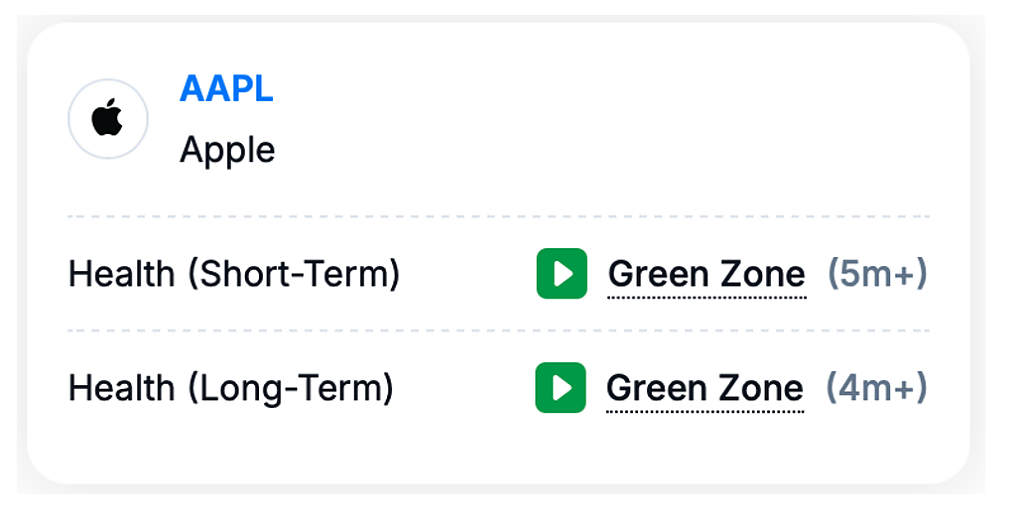
Right now, Apple is in the Green Zone on both measures – a sign of a healthy uptrend. It has been in the short-term Green Zone for more than five months and in the long-term Green Zone for more than four.
And it has a Quantum Score of 80.7.
That’s our measure of a stock’s overall strength, rated from 0 to 100. It combines how the business is performing, such as growth in sales and earnings, with how the stock is trading, including signs that big investors are buying. The higher the score, the stronger the stock. Anything above 80 puts Apple among the top-rated stocks we track.
That doesn’t guarantee Apple will keep rising. A stock can move from Green to Red, and when it does, that’s our signal to step aside. But today, the evidence shows Apple’s uptrend is intact.
As for Anthropic, it may well become one of the great companies of our time. But with its bills locked in, I’d rather let the evidence build before buying in. When its shares start trading, our software will begin measuring them like any other stock.
In the meantime, Apple offers a way to profit from AI without signing up for decades of fixed bills.
All the best,

Keith Kaplan
CEO, TradeSmith
P.S. I covered the Anthropic IPO in more detail on my X account here. I also named the chipmaker lined up to supply it with enough AI chips to draw up to 2 gigawatts of power… about what two large nuclear reactors put out. (Hint: It’s not Nvidia.)
P.P.S. Today, I showed you why I’d rather look at the evidence than guess how a story ends. My colleagues Andy and Landon Swan and our corporate partner Marc Chaikin take the same approach. The Swans track what millions of people say they plan to buy, often months before it shows up in a company’s earnings. Marc’s Power Gauge checks whether the business behind that demand is strong. Their new Stock Tsunami Detector flags the rare stocks where both systems agree. At this week’s Stock Tsunami Event, they walked through what it’s flagging right now and gave away three free stock ideas: two to buy and one to avoid. You can catch the replay right here.