Listen to the audio version of this article (generated by AI).
In This Digest:
• Nvidia fell 8% before anyone could read the news. Here’s how to stop chasing headlines – sign up for free access until our big event Wednesday
• Sellers just ran out of steam in these AI stocks, and our Snapback signals are already paying off
• Every rate scare is payday for this bond-trading platform
Nvidia fell 8% before most investors could read the news…
On Wednesday night, after the stock market closed, The Wall Street Journal reported that Nvidia’s board was meeting to decide whether to remove CEO Jensen Huang.
If you’ve been living under a rock, that might sound like the last thing anyone had on their 2026 bingo card.
Nvidia (NVDA) makes the chips that power most of the AI buildout. It’s among the largest and most important companies in the world.
But in the last few days, Huang has been at the center of an infidelity scandal involving both a suspected Chinese spy and, separately, a fellow Nvidia executive.
Last night, the stock fell about 8% in after-hours trading.
And this morning, about half an hour before market open, news broke that Jensen Huang would resign. The stock added to its losses, falling as much as 13% by the open.
This exposes the problem with trading stocks on the news: The price moves first… and the headlines let you know long after.
As our CEO, Keith Kaplan, showed you yesterday, that’s how it usually works. The price moves, and the explanation shows up afterward.
That’s why trading the headlines is a fool’s errand.
But you can trade the signals…
A market like this one is hard on buy-and-hold investors. The Nasdaq 100 had its worst day since 2020 last Thursday. It’s spent the week since then lurching up and down on whichever story is in front of it – and this morning, that story is Nvidia.
But big daily swings also throw off something buy-and-hold investors rarely see: short-term setups.
When stocks get pushed too far, too fast, they tend to leave behind the same clues in their trading data that showed up before past rebounds.
The trouble is spotting those clues in time. By the time a reason shows up in the news, the move is usually over.
That’s the problem our Signals system was built to solve.
It doesn’t read the news at all. It studies how each stock has traded – its price swings, and what the rest of the market was doing at the time – and flags the moment when conditions line up the way they did right before that stock’s past moves.
Take Equifax (EFX). When the credit-reporting company’s stock falls four days in a row while market volatility is running above its 10-day average, it has gone on to rise over the next two weeks 91% of the time.
During our test run this year, that pattern delivered a 15.2% gain in seven days.
Or take United Airlines (UAL). In April 2025, in the middle of a tech sell-off, the system flagged a pattern with a 94% historical success rate. United rose 10.2% in 11 days.
When we put the whole system through a live test in January, the top 100 trades it posted gained an average of 11.6% in seven days.
And right now, you can try it yourself. We’ve opened Signals free to TradeSmith Daily readers until next Wednesday.
Go here to unlock your free week of Signals.
Then next Wednesday, Nov. 18, at 10 a.m. ET, Keith is holding an online event to show you the patterns the system is flagging right now. He’ll name the stock with the strongest bullish pattern in the system today – and a popular stock it says to stay away from heading into Thanksgiving.
When sellers wear themselves out, the snap back is fast…
And when that happens, stocks can snap back quickly.
TradeSmith’s Snapback signal – part of our Trade360 software suite – is built to catch that moment. It fires when a stock takes a big loss in the middle of a downtrend that was already painful – exactly the setup we’re seeing today.
In a backtest of 342 trades going back to 2015, the stocks it flagged were higher 78.2% of the time within 21 trading days, with an average gain of 15.8%.
It’s a rare signal. In strong bull markets like the one we’re in now, we tend to see only a handful of signals a year.
Right now, it’s the busiest I’ve ever seen it.
As of Tuesday’s close, Snapback was flashing on 11 stocks, most of them AI data center and memory stocks.
Then Wednesday’s rally hit. Five of those signals hit their targets and closed out, bringing the list down to six.
That’s why it pays to see these signals when they fire, rather than read about the rebound in the news the next day. By then, the snap back has already happened.
And with Nvidia’s news hitting the AI trade again, more may be on the way.
The most recent signal still open is in Seagate Technology (STX).
Seagate makes the high-capacity hard drives that store the oceans of data AI data centers produce.
But the stock got caught in the AI sell-off. It’s down by more than 50% from its all-time high earlier this year. And since Election Day, it’s down more than 11%.
On Wednesday, it triggered a Snapback signal.
If STX follows the average of the past signals, it would reach about $639 per share by Dec. 2.
Consider STX for a short-term trade while the signal is open.
Every rate scare is payday for this trading platform…
Tuesday’s inflation report sent a jolt through the bond market.
The two-year Treasury yield jumped 17 basis points in a day.
That’s a big move for an asset most people think of as boring.
And every time rates lurch like that, big investors – pension funds, insurers, asset managers, and banks – have to reshuffle trillions of dollars in bonds to keep up.
They don’t care much whether rates go up or down. Either way, they have to trade.
And whoever runs the marketplace where they trade gets paid either way.
That’s Tradeweb Markets (TW).
Tradeweb runs electronic marketplaces where big investors trade U.S. Treasurys, corporate bonds, interest-rate swaps, and other investments.
Most retail investors have never heard of it. But on an average day in October, $3.6 trillion worth of trades went through its platforms. That’s up 26.3% from a year earlier.
Trading in U.S. government bonds alone jumped 32.6%.
Tradeweb collects a fee on most of those trades, like a toll on a busy highway. In the third quarter, its revenue rose 14.9% to $584.5 million, mostly on higher trading fees. CEO Billy Hult credited rising Treasury yields, shifting central bank policy and global uncertainty for driving clients to trade.
The Fed’s next meeting is Dec. 8–9, and traders are now debating how big a hike it will deliver. That’s the kind of question that keeps bond desks busy.
Our Predictive Alpha AI forecasting system agrees that Tradeweb has more room to run. It forecasts the stock will rise 8.7% by Dec. 4. And its forecasts for Tradeweb have hit their target 82% of the time – about 8 out of 10.
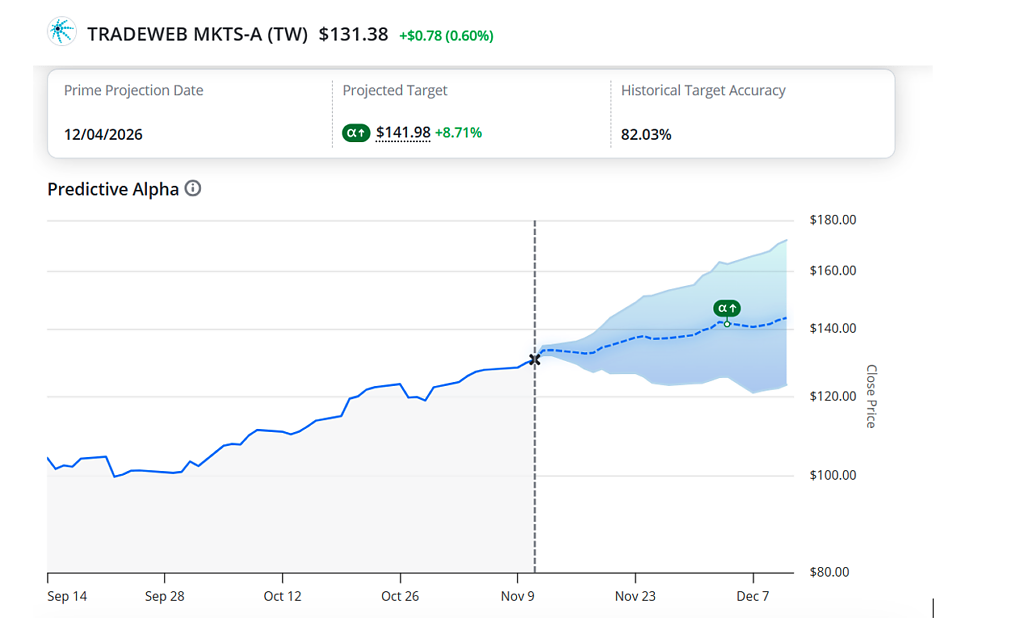
The stock has already climbed from about $100 in mid-September to $131. So there’s strong momentum behind it.
Consider buying Tradeweb. Every time the next inflation report or Fed speech sends the bond market into a spin, it collects the toll.
To building wealth beyond measure,
Michael Salvatore
Editor, TradeSmith Daily