Listen to the audio version of this article (generated by AI).
In This Digest:
- Anthropic goes public today – you may already own a big piece of it
- Why Iran is probing our grid, water systems, and banks… and this company is a leading defender
- The top half of the “K” is booking $25,000-a-night cruise suites. Wall Street hasn’t noticed
You probably already own a piece of Anthropic in your portfolio…
Today Anthropic – the company behind the Claude AI chatbot – started trading on the Nasdaq under the ticker ANT.
It’s being called the biggest IPO in history. Anthropic sold its shares at $83 apiece, above the $70 to $78 it first asked for. Investors put in orders for nearly $500 billion worth of stock… about six times what was on offer.
And as I write around noon today, the stock is opening about 17% higher than that.
That values the company at roughly $2 trillion.
But you don’t have to buy ANT today to profit. You may already own quite a big piece of it via one of the stocks you own.
Ecommerce and cloud titan Amazon (AMZN) has invested $18 billion in Anthropic since 2023. At the final $83 IPO price, Amazon’s fully converted stake would be worth about $289 billion – roughly 16 times its $18 billion investment and one-tenth of Amazon’s $2.9 trillion market value. At the final $83 IPO price, Amazon’s fully converted stake would be worth about $289 billion – roughly 16 times its $18 billion investment and one-tenth of Amazon’s $2.9 trillion market value.
Anthropic also trains and runs its AI models on Amazon’s AWS, the company’s cloud computing division. So as Anthropic grows, it pays more to Amazon.
Google owns a big stake, too – $33.3 billion invested, worth about $147 billion at the top of the range.
But big investors are treating these two companies very differently.
Our Quantum Score rates stocks from 0 to 100 on two things: the strength of the business and how strongly big investors are buying. Anything above 75 is a buy.
Amazon scores 85.8 – the highest in the Magnificent Seven. Its Fundamental Score of 91.4 shows a strong, growing business. Its Technical Score of 81.8 shows buyers are in control. Alphabet (GOOGL), by comparison, scores just 51.6 right now.
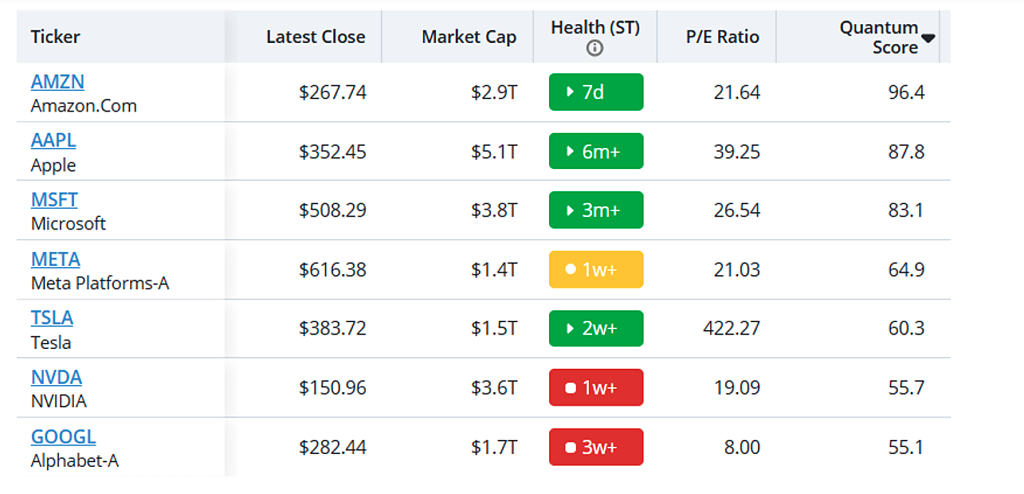
Amazon is also the newest Mag 7 stock to enter a Short-Term Health Green Zone, seven days ago on Nov. 12. Its trend turned healthy just as the IPO arrived.
And you’re not overpaying for it. Amazon trades at a price-to-earnings (P/E) ratio of 20.8 – that’s how much you pay for each dollar of profit. That’s the third-cheapest in the Mag 7. Apple, by comparison, trades at 39.2.
If you want a piece of Anthropic without betting on a brand-new stock, buy Amazon. You get the AI company’s biggest backer at a reasonable price – and our data on your side.
Iran is testing the locks on America’s power, water, and banks…
Yesterday, the head of Homeland Security told Congress that the U.S. was under attack by Iran.
Not with missiles or drones… but via cyberattacks on critical infrastructure.
“Iranian government cyber actors and pro-Iran cybercriminals have targeted U.S. critical infrastructure networks,” Secretary Markwayne Mullin said in written testimony to the House Homeland Security Committee.
The targets he named are the systems you rely on every day: transportation, hospitals, water, energy, and banking.
So far, Mullin said, the damage has been “localized and minimally disruptive.” Most of it hit poorly guarded control systems – the computers that run equipment like pumps, valves, and switches. But he warned that weak security in those systems “could create disruptive consequences.”
And no, Iran isn’t behind the outages we wrote about yesterday. FBI Deputy Director Christopher Raia told the committee there’s “no indication whatsoever that there is any cyber malicious activity related to any of those incidents.”
You might consider that cold comfort… America’s systems are breaking on their own – while a hostile government probes them for weak spots at the same time.
It’s stories like this that have led us to track cybersecurity as one of the biggest themes on our radar for months, most recently on Tuesday.
Every attack – and every attempt – makes the case for the companies paid to stop them.
But cybersecurity isn’t one trade. There are dozens of companies in it, and a headline like yesterday’s doesn’t tell you which stock is set up to move – or when.
That’s the job of our Signals system.
It doesn’t factor in headlines, analyst ratings, or company financials at all. Instead, it scans each stock’s trading history for combinations of factors that have come before moves higher.
When those factors line up again, it flags the trade – and tells you how often that pattern has worked on the stock before.
Each morning, it runs more than 4,000 calculations on every one of 2,467 stocks and weighs 10.4 million possible trades. So far, it’s found more than 30,000 of these patterns.
And this morning, one is firing on a company that guards the front door: Okta (OKTA).
Okta manages logins. When an employee signs in to work email, a hospital’s records system, or a utility’s software, Okta checks that they are who they say they are – often with a code or a tap on their phone.
That front door is where Iranian hackers have been knocking. In a 2024 advisory, the FBI, Cybersecurity and Infrastructure Security Agency, and National Security Agency warned that Iranian actors were guessing passwords at scale and flooding employees’ phones with login requests until someone tapped “approve.” Their targets included healthcare, government, engineering, and energy companies.
Companies are signing up to better secure these systems. In its latest quarter, Okta’s remaining performance obligations – revenue customers have signed up for that Okta hasn’t booked yet – climbed 17% to $4.9 billion. And it turned 28% of its sales into free cash flow, the cash left over after running the business.
The signal firing on Okta is a breakout. It fires when Okta closes well above the prior day’s high – by more than the size of a typical daily swing over the past two weeks.
It’s a rare setup. It’s fired 56 times since 2017 and eight times in the past year. Seven of those eight trades closed with a gain, and all eight together averaged 3.6%. The best gained 8.2%. And half were closed in less than two weeks.
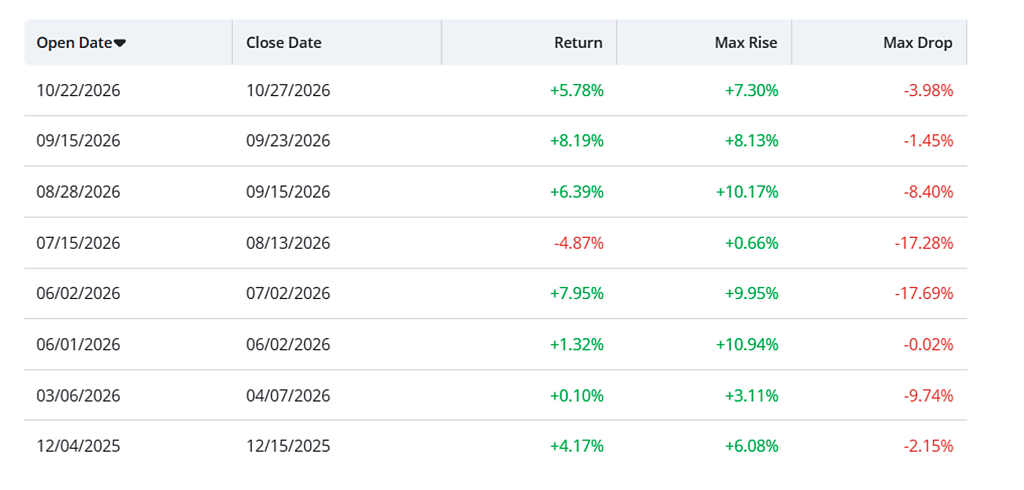
To trade this, buy Okta and hold until you see a 6% gain or for the next 21 trading days, about a month – whichever comes first. Then close the trade and move on to the next signal.
This week, 11,703 of you signed up to join our CEO, Keith Kaplan, for our AI Signals Trading Event. If you missed it, you can still watch the replay here.
Keith tells the story of Jim Simons, the math genius who built the most profitable hedge fund in history by hunting for repeating signals in market data… shows how we built a system that picks up where Simons left off… and names the stock with the strongest bullish signal in our system right now – plus a popular stock it says to stay away from heading into Thanksgiving.
I’d urge you to watch it while it’s still up. Catch it here before it goes offline.
Finally, watch what the top half of the “K” is doing…
Andy and Landon Swan head up our MegaTrends advisory. It’s where they uncover emerging market megatrends by tracking the purchase intent of millions of consumers online.
For the past couple years, one of the biggest themes they track is the K-Shaped Economy. Andy explained it to our Platinum members recently:
Our data tells us consumer spending is still holding up… But look closer, and this is a K-shaped economy… Some companies and households are doing fantastic, while others are falling behind. And the gap is widening every quarter.
Picture the letter K. One arm points up: households with savings, stock portfolios, and paid-off homes, who keep spending. The other points down: households squeezed by high prices and rising rates.
They both spend – but one group is decidedly spending on luxuries while the other focuses on the necessities.
You can see it in stocks like Norwegian Cruise Line Holdings (NCLH).
In the third quarter, its ships sailed 106.5% full – possible because cruise lines count two guests per cabin, and plenty of cabins carry three or four.
Last-minute bookings and onboard spending both beat the company’s expectations, and profits came in 20% above Wall Street’s estimate.
The luxury end is running hottest. When Norwegian’s luxury line Regent opened bookings on its newest ship, the Seven Seas Prestige, it beat its record for a new ship’s launch day by 26%. The ship’s top suite starts at $25,000 a night. It’s already booked on more than 70% of the ship’s 2027 sailings.
Consumers in the top half of the K are happy to spend on luxury cruises.
Yet NCLH stock trades 28% below its one-year high.
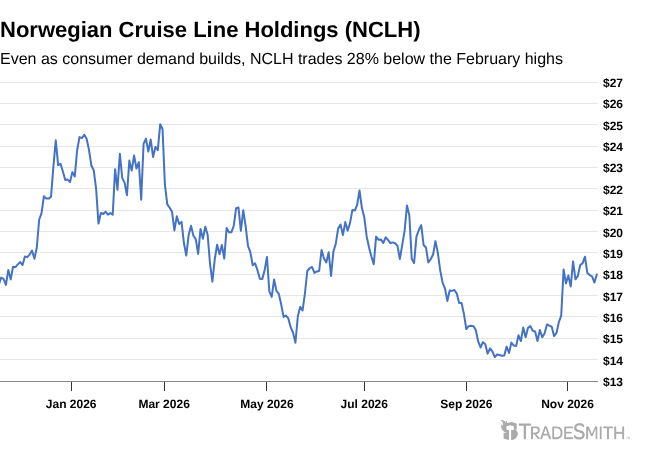
But the Swans’ Social Heat Score shows consumers are spending at Norwegian even as Wall Street ignores it.
Social Heat tracks whether demand for a company’s products is building online – in search trends, web traffic, social media and more – before it shows up in sales. Norwegian scores 74.0 out of 100 overall.
But the real story is in the two component scores. Norwegian’s Main Street Score, which measures that real-world demand, is 64.0. Its Wall Street Score, which reflects how investors and analysts see the company, is just 36.0. That 28-point Divergence is why our system flags the stock as undervalued.
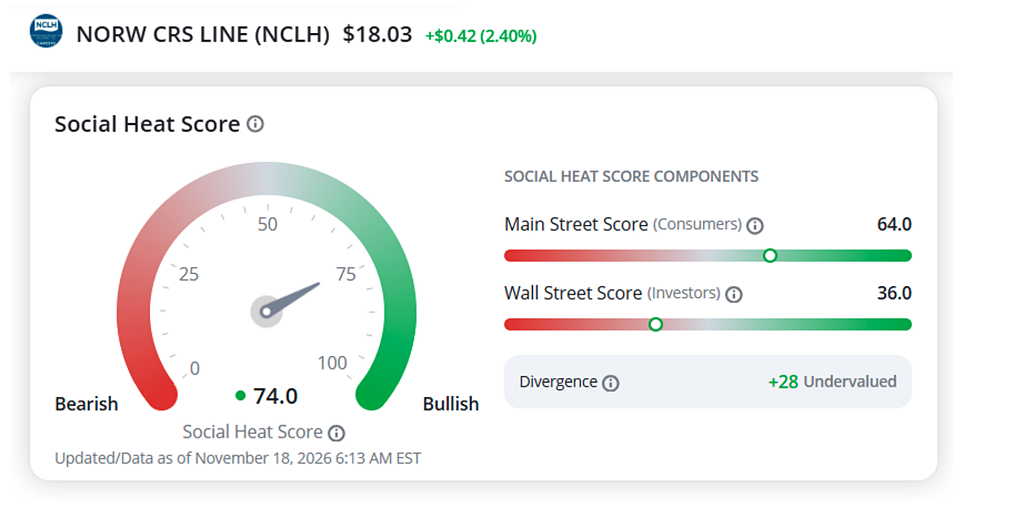
If you’re looking for exposure to the top half of the K-shaped economy, NCLH is a stock with a big consumer tailwind behind it. Consider putting it on your watchlist while this divergence is still open.
To building wealth beyond measure,
Michael Salvatore
Editor, TradeSmith Daily
Disclaimers: Michael Salvatore held shares of GOOGL at the time of publication.