From Factory Floors to Earth’s Orbit: 10 Ways to Play the New Robot Economy
It’s 2:11 p.m. in Oshino, Japan, and a factory hums in darkness.
No shift whistle blows. No foreman paces the line. No fluorescent bulbs buzz overhead.
A hydraulic robotic arm fits a bearing with perfect torque. An autonomous cart rolls past, delivering parts on its pre-programmed route. Overhead, cameras check the line for errors and send the data to servers humming in a back room.
The plant runs 24 hours a day, seven days a week. The lights are off because no one needs them.
This is a plant run by FANUC, a Japanese company that has shipped more industrial robots than anyone on Earth. Here, robots build other robots — about 50 a day — running unsupervised for as long as 30 days at a stretch.
And the darkness isn’t the only thing that sets this plant apart.
“Not only is it lights-out,” says FANUC’s vice president, Gary Zywiol, “we turn off the heat and air conditioning, too.”
Competitors in China and Europe are racing to copy the model, because dark factories don’t just cut costs. They create an output edge that rivals can’t ignore.
And that’s not the only place where robots are on the job.
At Amazon’s 855,000-square-foot fulfillment center in Tracy, California, squat orange robots ferry shelving units across polished concrete floors. They zip and pivot in tight formation, choreographed by AI to avoid collisions.

Together, they cut average order processing times from hours to minutes — essential in an era when customers expect one-day or even same-day delivery.
One warehouse can field more than 3,000 of them. Amazon now has more than 750,000 robots in operation worldwide — the largest deployment in history.
Rivals like Walmart and Alibaba are scrambling to copy the model. For Amazon, robots aren’t just a cost saver. They’re a moat. Faster fulfillment locks customers deeper into Prime, keeping competitors two steps behind.
And far from factory floors, robots are showing up in places you might least expect.
At a White Castle in Merrillville, Indiana, the fryer hisses at 375°F. Grease spits against the steel backsplash, and the air reeks of salt and oil.
In most kitchens, this is the station no one wants. It’s known for burns, boredom, and wages that barely cover rent. Turnover is so fast that new hires often barely last a month.
Here, a robot nicknamed Flippy leans over the fryer. Its stainless-steel arm dips into the vat, times the cook, shakes off the oil, and empties fries into a tray with the same rhythm every time.
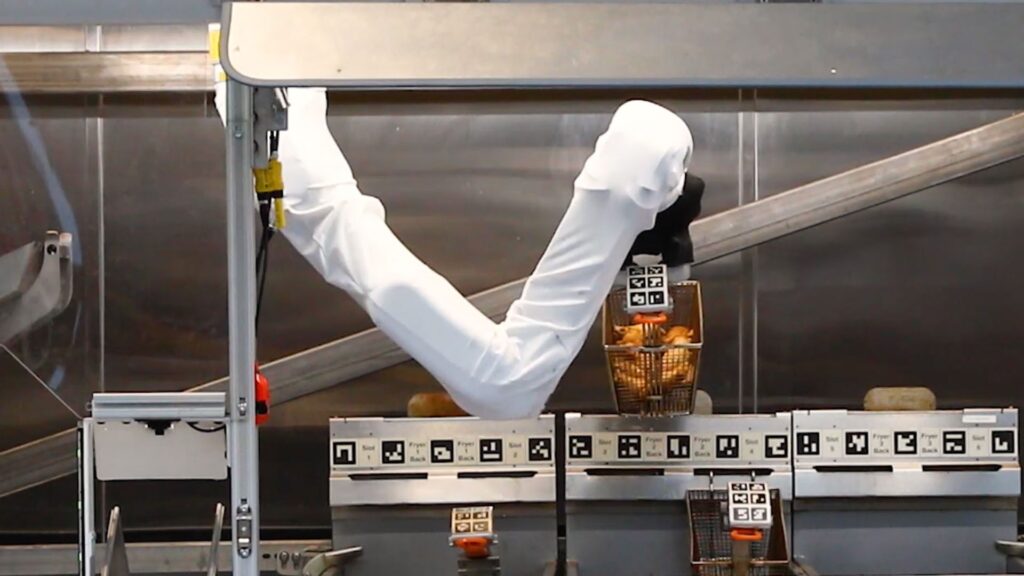
No burns. No missed orders. No forgetting the salt. And this robot line cook doesn’t get sick or bounce to another job.
This saves White Castle money. Flippy runs all day, every day, for about $3,000 a month — less than half the cost of two full-time line cooks at $20 an hour.
And restaurants aren’t adopting Flippy just for savings. In many areas, there aren’t enough human workers left to hire.
Commuters are also turning to robots for convenience.
In Phoenix, Arizona, a driverless taxi glides through traffic. The car — one of Waymo’s fleet of Jaguar I-Paces — bristles with cameras, radar, and spinning LiDAR domes that map the city street by street.
It stops at lights, makes turns, and merges onto freeways — all without a human touching the wheel. There’s no small talk, no tips, just the electric whir of the motor as its AI pilot steers through the city.
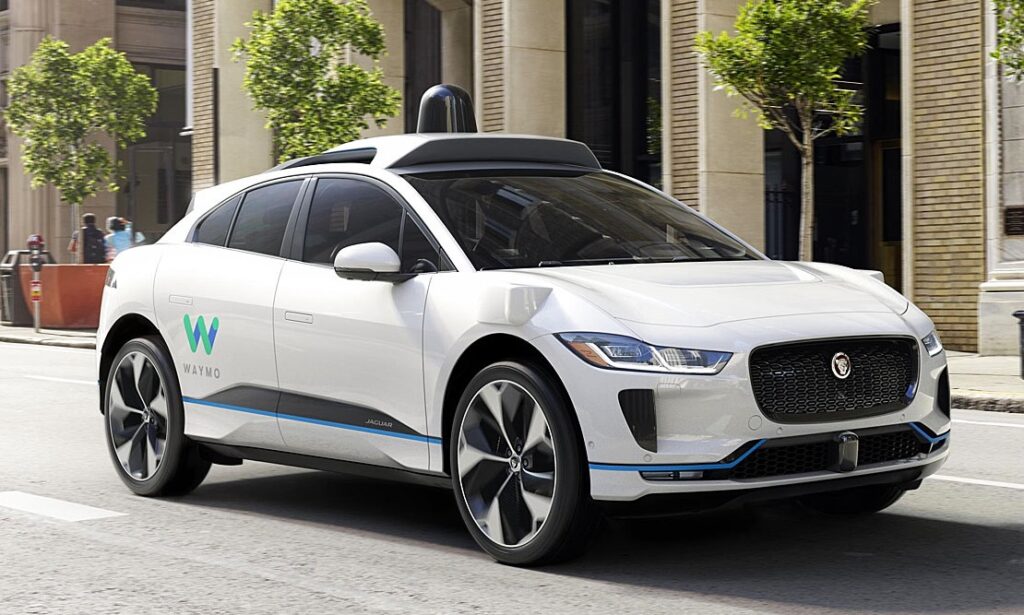
Waymo also operates robotaxi fleets in San Francisco, Los Angeles, and Austin. And it isn’t alone. Tesla, GM’s Cruise, and Baidu in China are racing to roll out their own driverless fleets.
And these aren’t the only robots Phoenix residents are turning to.
St. Joseph’s Hospital and Medical Center is one of the city’s top hospitals. Surgeons there perform hysterectomies and mitral valve repairs — a type of heart surgery — using the da Vinci Surgical System. It’s a precision-engineered, minimally invasive robotic platform.

For the mitral valve procedures, a steady mechanical arm holds instruments inside a patient’s chest, filtering out tremors and translating a surgeon’s movements into precise millimeter-scale motions. What once required large incisions and long recoveries now ends with a handful of stitches.
More than 10,000 da Vinci Surgical Systems are installed in hospitals worldwide. Surgeons use them in more than 2 million procedures a year.
Robots are also transforming the battlefield.
Over the fields of eastern Ukraine, a quadcopter buzzes low over the tree line. A soldier watches through VR goggles as the drone locks onto the shape of a tank.
Russian jamming cuts the video feed, but the drone stays on course, guided by a vision module trained to recognize its target. The drone slams into the turret, detonating an explosive charge and disabling the tank.
This is the frontline reality in 2025. Ukrainian engineers fit small first-person-view drones with computer vision so they can strike even if the pilot loses signal. Each unit costs a few hundred bucks, but the cost of the target can be millions.
The U.S. military is watching closely. At Nellis Air Force Base in Nevada, the Air Force has tested “loyal wingman” drones — unmanned aircraft that fly alongside F-35s, carrying weapons, jamming radar, or scouting ahead. They extend the reach of a fighter squadron without putting a pilot at risk.
From factories to warehouses, kitchens, hospitals, battlefields, and even space — robots are sparking a new Industrial Revolution. Like steam in the 18th century and electricity in the 19th, automation is transforming how work gets done and wealth is created.
Past revolutions minted fortunes. This one will be no different.
Where the Next Fortunes Will Be Made
For decades, robots were bolted to floors, performing the same repetitive motions on factory lines.
Today, thanks to AI, they are breaking out of those cages. They can adapt to new tasks, navigate their environment, and make decisions on their own.
The scale of this shift is staggering. The International Federation of Robotics, a robotics trade association, says nearly 4 million industrial robots are in operation worldwide. It expects 2 million more in the next three years.
And that estimate may turn out to be too conservative.
Here’s Nvidia’s CEO Jensen Huang, speaking at the company’s GTC keynote in 2023:
The ChatGPT moment for robotics is coming. We’re working towards a day where there will be billions of robots, hundreds of millions of autonomous vehicles, and hundreds of thousands of robotic factories.
Even if Huang is only half right, robotics is shaping up to be one of the most powerful market booms of the next decade. Early investors have the chance to really move the needle on their wealth.
Every wave of technology — from semiconductors in the 1980s, the internet in the 1990s, smartphones in the 2000s, and AI today — has produced extraordinary gains for those who acted early.
Robotics is the next wave.
Robots touch everything: the food you eat, the packages on your doorstep, the car you drive, the surgery you may one day need, and the military that defends you.
Wherever repetitive work is needed, a machine is on its way to doing it better, faster, and cheaper.
In this report, we’ve zeroed in on 10 companies at the heart of this shift. Each represents a critical piece of the robotics future — and a chance to profit as the boom accelerates:
1. The Brains – Nvidia (NVDA), Trimble (TRMB), Microsoft (MSFT)
Without brains, robots are limited to repeating pre-programmed tasks. These are the AI chips, cloud platforms, and positioning systems that let robots perceive, learn, and navigate.
Nvidia (NVDA)
If companies like Tesla are building the bodies of robots, Nvidia is building their brains.
Its chips – originally made for video games – have become the gold standard for computationally intensive AI models.
Nvidia’s chips can perform parallel calculations at lightning speed. This is exactly what’s needed to train and run neural networks that allow robots to see, think, and react in real time.
Robots rely on AI to interpret the world around them. It allows them to see objects, understand speech, recognize patterns, and make split-second decisions. Nvidia’s chips power all of that.
And it’s not just hardware. Nvidia has also created a simulation platform called Isaac Sim. It lets engineers train robots in hyper-realistic 3D virtual environments before deploying them in the real world.
Isaac Sim uses physics-based simulation—including gravity, friction, and sensor noise—so robots “experience” realistic conditions. This allows millions of scenarios to be run in hours: “What if the robot bumps into this? What if the floor is wet?” Once the AI has learned enough in simulation, you upload it to the physical robot.
Nvidia isn’t just selling silicon. It’s selling the intelligence layer that makes robots so useful.
Trimble (TRMB)
Trimble isn’t a household name like Nvidia. But it’s another important enabler of our robotics future.
It’s all about precision positioning – basically, GPS taken to the next level.
When you or I use GPS, being off by a few feet is no big deal. But for a robot laying out steel beams in a skyscraper, or a tractor planting crops row by row, accuracy down to the centimeter is critical. That’s what Trimble delivers.
Their tech gives machines a sense of place. Without it, autonomous robots can’t safely navigate construction sites, farms, or survey missions. With it, they can perform precise, repeatable tasks that humans either couldn’t do or would take far longer to achieve.
You don’t see its logo on the robot. But its GPS tech keeps those robots from getting lost or making costly mistakes.
Microsoft (MSFT)
When you think of Microsoft, you probably think of Excel, Word, and Outlook. What you may not think of is “flight school for robots.”
Robots are physical, but their brains are trained digitally. And Microsoft’s cloud platform, Azure, lets companies build digital twins of the real world—factories, warehouses, even city streets.
In these virtual spaces, robots can practice their tasks over and over until they get it right. It’s like how pilots train on simulators. Robots do the same thing in Microsoft’s cloud – millions of trial runs, in hours, instead of months of risky real-world testing.
Then you’ve got the human-robot interface. Microsoft’s HoloLens mixed reality headset allows a human operator to see through the robot’s “eyes,” guide it with hand gestures, and essentially collaborate with it. That makes robots more intuitive and less intimidating to use.
Microsoft may not be building the robots, but it’s providing the training grounds, the intelligence tools, and the control interfaces that make robots actually practical.
2. The Eyes – Ambarella (AMBA)
Robots can’t act in the world without sight. Cameras capture images. But the real work happens in the chip that interprets it.
That’s where Ambarella comes in. It gives robots their eyes.
The company designs advanced vision processors — low-power chips that allow machines to see objects, track movement, and make split-second decisions.
Its chips are already inside drones, security systems, and dash cams. But the bigger opportunity is industrial and automotive robots. These machines must process images in real time to operate safely.
In warehouses, Ambarella chips help autonomous robots navigate crowded aisles and avoid collisions. On the road, they power driver-assistance systems and self-driving cars, interpreting lane markers, stop signs, and pedestrians. On factory floors, they allow robotic arms to align parts with microscopic precision.
Efficiency is key. Ambarella’s edge-AI processors deliver high performance at a fraction of the power draw, which means longer battery life and faster reaction times — essential in mobile robots. That’s why leading automotive and robotics firms are building them into their next generation of machines.
That’s what makes Ambarella such a great way to play the robotics boom. Robots need eyes — and Ambarella makes them.
3. The Muscles – Lithium Americas (LAC), MP (MP), Freeport-McMoRan (FCX), Energy Fuels (UUUU), VanEck Rare Earth and Strategic Metals ETF (REMX)
If the Brains give robots perception, the Muscles give them strength.
It’s easy to overlook this part of the story. When we think about robots, we think of AI breakthroughs, sleek humanoid designs, or drones buzzing over battlefields. What we don’t see are the metals, magnets, and materials inside – the hidden inputs that actually make motion possible.
A robot can see a box it needs to lift — but without the stored energy to power its motors, the box stays on the floor.
Robots move thanks to actuators — the robotic equivalent of muscles. An actuator converts energy into motion: the grip of a robotic hand, the bend of a knee joint, the thrust of a drone’s rotor.
That energy depends on electricity supplied by a battery. And batteries are overwhelmingly lithium-ion.
Lightweight, rechargeable, and energy-dense, they are the only technology that can realistically power mobile robots at scale. Without lithium in batteries, actuators don’t push, motors don’t spin, and robots don’t move.
That’s why Lithium Americas is in this report. It controls two of the largest known lithium reserves in the world — the Thacker Pass project in Nevada and the Caucharí-Olaroz project in Argentina. Together, they represent a critical share of future supply at a time when demand is set to multiply.
Lithium demand isn’t only about electric cars. Every drone, every autonomous vehicle, every humanoid robot, every warehouse robot increases demand. Consider the coming addition of millions of machines, and the world’s lithium mines start to look very small.
Lithium Americas is a key supplier of energy for the robotics revolution. It provides the raw power that lets machines act on their intelligence. As robots scale from thousands to millions, lithium will become the choke point.
Similarly, a humanoid like Tesla’s Optimus may look like a software marvel. But its actuators depend on neodymium-praseodymium (NdPr) magnets, often hardened with trace amounts of dysprosium or terbium. Without them, Optimus couldn’t lift a box, bend an elbow, or walk across the floor.
One robot alone can require more than a kilogram of rare-earth magnets. Scale that across Morgan Stanley’s projection of a billion robots by 2050, and demand explodes to hundreds of thousands of tons of magnet material – far more than today’s global output.
And it’s not just robots. These magnets power EV motors, drones, wind turbines, and even missile guidance systems. Whoever controls the magnet supply chain controls the motors. And whoever controls the motors controls the machines.
That’s why the White House has labeled rare earths a national security priority. In fact, the U.S. government has taken a 10% stake in Lithium Americas’ Thacker Pass project to secure a domestic supply of critical minerals.
For decades, China has dominated mining and, more importantly, refining, with about 90% of global capacity.
The risk is obvious: Beijing could stall the robotics revolution at its whim. The response has been a scramble to fast-track domestic mining, refining, and magnet manufacturing.
Three other U.S. companies now stand out as the backbone of America’s robot “muscles”:
MP Materials (MP) – The Magnet Maker
- Owner of the Mountain Pass mine in California – the only large-scale rare earth mine in the U.S.
- Has built a Fort Worth, Texas, plant to produce finished NdFeB magnets, creating the first full mine-to-magnet supply chain outside China.
- It already supplies about 15% of the world’s REE output and is uniquely positioned to feed critical magnet components to Tesla, GM, and the Pentagon.
Freeport-McMoRan (FCX) – The Circulatory System
- America’s copper giant. Copper is the “blood” of robots: wiring their nervous systems, coiling their motors, and carrying current through their bodies.
- Also touches nickel and cobalt, essential for the lithium-ion batteries that keep humanoids untethered.
- As Washington pushes to classify copper as a “critical mineral,” Freeport’s role in the robotics supply chain grows even more strategic.
Energy Fuels (UUUU) – The Refining Edge
- Historically a uranium producer, it is now a rare-earth refiner through its White Mesa Mill in Utah.
- Produces neodymium-praseodymium oxide domestically and has processes in place for heavier rare earth elements, such as dysprosium.
- By building out America’s first real rare earth refining capability in decades, it’s helping close the gap that left U.S. mining dependent on Chinese processing.
For folks who want to play the theme more broadly, there’s the VanEck Rare Earth and Strategic Metals ETF (REMX). It offers exposure to a basket of global rare-earth producers, from MP in the U.S. to Lynas in Australia. And it carries an annual fee of 0.58%.
4. The Next Frontier – Rocket Lab (RKLB)
The robotics revolution doesn’t end on Earth. The same technologies transforming factories and hospitals are also carrying us into orbit — where robots are already at work.
Rocket Lab is one of the companies making that possible.
From its launch site on New Zealand’s Mahia Peninsula, its Electron rockets have delivered satellites into space for NASA, the U.S. Space Force, and dozens of private firms. Small, rapidly reusable, and reliable, these rockets have turned space travel into a routine rather than a rarity.
What sets Rocket Lab apart is how it builds. Its Rutherford engines are 3D-printed by automated systems in just 24 hours — a process that once took weeks. That makes it one of the first aerospace firms where robots are building the machines that carry other robots into orbit.
Once there, Rocket Lab’s work continues.
Through its Photon satellite platform, it provides the robots that operate in space—monitoring weather systems, tracking ships at sea, relaying communications, or conducting research far from human hands. It’s even exploring in-space manufacturing: satellites and structures assembled by robotic systems without ever touching Earth.
The company is developing the Neutron rocket, a larger vehicle capable of lifting payloads up to 13 tons. If successful, it could launch full constellations, robotic landers, or infrastructure for missions beyond Earth orbit.
Rocket Lab is the next frontier of robotics. It’s not about factory arms or warehouse robots. It’s about automation in space — robots building, operating, and maintaining the systems that extend human reach into orbit.
Time to Invest in This Unstoppable Force
Every era brings new unstoppable forces. Think steam power in the 1800s, electrification in the early 1900s, or the internet in the 1990s.
Each transformed how we live and created fortunes for those who saw the shift early.
Today, that force is automation and robotics powered by AI. For the first time, machines can see, think, and act on their own.
And it’s not just AI that’s fueling this shift. Cheaper sensors, faster chips, and new lightweight materials are making machines smarter, faster, more energy-efficient, and more adaptable.
These advances are arriving at precisely the moment they are needed most. Populations are aging, labor pools are shrinking, and costs are rising. Many economies are struggling to lift productivity.
From 2010 to 2018, U.S. labor productivity grew at 0.8% a year — less than half the pace of its postwar average of 2.1%.
Meanwhile, total factor productivity (TFP) in manufacturing, which tracks output growth not explained by labor or capital inputs, has been weak or near flat in recent years.
Robotics isn’t just a technological upgrade. It’s an economic necessity. The incentives are irresistible. Robots don’t sleep, don’t strike, and get cheaper every year.
That’s why I believe robotics is an inevitable trend. It’s not about guessing which robot arm or drone will dominate. It’s about seeing that automation is the foundation of the next era of productivity — an economic revaluation that could rival the Industrial Revolution.
By investing in the companies in this report, you’re taking part in a new industrial revolution — one driven not by steam or electricity, but by intelligence.