

As widely expected, the Federal Reserve finally got around to cutting interest rates yesterday – delivering a 0.50% reduction and lowering the Fed funds rate to a target range of 4.75% to 5%.
While that’s a healthy cut, that number is still relatively high compared to falling core Consumer Price Index (CPI) inflation, which is now down to an annual increase rate of just 2.4%. But don’t worry, because the Fed also indicated on Wednesday that another 0.50% rate reduction is on tap before year end – with more cuts to come in 2025.
That ends the longest rate hiking cycle in the last 15 years. And a long wait for the market since rate hikes ended: the Fed has held rates at a steady 5.25% to 5.5% for the past 14 months. So, rate cuts have been a long time coming, and the Fed didn’t disappoint.
But markets gave out a collective yawn after the news. Perhaps that’s because rate cuts were so widely anticipated in advance that it became a “sell the news” event.
As I noted in my last Inside TradeSmith column, a more aggressive series of rate cuts could send the wrong message about the economy. It could also become a convenient excuse for consumers and businesses to wait it out for even lower rates.
Look at it this way: If business owners and consumers expect more rate cuts to come, they may delay large investments or big-ticket purchases until next year – when financing is cheaper.
We’ve already witnessed a slowdown in the housing market, as mortgage rates rose above 7% from late 2023 through May of this year. And with the Fed forecasting lower rates to come, there’s a strong incentive to wait for even lower mortgage rates in future. The same is true for both auto loans and business investment projects.
Basically, any expenses that are financed with debt will get cheaper down the road as the Fed delivers more rate cuts – and that could bring a slowdown in consumption as people wait things out. But that doesn’t mean you should leave your capital on the sidelines. Historically, some areas of the market thrive in these rate-cutting environments.
Select Sectors Shine After First Rate Cuts
Historically, when interest rates are cut five times or more, stocks on the whole tend to show mixed results after the first rate cut – as you can see in the chart below:
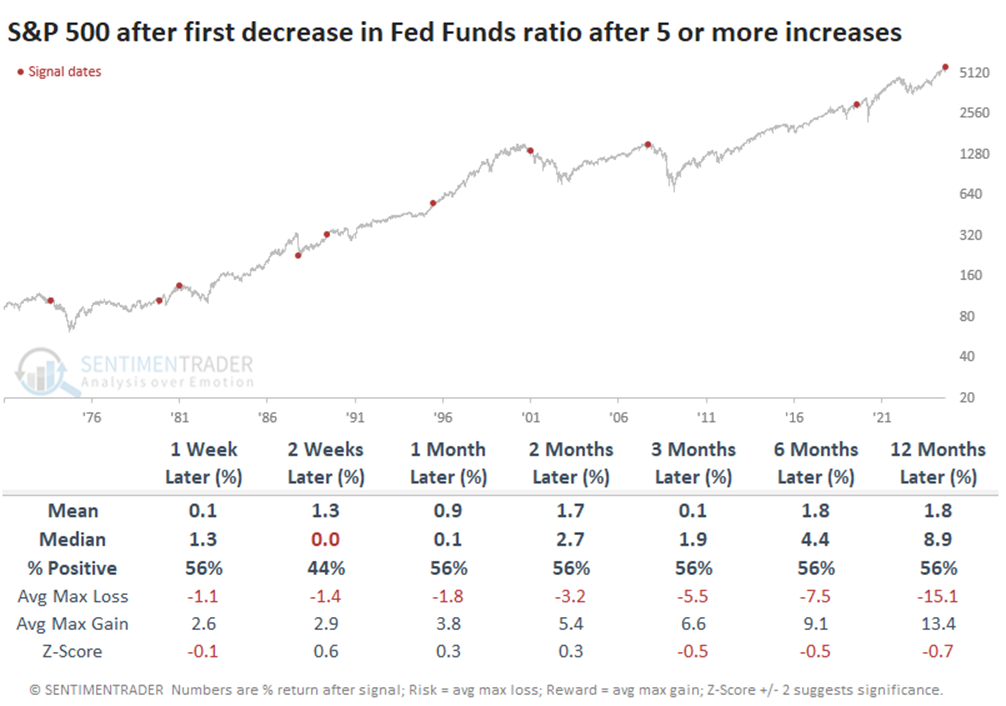
In fact, over the past nine rate cutting cycles going back to 1973, the S&P 500 Index shows average returns of just 1.8% one year later. And stocks are up just 56% of the time – barely better than odds of a coin toss.
Plus, the S&P 500 suffered significant drawdown risk during six out of the last nine rate cut cycles since 1973, averaging -15%.
But here’s the good news: Certain investment styles and sectors tend to outperform significantly when the Fed starts cutting rates – and that’s where you should focus as cuts begin.
Historically for instance, value stocks (+8.3%) outperformed growth stocks (+3.6%) by more than 2-to-1 in the six months after the first rate cut of a cycle. Defensive stocks and sectors also outperformed over the same time frame.
But in terms of sector returns, healthcare (+19.4%) and consumer staples (+16.8%) stand out ahead of the rest, outperforming the overall market up to one full year after the Fed lowers rates for the first time, according to Jason Goepfert at Sentiment Trader.
In my last column, I suggested a TradeSmith Screener with filters to uncover quality stocks, which also perform very well as interest rates fall and markets potentially turn more volatile.
First, go to your Invest button in the top navigation bar. Once you’re on the new page, select Screener from the white menu bar. Then, select the green + Create new screener button.
From there, you can easily tweak that screener to add filters for the styles and sectors that are proven outperformers during a rate cutting cycle, as shown below:
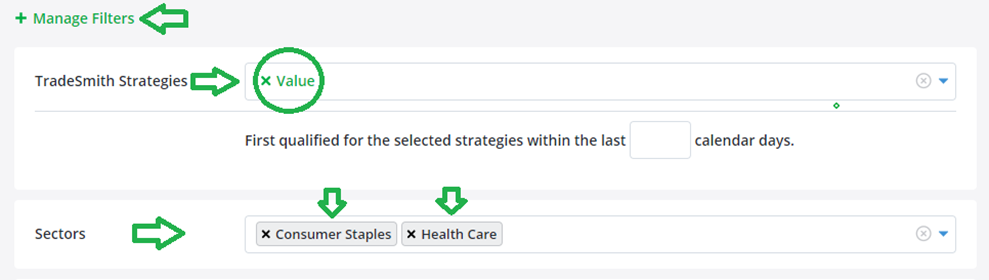
Simply log in to the TradeSmith Finance platform, take the previous screen from my last column and just click on + Manage Filters.
Add TradeSmith Strategies and scroll down to select Ideas Lab > Value. Next, add the Sectors filter and scroll down and check both Consumer Staples and Health Care.
When I ran this modified screen yesterday, I got plenty of results. See below for a brief sample:
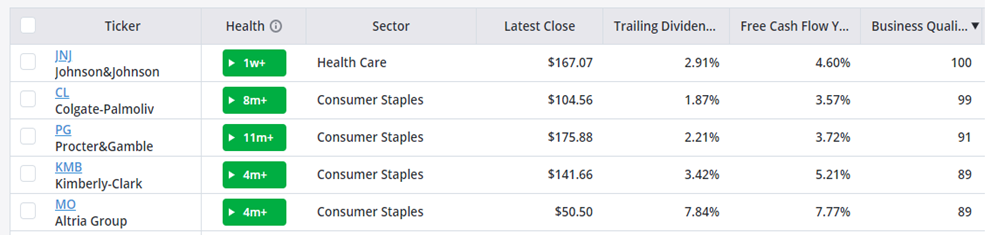
As always, don’t hesitate to explore and modify your screener filters to suit your tastes. Generally, the more filters you add and the tighter they are set, the fewer results you’ll get. Relax your filters a bit, and you’ll increase your results as a starting point for further research.
Now, this modified screener can help you find the right style of stocks in the right sectors that have historically outperformed during rate cut cycles.
But what about protecting your portfolios from the risk of a stock market drawdown? Well, if you ask me, I’d look to volatility.
Hedge Trade Idea: Buy Volatility on the Cheap
To help hedge yourself against market volatility in the months ahead, you can easily and inexpensively turn to the options market – and specifically to call options on the market’s fear gauge, the CBOE Market Volatility Index (VIX).
We already witnessed a VIX spike in early August, which was blamed on unwinding of the Yen carry trade. VIX jumped from a low of 16 to a high of 65 in just three trading days!
And if seasonal patterns hold true, we could see more upward spikes in VIX ahead. If so, the next bout of market volatility could last longer than just a few days.
Historically during election years going back to 1990, the VIX has typically risen about 10% in September… and it tends to rise another 25% in October.
In other words, that means we could see an average VIX reading of 25 or more at some point in October, just ahead of election day in early November. That’s up from just above 16 today!
Our own TradeSmith seasonal indicators confirms this – as shown in the seasonality chart below:
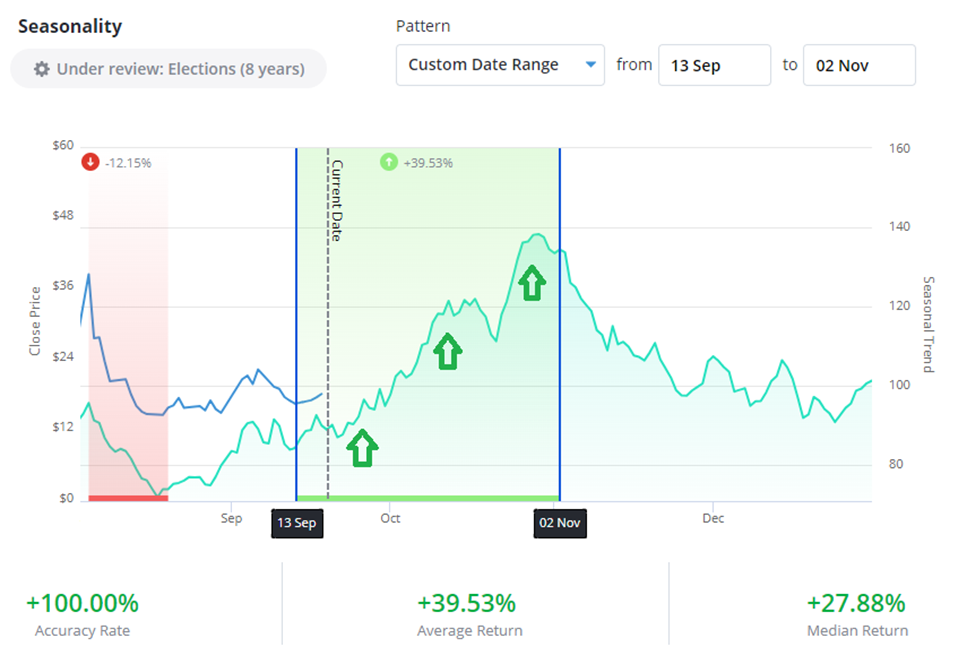
Based on our own data analysis, the VIX has surged 39.5% higher on average between Sept. 13 and Nov. 2 – with a 100% accuracy rate over the last eight election years.
A cheap and easy way to take advantage is with VIX call options, which are extremely cheap to buy right now as implied volatility has fallen significantly since the August peak. Just remember that options involve risk, and you should never invest more than you’re prepared to lose if the option expires worthless.
But this trade gives you an inexpensive way to hedge against the very real probability of another volatility spike ahead. Here’s how to find a potential trade:
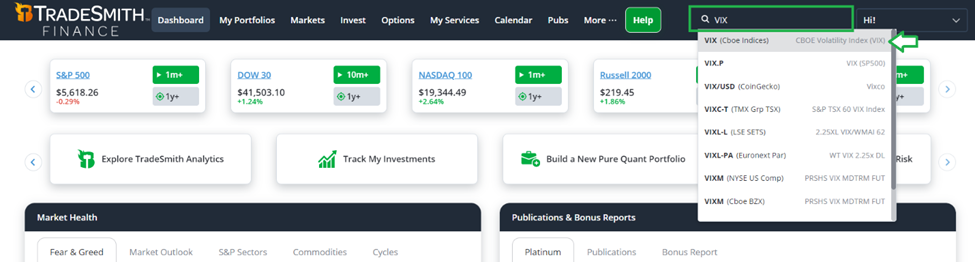
Simply log in to your TradeSmith Finance account and click on the search bar at the top right of the screen. Enter the ticker symbol for the CBOE Volatility Index, “VIX”, then select the correct option from the search results.
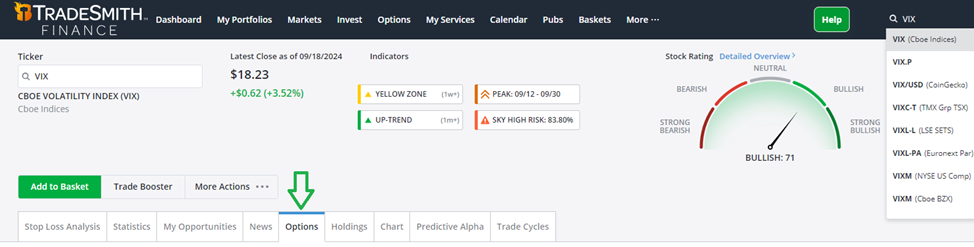
Next, open the Options tab in the TradeSmith Stock Analyzer:
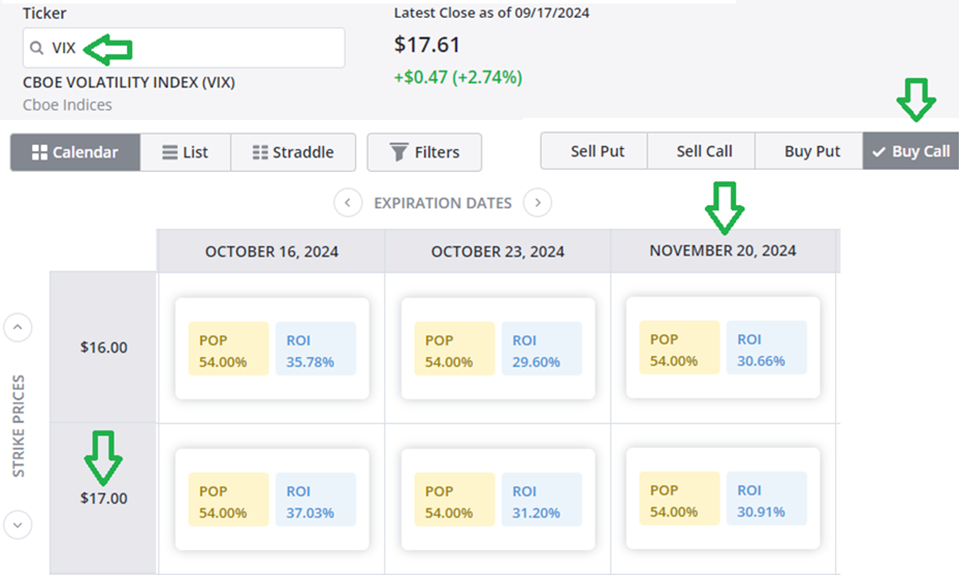
Finally, select “Buy call” from the list of options, then scroll through the Calendar view of the VIX option chain.
I have full access to the breadth of our TradeSmith tools via my Platinum subscription, so you may not have access to our options features shown above. If you’d like to add them to your account, simply contact us at 888-623-0858 to find out more.
Now the VIX Nov. 20, 2024 $17 strike call option looks interesting; it’s just out of the money based on the current VIX price of $16.50. Plus, you can buy this call option for about $2.60 per contract ($260) right now – and it provides unlimited upside potential.
Mike Burnick’s Bottom Line: If the VIX rises 39% – as our seasonality data suggests – it means a VIX reading of about $22.80. That would put this call option example shown above in the money by $5.80 per contract, for a potential gain of 123% in less than two months. That’s a fairly inexpensive way to hedge that could pay off nicely.
Good investing,
Mike Burnick
Senior Analyst, TradeSmith
P.S. Options are a fantastic tool to keep in your portfolio, especially when it comes to hedging against market volatility. But trading options comes with risk, and it can be daunting to get started.
TradeSmith offers plenty of educational resources to get comfortable with options trading, and plenty of tools to maximize your chances of success – but for those looking for a guided course, consider joining our corporate partner Jonathan Rose for the Masters in Trading 5-Day Options Trading Challenge, kicking off on Monday, Sep. 23.
We spoke with Jonathan earlier this month to learn about the Advanced Notice tools he uses to spot unusual options activity – and now, he’s offering something brand-new: A crash-course in options trading, to get you from knowing zero to options hero.
Over five days, you’ll learn proven options strategies from a seasoned market maker with over 25 years of experience – without risking any upfront capital.
And with the VIX historically spiking during election years, and the Fed beginning a new rate-cut cycle, Jonathan’s approach can help you position your portfolio for success – even in times of market volatility.
This challenge will teach life-long trading skills, including a simple three-step system designed to target the type of trades that have led Jonathan to gains of 126%, 245%, or even 463% – often in 30 days or less, regardless of market conditions.
But don’t wait – because this challenge is live. You must sign up by Sep. 22 to secure your spot.
If you’ve ever wanted to learn how to maximize your profits with options, this is your chance to gain the tools and confidence from one of the best. To learn more, click here for all the juicy details.