

Large-cap growth stocks have been grabbing all the headlines again and leading the overall market higher.
The S&P 500 Index gained 4.96% in the month of May, and almost half of this total return came from large-cap growth stocks like the Magnificent 7: Microsoft (MSFT), Nvidia (NVDA), Apple (AAPL), Amazon (AMZN), Meta Platforms (META), Netflix (NFLX), and Alphabet (GOOG).
What’s more, the Mag 7 contributed more than 75% of the S&P’s 11.3% total return year-to-date.
Meanwhile, small-cap stocks, which typically perform well early in a bull market, have been missing in action recently.
The S&P SmallCap 600 gained a paltry 1.6% so far this year, a far cry from the 11%-plus gain for the S&P 500.
But in May the SmallCap 600 jumped 5.04% compared to a 4.96% gain for the big-cap 500. If this continues, this could be the first year that small caps have outperformed since 2010.
Why Investors Should Buy Into Small Caps’ Surge
This could be just the beginning of a bigger reversal of fortune for small caps, and there are two good reasons to take notice of it.
Reason No. 1: Bargain-Basement Valuation
First, small-cap stocks have been lagging large for several years now. And this spring, they nearly set a new record-low valuation compared to the S&P 500: just 14 times forward price-to-earnings (P/E), compared to 20 times for big cap stocks. That represents a 30% discount!
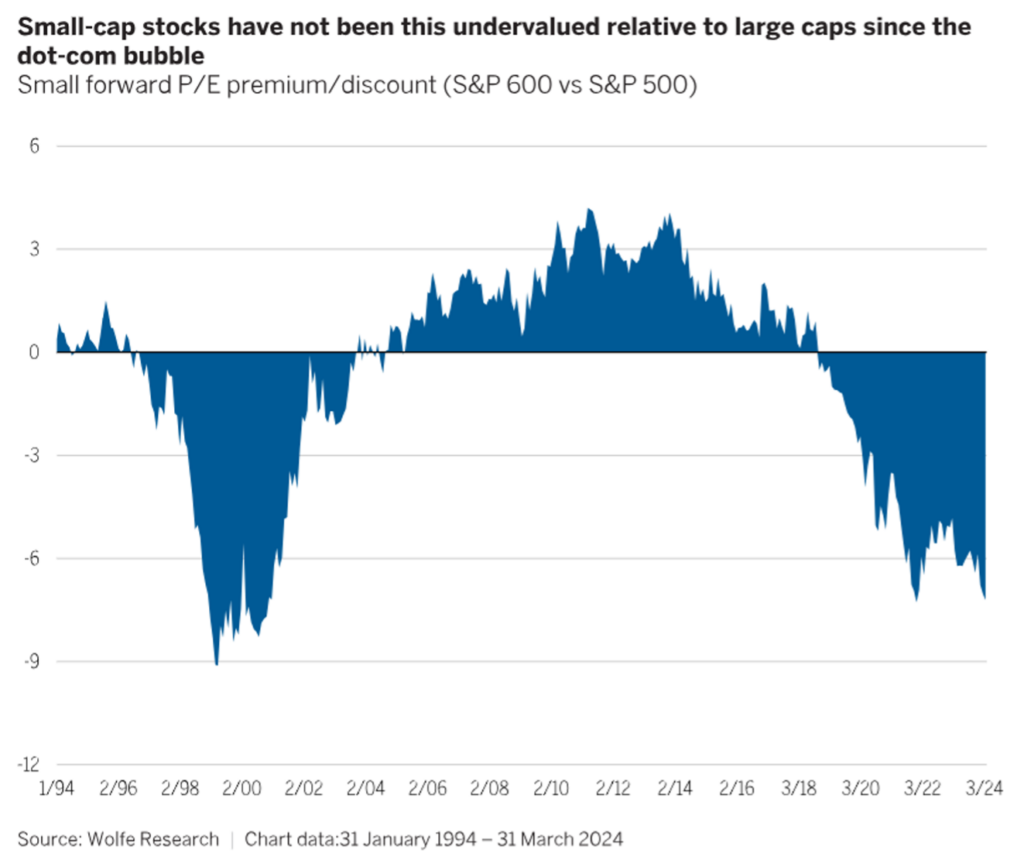
Even now, after small caps’ surge in May, they haven’t closed the valuation gap (yet): Their forward P/E ratio stands at 15.6, versus 21.4 for the large caps.
Reason No. 2: Faster Profit Growth
Not only are small caps far cheaper than their large-cap counterparts, but the companies are also growing faster. Among the Russell 2000 Index of small caps, expected earnings growth for 2024 is 17.7%, compared to just 10.5% for the S&P 500.
So, it’s no wonder small caps just grabbed the performance-leader position last month. And they might very well extend this lead straight through year-end.
With that in mind, I put together a TradeSmith Screener to scan for quality small-cap stocks with the right stuff to possibly lead the market higher.
How to Screen for the Best Small-Cap Buys Now
If you’re an Ideas by TradeSmith, Trade360, TradeSmith Essentials, or Platinum member, you should already have full access to the Screener tool I’m about to show you. But if you don’t see this in your TradeSmith Finance dashboard — and would like to — call 888-623-0858 to discuss.
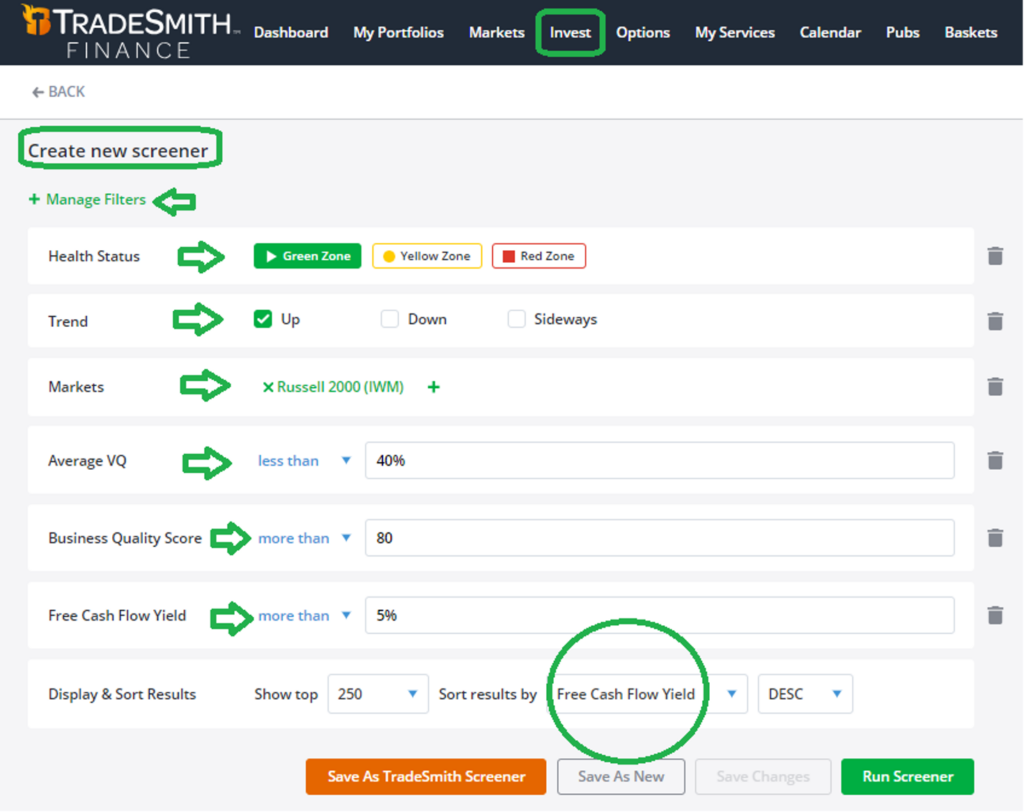
Log in to your TradeSmith Finance platform and click Invest in the top menu bar, then click on + Create new screener. Next, click on + Manage Filters and add the following filters:
- Under TradeSmith filters, make sure Health Status, Trend, Average VQ, and Business Quality Score are selected with the checkboxes. Uncheck any others there.
- Next, under General, click on the filter for Markets, and uncheck any others.
- And under Fundamental filters, add Free Cash Flow Yield.
Below is what your screener should look like with these specific boxes checked:
Now here’s why I chose these filters.
First, for the Trend, I want only the healthiest stocks found in the TradeSmith Health Indicator Green Zone and also stocks in a confirmed uptrend.
For Markets, I chose the broader Russell 2000 Index of small-cap stocks.
Average VQ is our proprietary measure of the average riskiness of a stock based on its historic volatility. The lower the number, the more stable the movement of that stock. So, here I chose less than 40%: the same filter level we use for our proven Low Risk Runners strategy.
Next comes our yardstick for quality, the Business Quality Score (BQS). As a refresher, BQS considers the most critical characteristics of stocks likely to outperform the market, which include:
- Growth in sales, profit, cash flow, and high returns on equity and assets
- Profitability compared to its own history and compared to other stocks
- Safety: low debt, low risk, and low volatility
- Payout: How profits are used to enrich shareholders and grow the business
Our BQS ranks every stock from zero (lowest quality) to 100 (highest quality), showing you at a glance how any stock measures up.
I chose to screen for stocks with a BQS of more than 80 to focus on the top 20% of small-cap stocks by quality.
Finally, I screened for stocks with Free Cash Flow Yield more than 5%, which is roughly twice the FCF yield of the average stock in the market overall.
So, this last filter narrows it down to stocks with very high FCF relative to the size of the business, measured by enterprise value (equity market value + debt).
This metric is not only another great indicator of business quality, it’s proven to be one of the most predictive measures of a stock’s fundamental value over many decades.
As with dividend yield, a higher FCF Yield is better. That’s why I sort my results by FCF Yield DESC (descending), so that TradeSmith lists the highest-yielding stocks at the top.
When I ran this screen after the close yesterday, I got 19 results. Due to space limitations, here are the top 10:
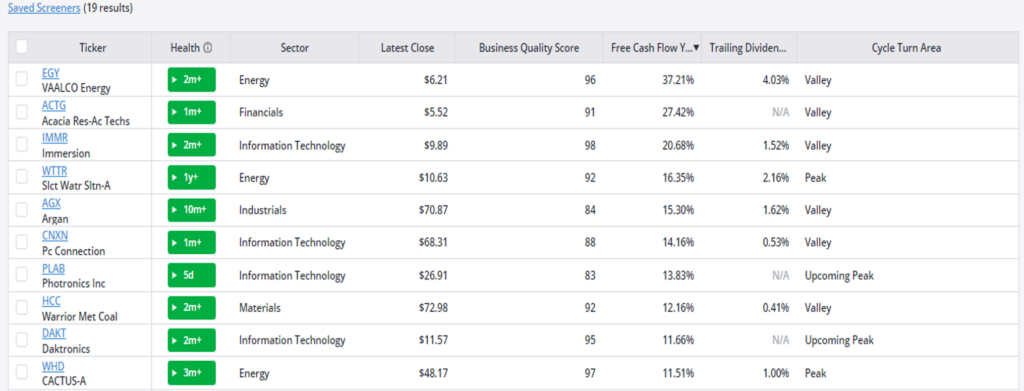
Keep in mind that you can get more results by relaxing some of these filters… or narrow your search by tightening these parameters or adding more filters.
In other words, take this example as a starting point, then make the small-cap TradeSmith Screener that suits you best.
Mike Burnick’s Bottom Line: Small-cap stocks are dirt-cheap, growing faster than big-cap stocks, and last month they began to outperform the S&P 500. And by building your own TradeSmith screener using these, and your own filters, you can zero in on small-cap stocks with the best upside potential should their hot streak continue, as I expect.
Good investing,

Mike Burnick
Senior Analyst, TradeSmith