

Over the past couple of weeks, we’ve been taking a closer look at the health of the markets.
I explained why I think every investor should start preparing for potential trouble ahead. But I also showed you that our TradeSmith market health tools say it’s still too early to get bearish right now.
So today, I’ll share one more proprietary tool that can help us know when it IS time to take protective action.
It’s called the TradeSmith Bearseye signal. And as I mentioned last week, it’s the most powerful bear market warning system I’ve ever come across.
This tool harnesses the Health and Health Distribution data I showed you last week to generate highly reliable broad market sell signals.
Our research shows that the Bearseye would’ve correctly predicted every bear market and significant market decline over the past few decades.
And it personally allowed me, and thousands of TradeSmith subscribers, to safely get out of the markets before the March 2020 crash.
Here’s how it works…
An index must meet two specific criteria to trigger a Bearseye signal:
- The index itself must be in the TradeSmith Health Indicator Red Zone. (We can track this under the “Health” column of our Market Outlook tool, which I discussed last week.)
- At least 40% of the component stocks that make up that index must also be in the Health Indicator Red Zone, no more than two days after meeting the first criterion. (Again, we can track this under the “Health Distribution” column of our Market Outlook tool.)
To put it simply, the Bearseye is triggered when an index and at least 40% of the stocks that make up that index become “unhealthy” at the same time.
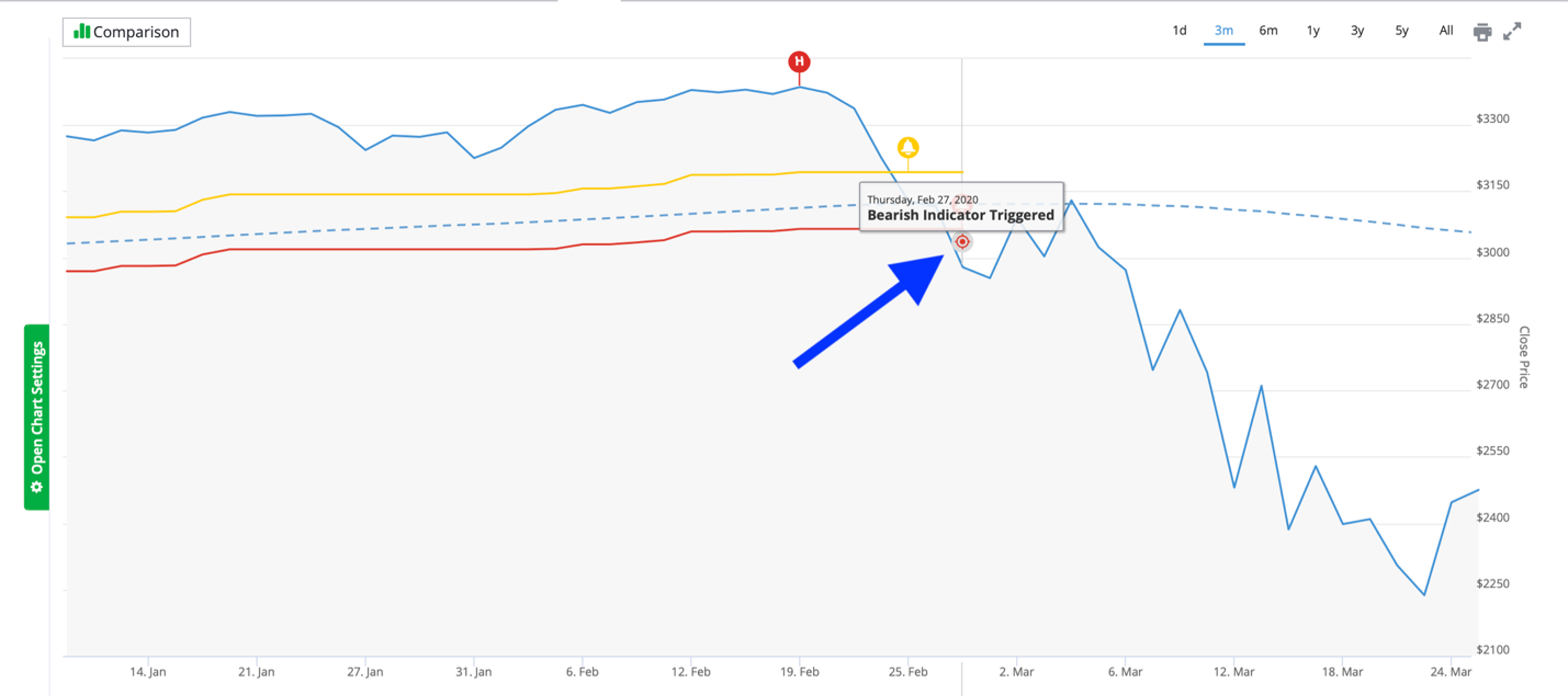
When a Bearseye alert occurs, it appears as a small red crosshair symbol on the charts in our system. This chart of the S&P 500 from last winter shows an example.
That’s all there is to it. But don’t let its simplicity fool you.
As I mentioned before, this signal would’ve gotten you safely out of stocks before every bear market over the past few decades.
Whenever bear markets have occurred, the broad market — as tracked by the S&P 500 — has gone on to fall another 20% on average. Last March, the S&P lost nearly 35% in the weeks following this signal. And many smaller indexes and individual stocks plunged even more.
Now, if you’re a regular Money Talks reader, you know I love trailing stop losses — especially the smart trailing stops we’ve created for TradeSmith subscribers.
They’re a great way to reduce your risk in any investment. But they can also help you maximize your gains by keeping you from selling a winner too early. So, I generally recommend letting your trailing stops tell you when to sell any individual stock or asset.
But I’m willing to break the rules for our Bearseye signal.
Whenever a Bearseye signal triggers in an index, I believe the safest thing to do is to get out of any stocks in that index immediately.
And if several Bearseye signals trigger in multiple indexes at the same time (like we saw in February 2020), I would recommend getting out of the markets altogether.
That’s exactly what I did last year, and I’m so grateful that I did.
It saved me a ton of unnecessary stress and anxiety when the market was crashing. And it ensured I had plenty of cash available to pick up bargains when the market bottomed several weeks later.
Now, typically the Bearseye signal is only available to folks with access to our market health tools. That includes Ideas by TradeSmith subscribers, as well as TradeSmith Platinum and Trade360 members.
But as I’ve told you since the beginning, my goal in Money Talks is to educate and empower you, not to promote TradeSmith products. So I’m going to make an exception and do something we’ve never done before:
I’m going to notify ALL Money Talks readers — whether you’re currently a TradeSmith subscriber or not — when the next Bearseye signals appear in any of the major market indexes we follow.
It’s just a small way of saying “thank you” for being a loyal Money Talks reader.
As always, if you have any questions or comments on the Bearseye or anything else we’ve covered, I’d love to hear from you at [email protected]. I can’t respond to every email, but I promise to read them all.