The AI Super Portfolio: The 5-Stock Secret to Quadrupling Your Money Every Year
In 1961, a meteorologist at MIT made a mistake that changed science forever.
Edward Lorenz had built one of the first computer-based weather models. To save time, he rounded a number from six decimal places to three.
When he reran the simulation, the calm skies turned into storms.
From that small error, Lorenz discovered what is now known as the butterfly effect – the concept that tiny changes can lead to significant consequences.
Weather systems are dynamic. Small changes can lead to very different outcomes. Even the tiniest change – a gust of wind or a slight rise in humidity – can cascade into a wildly different outcome.
The stock market works the same way.
Every trading day, it absorbs thousands of tiny shocks. A Fed comment, a surprise earnings miss, or even a social-media post can shift sentiment.
These are financial “butterfly effects” – tiny shifts that ripple through the system and affect the prices of thousands of stocks.
That’s why many large hedge funds spend billions developing algorithms to detect these small market signals.
Take Jim Simons’ Medallion Fund. It has averaged 66% annual returns since 1988 by spotting butterfly effects in vast stock-market datasets.
And Ken Griffin’s Citadel made $16 billion in profits in 2022 – the biggest gain ever recorded by a hedge fund. It used advanced quantitative trading models and high-speed automated systems to exploit short-term market inefficiencies.
Neither of these funds relies on human decision-making. They rely on math. Their algorithms sift through oceans of market data to uncover statistical edges long before human analysts can spot them.
That’s why TradeSmith created the AI Super Portfolio.
TradeSmith’s mission is simple: Give individual traders and investors access to powerful tools, the likes of which were once only reserved for hedge funds. And the AI Super Portfolio is the most powerful system the team has built in our 20-year history.
As we’ll explain in this report, it’s powered by cutting-edge AI pattern recognition and forecasting.
Hi, our names are John Jagerson and Wade Hansen. We are the Senior Analysts at the AI Super Portfolio and the other Predictive Alpha services.
- John is a Harvard-educated analyst who holds two respected financial certifications: CFA (a Chartered Financial Analyst) and CMT (a Chartered Market Technician). Because of his market experience and insights, he’s been featured in Forbes and on Nasdaq.com. He’s also a natural-born teacher and coach who’s created investment courses for some of the largest banks and brokerage houses in the country.
- Wade is cut from the same cloth… he holds an MBA and CMT, and he lives and breathes investing. He’s also developed investment courses and has been published numerous times, including a book he co-authored about Forex trading.
Now, we use our experience to help traders like you achieve market-beating results with world-class software and analytics.
In this guide, we’ll show you…
- The technology behind the AI Super Portfolio…
- The simple rules to follow for your five-stock portfolio…
- The secret to boosting your gains using options…
- And how to manage position sizing and risk like a pro.
The goal of this guide is to get you up and running with the AI Super Portfolio. If there’s more you’d like us to cover, please let us know. You can contact the editorial team at [email protected].
Until then, let’s get started.
The Rise of AI Investing
By now, you’re probably familiar with ChatGPT, Gemini, and Copilot.
These popular AI chatbots can draft professional emails, summarize complex research, and even brainstorm creative ideas.
They’re called large language models because they’re trained on massive datasets of words.
Think of this AI system as a model designed to analyze huge amounts of numerical data.
The stock market runs on numbers, not words. To create an accurate forecast, we need a model designed to predict the next number.
That’s why our system runs on TimeGPT – a large neural network trained exclusively on numbers. Unlike basic machine learning, TimeGPTs are designed to read, learn, and forecast data organized by time.
Time-series models study how numbers change over time. That makes them well-suited for forecasting stock prices. That’s because time-series models learn from how data evolves over time.
Most importantly, they’re perfect for the stock market, where prices unfold minute by minute in sequential data.
The system was trained using more than 100 billion pieces of historical market data. That training allows it to understand seasonality, trend reversals, and volatility without constant manual tweaks.
Why Old Models Struggle
They assumed relationships between variables were simple, that data wouldn’t change much over time, and that recent values could reliably predict the next ones.
But financial markets don’t behave that way.
A constantly shifting mix of factors – surprise earnings, rate hikes, geopolitical events, investor sentiment – creates nonstop turbulence.
Those older models were designed for a slower, more predictable world. In today’s markets – where information travels at light speed and sentiment can flip in seconds – they fall apart.
Take Apple (AAPL) as an example.
Let’s say its share price rises for several weeks after a strong earnings report. An older model might project continued gains simply because it sees an uptrend.
But if the Fed surprises markets with a rate hike or a supply-chain issue hits Asia, Apple’s stock could gap down.
Static models can’t handle those inflection points.
Our model doesn’t rely on fixed assumptions. It analyzes how prices behave over time – including sudden jumps, volatility clusters, and reversals that break old patterns.
And it doesn’t just memorize prices. It understands their rhythm and reaction to stress.
When new data begins to resemble the early stages of a past shock – say, a rate surprise or sector rotation – it detects the pattern forming and instantly adjusts its forecast. So, it can make accurate predictions for stocks it’s never seen before, without retraining.
That blend of learning from history and adapting in real time makes our model far more capable in messy, real-world markets.
Here’s how that technology powers the AI Super Portfolio…
Inside Predictive Alpha
The AI Super Portfolio is powered by a forecasting engine we built called Predictive Alpha.
It combines two complementary models to forecast prices up to 21 trading days (roughly one month) ahead for more than 2,300 stocks.
- The first model tracks slowly changing forces such as company fundamentals, investor sentiment, and overall economic health.
- The second model focuses on day-to-day price action – short-term volatility and sudden swings.
We assign greater weight to the first model. This keeps forecasts grounded and stops short-term noise from over-influencing results.
Predictive Alpha also produces a Prime Projection Date (PPD) – the day in that 21-day window with the highest historical accuracy.
Each projection displays a probable price range – the blue cone you’ll see around the price path in our charts. Prices rarely move outside those bands.
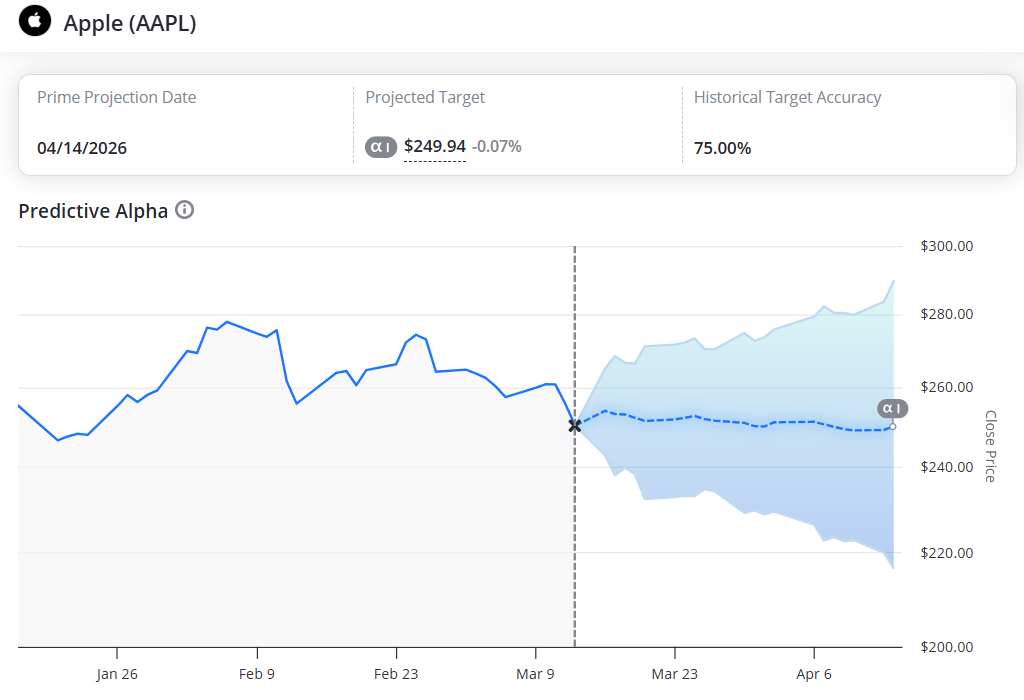
For some stocks, the hit rate exceeds 90%. Across all forecasts, accuracy averages about 70%, meaning roughly 700,000 projections have been on target every month since launch.
Even with that success, the TradeSmith team wanted to make the system more accessible – and more powerful.
That’s where the AI Super Portfolio comes in. Backtesting shows it could have delivered a 602% gain in 2024 alone.
And over a five-year test period – spanning the pandemic, the 2022 crash, rising interest rates, the 2025 tariff tantrum, and two wars – it returned an average annual gain of 374%.
How to Trade the Portfolio
The AI Super Portfolio holds five stocks at a time.
Once you buy your positions, you will hold each stock until one of two things happens:
- It reaches its Prime Projection Date (or PPD… the date that the system believes a stock will most likely reach its Target Gain), or…
- It reaches its Target Gain (the percentage return that the system believes the stock will achieve). Some stocks might have an 8-day PPD. Others could be 15 or 18 days.
Similarly, some stocks may have a 10% Target Gain. Others may have a 2% or 5% Target Gain.
When either of those happens, we send an exit alert around 10:30 a.m. Eastern on the next market day. So if Apple hit its PPD on a Tuesday, we would exit on Wednesday. That exit alert will also have instructions for the next stock to buy.
Here is an example of what an alert will look like…

Step-by-Step: Getting Started
Follow these steps, and you’ll be fully invested within a month.
- Buy the open recommendations in the Model Portfolio – as long as they’re trading under their Maximum Buy Price. Find the Model Portfolio here.
- Hold each until it hits either its Prime Projection Date or its Target Gain – then exit the following market day.
- Use the money from closed positions to buy the next recommended stocks.
- This may be the most important step: Manage your risk. (We talk about this at length in your AI Super Portfolio Quick-Start Guide.)
How to Boost Your Gains by Buying Long Call Options
You can use call options to amplify your returns.
A call option gives you the right, but not the obligation, to buy a stock at a set price before a certain date – this allows you to control a larger position with less upfront capital.
Options offer higher potential gains, but they also lose value faster than stocks. So, take profits when appropriate and avoid holding through expiration. In backtesting, we followed specific rules to select options for these trades.
- Buy calls with a strike price slightly “out of the money”: This means choosing the first strike price above the stock’s current price. If a stock is trading at $98, consider the $100 strike price, if it’s available.
- Choose the first expiration after the PPD: If it’s April 14, you could choose an option expiring on April 17. The exact expiration date will always depend on which contracts are available.
These are general guidelines. When you’re trading options, some discretion is required. Consider an option’s liquidity. If there are very few buyers and sellers for that option, it may be best to use the next strike price or expiration to ensure there’s sufficient liquidity.
And remember to target the first out-of-the-money call. A contract further out of the money costs less but also has a smaller probability of success.
Going into the money reduces risk. But it also carries higher costs and potentially lower rewards.
The same thing goes for expiration dates. Using a shorter expiration date will cut your trading costs. But it will also increase your risk because the expected price move could develop after the option expires.
Let me use another example to show you what we mean.
Bitdeer Technologies (BTDR) is a Bitcoin mining and digital infrastructure company.
It was added during the backtest on April 15, 2025, with a PPD of May 15.
Although the stock had been stagnant since 2024, our model forecast a 6.4% gain in 21 trading days.
It hit that target within 48 hours – and kept climbing. The stock gained 94% in 21 days.
But the May 16 $10 call option surged from $0.20 to $3.50 – a 1,650% gain. And at its peak, it reached $5 – or 2,400%.
It’s Time to Get Trading!
To follow the AI Super Portfolio recommendations, you need to keep just four rules we talked about earlier in mind:
- Buy the open recommendations in the Model Portfolio – as long as they’re trading under their Maximum Buy Price. Find the Model Portfolio here.
- Hold each until it hits either its Prime Projection Date or its Target Gain – then exit the following market day.
- Use the money from closed positions to buy the next recommended stocks.
- This may be the most important step: Manage your risk. (We talk about this at length in your AI Super Portfolio Quick-Start Guide.)
That’s it. No guesswork. No chasing headlines. Just a repeatable process grounded in data, discipline, and deep backtesting.
Markets will always surprise us – that’s what they do.
But with the AI Super Portfolio, the goal is simply to follow the process and let the system guide the trades.
Regards,
John Jagerson and Wade Hansen
Senior Analysts, The AI Super Portfolio