The Robot Rush: How to Profit From the Next AI Revolution
In 1921, a curtain rose in a Prague theatre to reveal a word that would change the world: robot.
It debuted in Karel Čapek’s play Rossum’s Universal Robots – a dark fable about a new class of artificial workers built to serve without question.
They built cars, cleaned houses, and took over every task their human masters no longer wished to do. The name came from the Czech word robota, meaning “forced labor” or “serf.”

The play was an international sensation. And the word robot moved from the stage into pulp magazines, comic strips, and radio dramas – quickly becoming shorthand for a future where work might no longer require humans.
But these robots were missing the one thing that could make them truly independent: a brain.
For another century, real-world machines would lift, weld, and assemble, but only by following rigid instructions. Now, with advances in artificial intelligence (AI), we’re entering a more realistic – and in some ways truer – version of Čapek’s original idea.
Today, robots can not only work, but also perceive, adapt, learn, and decide for themselves.
They don’t sleep, take breaks, or call in sick. And they’re showing up in assembly lines, warehouses, hospitals, and homes.
As investors, we want to pay attention.
Already, folks are making money – lots of it – by investing in companies that are making our robot future a reality.
And it’s not too late to profit. We’re still in the early stages of the robotics boom.
A “ChatGPT Moment” for Robotics is Coming
Think Nvidia, whose chips power robots’ brains. Over the past five years, its stock has surged 1,250%.
And over the past 12 months, robotics warehouse automation company Symbotic (SYM) is up 133%.
Or take Celestica (CLS). It makes networking gear that allows robots to communicate with each other. And over the past 12 months, it’s up about 200%.
And we’re still in the early days of the robotics boom.
The International Federation of Robotics is a robotics trade association based in Germany. It reports that there are about 3.9 million industrial robots installed worldwide – a record high, but still only a fraction of the workforce.
In the next three years, more than six million are expected to join them.

Many of these robots repeat the same motions, usually along an assembly line or in other tightly controlled environments. They work shoulder-to-shoulder with human workers, cutting labor costs while cranking up efficiency.
Now, thanks to AI, robots are breaking out of the assembly line and learning to handle more complex work in messy, unpredictable settings.
This shift will open the door to a surge of new applications. And companies across nearly every industry are clamoring to put them to use.
As Nvidia CEO Jensen Huang remarked…
The ChatGPT moment for robotics is coming… We’re working towards a day where there will be billions of robots, hundreds of millions of autonomous vehicles, and hundreds of thousands of robotic factories.
If Huang is even half right, robotics is shaping up to be one of the most powerful market trends of the next three to five years.
This means outsized gains for folks who take stakes now in our robotic future.
And in this report, I’ll lay out the steps you need to take to profit. We’ll look at…
- How robots are transforming industries from healthcare to autos to defense
- Why the mix of AI and robotics is creating a new class of high-growth “physical AI” stocks
- The three types of robotics stocks you can invest in today
- The name and ticker symbols of six cutting-edge robotics stocks to invest in today
- Why the 21st century’s automation age will run on rare earths and battery metals, and four ways to play it
- The simplest, “one-stop-shop” way to profit from the robot rush today
And AI isn’t just transforming robotics. It’s also changing the way we trade and invest.
As I’ll get into in more detail later on, my team and I at TradeSmith have developed a new AI-powered trading system.
It identifies a stock’s “profit windows” so you can enter with more confidence, exit with better timing, and avoid dead money.
And it’s spotted wins such as…
- 16.4% on TCMD in 16 days
- 16.4% on APLD in 6 days
- 17.6% on NTAP in 21 days
- 21.4% on W in 14 days
- 25.5% on CVNA in 2 days
Normally, tools like these are the exclusive domain of hedge funds and Wall Street elites. But thanks to the breakthrough we’ve made at TradeSmith, everyday investors like you can, too.
I’m a software engineer with a degree in computer science. I know it takes an insane amount of research, calculation, computer processing power, trial and error – not to mention grit – to create a system that can get damn close to true foresight.
But at TradeSmith, we’ve done it. And it’s free to demo right here.
You’ll see how our AI analyzes five top stocks and predicts where their share prices could land over the next 21 days.
First, let’s walk through how robots are spreading into every corner of work and life.
Bright Yellow Arms
Industrial robot arms – usually bright yellow and bolted to the floor – have been swinging through the motions of mass production for decades.
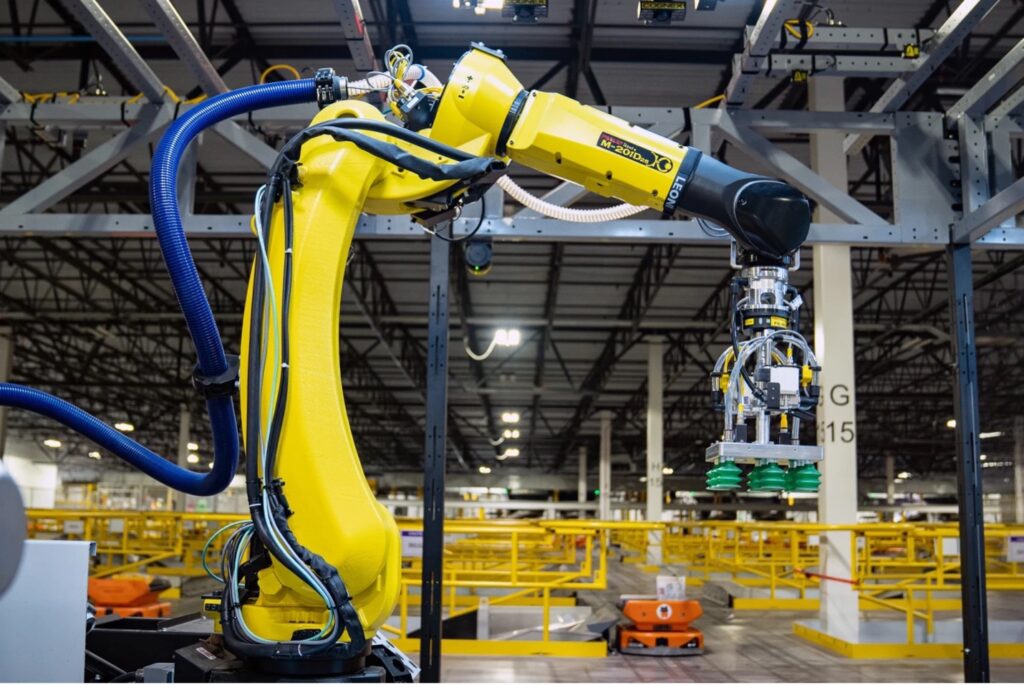
Japanese automation giant FANUC has built millions of them. These robotic arms weld, paint, lift, and assemble – their strength measured not in horsepower, but in cycle times per minute.
But even these time-tested innovations are changing. Because these factory robots are now easier than ever to access.
For most of their history, these arms were the exclusive tools of billion-dollar automakers or electronics giants. Programming them required specialists fluent in arcane coding languages. Buying them required capital budgets the size of small nations.
But that barrier is cracking.
In the U.S., a company called Standard Bots is pushing costs down and ease-of-use up. Their machines can be taught by demonstration – show the arm what to do with your own hands, and it remembers the motion.

Suddenly, automation is no longer the preserve of Toyota or General Motors. A mid-sized furniture maker in Ohio, or a parts supplier in Detroit’s auto supply chain, can buy one and start automating within days.
“Cobots” – Partners on the Line
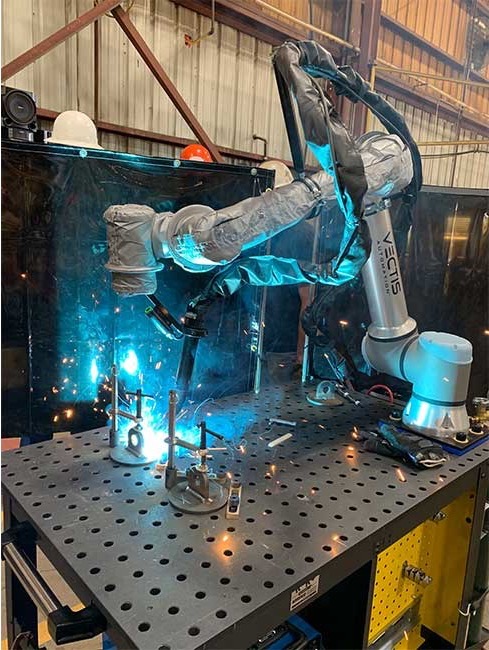
If industrial arms are the muscle of robotics, collaborative robots – or cobots – are the helping hand.
Instead of working behind cages, they’re designed to operate safely beside humans. They move more slowly and carry less weight, but they adapt to people in a way the old arms never could.
Universal Robots in Denmark built a global business on this model. Its machines aren’t glamorous, but they’re practical. They help welders hold steady, machinists load parts, or warehouse staff stack boxes.
But the real significance of cobots lies in our shifting demographics.
In Germany, Japan, China, and other rapidly aging societies, labor shortages aren’t cyclical – they’re structural.
In Japan, the workforce is shrinking by about 600,000 people a year due to aging. In Germany, one in five skilled manufacturing workers will retire by 2035.
And in China, the working-age population peaked back in 2011. The country is now losing roughly five million workers a year – the fastest demographic decline in modern history.
Immigration and retraining can’t fill these gaps.
A robot that can extend the career of a skilled worker by taking the strain off their back isn’t just a fancy new gadget. It’s a solution to one of the most serious challenges many of the world’s largest economies face.
The Largest Deployment of Robots in History
Nowhere is the scale of automation more visible than inside Amazon’s fulfillment centers.
Instead of armies of workers walking miles of aisles, fleets of squat orange robots – acquired through Amazon’s 2012 purchase of Kiva Systems – ferry entire shelving units directly to human pickers.

The result is less wasted time, faster deliveries, and warehouses that can process hundreds of thousands of orders a day.
Amazon now operates more than 750,000 mobile robots across its facilities worldwide. That makes it the largest deployment of robots in history.
These robots aren’t humanoid, but they illustrate the raw power of “physical AI” when applied at scale. A single fulfillment center might host 3,000 of them – all choreographed by AI to avoid collisions while zipping across the floor with uncanny precision.
This system has become so effective that rivals from Walmart to Alibaba are scrambling to copy it. For Amazon, the payoff is both speed and savings: fewer human steps, lower operating costs, and delivery times that keep Prime customers locked in.
Machines on the Move
Then there are robots built not for the factory floor but for the world beyond.
Boston Dynamics is the poster child here. Its four-legged Spot robot – once an internet sensation for its dog-like trotting – now works on oil rigs, in mines, and on construction sites.
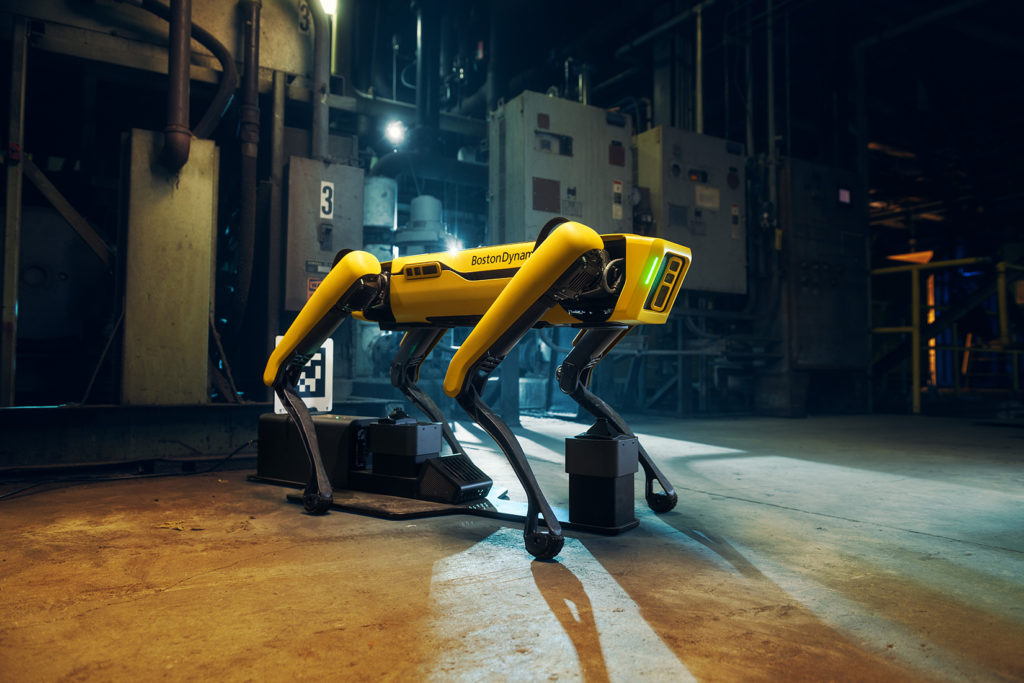
Companies use Spot to inspect dangerous areas such as chemical storage tanks, and it can also climb stairs and carry sensors. This solves a deadly serious problem.
Sending a $75,000 robot into a hazardous area is cheaper and safer than risking a human life.
Boston Dynamics’ humanoid Atlas is still in the experimental stage, showing off parkour and gymnastics routines. But agility matters. A robot that can balance, climb, and adapt to rough terrain doesn’t have to be a humanoid. It just has to go where wheels and conveyor belts can’t.
Soon, agile robots may be used for disaster response, firefighting in high-rises, repairing offshore wind turbines, or carrying supplies across battlefields.
Robot Surgeons and Soldiers
Robots are also a matter of life and death.
In hospitals, robotic systems allow surgeons to perform operations with a level of precision the human hand can’t match.
The robot doesn’t replace the human surgeon. Instead, it extends their reach, filters out tremors, and offers a magnified 3D view inside the body.

More than 10,000 of these systems are now installed worldwide. They help doctors perform more than two million procedures a year – from delicate prostate surgeries to minimally invasive heart operations.
For better or worse, the combination of AI and robotics is also transforming the battlefield.
This is most notable in the Russia-Ukraine war, where drone combat has become a major component of the conflict.
Typically, Ukrainian first-person view drones rely on a human pilot wearing goggles.

But in late 2023, Ukrainian engineers began adding computer vision modules. These help the drones lock onto moving targets such as tanks or trucks.
If the human pilot loses signal – common due to Russian jamming – the drone can still home in on its target using AI object recognition.
And the Pentagon is testing robotic supply convoys that reduce the need to risk soldiers in ambush zones.
It’s also experimenting with AI-powered “loyal wingman” drones. They fly alongside piloted fighter jets – carrying weapons, jamming enemy radar, or scouting ahead without risking a human pilot.
Humanoids – Fitting the Human Mold
Still, humanoid robots capture the imagination most – and for good reason.
Our world is built for human bodies. Our doorways, tools, workstations, and vehicles are designed with arms, legs, and hands in mind.
Rather than redesign entire factories for machines, why not design machines that fit into the human mold?
Step into a BMW factory in Dingolfing, Bavaria, and you’ll see a familiar scene – rows of workers in blue overalls moving along an assembly line, their hands darting in and out with practiced precision.
But then your eye will catch something slightly off.
A taller, unnervingly fluid figure bends, straightens, and pivots. It lifts a car part from a pallet, turns, and places it carefully on the line.
At first glance, you might think it’s just another worker until you notice the gait, a little too smooth, and the “face” – a glossy, blank panel. This is Figure 01, a humanoid robot from California startup Figure Robotics.
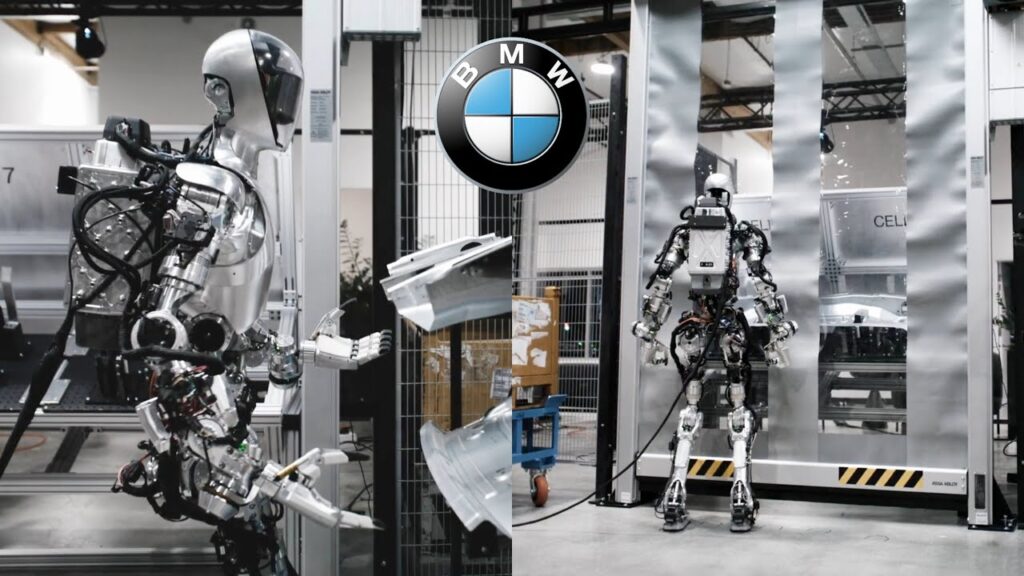
On a single charge, it can place up to a thousand parts before the battery drains. It can also handle repetitive material handling tasks, stack crates, and even perform basic machine tending – loading and unloading CNC machines, automated devices used in manufacturing that operate tools like lathes and mills through computer programming.
And in Berlin, Mercedes-Benz is piloting Apptronik’s Apollo robots on its production lines. The luxury carmaker has tasked them with repetitive jobs – lifting parts, moving components, doing the sort of labor that wears out human backs.
Their batteries last only a few hours. Their grips are clumsy compared to a human hand. But they’re good enough to start filling gaps in the workforce.
If the 20th century was the age of electrification and computerization, the 21st will be remembered as the age when machines carried our boxes, walked our factory floors, cared for the sick and elderly, and defended our homeland.
Now for the most important question: How can you profit?
A “One-Stop-Shop” Robotics Play
A one-stop-shop way to profit from the “robot rush” is Robo Global Robotics and Automation Index ETF (ROBO).
It gives you sector-wide exposure to this trend. If robotics and automation live up to their promise, this will make a great long-term holding.
Launched in October 2013, the ROBO ETF aims to mirror the performance of the ROBO Global Robotics and Automation Index. It tracks companies developing robotics, automation, and enabling technologies.
ROBO has about 78 holdings. And its top 10 holdings make up roughly 20% of the fund. That makes it well-diversified compared to typical tech ETFs.
The fund typically allocates at least 80% of its assets to stocks in the ROBO index. But it may invest up to 20% elsewhere if it believes it supports its tracking goals.
ROBO carries an annual fee of 0.8%, which is on the high side for an ETF. The average ETF fee is between 0.5% and 0.75%. And fees go as low as 0% for some ETFs.
And a nearly 1% annual fee for holding this ETF means you have to shave 1% off the returns you make on the stocks it holds.
When you invest in ROBO instead of individual stocks, it’s important to keep in mind that you’re getting general exposure to the sector.
Some of its 78 holdings will do well. Others, not so much. You’ll end up with the average performance across the holdings.
For more targeted plays with higher potential upside, it’s helpful to think about this robotics revolution in three categories: the brains, the bodies, and the muscles.
The Brains, the Bodies, and the Muscles
The analogy isn’t perfect, but it allows us to break down the different ways to profit from the “robot rush” on Wall Street.
- The Bodies are the machines themselves, from general-purpose humanoids to highly specialized drones and surgical systems.
- The Brains are the chips and AI platforms that let robots see, learn, and make decisions.
- And the Muscles are the raw materials — the magnets, metals, and batteries that give them strength and motion.
1. The Bodies
This is where hardware meets the real world. Some robots are generalists designed to handle a wide range of tasks. Others are specialists, purpose-built for critical missions where precision and reliability are non-negotiable.
Tesla (TSLA)
Everyone knows Tesla as an electric car company. But the bigger story now is its pivot into robots.
Its newest product is the Optimus humanoid robot. It looks like something out of a sci-fi movie. But it runs on the same AI that powers Tesla’s self-driving cars.
That makes Tesla the most promising of the generalist robotics plays. Unlike a startup chasing a single niche, Tesla already has global scale, a proven AI training pipeline through its self-driving fleet, and the manufacturing muscle to mass-produce robots if the economics line up.
In demos, Optimus has been shown walking, picking things up, and even cracking eggs in a kitchen. Elon Musk’s vision isn’t far off from the one on stage in Prague in 1921. Optimus will eventually do the repetitive or dangerous jobs humans don’t want to do – lifting boxes in warehouses, assembling parts on a line, maybe even working in your home.
And Musk is thinking big. He claims Tesla will sell millions of these robots. If he’s even half right, Optimus could be bigger than Tesla’s car business.
Remember, Tesla’s cars and trucks are essentially robots on wheels. Its robotaxi network is in the early rollout stage now. If it scales, it means an entirely driverless transportation service.
So, when you think Tesla, don’t just think “cars.” It’s building humanoid robots and fleets of autonomous vehicles.
Intuitive Surgical (ISRG)
This company is the pioneer of medical robotics.
Its flagship da Vinci system is already in more than 8,000 hospitals worldwide. Surgeons use it to perform minimally invasive surgeries. Instead of opening up a chest or stomach, they operate with tiny instruments controlled by robotic arms.
Patients love it because they recover faster, with less pain and fewer complications. Surgeons love it because it gives them superhuman precision. Imagine having your hands shrunk down to the size of a pencil tip, but steadier than you could ever be naturally.
This isn’t speculative – it’s happening right now at a hospital near you. Millions of surgeries are performed each year with da Vinci.
And each surgery uses proprietary Intuitive Surgical instruments and supplies. So, every robot in the field generates recurring revenue.
This isn’t just a cool robotics story. It’s also a highly profitable business model.
AeroVironment (AVAV)
On the other end of the spectrum, you’ve got AeroVironment. It builds small unmanned aerial drones that are changing modern warfare.
The U.S. military and allies use the company’s Puma and Raven drones for reconnaissance, surveillance, and front-line intelligence gathering.
In Ukraine, drones like these have been critical for spotting enemy positions, delivering strikes, and saving lives by keeping soldiers out of harm’s way.
Drones have become as game-changing as tanks were in the last century. In World War I, tanks rewrote the rules of battle – forcing generals to rethink defense, logistics, and strategy almost overnight. What once required battalions of men and artillery can now be achieved by a handful of operators flying machines that cost a fraction of a tank.
And it’s not just about defense. The same technology – autonomous flight, sensors, data collection – is being applied to agriculture, disaster response, and environmental monitoring.
AeroVironment isn’t just a war story. It’s part of a broader shift where “eyes in the sky” robots become essential tools across industries.
2. The Brains
If the bodies are what you see, the brains are what make them useful. These are the chips, cloud platforms, and positioning systems that let robots perceive, learn, and navigate.
Nvidia (NVDA)
If Tesla, Intuitive, and AeroVironment are building the bodies of robots, Nvidia is building their brains.
Its chips – originally made for video games – have become the gold standard for computationally intensive AI models.
Nvidia’s chips can perform parallel calculations at lightning speed. This is exactly what’s needed to train and run neural networks that allow robots to see, think, and react in real time.
Robots rely on AI to interpret the world around them. It allows them to see objects, understand speech, recognize patterns, and make split-second decisions. Nvidia’s chips power all of that.
And it’s not just hardware. Nvidia has also created a simulation platform called Isaac Sim. It lets engineers train robots in hyper-realistic 3D virtual environments before deploying them in the real world.
Isaac Sim uses physics-based simulation – including gravity, friction, and sensor noise – so robots “experience” realistic conditions. This allows millions of scenarios to be run in hours: “What if the robot bumps into this? What if the floor is wet?” Once the AI has learned enough in simulation, you upload it into the physical robot.
Nvidia isn’t just selling silicon. It’s selling the intelligence layer that makes robots so useful.
Trimble (TRMB)
Trimble isn’t a household name like Nvidia. But it’s another important enabler of our robotics future.
It’s all about precision positioning – basically, GPS taken to the next level.
When you or I use GPS, being off by a few feet is no big deal. But for a robot laying out steel beams in a skyscraper, or a tractor planting crops row by row, accuracy down to the centimeter is critical. That’s what Trimble delivers.
Their tech gives machines a sense of place. Without it, autonomous robots can’t safely navigate construction sites, farms, or survey missions. With it, they can perform precise, repeatable tasks that humans either couldn’t do or would take far longer to achieve.
You don’t see its logo on the robot. But its GPS tech is what keeps those robots from getting lost or making costly mistakes.
Microsoft (MSFT)
When you think of Microsoft, you probably think of Excel, Word, and Outlook. What you may not think of is “flight school for robots.”
Robots are physical – but their brains are trained digitally. And Microsoft’s cloud platform, Azure, lets companies build digital twins of the real world – factories, warehouses, even city streets.
In these virtual spaces, robots can practice their tasks over and over until they get it right. It’s like how pilots train on simulators. Robots do the same thing in Microsoft’s cloud – millions of trial runs, in hours, instead of months of risky real-world testing.
Then you’ve got the human-robot interface. Microsoft’s HoloLens mixed reality headset allows a human operator to see through the robot’s “eyes,” guide it with hand gestures, and essentially collaborate with it. That makes robots more intuitive and less intimidating to use.
Microsoft may not be building the robots, but it’s providing the training grounds, the intelligence tools, and the control interfaces that make robots actually practical.
3. The Muscles
If the Brains give robots perception and the Bodies give them form, the Muscles give them strength.
It’s easy to overlook this part of the story. When we think about robots, we think of AI breakthroughs, sleek humanoid designs, or drones buzzing over battlefields. What we don’t see are the metals, magnets, and materials inside – the hidden inputs that actually make motion possible.
This isn’t new. Every industrial revolution has had its invisible foundations:
- The 19th century’s steam age ran on coal and iron.
- The 20th century’s digital age ran on copper and silicon.
- The 21st century’s automation age will run on rare earths and battery metals.
A humanoid like Optimus may look like a software marvel. But its actuators – the robotic equivalent of muscles – depend on neodymium-praseodymium (NdPr) magnets, often hardened with trace amounts of dysprosium or terbium. Without them, Optimus couldn’t lift a box, bend an elbow, or walk across the floor.
One robot alone can require more than a kilogram of rare-earth magnets. Scale that across Morgan Stanley’s projection of a billion robots by 2050, and demand explodes to hundreds of thousands of tons of magnet material – far more than today’s global output.
And it’s not just robots. These magnets power EV motors, drones, wind turbines, and even missile guidance systems. Whoever controls the magnet supply chain controls the motors. And whoever controls the motors controls the machines.
That’s why the White House has labeled rare earths a national security priority. For decades, China has dominated mining and, more importantly, refining, with about 90% of global capacity.
The risk is obvious: the robotics revolution could be stalled at Beijing’s whim. The response has been a scramble to fast-track domestic mining, refining, and magnet manufacturing.
Three U.S. companies now stand out as the backbone of America’s robot “muscles”:
MP Materials (MP) – The Magnet Maker
- Owner of the Mountain Pass mine in California – the only large-scale rare earth mine in the U.S.
- Has built a Fort Worth, Texas, plant to produce finished NdFeB magnets, creating the first full mine-to-magnet supply chain outside China.
- Already supplies about 15% of the world’s REE output and is uniquely positioned to feed Tesla, GM, and the Pentagon with critical magnet components.
Freeport-McMoRan (FCX) – The Circulatory System
- America’s copper giant. Copper is the “blood” of robots: wiring their nervous systems, coiling their motors, and carrying current through their bodies.
- Also touches nickel and cobalt, essential for the lithium-ion batteries that keep humanoids untethered.
- As Washington pushes to classify copper as a “critical mineral,” Freeport’s role in the robotics supply chain grows even more strategic.
Energy Fuels (UUUU) – The Refining Edge
- Historically a uranium producer, it is now a rare-earth refiner through its White Mesa Mill in Utah.
- Produces neodymium-praseodymium oxide domestically and has processes in place for heavier rare earth elements, such as dysprosium.
- By building out America’s first real rare earth refining capability in decades, it’s helping close the gap that left U.S. mining dependent on Chinese processing.
For folks who want to play the theme more broadly, there’s the VanEck Rare Earth and Strategic Metals ETF (REMX). It offers exposure to a basket of global rare-earth producers, from MP in the U.S. to Lynas in Australia. And it carries an annual fee of 0.58%.
And as I mentioned up top, investing in these and other next-gen robotics plays isn’t the only way to profit from the AI boom. You can also put AI on your side as a trader.
At TradeSmith, we’ve created an AI-powered system to help you enter trades with more confidence, exit with better timing, and avoid the dead money traps that sink so many portfolios.
Our AI Finds Stocks’ “Profit Windows”
TradeSmith is a leading U.S. fintech platform headquartered in downtown Baltimore.
We have a staff of 36 data scientists, software engineers, and investment analysts. And we’ve spent more than $22 million and more than 50,000 hours developing cutting-edge investing and trading systems to help everyday investors level the playing field with Wall Street.
These systems help more than 120,000 people around the world track about $30 billion in assets. And because of our breakthroughs, we’ve been profiled in Forbes, The Wall Street Journal, and The Economist.
But we recently embarked on the most important project of our 20-year history. We call it Predictive Alpha.
It’s a large-scale AI model trained on vast amounts of stock market data. And it uses proprietary machine learning models to forecast the expected price path of thousands of stocks for every trading day over the next month.
We’ve engineered Predictive Alpha on more than 120 million data points. These include…
- 4.2 million historical price outcomes, spanning seven years and more than 2,300+ stocks
- 88.9 million daily forecasts, covering 21 forecast days for every stock on every trading day of the year
- Plus, tens of millions of additional “validation runs,” including target accuracy, pattern recognition layers, and more
Based on this data, Predictive Alpha learns from the past, adapts to the present, and projects the future.
What we’ve found is that every stock has a specific “profit window” when it can move the most. For example, Tesla may have a 6-day window, but Apple may have a 15-day window.
Every day, our system finds the ideal window to trade a particular stock and the ideal type of trade to maximize your profits.
Predictive Alpha can’t predict the future with 100% accuracy. And it won’t get every trade right. But it can forecast with up to 90% certainty where stocks will be tomorrow.
And the longer it runs, the smarter it gets. Here are the top 10 wins that it has identified so far…
- 12.9% on AEHR in 1 day
- 13.1% on TGTX in 17 days
- 14.3% on APLD in 1 day
- 14.7% on CIR in 16 days
- 14.7% on QS in 7 days
- 16.4% on TCMD in 16 days
- 16.4% on APLD in 6 days
- 17.6% on NTAP in 21 days
- 21.4% on W in 14 days
- 25.5% on CVNA in 2 days
These aren’t annual returns. They’re happening over a matter of days. Repeating these types of gains over these timeframes is like having a “house edge” on a Las Vegas casino-hopping trip.
Put the “House Edge” on Your Side
Each year, the Nevada Gaming Control Board (NGCB) writes a report on the success of the casinos on the Las Vegas Strip.
We all know the house always wins – this report tells us by how much.
In 2019, tens of millions of people flocked to Las Vegas to play casino games like blackjack, poker, and roulette. The NGCB shows that, collectively, those folks went home $6.6 billion poorer.
The house edge is the percentage of a player’s bet that the casino is likely to win. Said another way, it’s the statistical advantage a casino holds in any given game.
Casinos don’t win year in and year out because they get lucky. They have a deep knowledge of probabilities. And they use this knowledge to build an edge into every game they operate.
They make small wins thousands of times a day, millions of times a year. And these small edges, applied relentlessly, pile up.
It’s the same with Predictive Alpha. A 9.4% win in three days is great. But kept up across the trading year, it stacks up to a gain of nearly 800%.
The secret to making a fortune on the Las Vegas Strip and on Wall Street is finding and applying an edge over and over again.
Want to See Predictive Alpha in Action?
With Predictive Alpha, we didn’t chase the impossible dream of predicting the future or being right 100% of the time. We looked for an edge we could exploit over and over again.
Billionaire casino operators know how powerful that kind of edge is. The world’s best traders know it as well.
And as I mentioned up top, you can now put this edge to work for you.
So, if you haven’t already, check out a live demo.
You’ll see how our AI analyzes five top stocks and predicts where their share prices could land over the next 21 days. It’s one of the most powerful trading tools ever developed – and you can try it free.
Just click the link below. It will take you to the page where you can try out the free demo, live on screen.
When you do, you’ll also discover how you can use this same AI system to forecast price movements on any of the 2,300+ stocks we track. From the robotics winners in this report to every major stock on Wall Street.
The future belongs to those who embrace AI — as an investment theme and as a trading edge.