Listen to the audio version of this article (generated by AI).
In spring 1974, a 29-year-old architecture professor in Budapest set out to solve an engineering problem – and accidentally created one of the world’s most fiendish puzzles.
Erno Rubik wanted to see if he could move a set of interconnected blocks independently without the whole structure falling apart.
He built a prototype from wood – 26 small blocks, held together by a rounded core inspired by the smooth stones he’d noticed along the banks of the Danube.
Then he scrambled it… and spent the next month trying to put it back together.
His cube had 43 quintillion possible configurations – the result of 6 faces, 54 colored squares, and every twist reshuffling their relationships.
What eventually cracked it wasn’t brute force. It was the discovery that certain specific sequences of moves produced reliable, repeatable outcomes – every time.
For example: Turn the top layer clockwise twice, rotate the right side up, turn the top layer once more. Done in the right order, on the right pieces, that sequence always produced the same result. It didn’t matter what the rest of the cube looks like. The outcome was entirely predictable.
What we’ve discovered at TradeSmith is that the stock market has its own version of this problem… and its own solution.
Each stock’s trajectory is shaped by thousands of variables simultaneously – price history, momentum, volatility, economic data, sector trends, and hundreds of other obscure factors most analysts would never think to connect.
The combinations are effectively infinite. No human brain can sort through them all. But AI can.
That’s the principle behind the new AI-powered trading system our engineers have spent more than a year developing. By evaluating 10.4 million potential trades every day, it’s found something striking. When certain combinations of factors align, they point to trade setups with 90% or better historical accuracy.
These alignments don’t just happen once or twice. They repeat across bull markets and bear markets, crashes and recoveries.
We call them “signals.” And in a one-year backtest, a portfolio of these signal-based trades outperformed the S&P 500 by roughly 3-to-1.
Last week at the AI Signals Trading Event, I showed you some examples of those trades, including the stock with the strongest bullish signal in our system right now… plus a popular stock it says to stay away from heading into Thanksgiving. Catch it here before it goes offline.
First, it helps to know what’s happening under the hood.
Solving the Market’s Puzzle… One Unit at a Time
Every signal in our system is built from a specific combination of factors – technical indicators, price patterns, market conditions – that have lined up before and preceded big moves.
When they all line up again, the signal fires.
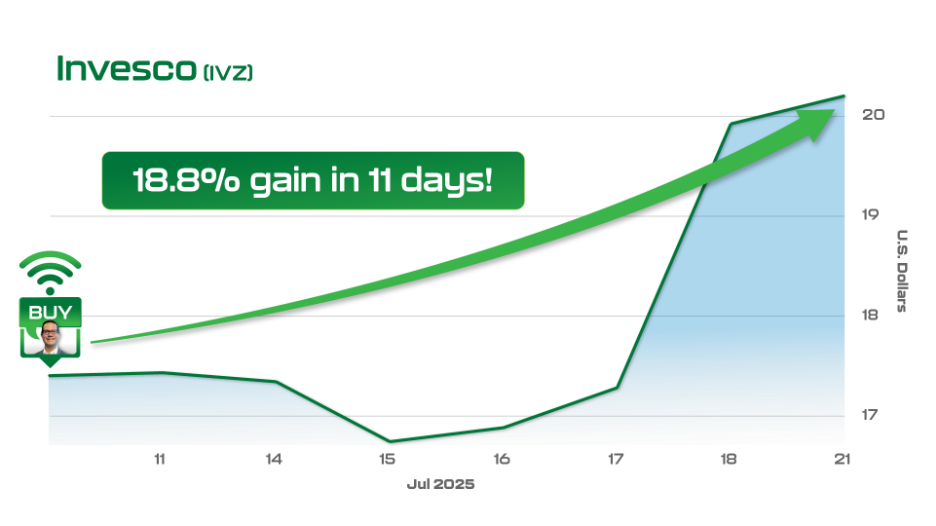
Take Invesco (IVZ), one of the world’s largest investment management firms.
Two factors have to align for this signal to fire. The stock’s Bollinger Percent B and its Money Flow Index both had to exceed 80.
Bollinger Percent B measures where a stock’s price sits relative to its recent trading range. The Money Flow Index tracks whether money is flowing into or out of the stock.
This is the kind of pattern no human analyst would ever find. Not because it’s complicated – but because nobody would ever think to look for it.
But this IVZ signal produced an 18.8% gain in 11 days.
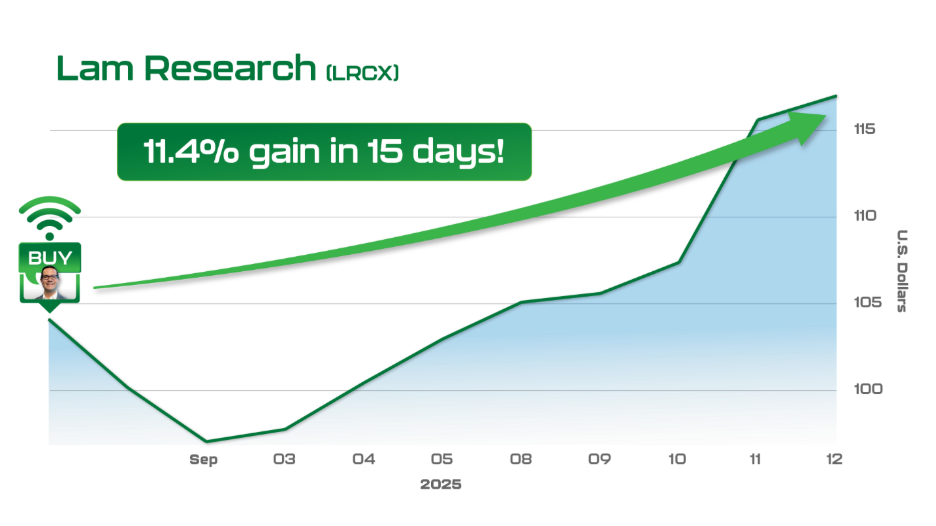
For Lam Research (LRCX), one of the largest makers of semiconductor manufacturing equipment, two different factors had to align.
The stock had to close above its 200-day moving average. And that close had to fall two trading days before a market holiday.
That’s it. Nothing about the company’s earnings. Nothing about the semiconductor sector. Nothing about the broader market. Just a price condition and a calendar condition, lining up at a specific moment.
When the signal fired on Aug. 28, 2025 – two trading days before Labor Day – LRCX gained 11.4% in 15 days. The historical accuracy rate behind that signal was 86%.
And we didn’t just backtest this strategy using historical data. In January and February, we also ran a live internal beta test – led by TradeSmith’s chief developer, Mike Carr.
Seven Times the Market’s Return
Mike started out writing code for the U.S. Air Force and working in cryptography for the Pentagon. He went on to co-manage mutual funds and high-net-worth accounts worth up to $200 million.
He also holds the Chartered Market Technician designation – a credential in technical analysis that’s held by fewer than 5,000 people worldwide.
So he’s the perfect person to put this new system through its paces.
Of the top 100 trades he posted, we saw a 2.6% average gain in nine trading days. Over that same stretch, the S&P 500 went up just 0.4%.
Mike’s test beat the market by roughly 7x.
And keep in mind, a 2.6% gain over 9 trading days is the equivalent of a 73% gain across a full year. Not from swinging for the fences on a handful of high-risk bets. But from a steady sequence of short, high-probability setups, each one identified by AI the night before the market opens.
And when we traded these signals with options, the results included:
- Caterpillar (CAT): 126% in 72 hours
- Nvidia (NVDA): 129% in 5 days
- Lockheed Martin (LMT): 365% in 30 days
- HCA Healthcare (HCA): 461% in 13 days
- Generac (GNRC): 1,082% in 33 days
We’ve Never Done This Before in TradeSmith History
Erno Rubik cracked his cube by ignoring the 43 quintillion possible configurations and learning the sequences that work every time. Our signals system takes the same approach to the market.
At the AI Signals Trading Event, I showed you what that looks like in practice. Mike agreed to put real money into whatever stock our system flagged one morning — without researching the company at all.
He didn’t look at the earnings. He didn’t check the news. He didn’t even look up what the company did. He followed the signal and nothing else.
We recorded the whole thing, and it’s online for a limited time.
You’ll see how the system works, which factors it tracks, and the trades it’s flagging right now. I think the weeks ahead could be one of the most target-rich stretches for signals trading we’ve seen in years.
And I’ll give you two names: the stock with the strongest bullish signal in our system today, and a popular stock it says to avoid heading into Thanksgiving.
Watch the replay before it comes down.
All the best,
Keith Kaplan
CEO, TradeSmith