The Tesla Signal Wall Street Hasn’t Priced in Yet
Listen to the audio version of this article (generated by AI).
If you drive through downtown Austin this week, you’ll likely pass a gold two-seat car with no steering wheel.
Then another.
One intersection had four of them waiting at the same light. A clip of the scene posted Wednesday night has more than a million views on X.
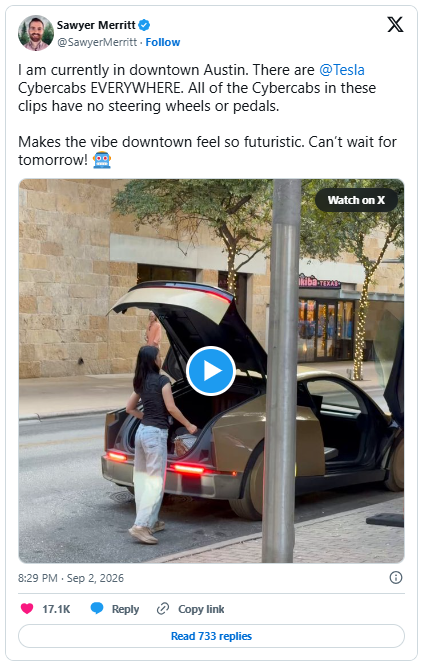
This month, Tesla (TSLA) put the first members of the public inside one of these Cybercabs – its new self-driving taxi built without a steering wheel or pedals.
But something caught our attention before those first riders ever climbed aboard.
Consumers were already moving.
How We See Consumer Demand Before Wall Street
My brother Landon and I have spent years studying a simple idea: Consumers often show you where a company is headed before its financial results do.
They search for products before they buy. They visit company websites and talk about brands online. Increasingly, they’re asking AI chatbots what to buy next. Put enough of those actions together, and you can see demand changing in real time.
So we built a system to track them.
Our MegaTrends data engine analyzes millions of consumer data points from across the web in real time. Then our proprietary algorithm distills those signals into a single number from 0 to 100 – the Social Heat Score.
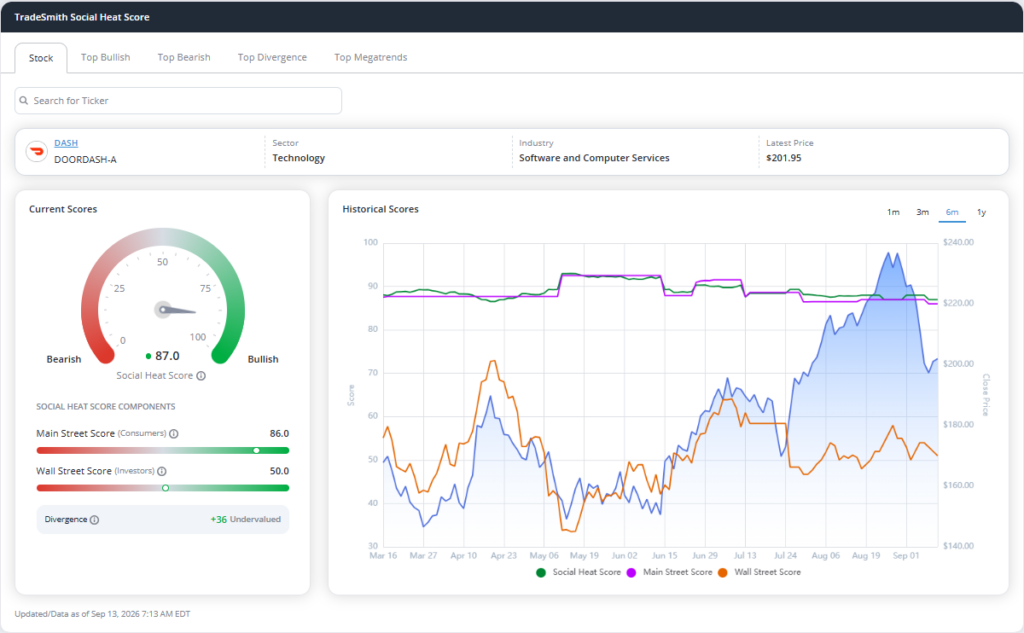
A score above 60 tells us consumer momentum is bullish. Below 30, it’s bearish. Anything in between is neutral.
More important, we’re looking forchange – moments when consumers start moving before Wall Street catches up.
We’ve used this approach to spot some remarkable opportunities, including Robinhood (HOOD) below $20 before a 556% gain and Oklo (OKLO) below $25 before a 461% run.
Right now, Tesla is a great example.
The stock is down about 20% this year. Consumer demand is heading the other way.
Cybercab interest is exploding as Tesla’s purpose-built robotaxi has barely begun carrying the public. And Tesla shoppers are coming back.
Let me show you what we’re seeing.
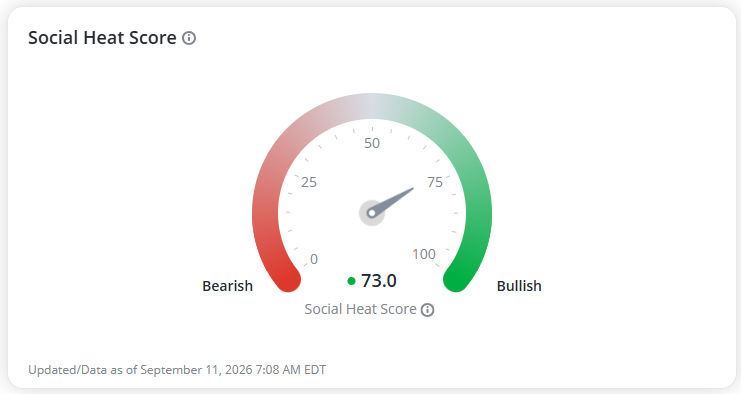
Tesla (TSLA) Social Heat Score: 73/100 – Bullish
That bullish 73 stands in sharp contrast to a stock that’s down about 20% this year. Cybercab helps explain why.
Signal No. 1: Consumers Started Moving Before the Launch
Search behavior is one of the earliest signals we watch because people often search before they act.
Google searches for Cybercab in the U.S. hit their highest level ever in August, above the month Tesla first showed the car in October 2024. Searches for Waymo (GOOGL) peaked in June 2025 and have moved sideways since.
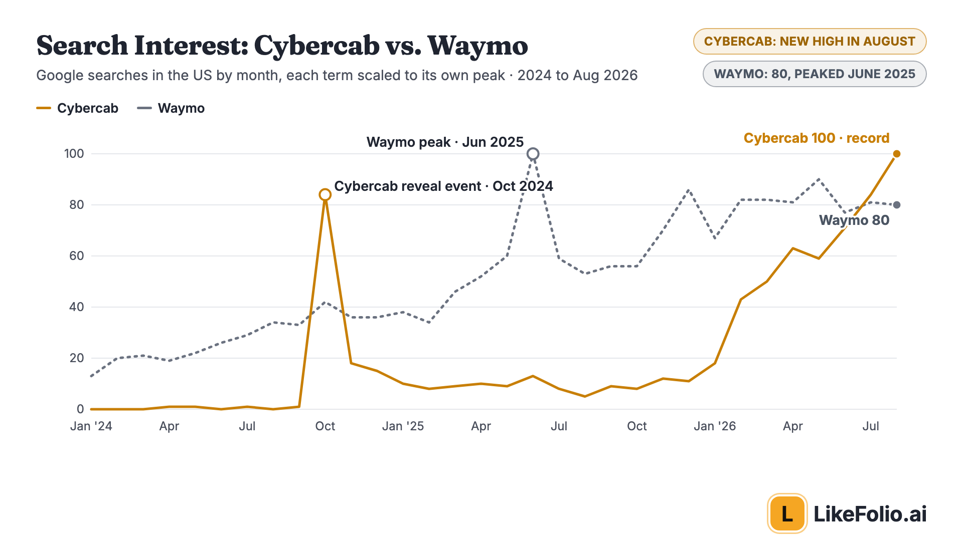
The chart above shows how interest in each brand has changed over time – not which one gets more total searches. Each is measured against its own search peak. Cybercab was already gaining ground before a single member of the public had ridden in one.
Now put Cybercab and Waymo on the same starting line in January 2026, and the gap becomes much clearer:
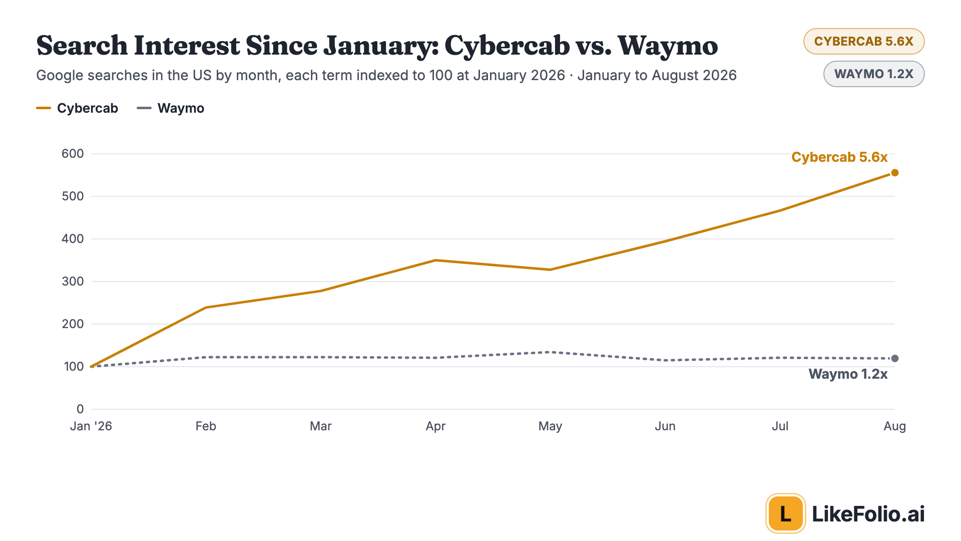
Cybercab search interest has climbed more than fivefold since January. Waymo is up just 20%.
We think robotaxis at large are the future of ride-hailing. Tesla won’t be the only winner. But Tesla is pulling away in consumer interest. And it already has a major advantage on price.
A Tesla Ride Costs Half an Uber
You can already see that advantage in what riders are paying.
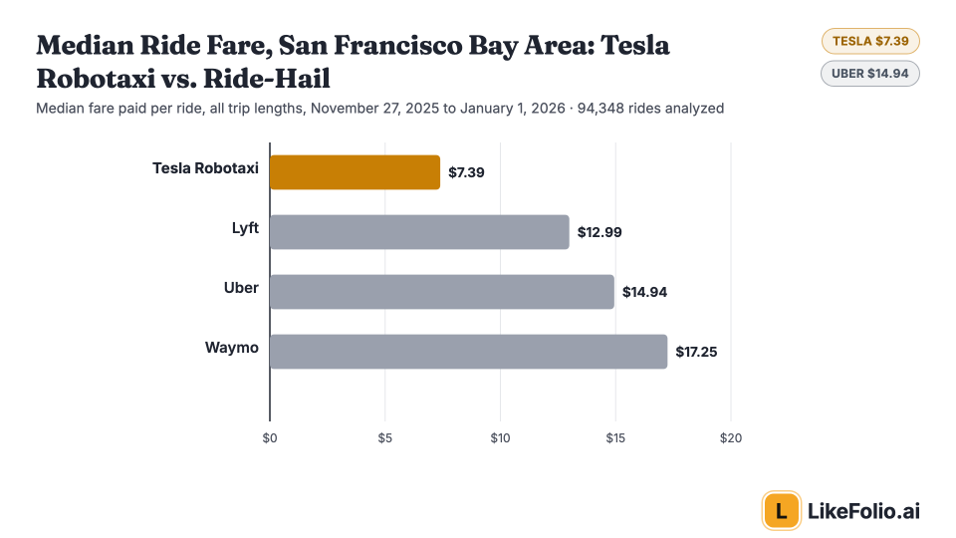
Rideshare aggregator Obi pulled data from more than 94,000 ride requests in the San Francisco Bay Area between Thanksgiving and New Year’s Day.
Tesla was the cheapest option by a wide margin.
The median Tesla Robotaxi fare came in at just $7.39. Uber cost $14.94 – more than twice as much. Waymo was even pricier at $17.25.
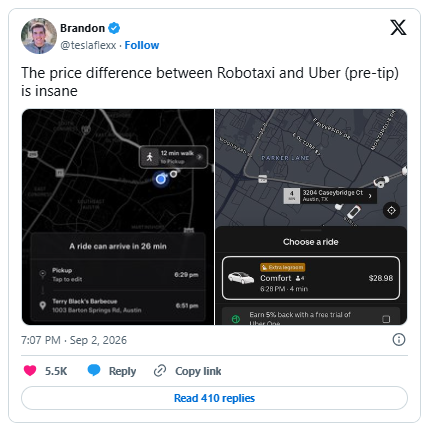
In Austin, the gap is even wider. On September 2, one rider posted both receipts for the same trip to Terry Black’s Barbecue: $12.60 in a Tesla, $28.98 in an Uber Comfort before the tip.
Tesla can flex this kind of pricing because of its massive scale and expertise. It didn’t have to figure out how to build a fleet – it already made cars. It didn’t have to figure out self-driving either, with Tesla technology logging years and millions of Full Self-Driving (FSD) miles under its hood.
Musk has said rides should end up costing about what a bus ticket costs.
The fleet on the road is small, for now. But competitors shouldn’t underestimate Tesla’s position or its vision. Obi measured waits close to 16 minutes for a Tesla against three to six minutes for the others, and the Texas state registry lists 420 Tesla robotaxis against 988 for Waymo.
Tesla still has some catching up to do on availability. But adding more cars to the fleet should bring those wait times down. And this tension is felt by more than Waymo…
Uber Cut One in Ten Jobs
On September 2, Uber laid off 3,300 people, its largest cut since 2020. Its chief executive told employees the company had grown too many layers and would put the savings into ridesharing, delivery, and robotaxis.
Uber has committed more than $10 billion to self-driving partners, over 30 of them, and runs Waymo cars through its own app in Austin and Atlanta. It is paying so that riders book through its app, in cars it does not own.
Uber needs partners to supply the self-driving cars. Tesla can build its own.
Tesla also controls the ride from booking to payment.
Signal No. 2: Tesla Shoppers Are Coming Back
Cybercab could be dismissed as hype if the rest of Tesla’s consumer data were weakening.
It isn’t.
We also track visits to Tesla’s website – where consumers actually shop for its cars. That number is up 21% since January.
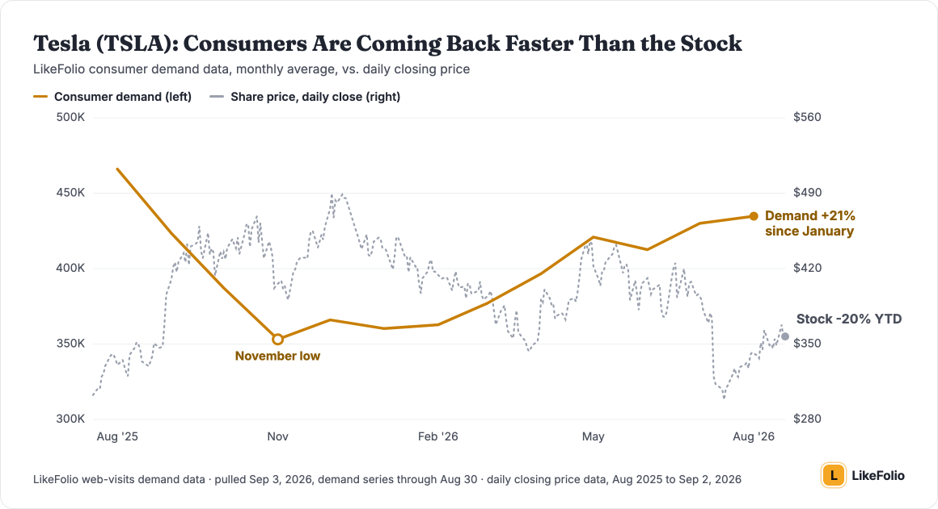
The stock has traded in the opposite direction.
Tesla reported a record 480,126 deliveries for the second quarter on July 22. But heavy spending on AI and robotaxis squeezed its profit from the car business, pushing operating margin – the profit left from each dollar of sales before interest and taxes – down to 1.4%.
Investors punished the stock. TSLA fell 14% the next day and kept sliding for a week.
Yet August was Tesla’s busiest month for website traffic in a year – a sign shoppers are warming back up to the brand.
And keep in mind, there’s a major piece of Tesla’s future that none of this consumer data captures yet: Optimus, the humanoid robot Tesla is developing for factory work and other physical tasks.
Then There’s Optimus
Speaking to a meeting of G20 ministers on September 1, Musk said he would bet serious money that at least a billion humanoid robots exist within 10 years, each producing five times what a person can.
The company stopped building the Model S and X in Fremont this spring so it could convert that same factory floor to build Optimus. The first units are due this quarter.
Musk says output will be slow at first. Optimus has 10,000 parts that have never been mass-produced, and he calls it the hardest product Tesla has ever tried to scale.
Every chart above captures the Tesla business we can measure today.
We’ve recommended Tesla to MegaTrends members since 2023, and it remains in our model portfolio today because we believe its biggest opportunities may still lie ahead.
The Bottom Line
This Tesla story is a good example of what we look for at MegaTrends.
The stock is down about 20% this year. Cybercab search interest has jumped 5.6x since January, while Tesla’s website just had its busiest month in a year.
Wall Street sees the stock price.
We can see what consumers are doing underneath it.
Finding gaps like this early is the whole idea behind MegaTrends. We follow consumer behavior to find companies gaining traction before the change becomes obvious in their financial results – or their stock price.
That approach helped us get into Robinhood below $20 before a 556% gain and Oklo below $25 before a 461% run.
Today, we track millions of consumer signals across hundreds of publicly traded companies, looking for the next opportunity.
Tesla is one of the stocks our data likes right now.
MegaTrends members get our strongest opportunities, along with the consumer data behind each one. When our system identifies a stock we want to own, members get the recommendation and our full investment case.
And now MegaTrends members can go deeper into the Social Heat Score themselves – tracking more than 1,000 stocks, following how their scores change over time, and seeing where consumer strength is running ahead of Wall Street expectations.
If you’d like access to the Social Heat Score and the opportunities we uncover with it, you can learn more about MegaTrends here.
Until next time,
Andy Swan
Founder, LikeFolio
About Andy Swan
Andy Swan is the cofounder of LikeFolio and co-creator of the consumer-data system behind MegaTrends.
Along with his brother Landon, Andy pioneered a new way to hunt for investment opportunities: track what consumers are buying, searching for, and talking about online – then use those signals to spot shifts in demand before they become obvious on Wall Street.
Their research has been featured by CNBC, Fox Business, Barron’s, Forbes, and other major financial outlets. Their stock-picking methodology has even been studied by academics at Georgetown University. Today, Andy uses that same consumer-first approach to find the stocks benefiting from some of the biggest shifts in how people live and spend.