The Top 25 S&P Stocks to Sell Right Now
Introduction
Main Street investors often believe that success comes from picking the “right” stocks. Every investor knows that thrill. But professional traders and hedge fund managers know the truth: Profits don’t come from buying alone – they come from selling at the right time.
That’s the real secret to long-term success: Knowing when to sell.
And yet, few experts talk about this openly. Instead, investors are bombarded with buy recommendations but left guessing when it’s time to exit.
This knowledge gap is exactly why so many investors hold on too long, watching their winners turn into losers. Or worse, they sell too soon – missing out on explosive gains.
Here’s the harsh truth: If you’re holding onto stocks that are losing ground – without a clear exit strategy – you’re putting your financial future at risk. It’s about how you protect your capital and lock in gains.
This report is your guide to navigating that critical decision.
Yes, we’ll highlight 25 widely held S&P 500 stocks that may no longer deserve a place in your portfolio. But more importantly, we’ll equip you with a system to determine exactly when to sell – whether it’s one of these stocks or any other investment you own.
Timing a sale isn’t just about gut instinct or reacting to the latest headline. It’s about having a disciplined, data-driven strategy that eliminates emotion and guesswork.
Yet, few investors have a concrete system in place. Instead, they fall into one of two costly traps:
- Hoping for a rebound: They tell themselves, “I’ll sell when it gets back to breakeven,” only to watch the stock fall even further.
- Panicking too soon: They see a stock dip temporarily and rush to exit, only to watch it surge to new highs.
This report will help you avoid both pitfalls.
Volatility is far from over. The market is shifting, and new opportunities are emerging – but only for those who know when to take profits and reallocate their capital wisely.
That’s why this report is more than just a list of stocks to sell. It’s a playbook for smart risk management. You’ll learn:
- Which 25 S&P 500 stocks are flashing clear sell signals today
- How to use proprietary, volatility-based trailing stops to protect gains
- A simple, repeatable strategy to time your exits with confidence
If you’re serious about maximizing returns and safeguarding your portfolio, this is essential reading. Let’s dive in.
When to Get In: Momentum, Trend, and Volatility
As we’ve already said, it’s extremely important to know what kind of stocks to buy and when to buy them. That’s not the focus of this report, but we can’t just skip the topic altogether.
Fundamentally, most successful investors strive to invest in stocks with strong momentum and a favorable trend. There’s much more to it than that – but without those, you’re probably better off taking a pass.
By looking at the momentum and trend, investors can have a good idea which stocks and options have the potential to be the most successful before even investing a penny.
There are two other factors we need to touch on: volatility and research.
Volatility: This measures the way stocks move up and down as a natural function of the market. No two stocks are identical; some are highly volatile, and others are much less so. And that’s as it should be.
This matters because having a reliable way of taking into account each stock’s unique measure of volatility is one of the keys to successful investing. It allows investors to compare one stock with another and align their picks with their investing goals.
Research: It’s critically important that investors make their picks based on research-backed information. Because if their picks are not based on research, they are almost certainly based on guesswork, emotions, or “blind trust” in some person or organization. And that isn’t likely to work out very well for most investors. Certainly not with any consistency.
When it comes to buying, the key to entry on any stock is to focus on momentum and trend, using reliable research to take account of each stock’s unique volatility profile.
When to Get Out: The Necessity of Having an Exit Strategy
So how do you know when to get out of a stock?
Here’s the bottom line: You must know the timing of your exit before you even buy.
It’s called an exit strategy – and it is impossible to overstate the importance of having one.
This is critical for (at least) two reasons.
First, an exit strategy helps smart investors lock in and preserve gains while protecting themselves from loss.
For example, by combining a stop-loss order with knowledge of a stock’s level of volatility, investors can decide ahead of time how much give-and-take they are willing to tolerate for their stock pick.
This helps them strike a critical balance as they watch the ups and downs of the market:
- If they sell too soon, because their stock is dropping at the moment, they’re likely to miss out on incredible gains. (This can especially happen with highly volatile stocks.)
- If they sell a stock too late, and ride its downward plunge too long, they’ll likely suffer a major loss. (This can happen especially with less volatile stocks.)
You definitely want to avoid both of those situations.
Second, an exit strategy removes dangerous emotions and guesswork from the equation.
In other words, the worst time for an investor to make a decision about whether or not to sell a stock is when they are in a state of uncertainty, or maybe even anxiety, about their stocks – and reacting to the fear-mongering and chaos from the media.
Under those circumstances, it’s far too easy for investors to tell themselves they’ll sell their stock “when it returns to breakeven” — and then watch it keep falling until it’s all but worthless. Or they may panic and dump their stock too soon — only to watch it soar hundreds of percent afterward.
In fact, psychologist Daniel Kahneman won a Nobel Memorial Prize in Economic Sciences for his work with Amos Tversky, proving that investors are not rational decision-makers. Instead, investors regularly do things like buy high and sell low (instead of the opposite) and get caught up in the “herd mentality.”
So, successful investors don’t rely on their irrational decisions made in the moment. Instead, they decide ahead of time under what conditions they will sell their stock. And when those conditions come together, they sell – regardless of their emotions or what the news and “experts” tell them.
That is the best time for an investor to sell their stocks – by following an exit strategy put in place before even buying a stock and holding on to the stock until the conditions of that strategy come to pass.
What Not to Do: Even Billionaires Miss This
At this point, let’s look at a real-life example to show you that it’s all too easy to pick the right stocks, but miss out because of exit uncertainty.
Backtesting shows that even the most esteemed billionaires have made big emotional mistakes that cost them massive sums of money.
Take David Einhorn, for example. He is the founder and president of Greenlight Capital, a “long-short value-oriented hedge fund” with roughly $2 billion in assets under management.
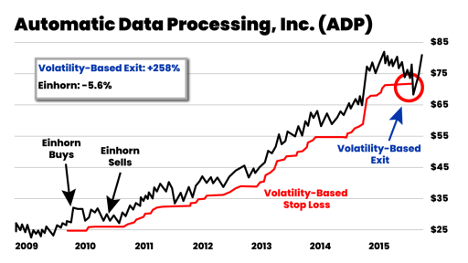
In late 2009, he opened a position in ADP, a provider of payroll and HR solutions software, for about $31 per share. He went on to hold the position for about nine months, during which time it did not do anything spectacular — it primarily fluctuated between $29 and $33 per share. You almost can’t blame him for stopping out with a small loss — 5.6% — and moving on to something potentially more profitable.
But our backtesting shows that if he had used a simple, volatility-based trailing stop, he could have stayed in the position for nearly six years — and would have had a 258% gain to show for it.
Of course, this is just one example of a mistake a particular billionaire made — and Einhorn didn’t become a billionaire without plenty of successes, too. But it’s a solid reminder of how important it is for investors to get their exit strategy right.
Case Study: When to Sell These 25 S&P Stocks
A proprietary system of volatility-based trailing stops can tell you when to sell any stock you own.
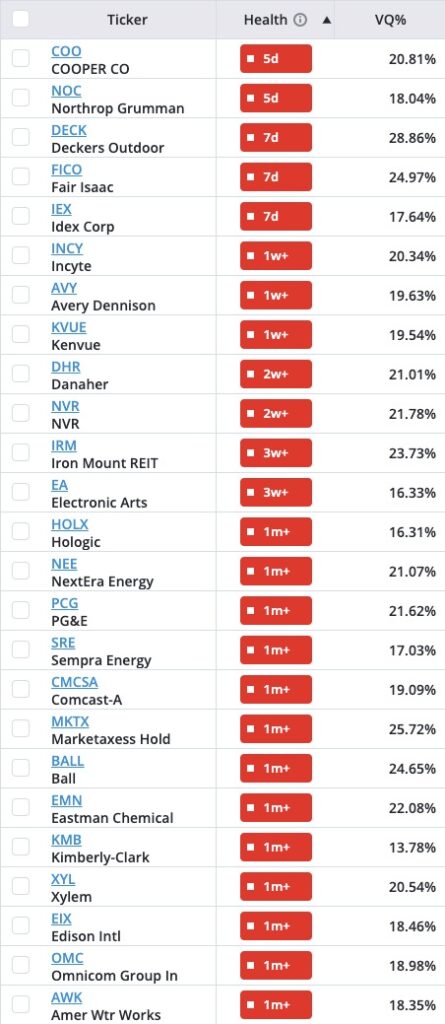
One exit strategy you could consider is based on the stock’s expressed volatility quotient. If you have one of these stocks in your portfolio and it is down by more than its unique volatility quotient, consider selling.
You can also interpret this system of volatility-based trailing stops based on its color status. A stock with a red rating is not healthy; it has fallen from its most recent high by the amount of its unique volatility quotient and is not acting normally. This is a stock you might consider selling.
By now, you’ve seen firsthand how strategic risk management and data-driven decision-making can transform your investing – eliminating guesswork and emotional pitfalls. But this is just the beginning.
On Feb. 27 at 8 p.m. Eastern, TradeSmith CEO Keith Kaplan will unveil the biggest prediction in TradeSmith’s 20-year history during The Last Meltup. You’re already registered, so mark your calendar, set a reminder, and log in early to ensure you won’t miss anything. This could be the most important investing insight you gain all year; don’t miss a second.