The Whoop Effect: A Grand Slam Ban Just Exposed the Next Health Tech Boom
BY ANDY SWAN, FOUNDER, LIKEFOLIO
Something happened at the Australian Open this week that investors shouldn’t ignore.
Aryna Sabalenka – the No. 1 player in women’s tennis and a two-time defending champion – stepped onto the court for her first-round match wearing a small band on her wrist.
Officials stopped her. They told her to take it off.

Days later, the same thing happened to Carlos Alcaraz – the No. 1 player in men’s tennis –during his fourth-round match against Tommy Paul.
The following day, officials spotted four-time Grand Slam winner Jannik Sinner wearing one under his wristband. They made him remove it, too.
Three of the best tennis players on the planet. All wearing the same device. All told they couldn’t compete with it on.
The device wasn’t flashy – no screen, no alerts, no distractions.
Just a Whoop band – a 24/7 biometric tracker that continuously monitors heart rate, strain, recovery, and stress. The data feeds into an AI-powered app that athletes use to manage performance and rest in real time.
Sabalenka relies on it between matches. When her data hits the “red zone,” she knows her body is overstressed – and it’s time to back off before something breaks.
Tournament officials banned the devices anyway. Despite the International Tennis Federation (ITF) previously approving in-match wearables. Despite the Women’s Tennis Association (WTA) naming Whoop its Official Fitness Wearable. Despite the ATP Tour approving in-competition wearables as of July 15, 2024.
But the ban itself isn’t the story.
The real story is that these elite athletes have access to the best coaches, doctors, nutritionists, and recovery tools money can buy. And still, they’re so dependent on continuous biometric data that they’re hiding devices under wristbands at a Grand Slam.
That’s not a gimmick. That’s a full-blown behavioral shift.
And it’s exactly the kind of shift our consumer Data Engine is built to detect early.
We analyze millions of real-time data points from across the web – social activity, search behavior, and consumer demand signals – to spot mega trends as they form, not after Wall Street prices them in.
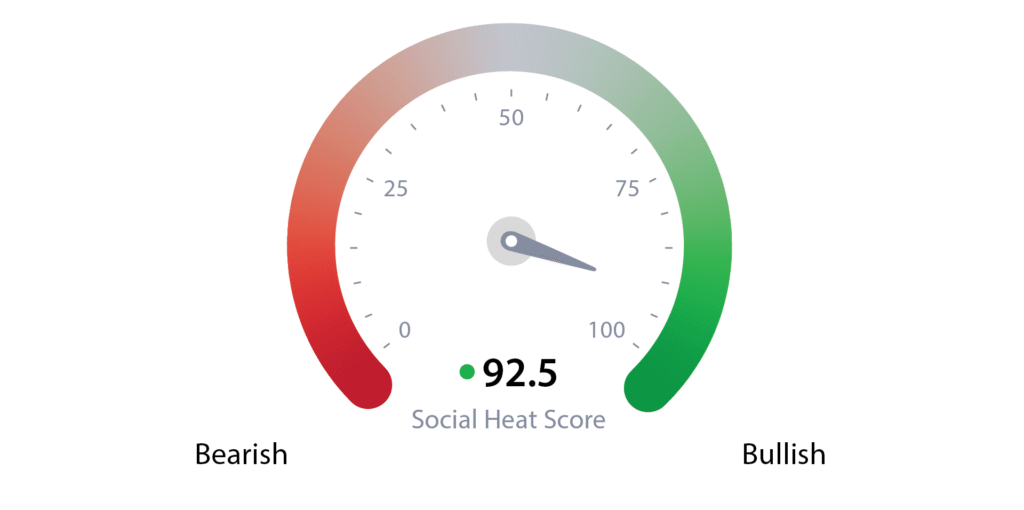
Our Social Heat Score ranks stocks on a 0–100 scale based on what consumers are actually doing, not what analysts are predicting. (Higher scores signal rising demand – and bullish opportunities.)
In this report, we’ll put that Data Engine to use to show you how the Australian Open’s Whoop ban helped surface a major health tech mega trend before the crowd.
We’ll hand you the tickers on two publicly traded companies positioned to benefit as personalized health goes mainstream: One platform knows what’s wrong before you do. The other knows what to do about it. Both are already in your pocket.
You’ll see for yourself why the platform they’re building could power the next wave of winners – and what to watch next.
This is what it looks like when a consumer trend crosses the point of no return – and the playbook to profit…
When Elite Athletes Can’t Live Without Consumer Tech, Pay Attention
Whoop itself isn’t publicly traded.
But what Whoop represents – the consumer demand for personalized, continuous health data – is a mega trend with clear investment implications.
More than 500 million consumers use smartwatches. Everyday people like you and me who increasingly expect their health to be personalized, data-driven, and proactive rather than reactive.
Personalized fitness is the gateway to personalized everything – personalized medicine, personalized supplements, personalized treatment protocols.
Two publicly traded companies are building complementary pieces of this puzzle:
- One is quietly amassing the largest health dataset ever assembled – and building the AI to interpret it.
- The other is building the infrastructure to turn insights into personalized treatments.
Together, they represent one way to play this trend. But they’re also opening the door for new winners to emerge…
Stock No. 1: The Health Data Empire
Apple (AAPL) might be sitting on the most valuable health dataset ever assembled.
The Apple Heart and Movement Study trained a model called WBM (Wearable Behavior Model) on over 2.5 billion hours of health data from approximately 162,000 participants. That model was evaluated on 57 different health prediction tasks.
The results: 92% accuracy for pregnancy detection when combined with other health data.
In September 2025, Apple launched hypertension notifications on Apple Watch Series 11. The feature was developed using machine learning trained on data from over 100,000 participants and validated in a clinical study of over 2,000 participants. Apple expects to notify over 1 million people with undiagnosed hypertension within the first year.

Apple Health stores over 150 different types of health data from connected apps and devices. The company’s Research app has over 350,000 participants contributing data. It has collected exposure data from 400 million hours of environmental sounds for their Hearing Study.
Here’s the part most investors are missing: A vibe coding explosion is about to unlock all of that data for regular consumers.
The Vibe Coding Accelerant
With “vibe coding,” just about anyone on Main Street can build software. You describe what you’d like to build in plain English and let AI generate the code for you. No blueprint, no jargon, no training, no engineering experience. Just vibes – a feel for how it should work.
OpenAI co-founder Andrej Karpathy coined the term in February 2025. Within months, it went from concept to movement.
More than 90% of U.S. developers use AI coding tools daily. More striking? 63% of people using vibe coding tools aren’t developers at all. They’re designers, marketers, and regular people with ideas.
Why does vibe coding matter for Apple? Because Apple’s Mac Mini M4 offers a trusted environment that’s accessible to everyday folks – and perfect for AI assistant buildouts.
Take the open-source AI assistant ClawdBot as an example. The project, hosted entirely on a Mac Mini, lets AI control an entire computer autonomously – browsing websites, filing forms, handling tasks – all through messaging apps like WhatsApp, Telegram, or iMessage.
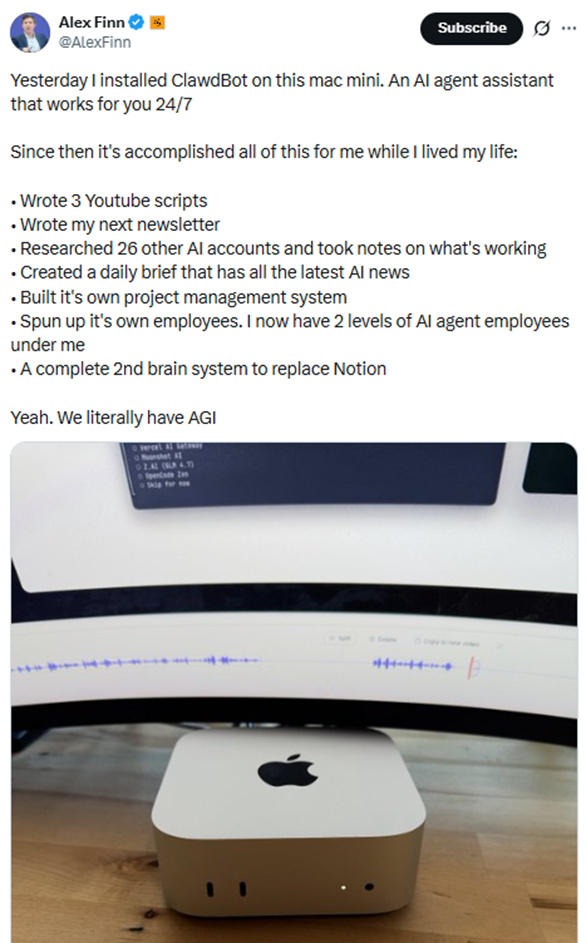
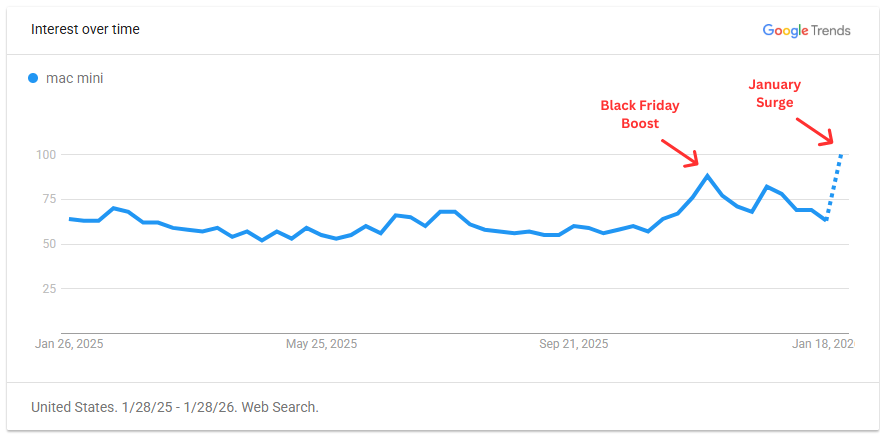
ClawdBot gained 9,000 GitHub stars in a single day – the equivalent of “going viral” in the developer community. And Mac Mini interest in January surged to Black Friday levels.
Developers are racing to set up dedicated machines for AI agents that can access their calendars, emails, and – critically – their health data… all through Apple’s native ecosystem hooks, such as Shortcuts, AppleScript, and Health.
Apple Health data has always been locked in a walled garden. You could export it as a massive XML file, sure. But most people don’t know what to do with 90+ megabytes of raw health data.
With vibe coding, a new wave of developers is building apps to interpret that data:
- Apps that analyze your heart rate variability trends.
- Apps that correlate your sleep quality with your workout performance.
- Apps that turn raw Apple Health exports into actionable insights using AI.
Apple maintains strict guidelines so that third-party apps can’t use health data for advertising or marketing. In fact, apps are required to disclose and get explicit permission before sharing personal data with third-party AI.
That’s privacy protection that creates trust – and trust creates willingness to share more data.
The Flywheel Effect
Think of it this way:
Apple collects billions of hours of health data → builds AI models that can interpret it → and provides the hardware (Mac Mini M4) that lets hobbyist developers run local AI models → those developers build apps that help consumers unlock their health data → consumers get value and share more data → Apple’s dataset grows.
Our real-time consumer data confirms Apple demand is picking up into 2026, with web visits rising 5% year over year:
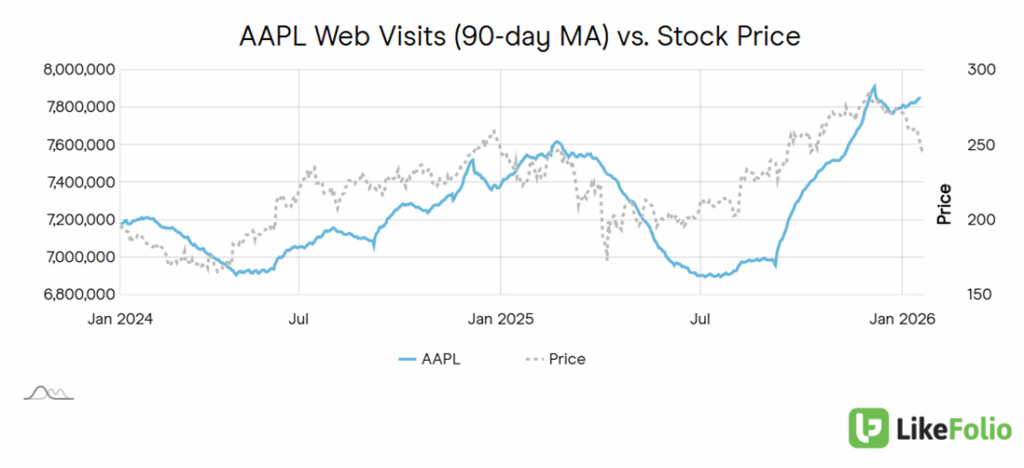
This underlying growth supports AAPL’s current multiple – and suggests further upside ahead.
AAPL Social Heat Score: 64.2 out of 100 (Bullish)*

Stock No. 2: Turning Insights into Personalized Action
Apple can tell you something might be wrong. But then what?
That’s where Hims & Hers Health (HIMS) steps in.
Hims & Hers is a personalized telehealth platform that provides treatments for stigmatized issues like hair loss, erectile dysfunction, and obesity. But those treatments are just the entry point.
What HIMS is actually building is the infrastructure to deliver personalized health at scale…

Verticalizing the Entire Healthcare Diagnostic Loop
The market may not realize it yet, but Hims & Hers is strategically positioning itself to own the most valuable asset in medicine: proprietary patient data.
💊 Compounding: In 2024, HIMS acquired MedisourceRx, an FDA-registered compounding facility to expand its pharmaceutical operations. Compounding allows pharmacies to create customized medication doses tailored to individual patients rather than one-size-fits-all pills. It’s critical to HIMS’ personalized approach.
🏭 Manufacturing: In February 2025, it acquired a U.S.-based peptide manufacturing facility in California to strengthen its domestic supply chain for personalized medications, including ultra-popular GLP-1 treatments such as semaglutide (aka Ozempic).
🔬 Testing: That same month, it acquired Trybe Labs, a lab testing services business to support at-home blood draws and whole-body testing – expanding HIMS’ ability to offer personalized treatments based on actual biomarker data.
Hims & Hers has relationships with major health systems including Ochsner Health, Mount Sinai Health System, Carbon Health, ChristianaCare, and Hartford Healthcare, giving HIMS patients access top-tier medical providers – and in-person care when they need it.
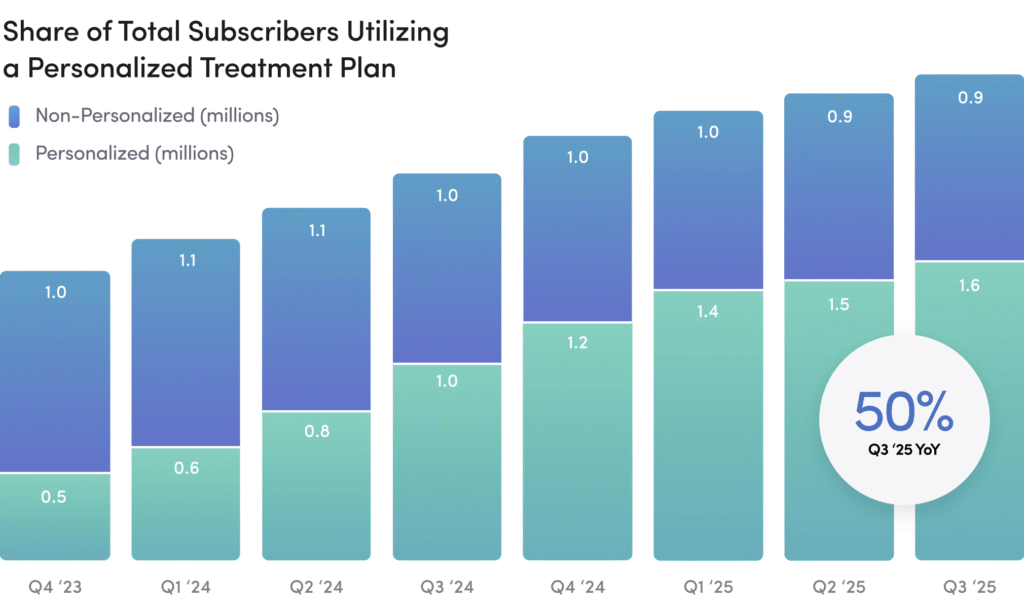
This is a company that’s growing revenue at 49% year over year (nearly $600 million in Q3). Its subscriber base is expanding, up 21% to 2.5 million.
Those subscribers are using HIMS’ personalized treatment plans at an accelerating clip: +50% year over year. They’re increasingly trusting HIMS to treat multiple conditions (+80% year over year). And they’re spending more with HIMS each month (online revenue per average subscriber gained 19% in Q3).
An Undervalued Asset Primed for a Massive Re-Rating
HIMS is quietly building a healthcare empire, yet the stock remains entirely misunderstood by the market. Shares are down 5% on a year-over-year basis, lagging 50% from levels seen six months ago… even as demand ramps on Main Street:

This disconnect between price and performance is a classic signal of an undervalued asset primed for a massive re-rating.
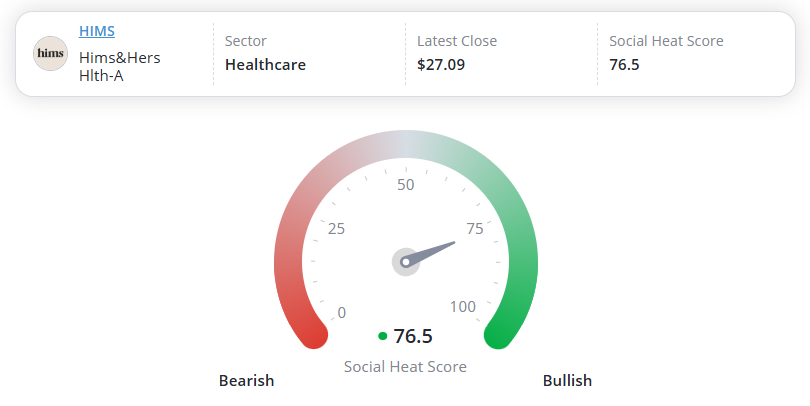
HIMS Social Heat Score: 76.5 out of 100 (Bullish)*
Connecting the Dots from AAPL to HIMS
Here’s the connection that brings these two opportunities together: As Apple’s ecosystem generates more health insights – both from Apple’s own AI and from the explosion of third-party apps built by vibe coders – consumers will increasingly want to act on those insights.
Your Apple Watch detects signs of hypertension. Now, you want someone to actually do something about it. HIMS has built the compounding labs, the testing infrastructure, and the telehealth platform to deliver personalized treatment based on your specific data.
Apple unlocks the data. HIMS delivers the personalized response.

The Bigger Picture: A Platform for New Winners
The Australian Open banning Whoop bands matters because it demonstrates how deeply elite performers have come to rely on continuous biometric data.
That mindset is filtering down to regular consumers. And three forces are accelerating it:
No. 1: The data collection layer is maturing. Apple has billions of hours of health data and is building AI that can predict health conditions from behavioral patterns. Its hypertension notification alone is expected to reach 1 million people with undiagnosed conditions in year one.
No. 2: The “unlock” layer is exploding. Vibe coding has made it possible for non-developers to build apps that interpret health data. The Mac Mini M4 made local AI accessible for $599. ClawdBot going viral in January shows this isn’t slowing down. A flood of new apps is helping regular consumers make sense of what their devices are collecting.
No. 3: The action layer is scaling. HIMS has built the labs, the compounding facilities, and the telehealth infrastructure to actually deliver personalized treatments – doses calibrated to individual patients based on their biomarkers.
The mega trend here is the belief that health should be personalized, data-driven, and proactive.
HIMS and Apple are two clear beneficiaries. But they’re also building the infrastructure that enables entirely new companies to emerge.
Think about it: Apple’s data platform and privacy framework creates the foundation. The vibe coding explosion lowers the barrier for new apps. HIMS has proven the model for personalized treatment delivery works at scale.
That opens the door for:
✅ New apps that interpret specific health conditions using Apple Health data
✅ New telehealth platforms focused on niche conditions
✅ New compounding and personalization plays in supplements, peptides, and beyond
✅ New hardware players building specialized sensors
We’re watching this space closely. Whoop getting stopped at the Australian Open is the newest signal that personalized health data has gone mainstream.
Our Social Heat Score is already uncovering winners like AAPL and HIMS…
But the investment opportunities – both in established players and emerging ones – are just getting started.
Until next time,

Andy Swan
Founder, LikeFolio
With real-time Social Heat Score tracking on hundreds of publicly traded stocks inside TradeSmith Finance, MegaTrends members will know as soon as the next opportunities surface on Main Street – well before Wall Street catches on.

To learn how you can unlock real-time consumer insights with MegaTrends – and uncover the market’s next big winners ahead of the crowd – go here now.