Listen to the audio version of this article (generated by AI).
In This Digest:
- More people are searching on Google than ever. So why did the stock drop 10%?
- How Jeff Clark used Bitcoin to spot this market slide three weeks before it hit
- The “bio-intelligence” boom runs through this drug-testing stock
Google is disrupting itself…
On yesterday’s earnings call, CEO Sundar Pichai told investors that the company had its fastest growth in search queries since 2021.
More people are asking Google more questions than ever.
But that didn’t stop its stock from falling about 10% after the call.
The problem is that while search volume shot up, search revenue grew just 12% to $63.4 billion – less than the $64.9 billion Wall Street expected. And it was a sharp slowdown from 17% growth in search revenue from the quarter before.
You may have noticed what happens now when you Google something. Before you see any links, Google’s AI writes you an answer at the top of the page… using its Gemini AI model.
That’s handy if you’re the one searching. But for Google, it’s a problem. If the answer is right there, you don’t need to click anything. And clicks are how Google makes money. Advertisers pay every time someone clicks on one of their ads.
Since the start of the AI boom, investors have worried that AI chatbots would steal Google’s search business. It turns out the bigger risk may be Google cannibalizing itself. For the first time, search now brings in less than half of total revenue for its parent company, Alphabet.
That would be easier to stomach if Alphabet’s AI spending were paying for itself. It isn’t – at least not yet.
Alphabet is spending so heavily on data centers that its free cash flow – the cash left over after running the business and paying for new investment – came in at negative $9.1 billion. That’s the second straight quarter it has burned cash.
For comparison, Microsoft also reported after yesterday’s close. Its Azure cloud business – which rents out computing power to companies building AI – grew 48%. But even after heavy spending, Microsoft produced $18.6 billion in free cash flow. Its stock rose about 4% after hours.
That’s the dividing line running through the Magnificent Seven right now. Microsoft, Apple, and Nvidia are still producing cash. Alphabet, Meta, Amazon, and Tesla have all reported negative free cash flow in recent quarters.
And you can see that dividing line in how these companies are trading.
The three cash producers – Microsoft, Apple, and Nvidia – are in Short-Term and Long-Term Health Green Zones. This shows they’re in healthy uptrends. You can’t say the same for any of the cash burners.
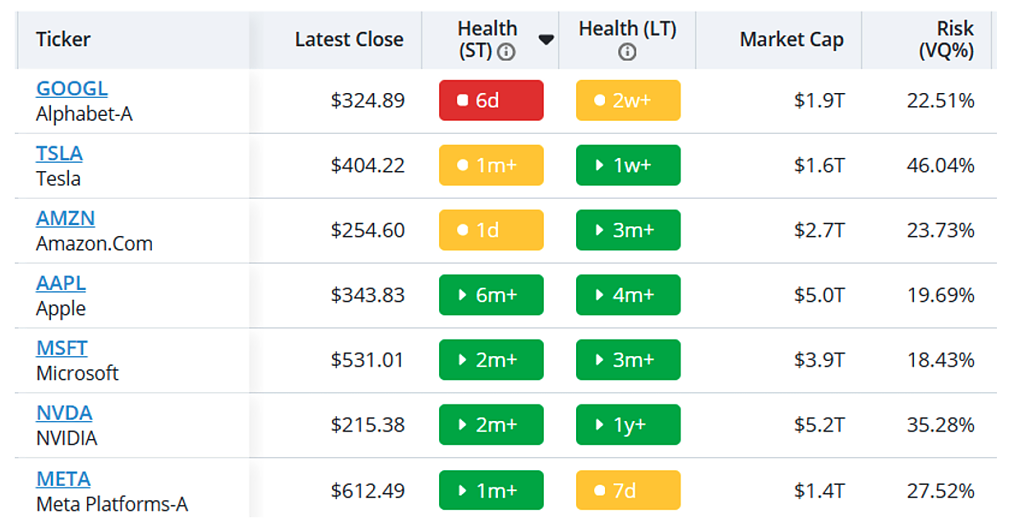
Alphabet sent the clearest warning. It entered a Long-Term Health Yellow Zone on Oct. 14. Then on Oct. 23 – three trading days before its earnings report – it entered a Short-Term Health Red Zone.
Its bullish trend was already breaking down before its earnings release.
If you want exposure to the Mag 7 right now, stick with the three stocks in Green Zones: Microsoft, Apple, and Nvidia.
And if you’re a paid-up subscriber, set a Health alert on GOOGL in TradeSmith Finance. That way, you’ll know the moment the trend turns back in your favor.
Jeff Clark heard the canary cough three weeks early…
On Oct. 9, TradeSmith’s master options trader Jeff Clark made his latest market call without looking at stocks at all.
Instead, he watched Bitcoin.
The world’s most valuable cryptocurrency had traded as high as $87,000 on Oct. 5. Two days later, it had dipped near $82,000.
To most investors, that’s just crypto being crypto. But Jeff has learned that Bitcoin is also a leading indicator when it comes to stock market moves.
As he puts it, Bitcoin is the ultimate “risk-on” asset. When it’s going up, it means that investors are willing to take on more risk. When it’s falling, it’s a sign they’re becoming more cautious.
Jeff went back through the charts and found that Bitcoin’s short-term peaks came about two weeks before the stock market’s peaks. So when Bitcoin rolled over in early October, he gave his readers a clear warning:
When the environment shifts from risk-on to risk-off, Bitcoin is the canary in the coal mine. And, right now, the canary is coughing.
He also warned that the high-flying momentum stocks propping up the market were “on borrowed time.”
Since Bitcoin flashed that warning on Oct. 9, the S&P 500 is down about 1%. The tech-heavy Nasdaq 100 is down 3.4%. And the VanEck Semiconductor ETF (SMH) – a proxy for the AI trade – has dropped nearly 6%.
Jeff says the canary isn’t done coughing. In yesterday’s edition of his Market Minute e-letter, he wrote:
If we’re going to get a year-end stock market rally, then Bitcoin needs to turn higher. Until that happens, any strength in the broad stock market will likely prove temporary.
Our Health Indicator agrees. Bitcoin shifted into the Short-Term Health Red Zone on Oct. 22. Since then, it’s down nearly 4%.
So treat Bitcoin as your early-warning system. While it’s in the Red, go easy on adding aggressive AI and momentum stocks, and keep your stop-losses tight. When it flashes Green again, that’s the canary telling us it’s safe to take on more risk.
If you’re a paid-up subscriber, set a Short-Term Health alert on Bitcoin in TradeSmith Finance. You’ll know the moment the canary stops coughing.
And if you don’t already read Jeff’s Market Minute e-letter, sign up right here. It’s where he shares his best trading ideas for the week and the chart patterns that guide them.
The “bio-intelligence” boom runs through this testing company…
AI is filling the drug pipeline faster than ever.
According to a peer-reviewed analysis presented at the American Society of Clinical Oncology this year, 117 drugs developed with the help of AI have now entered human trials – from 63 different companies.
And just last month, Insilico Medicine gave the first patient a dose in what it calls the world’s first Phase 3 trial of a drug designed with generative AI. Phase 3 is the final, largest round of human testing before a drug can be approved.
This is bio-intelligence at work.
As our CEO, Keith Kaplan, has laid out in these pages here and here, bio-intelligence is the emerging trend of using AI to read our bodies to cure diseases and slow aging.
But even if AI can design a promising drug faster than any human, it can’t skip testing.
Every one of those drugs still has to go through clinical trials – studies in human volunteers that prove a drug is safe and that it works. The more drugs AI finds, the more trials somebody has to run.
That’s great news for Medpace (MEDP).
It runs clinical trials on behalf of drug companies. And its order book is filling up fast. In its latest quarter, the company won $873.4 million in new business, up 10.6% from a year ago. Over the past 12 months, new contracts climbed 24% to $3 billion. And it’s sitting on a backlog of $3.2 billion in work still to be done.
Sales growth slowed to 8.5% last quarter, so this isn’t a stock without hiccups. But the contracts coming in the door point to more work ahead.
The trouble is, if you wait for Medpace’s next earnings report to confirm that, you’ll likely be late.
An earnings report looks backward. It tells you what happened over the past three months. And the day it comes out, every investor on Wall Street is reading the same numbers at the same time. By then, the stock has often already moved.
That’s the problem my colleagues Andy and Landon Swan set out to solve.
Since 2012, they’ve tracked the “purchase intent” of millions of people. Their data pulls from X, Reddit, and YouTube, plus search trends, website traffic, and app downloads.
Then AI picks out the buying behavior that has tended to come before big stock moves.
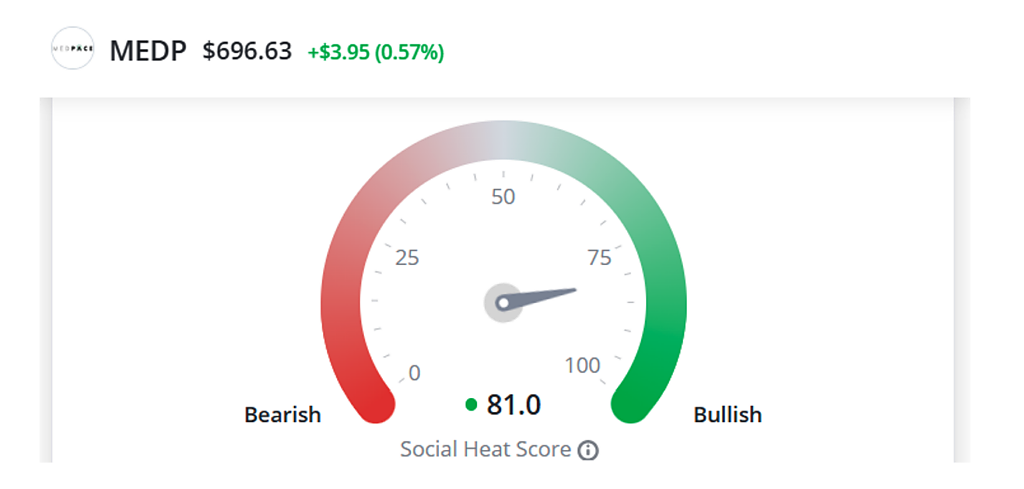
They roll all this data into their Social Heat Score. Ranging from 0 to 100, it gives you a read on how hot a company is for both everyday consumers and business customers.
But spotting demand early only gets you halfway. A product can catch fire online at a company with shaky finances, and that buzz may never turn into gains for shareholders.
To close that gap, the Swans teamed up with legendary Wall Street “quant” Marc Chaikin. His Power Gauge rates stocks on more than 20 factors, from a company’s finances and earnings to whether big money is flowing in or out. It confirms that the demand is landing at a strong business – the kind you’d be comfortable owning.
As Marc puts it:
Their instrument sees the demand wave forming. Mine confirms it’s arriving…
Together, they built the Stock Tsunami Detector to flag the rare stocks where both systems agree. In a six-year backtest, they found 432 cases where both lined up. About 6 in 10 went on to double or more at their peak. Those are backtested results, and no system wins every time.
Medpace is one of the stocks on the list right now. And its Social Heat Score is a healthy 81 out of 100, firmly in bullish territory.
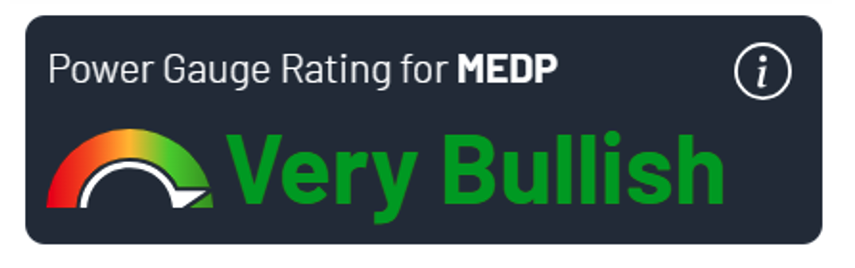
And Marc’s Power Gauge gives Medpace its highest rating: Very Bullish:
Medpace is one of a few hundred stocks that made the cut. Marc and the Swans walked through what their combined systems are flagging right now at the Stock Tsunami Event, and they gave away three free stock ideas: two to buy and one to avoid. Catch up right here.
To building wealth beyond measure,
Michael Salvatore
Editor, TradeSmith Daily
Disclosure: At the time of this writing, Michael Salvatore owned shares of GOOGL.