“There is an entity that cannot be defeated.”
That’s how Lee Sedol – one of the world’s greatest Go players – described AI when he retired in 2019 after losing a five-game contest against Google’s AlphaGo AI model in Seoul in March 2016.
Go was invented in China more than 2,500 years ago. Two players place black and white stones on a grid, trying to capture each other’s pieces.
It looks easy. But it contains more possible positions than there are atoms in the observable universe. The best players win by feel and intuition rather than brute calculation.
So Sedol thought he was safe. The game was too creative – too deeply human – for a machine to crack. Before the match, he predicted he’d win every game.
Then came Move 37 in the second game.
AlphaGo placed a stone in a position no normal player would make – a move so strange that one commentator blurted out, “It’s not a human move.”
He was right.
AlphaGo’s analysis showed that a human player would make that move less than 1 in 10,000 times. But it turned the tide in AlphaGo’s favor, and Sedol lost the game.
He went on to lose the contest 4–1.
The machine wasn’t smarter. But it could see patterns no human eye could. And that was enough to defeat the world’s best player.
It’s a cautionary tale for investors today. AI models are way better at recognizing patterns now than they were a decade ago. And there’s no domain richer in hidden patterns – or more ruthlessly efficient at rewarding those who spot them and punishing those who miss them – than the stock market.
That’s why my team at TradeSmith and I have spent more than a year building a new application of AI for self-directed investors like you.
It uses the same principles that defeated the world’s greatest Go player to spot patterns that flag the day’s most promising trades – 90 minutes before they happen.
And you can test drive it ahead of the Nov. 18 launch event. I’ll show you how it works today – and pass on the link where you can try it out for free.
We’ve Gone Deeper Than Ever Before
TradeSmith is one of the world’s largest financial technology firms for self-directed investors.
We’ve invested more than $32 million to create hedge-fund-level analytical systems and strategies for folks like you. But we’ve never gone this deep.
Our new AI-powered trading system doesn’t look at balance sheets… read earnings reports… or follow news headlines. Instead, it detects tiny anomalies in stocks’ historical data. Then it finds statistical connections between them that a human analyst would never find.
Think of it like a fingerprint. Every great trade has one. A unique alignment of factors – technical indicators, price patterns, market conditions – that has lined up before.
When those factors align again, our system flags a high-probability setup. Some with historical accuracy rates of 90% or more.
Here’s what happens when we tested it out.
Turning Patterns Into Profits
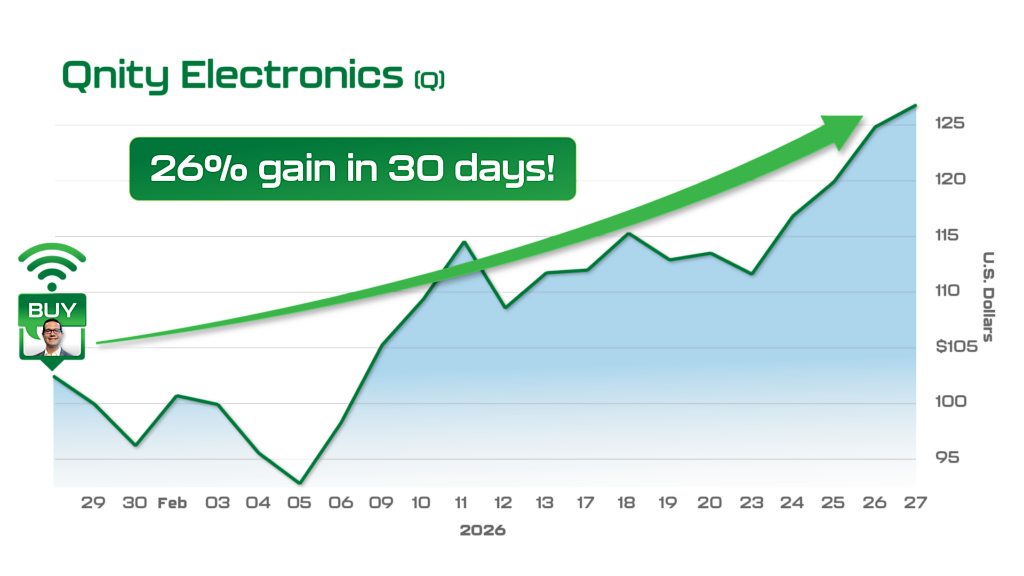
Early this year, our system flagged a trade in Qnity Electronics (Q) – a company I’d never heard of before.
It identified three factors that had aligned only four times over the past decade. Every time those same factors lined up for Q, the stock went up.
On Jan. 28, this signal fired again – and over the next 30 days Q shares jumped 26%.
Or take AI chipmaker Advanced Micro Devices (AMD). On a recent signal, our system forecast an 8.4% move in 14 days, based on a pattern with 95% historical accuracy.
The result was an 8.1% gain in 48 hours.
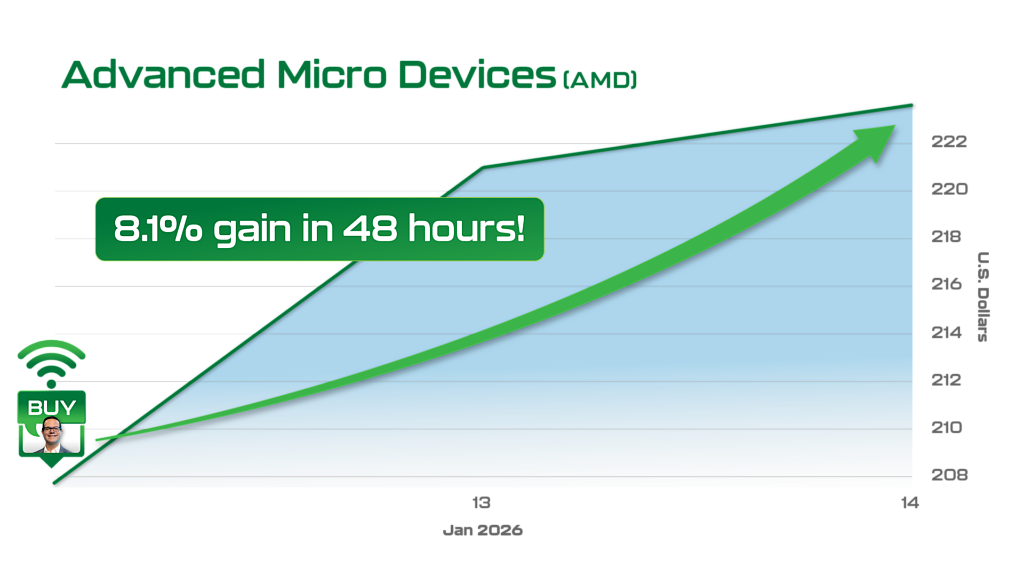
Or take another popular AI stock, Palantir (PLTR). Our system signaled a 5.8% move in nine days, again with a historical accuracy rate of 95%. The result was a 15.1% gain in seven days – nearly three times the forecasted return.
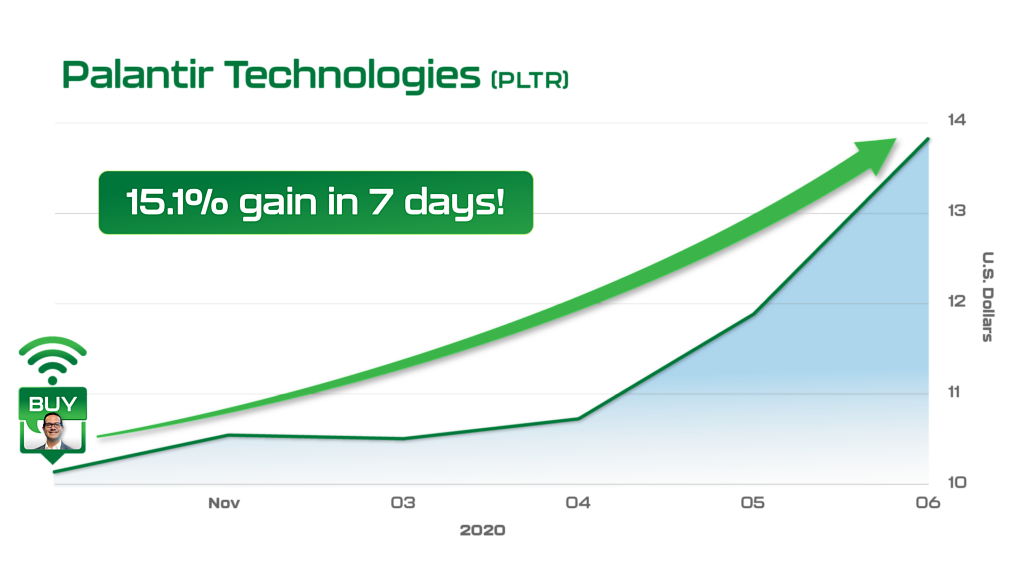
These returns are from trading our signals with stocks. Here’s what those same signals produced using options:
- Caterpillar (CAT): 126% in 72 hours
- Nvidia (NVDA): 129% in 5 days
- Lockheed Martin (LMT): 365% in 30 days
- HCA Healthcare (HCA): 461% in 13 days
- Generac (GNRC): 1,082% in 33 days
Now you’ve seen some of what the signals can do. Let’s look at what’s happening under the hood.
Finding the What, Not the Why
The technology behind this new trading system is similar to what powers ChatGPT and other AI models.
They soak up massive samples of language, find statistical relationships between words, and predict what comes next. Our system uses the same principle – but for numbers.
We fed it data on 2,467 stocks going back 10 years – including interest rates, Treasury yields, Relative Strength Index readings, Bollinger Bands, and intraday trading ranges.
It also looks at indicators most traders never use. Things like:
- Kaufman Efficiency Ratio: It measures how cleanly a stock is trending versus how much it’s just drifting sideways.
- Williams %R: It’s a momentum oscillator that measures where price sits relative to its recent high-low range.
- DMI+/DMI-: They measure the strength of upward versus downward movement independently, rather than just looking at price direction.
No one knows exactly why each signal works so well. Frankly, it doesn’t matter. Like AlphaGo, our AI finds the what… not the why.
It runs each stock through 4,000 individual calculations daily, compiling more than 10.4 million trade evaluations every 24 hours.
It’s looking for combinations that have worked before – regardless of whether there’s an obvious reason why.
The result is a trading system that doesn’t care whether we’re in a bull or a bear market. It doesn’t need a strong economy or a calm geopolitical environment. It just needs the ingredients to align.
Given what we’ve seen in 2026 – a wipeout in software stocks, oil above $100 a barrel, and our own market health indicators flashing red – that kind of neutrality matters more than ever.
Now You Can Try This Breakthrough for Yourself
This is unlike anything we’ve released in our firm’s 21-year history.
The 30,000 (and counting) signals our system has discovered give you the kind of edge that would otherwise be off-limits for most investors.
Find out more about it at my AI Signals Trading Event on Wednesday, Nov. 18, at 10 a.m. Eastern.
I’ll walk you through how it works in more detail – including the signals it’s tracking right now and the trades it’s flagging for the weeks ahead.
Use this link to register your interest, and you’ll get immediate access to test drive our software ahead of the event.
I hope to see you there.
All the best,
Keith Kaplan
CEO, TradeSmith
P.S. Our chief developer, Mike Carr, agreed to put real money into whatever stock our signals system flagged one morning – without looking up the company, checking the news, or reading a single earnings report. He just followed the signal.
We recorded the whole thing. You’ll see how it played out when you join us on Nov. 18. Here’s that link again to secure your spot.