100x Blackouts If These Companies Don’t Fix the Grid
Listen to the audio version of this article (generated by AI).
In This Digest:
- America’s power grid will fail unless this happens
- An AI chokepoint most folks have never heard of
- Missed the U.S. AI Super Summit? Catch up here
America’s power grid is about to break a 20-year-old record…
Ahead of this weekend’s 4th of July celebrations, a heat dome has settled over the eastern half of the United States.
Like a lid on a pot, it’s trapping hot air in place over the same stretch of country for days… maybe weeks.
Cities from Washington to Boston are bracing for some of the highest readings in over a decade. And millions of Americans across the affected areas are going to crank the A/C to the max.
On Tuesday, the Department of Energy responded by doing something it doesn’t normally do. It let power plants serving 67 million people run past their environmental caps – limits set on production to keep local air pollution in check – just to keep the lights on.
The grid operator overseeing 13 states and the District of Columbia, PJM Interconnection, is forecasting demand of more than 166,000 megawatts. That would break a record that has stood since 2006.
Summer heat alone is a stress test for an aging grid. But this year, there’s a new variable the engineers who built that grid never planned for.
AI data centers.
One large AI data center can draw as much electricity as 2 million homes – roughly the demand of a city the size of Houston or Chicago. And we’re building them fast. Total spending on data centers is on pace to top $650 billion this year. By 2030, McKinsey projects that figure will climb to $7 trillion.
All those new AI datacenters will consume huge amounts of power. Goldman Sachs forecasts global data center electricity demand will climb 50% by 2027 and as much as 165% by 2030.
The situation has gotten so bad, the Department of Energy is projecting a 100x spike in blackouts by 2030 if there isn’t a buildout in capacity.
That buildout is already showing up in corporate order books – new substations, transmission lines, and grid connections, with some contract backlogs multiplying five times over in a single year.
These are businesses building the grid connections, the substations, and the transmission infrastructure that both your air conditioner and the next data center are competing for.
That’s the opportunity TradeSmith’s Landon Swan dug into at today’s U.S. AI Super Summit. Along with forensic accountant and analyst Joel Litman from our sister research firm Altimetry, he broke down four overlooked, mostly unknown companies building that infrastructure right now. They also shared the name and ticker of one of their favorite plays.
More than 3,100 TradeSmith and Altimetry folks joined Landon and Joel today for their summit. If you missed it, it’s not too late to catch the replay here.
Power isn’t the only AI chokepoint…
So is something most folks have never heard of – silicon photonics.
Every time you ask an AI chatbot like ChatGPT or Claude a question, thousands of chips inside a data center have to pass information back and forth to each other – instantly and constantly.
In a typical data center, information travels over copper wire, the same basic technology used in a phone cable. But copper has a speed limit. As AI chips get faster, copper is becoming the traffic jam that slows the whole system down.
Silicon photonics solves that problem by moving data using pulses of light instead of electricity. It’s faster, it runs cooler, and it’s quickly becoming the standard the entire industry is racing to adopt.
It’s a niche AI theme Lucas Downey has been tracking for subscribers of our Quantum Edge Pro advisory.
Lucas uses our Quantum Score to scan roughly 5,500 stocks for outliers – companies with growing businesses whose stocks are seeing unusually large buying from Wall Street.
He’d never heard of silicon photonics before these stocks started climbing to the top of the score rankings. When he dug in, he found an AI infrastructure chokepoint still flying under most investors’ radar.
Right now, two silicon photonics plays are lighting up with high scores:
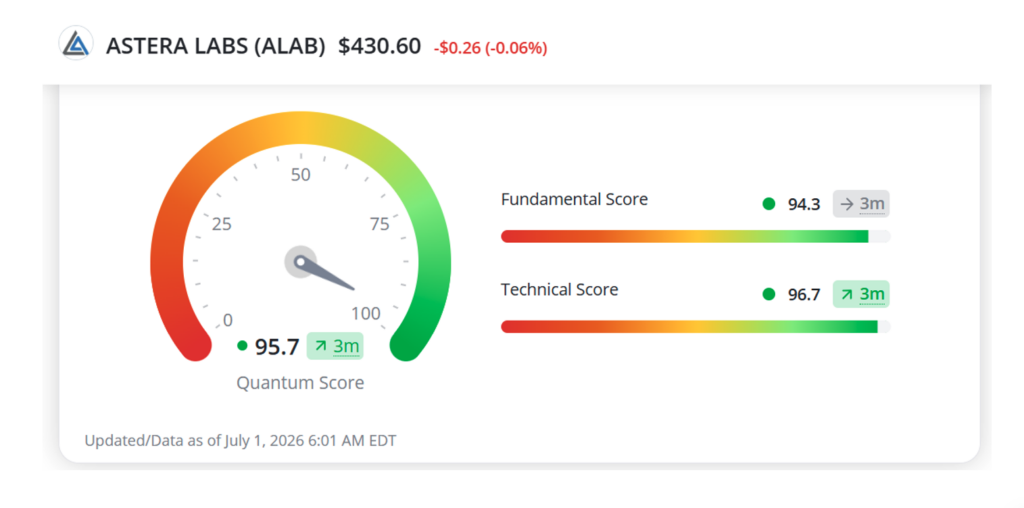
Astera Labs (ALAB) – Quantum Score: 95.7. Astera makes the chips that let AI processors talk to each other without losing the signal. It recently bought a photonics company specifically to build light-based connections into its products.
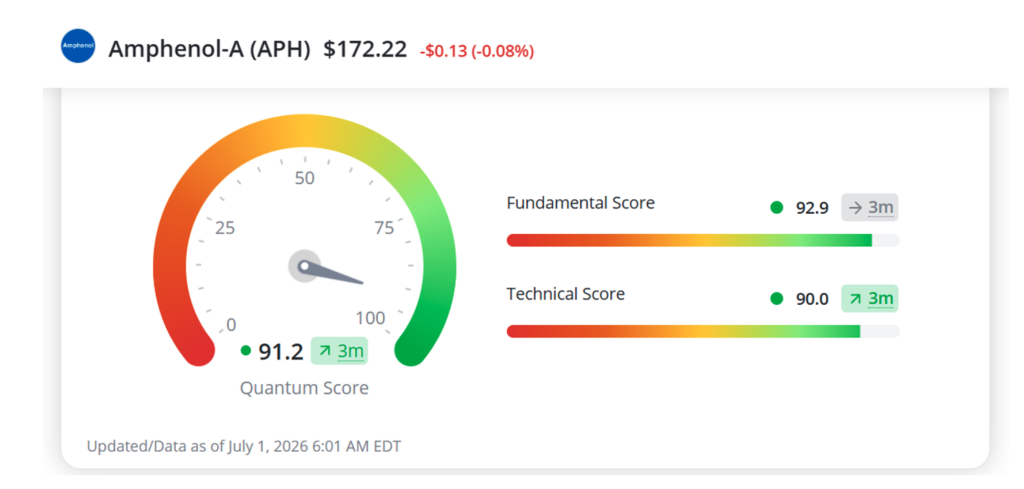
Amphenol (APH) – Quantum Score: 91.2. Amphenol makes the cables and connectors that carry data inside AI data centers. It just spent $10.5 billion buying a fiber-optic connectivity business built for AI data centers.
If you haven’t heard of these stocks, that’s a good thing. They’re still not household names like Nvidia (NVDA) and AI memory play Micron Technology (MU).
That’s what sets TradeSmith apart from traditional newsletters. We don’t go looking for trends to follow in the press. Instead, we rely on our world-class data analytics finding these trends before they show up in the headlines.
It’s why Quantum Edge Pro subscribers spotted this chokepoint before it had a name most investors would recognize.
The quest to live forever is no longer science fiction…
On June 9, a Boston biotech company did something that had never been done before in a human being.
Life Biosciences injected a patient’s eye with a therapy designed to reverse the effects of aging at the cellular level – reprogramming aged cells to behave young again.
It’s aimed at reversing vision loss from glaucoma and a condition called NAION.
It’s only a first step – a safety study, not a cure – but it’s the first time this kind of “cellular rejuvenation” science has left the lab and entered a person.
It’s not the only sign longevity science is making strides.
Researchers running a 48-week clinical trial on 150 adults between the ages of 50 and 85 found that a low-cost generic drug – rapamycin, long used to prevent organ transplant rejection – showed early signs of improving markers tied to healthy aging, from muscle and bone strength to overall physical function.
And in January, a San Francisco biotech company called Loyal cleared a bigger hurdle. The FDA accepted the safety data for what could become the first drug in history approved specifically to extend lifespan – not of humans but of dogs.
If the drug is approved, it won’t just be a win for dogs and their owners. It’ll be the first real-world proof that this entire approach to slowing aging – turning down the specific biological dial that drives it – works outside of a lab mouse. Drug companies are watching this pill closely, because a version aimed at humans is likely the next step.
Landon and Andy Swan have been watching this shift closely – not just this one trial, but the broader forces converging around it. In their latest MegaTrends update, they zeroed in on three of them:
- AI has entered healthcare. New tools can scan a body for early signs of disease in about a minute, and hospitals are already using AI tech from Palantir (PLTR) to catch conditions like sepsis earlier and save lives. Better, earlier detection means people act sooner instead of waiting until they’re sick.
- GLP-1 weight-loss drugs – The class that includes Ozempic and Wegovy are changing behavior on a mass scale. Roughly one in eight U.S. adults now takes these drugs. After decades of rising obesity, we’re starting to see those numbers move the other way. There’s even talk of GLP-1 drugs working more broadly to slow aging.
- The science of slowing aging is moving from theory into the lab. Life Biosciences’ trial, described above, is exactly the kind of proof point Andy and Landon have been tracking.
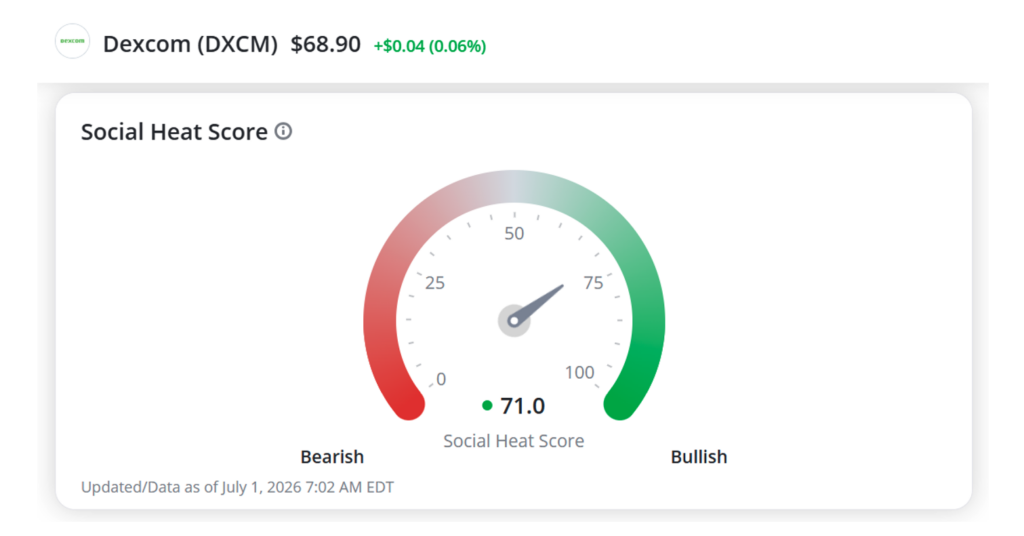
How do you find the best stocks to play this trend? That’s where the Swans’ Social Heat Score comes in. It tracks consumer behavior trends on social media and across the web to trending companies before Wall Street does.
And one stock on their longevity watchlist – DexCom (DXCM) – stands out with a bullish Social Heat Score of 71.
DexCom is best known for the glucose monitors that have transformed daily life for people with diabetes. But Andy sees a bigger opportunity ahead as the company pushes into broader wellness tracking for people who simply want to understand their health – the kind of proactive, longevity-minded consumer this trend is creating.
DexCom is one of a handful of watchlist stocks the Swans are tracking as this trend develops. MegaTrends subscribers also have access to monthly research reports and their highest-conviction recommendations.
To building wealth beyond measure,

Michael Salvatore
Editor, TradeSmith Daily