A New “DeepSeek Moment” for AI
Listen to the audio version of this article (generated by AI).
In This Digest:
- A new AI model out of China is rattling Wall Street
- This chip equipment maker shows the AI trade is alive and well
- A new bullish seasonal window for your radar
A new Chinese AI model has Wall Street spooked (again)…
Last week, Chinese lab Moonshot AI released a new model – Kimi K3. It reportedly matches or beats the best U.S. models from OpenAI and Anthropic at writing computer code.
And it set off alarm bells on Wall Street.
Because Moonshot has not only built an AI that reportedly keeps up with the best U.S. models. It also reportedly costs about half as much to use.
That raises some uncomfortable questions.
The big U.S. tech companies are on track to spend around $700 billion this year on the chips and data centers that power AI. But if a free Chinese model can go toe-to-toe with the best paid ones, will all that spending ever pay off?
If it doesn’t, the companies pouring fortunes into AI – and the ones selling them the chips and building the data centers – are in trouble. And their stocks got hit hard.
I pulled the stocks with the largest losses across the S&P 500, the tech-heavy Nasdaq-100, and the Dow over the past week, using the Performance Leaders tool in TradeSmith Finance:
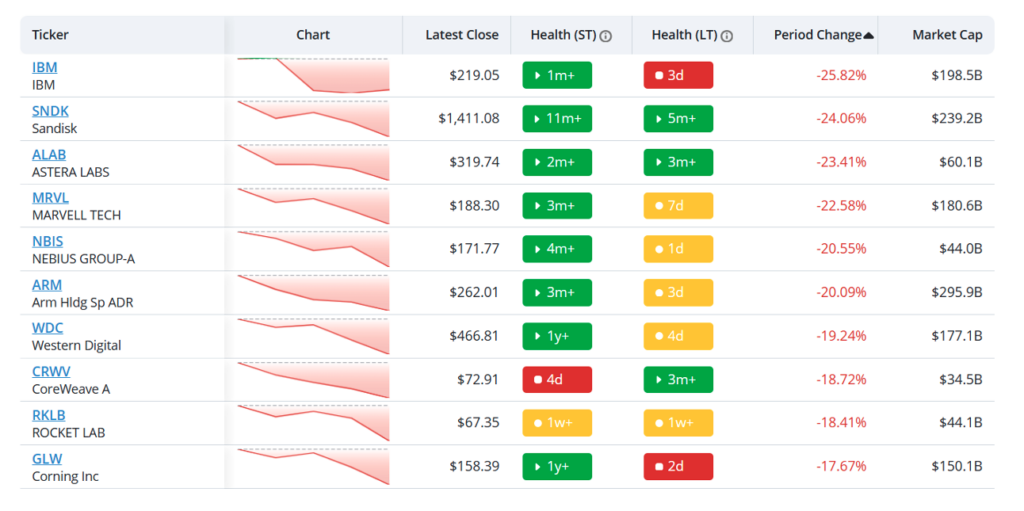
Outside of Rocket Lab (RKLB), a rocket company, this is a who’s-who of the AI buildout – AI software (IBM), chipmakers (Astera, Marvell, and Arm), memory (Sandisk and Western Digital), data centers (Nebius and CoreWeave), and the fiber optic cabling that connects them (Corning). All are down between 17% and 26% in just five trading days.
And the iShares Semiconductor ETF (SOXX) has fallen more than 21% from its highs – bear market territory by the textbook definition of a 20% or more fall from a high.
If this sounds familiar, it should.
In January 2025, another Chinese AI lab – DeepSeek – spooked the market the same way. It claimed to have built a model that rivaled the top U.S. systems for under $6 million – pennies by industry standards.
In a single day, chip giant Nvidia (NVDA) fell 17% and lost close to $600 billion in value – the biggest one-day loss for any company in U.S. history. Chip stocks tumbled across the board.
Then the market recovered and soared to new highs. And while we understand the concern over Kimi, our data is still bullish on the overall health of this market this time around.
About 62% of S&P 500 stocks are in a Long-Term Health Green Zone.
Think of Long-Term Health as a traffic light for a stock’s long-term trend. Green means it’s healthy and heading up. And here’s what makes it smart: It grades each stock against its own normal ups and downs – not a one-size-fits-all rule. A steady blue chip and a jumpy tech name are each judged on their own terms.
And the percentage of Green Zone stocks has been growing, not shrinking.
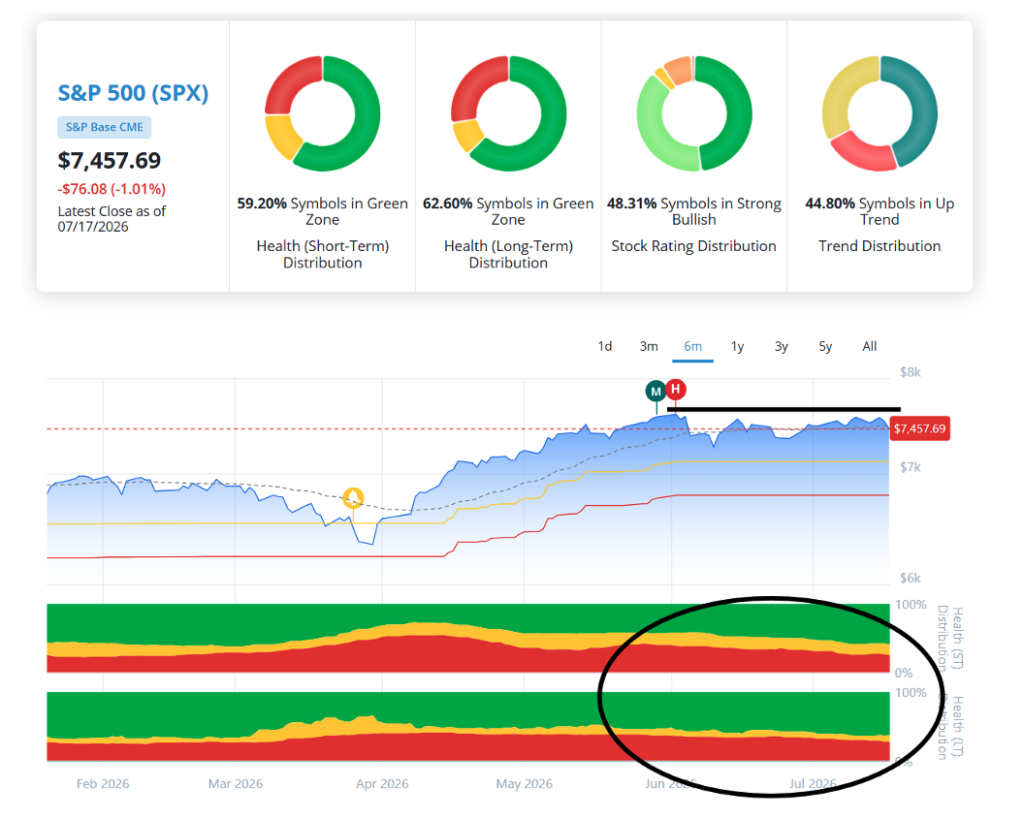
The circled section on the chart shows you the trend in the number of stocks in both Short- and Long-Term Green Zones has been steadily climbing over the past six weeks.
Lucas Downey says you shouldn’t “mistake the pause for the end”…
Every big construction project hits a moment when the cranes just… stop.
From the sidewalk, it looks dead. Nothing moving behind the fence. You start to wonder if the whole thing got scrapped.
But step inside the gate, and it’s a different picture. Permits are getting finalized. Materials are stacked and staged for the next phase. Crews are regrouping before the next push.
The project didn’t stall. It just went quiet for a moment.
That’s exactly where AI stocks sit right now. At least, that’s how colleague Lucas Downey sees it.
After a blistering run, AI stocks have pulled back hard over the past few weeks. Some of the biggest names are down double digits from their highs. If that’s made you nervous, that’s understandable.
But here’s what the scary headlines miss. A stock cooling off is not the same thing as the buildout cooling off. Here’s Lucas:
The physical infrastructure of the AI boom – the data centers, the networking gear, the computing power – isn’t slowing down one bit. If anything, it’s ramping up. Prices got ahead of themselves. The fundamentals didn’t.
Lucas heads up our flagship TradeSmith Investment Report. He uses our Quantum Score to hunt for standout stocks – companies with growing businesses that are also drawing unusually heavy buying from Wall Street’s biggest players. It boils all that down to a single score from 0 to 100. The higher the score, the stronger the stock.
And this week, Lucas got what might be the clearest proof yet that the AI buildout is nowhere near done.
ASML Holding (ASML) just reported blowout earnings and raised its forecast for the whole year well above what Wall Street expected.
ASML makes the machines that other companies need to make chips. Nearly every major chipmaker in the world is a customer.
So when ASML’s orders are booming, it means chipmakers are still buying the equipment to crank out more chips. And nobody spends billions on new machines unless they expect demand to keep climbing.
ASML has been in TradeSmith Investment Report model portfolio since last July. It’s up more than 64% since. But our Quantum Score still rates it a buy.
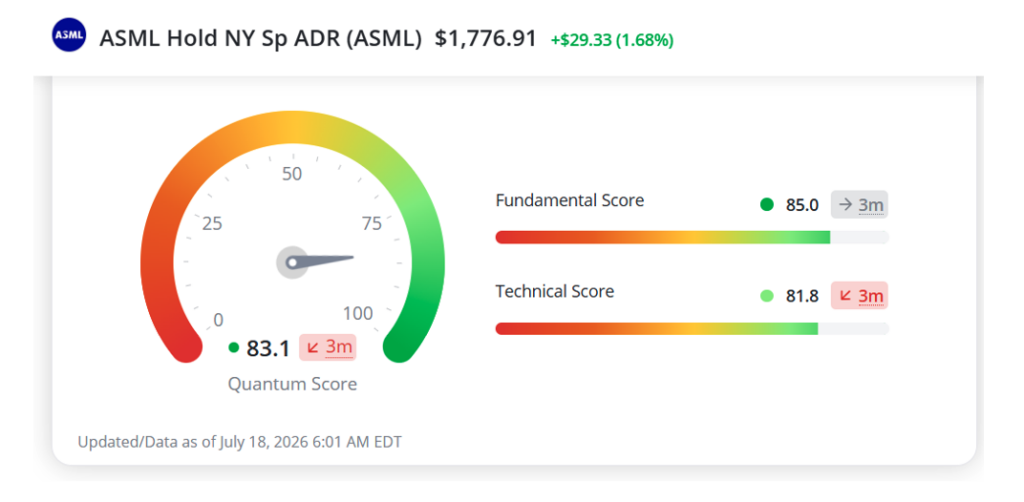
As you can see, it has rock-solid fundamentals with a Quantum Score of 85. It has a Technical Score of 81.8, meaning it’s got strong momentum and lots of institutional buying.
Another seasonal buy window just opened in a little-known outperformer…
Part of my daily routine on our analytics platform, TradeSmith Finance, is screening for the top seasonality windows opening each day.
Our Seasonality tool digs through decades of a stock’s own trading history and looks for stretches of the calendar when it has tended to rise – or fall – year after year. Not a vague “good month,” but a specific window, down to the day.
Today, this bullish seasonal window in PC Connection (CNXN) caught my eye:

This IT hardware and technology distribution company has been up 12 of the past 15 years between July 22 and Sept. 2 for an average return of 5.3%.
Factoring in only the winning years, the average gain was more than 9%.
And the stock itself has been a strong outperformer in recent months. Take a look at the chart below, along with its Short-Term Health status:
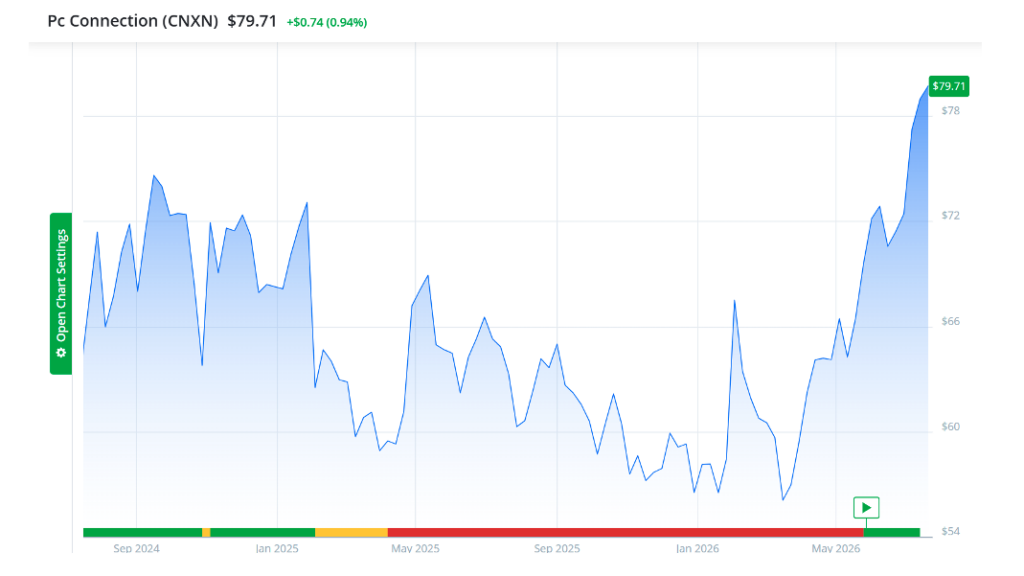
The stock had been a laggard from early 2025 until just this past May, when it started a strong new uptrend – triggering the Short-Term Health Green Zone on May 28. Since then, it’s up more than 17%.
That comes on the heels of its earnings report, when the company cited “strong demand in AI, cloud, and security” after a record profit and margin expansion.
Seasonality and Short-Term Health are both pointing us back to a major theme we’ve been covering in these pages – the cybersecurity revival.
In early 2026 when new AI tools from Anthropic were disrupting everything from software development to financial research, cybersecurity stocks got caught in the crossfire. But more recently, the advances in agentic AI – autonomous AI bots that perform complex tasks with little to no supervision – have thrown a spotlight on the cybersecurity sector.
CNXN is in a strong uptrend and entering a bullish seasonal window. That makes it a great trade to watch.
And for more key seasonality trade ideas, make sure you check out the Breakthrough 2026 event we aired last week.
There, TradeSmith CEO Keith Kaplan walked through the seasonal patterns coming up that you need to watch for… why they keep working even when markets get chaotic… and how to put them to work in your portfolio.
As you’ll see, getting your seasonal timing right could matter more to your wealth than any stock pick you make this year.
The next date to watch is July 23. That’s when one of the biggest seasonal windows in the market comes to an end.
Every prior year it’s closed, the market has turned choppy – and this time it closes right as Tesla, Amazon, Apple, and Microsoft report earnings.
We can’t say which way these stocks will break. But we’d rather watch that window close with our eyes open than be blindsided by the market regime shift it could trigger.
Get the full playbook in our Breakthrough 2026 event replay before it comes offline.
To building wealth beyond measure,

Michael Salvatore
Editor, TradeSmith Daily