AI Breaks the Grid Unless This Happens
Listen to the audio version of this article (generated by AI).
Michael’s note: It’s July 4th weekend. And while you might be thinking about fireworks and barbecue, a couple hundred million Americans are pushing their A/C to the brink inside a record heat dome. It’s this year’s summer stress test for the power grid… only now, AI is piling on top of it.
As you’ll hear in today’s essay from Landon Swan, editor of our MegaTrends advisory, he thinks small energy infrastructure companies are positioned to profit as federal money pours in to fix the power grid. And a set of catalysts are converging around July 10.
He and Joel Litman went public with the full story – all four companies, names and tickers – at The U.S. AI Super Summit this past Thursday. If you missed it live, watch the replay here.
Somewhere right now, a grid operator is staring at a dashboard glowing red, watching power demand climb faster than the system can keep up.
It’s Independence Day. And temperatures are pushing 100°F across the Midwest and Eastern seaboard – topping 110°F in some areas.
Where I am in Delray Beach, Florida, it’s 90 degrees and the humidity makes it feel even hotter.
Forecasters says 200 million people are caught inside a heat dome – a mass of high-pressure air that traps like a lid on a pot. And you can bet that just about every one of them has the A/C running.
Grid operators call this the summer peak. It’s the most stressful test the U.S. power grid faces all year – hundreds of millions of people drawing maximum power at the same time right when there are only skeleton maintenance crews on holiday shifts.
Most years, the grid holds… barely. This year, the heat dome arrived to push it to the brink.
And that’s before AI enters the equation. As you may be aware, it’s pushing the grid to new limits. If something doesn’t happen fast to build out new capacity, something’s going to snap.
Take the recent warning from Department of Energy (DOE). As we’ll get into today, it sees a major disaster hitting the grid as soon as 2030 if major investment doesn’t happen.
It’s the biggest challenge our country has faced since WWII when the Manhattan Project built the bomb that ensured an Allied victory. It’s also one of the biggest opportunities for investors of the AI era.
100x Spike in Blackouts
Last summer, the DOE published a projection that barely made the news. Without significant infrastructure investment, America could see a 100x spike in blackouts by 2030 as AI demand explodes.
President Trump called it a national energy emergency. And he invoked wartime powers under the Defense Production Act – the same legal authority used to mobilize industrial production during World War II – to accelerate funding for new grid infrastructure.
Last 2025, he signed an Executive Order launching a project called the Genesis Mission. It mobilizes all 17 Department of Energy National Laboratories, 40,000 government scientists, and the world’s most powerful supercomputers toward one goal: Solve America’s AI energy crisis.
And it doesn’t lose sight of the historical parallels. The order describes the Genesis Mission as “comparable in urgency and ambition to the Manhattan Project.”
That urgency is real.
Across the country, more than 3,000 AI data centers are already drawing power from the grid, with another 1,500 in development.
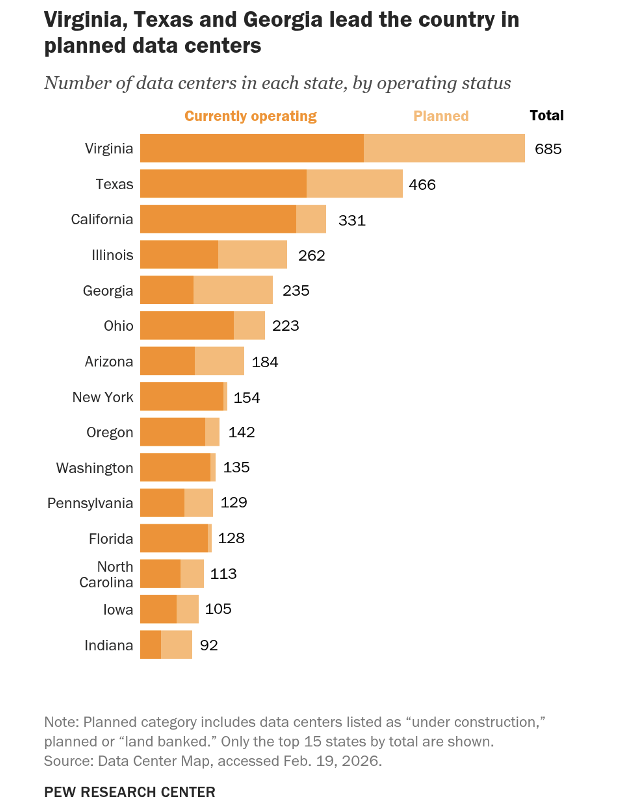
A typical hyperscaler AI data center consumes as much power as Houston, Texas. The summer peak passes. AI demand doesn’t.
And it’s set to get worse. McKinsey projects data center spending will rocket from $650 billion this year to $7 trillion by 2030.
That’s 10 times the already-record spending from the tech giants on datacenters this year.
This Nuclear Trade Was the Canary in the Coalmine
My brother Andy and I have been tracking this shift for the better part of a year.
Our Social Heat Score system tracks hundreds of millions of data points across the web – social media posts, search trends, website traffic, investor conversations – and distills all of it into a 1-100 score for every stock we follow.
The higher the score, the stronger the momentum building behind a company before it shows up in earnings or analyst estimates.
That score started climbing on AI energy infrastructure companies before the Genesis Mission made headlines. We saw more people searching for these companies and their products and services. More time spent on their websites. More conversations in industry circles about a corner of the market most investors had never thought to look at.
The first signal we acted on as we followed the trend was Oklo (OKLO) – a small nuclear energy developer whose Social Heat Score hit 79 in April 2025, well into bullish territory. Based on that score, we gave our subscribers the chance to close out a 461% gain in less than five months.
And Oklo was just the beginning.
What we’re seeing now is much broader. The same pattern is spreading across a spectrum of companies being pulled into the center of America’s AI energy buildout – civil engineering firms, pipeline operators, substation builders, grid specialists.
These are the companies that have to be involved before a new AI data center goes online. They’re also critical if we want to head off the blackout surge the DOE sees coming.
These Catalysts Will Force Market to Pay Attention
When our Social Heat Score started flagging this sector with increasing urgency, I knew this was a major emerging trend.
To pinpoint the best stocks to profit from this trend I brought it to Joel Litman – an analyst who’s spent three decades figuring out what companies are actually worth versus what Wall Street thinks they’re worth.
His research is followed by 150 of the world’s top 300 money management firms, including the top 10.
Joel created system called True Blue over at our corporate affiliate Altimetry. It strips out the accounting distortions baked into public earnings reports to find what a company is actually generating.
When that gap is large – and a catalyst forces the market to finally pay attention – stocks have made extraordinary moves. In backtesting, Joel’s system flagged Silicon Motion (SIMO) before a 1,605% run. Deckers Outdoor (DECK) before 3,718%. Illumina (ILMN) before 4,517%.
Joel ran True Blue across a basket of still-small energy companies. What came back were some of the strongest earnings distortion signals his system has flagged in years.
We went public with everything in our U.S. A.I. Summit on Thursday.
As we showed the folks who joined us, three market catalysts will hit on July 10 – the last day of President Trump’s America 250 celebration on the National Mall.
One of them is a momentum setup that’s only occurred twice in the past 76 years – and both times, it kicked off some of the most explosive stock market rallies in history.
The window to get positioned ahead of them is still open – but not for long. So make sure to watch it here before July 10.
Celebrate our independence, enjoy the fireworks this weekend – and stay cool out there.
Cheers,
Landon Swan
Cofounder, MegaTrends