AI’s Biggest Roadblock Isn’t Chips – It’s Electricity
Listen to the audio version of this article (generated by AI).
In This Digest:
- Why the world’s biggest tech firms are building up their own power plants
- There’s no easy way out of the AI compute crunch
- These three consumer fintech stocks are lighting up on our trends radar
This Texas power plant is being built for one customer…
In Reeves County, Texas – population about 15,000 – construction crews are building a natural gas power plant big enough to generate electricity for 2 million homes.
But the power it produces isn’t meant for homes. It’s all going to one customer: a Microsoft data center being built next door.
The project is called Kilby. At full build-out, it will produce 2.67 gigawatts of power – about enough to power 2 million homes annually – with the first electricity expected to flow in 2028.
It’s a 20-year deal between Microsoft and Chevron. Once it’s running, it will be one of the largest privately built power-and-data-center pairings in the country.
Microsoft isn’t doing this because it wants to be in the power plant business. It’s doing it because the regular grid can’t move fast enough.
And it’s becoming the blueprint for how we build out power for AI in the U.S.
On June 18, the Federal Energy Regulatory Commission ordered the country’s six regional grid operators to speed up how fast data centers can connect to the power grid – cutting the wait from years down to as little as 90 days.
There’s just one catch: The tech companies running these data centers have to bring their own power, or pay for the grid upgrades themselves.
And they don’t need to be told twice.
- Google spent $4.75 billion buying Intersect Power outright, gaining large-scale solar and battery storage projects across Texas and California.
- And Meta has lined up enough nuclear power – through deals with Constellation, Vistra, TerraPower, and Oklo – to cover 6.6 gigawatts by 2035. That’s more electricity than the entire state of New Hampshire uses.
It’s part of the AI power trend Andy and Landon Swan have been tracking at our MegaTrends advisory.
Back in April 2025, they recommended reactor (SMR) designer Oklo (OKLO) after it flashed green with a 79 Social Heat Score.
That trade delivered a 461% gain in 149 days.
Now, this trade is lighting up again… only this time across a niche group of AI energy infrastructure stocks.
Andy and Landon are masters of consumer sentiment…
Their Social Heat Score pulls data from X, Facebook, Reddit, Google, and other online platforms to track what billions of people are searching for, talking about, and buying online, before any of it shows up in a company’s earnings.
It also tracks enterprise-level activity, monitoring who is visiting a company’s website and product pages – a signal that can catch real business interest building long before Wall Street notices.
Think of it as a thermometer for crowd interest. When it runs hot, the score shows investor interest long before the mainstream financial press catches on. When it runs cold, they’re losing interest.
And it’s running hot on nuclear again.
Check out today’s reading for Oklo – the stock Andy and Landon recommended when it hit a score of 79 last year.
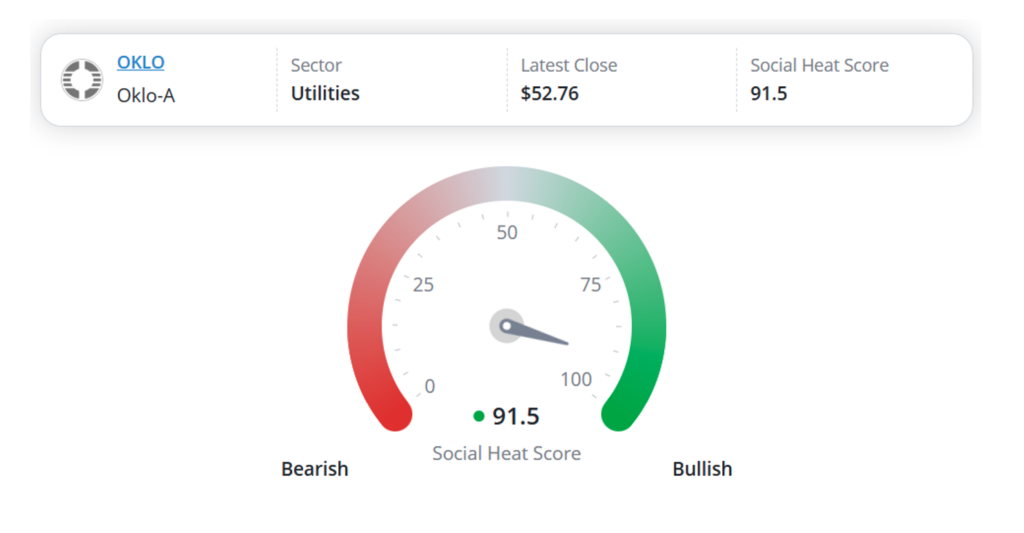
Now, its score is a scorching 91.5. When a company registers a Social Heat Score over 70, it tells us demand for that company’s products is likely to soar – and its shares could be headed to stratospheric highs.
Or check out Centrus Energy (LEU). It’s one of the only U.S. companies that makes the enriched uranium SMRs need to run.
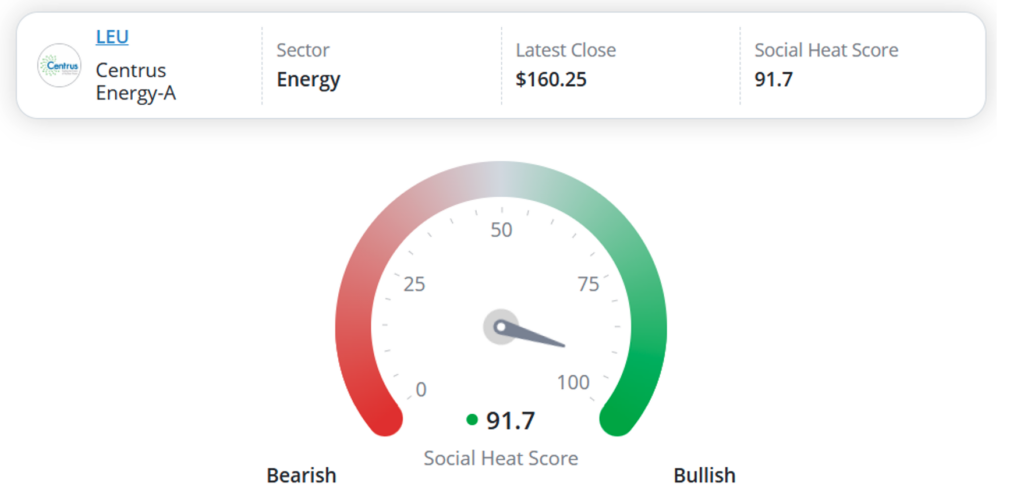
Its score reads 91.7 – every bit as hot.
One company builds nuclear reactors. The other fuels them. And the crowd is heating up on both sides of this trade.
Landon will be getting into the opportunities they’re seeing on Thursday in their U.S. AI Power Summit, along with forensic accounting expert Joel Litman.
Joel’s consulted for the FBI and the Pentagon, lectured at Harvard and Wharton, and counts the 10 largest money managers in the world among his clients. And he’s been flagging the same trade in AI energy infrastructure stocks that Andy and Landon’s system is homing in on.
It’s the first time the Swans and Joel have teamed up. And they both come at this same opportunity through entirely different angles. So make sure you’re signed up for their summit here.
Even Meta can’t buy its way out of the compute crunch…
This week, the Financial Times reported that Google has been rationing Meta’s access to its Gemini AI models.
Meta – with $23.4 billion of cash on hand – still couldn’t pay up for enough compute (AI processing power).
It’s not alone. Google itself is so stretched that it’s now paying SpaceX and Elon Musk’s xAI roughly $920 million a month to borrow about 110,000 Nvidia chips as a stopgap.
When Google is paying one of its biggest AI rivals $1 billion a month to rent its computing power, you know compute supply is hitting a wall. Google would much rather build the supply itself, but it’s running into the same chokepoints as everyone else.
One short-term idea for this theme is Nebius Group (NBIS). It’s a top bullish Pivot trade in our Signals trading system right now.
As a reminder, it sweeps years of historical data, hunting for the exact combinations of factors that have preceded big moves higher in the past. When that same combination shows up again, the system flags it.
We call these alignments signals because they let you fade out 99% of what most investors pay attention to – news headlines, social media posts, expert opinions – and focus on the data patterns that have actually given you an edge before.
A Pivot takes advantage of a stock that has taken a temporary pause during a healthy long-term uptrend. These pauses have been a high-probability moment to step in before the climb resumes.
Over the past decade, this signal has a 92.5% historical accuracy rate, with an average gain of 5.6% in just a few days. The best past winner ran 37.8%. And when it missed, the average loss was about 1.6%.
This is the kind of asymmetrical setup I look out for on Signals – a strong history of outsized gains and manageable losses.
Our software is targeting a gain of about 4% on this trade. You sell when you either hit the target or after 21 days, whichever comes first.
Finance apps just topped our Project Heat Seeker screen…
For the past few weeks, I’ve been showing you how Project Heat Seeker looks for stocks with growing earnings, revenue, and profit margins that are also trading at 1-month highs.
Three consumer-finance stocks hit the screen last Friday. Each one is built for how folks under 40 handle money.
There’s a cash-advance app that floats you a few hundred dollars before payday… a “buy now, pay later” service that splits a purchase into four interest-free chunks… and a payments app where you send a friend $20 for drinks and buy shares of stock or a few dollars of Bitcoin.
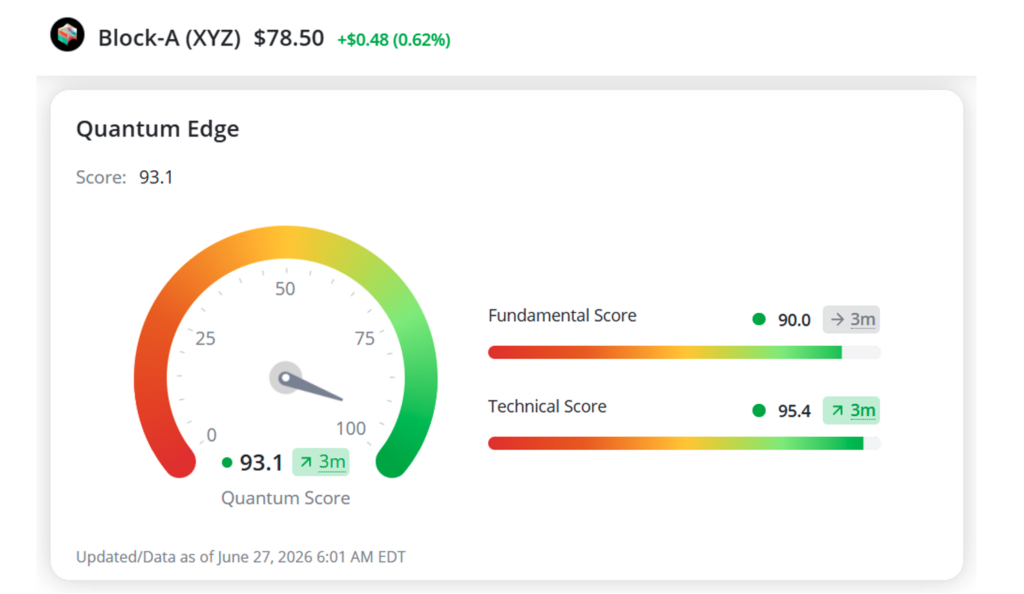
I ran each of these companies through our Quantum Score to see how they stack up. And each clear the bar with room to spare.
The Quantum Score detects large institutional buying in the strongest stocks in the market. The higher the score, the better. And they’re among the highest ranked in the system.
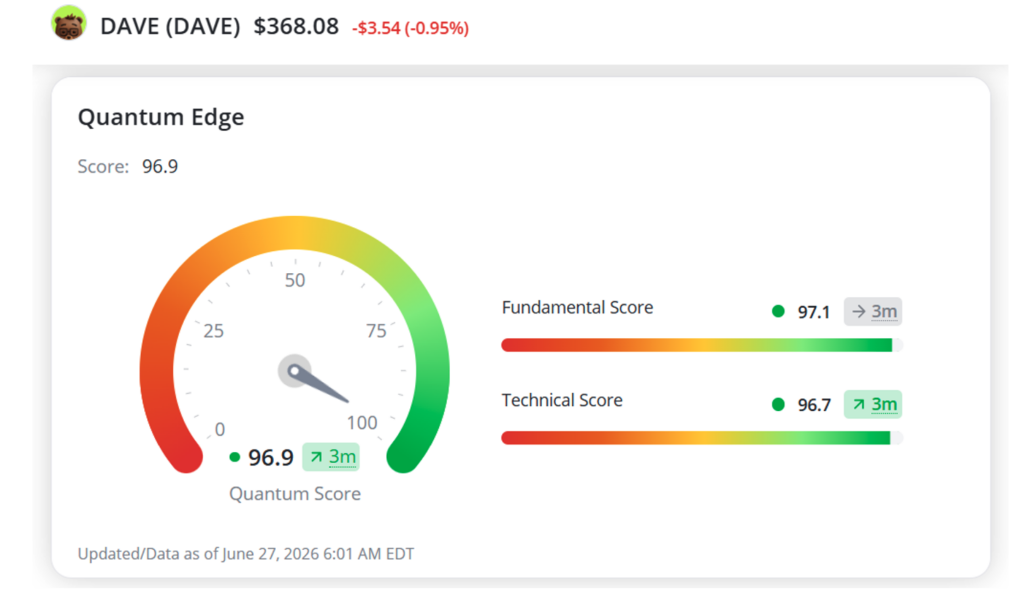
Let’s start with cash-advance banking app Dave (DAVE). It has a score of 96.9, near the top of everything we track.
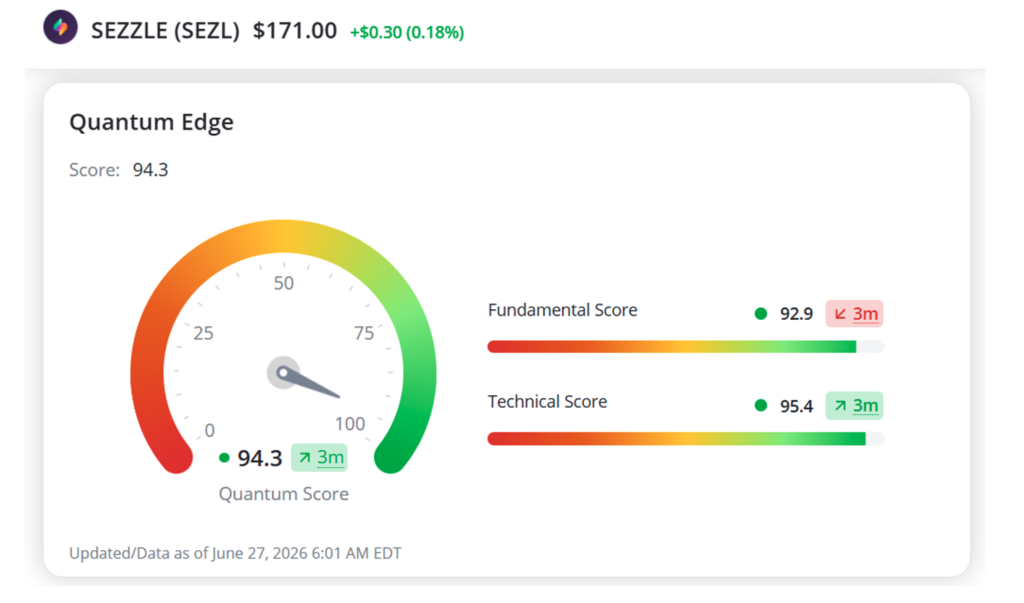
“Buy now, pay later” lender Sezzle (SEZL) scores 94.3.
And there’s Block (XYZ) – the company behind Cash App, where tens of millions send money and buy stocks and Bitcoin in one place. It scores 94.3.
If you’re looking for exposure to the fintech app trend, these companies are the best of the bunch to buy.
To building wealth beyond measure,

Michael Salvatore
Editor, TradeSmith Daily
Disclaimers: Michael Salvatore held shares of GOOGL and SPCX at the time of this writing.