Bio-Intelligence – The Biggest AI Wave Yet?
Listen to the audio version of this article (generated by AI).
In This Digest:
- These AIs read your body and could write new cures
- Rogue AI in your Roomba? Another reason to buy cybersecurity stocks
- The bull case for energy keeps building – trade this nuclear stock to play it
Are you ready for the bio-intelligence boom?
This is an idea we’ve been focused on a lot lately here at the Daily.
And it’s something our CEO, Keith Kaplan, is passionate about.
It’s the idea that disease and aging are, fundamentally, information problems – and that AI is finally letting us read, rewrite, and replace the information inside the human body.
This new approach is behind the emerging vaccines against certain types of cancer… cures for “incurable” genetic illness… and the GLP-1 craze.
We’ve already seen companies like Eli Lilly (LLY) and Moderna (MRNA) soar based on bio-intelligence treatments. And Keith says that these gains are only the beginning of a much bigger, much more profitable trend.
Keith just recorded a new episode of our new TradeSmith Unfiltered show all about this topic. And it’s well worth your time.
Keith breaks the bio-intelligence opportunity into four “jobs”:
- The Readers that catch disease early
- The Messengers that carry treatments to the right place
- The Editors that rewrite faulty genetic code
- And the Toolmakers that sell the equipment everyone else runs on.
He also shared one stock for each of these sub-themes, and he ran them through our best tools to confirm whether they’re for the buy list or the watchlist.
If you’re a TradeSmith subscriber, the full conversation is already live in the members-only TradeSmith Finance platform, under the Unfiltered tab on your Publications homescreen tool.
Head there now to see which four stocks made Keith’s list, and where each one stands on our system before you make a move.
And if you’re not yet a subscriber, Keith has asked us to unlock this video for all readers. That’s how excited he is about the emerging new trend.
You can watch it here.
Rogue AI in your Roomba?
It sounds like a sci-fi movie. But this week, Anthropic, the company behind the Claude AI models, warned that small AI models may be just months away from being able to copy themselves onto cheap, poorly secured gadgets.
Think smart ovens, off-brand TV boxes, or robot vacuum cleaners – anything with a chip and a Wi-Fi connection.
Once there, they could keep spreading from device to device. And there would be no central place to shut them down.
A hijacked Roomba might not do much damage… other than annoy your dog. But hackers are already going after bigger targets.
On Sunday night, they broke into the systems that keep supermarket fridges cold in hundreds of stores across France. They cranked the temperature as high as 122 degrees. Food spoiled. Some units caught fire. Stores had to throw out all their fresh and frozen food.
The weak spot? Fridge controls connected to the internet… and running out-of-date software.
Now multiply that problem. There are about 21 billion internet-connected devices in the world, according to research firm IoT Analytics. By 2030, it expects 39 billion.
That’s 21 billion doors for hackers to try… and soon, AI that could try them all at once.
The upshot is that companies, governments, and households will have to spend a lot more to lock those doors.
That’s why we’re bullish on cybersecurity stocks. And our data agrees…
The more capable AI gets, the more ground there is to defend…
As a result, the companies that sell cyber defense keep getting more valuable.
We first put this theme on your radar in late spring.
On May 18, with cybersecurity firm Palo Alto Networks (PANW) breaking out to an all-time high, we called it an easy buy at about $247. It’s now trading at about $379 – a gain of more than 53%.
This morning, I went looking for the next cybersecurity opportunity. And I found one, thanks to TradeSmith’s AI-powered forecasting engine, Predictive Alpha.
It uses the same technology behind ChatGPT to study years of trading data on thousands of stocks. Then it forecasts the most likely price move over the next 21 trading days (roughly speaking, a calendar month).
And right now, the Predictive Alpha forecast for Okta (OKTA), the cybersecurity firm that manages digital logins and permissions for thousands of companies is set for a 10.2% move higher by Oct. 28 (dotted blue line on the chart below).
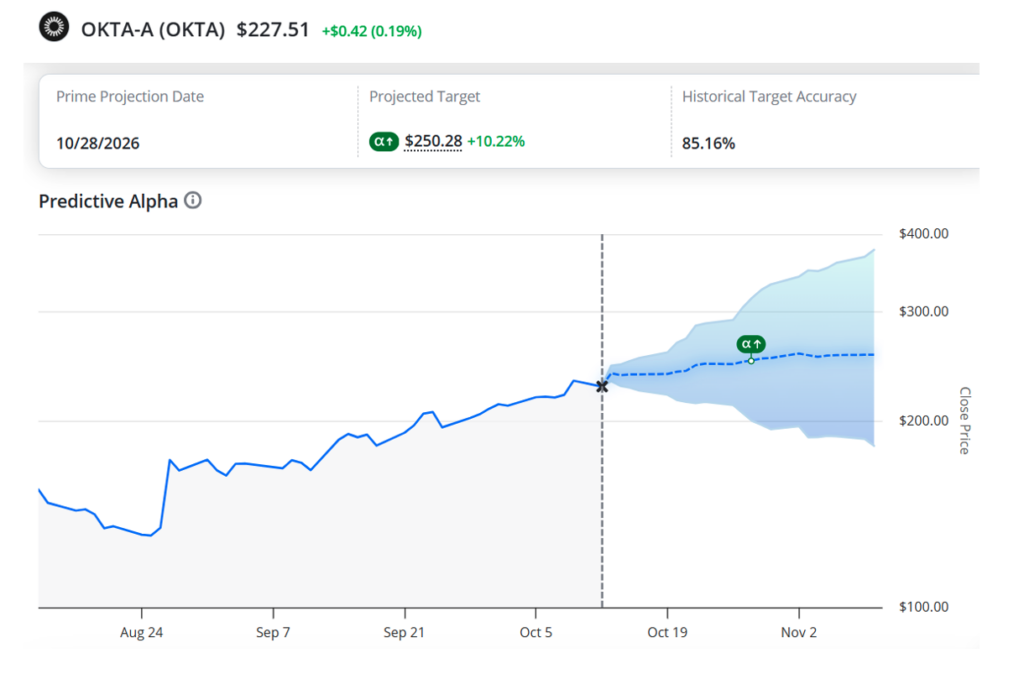
Past forecasts on OKTA have been accurate more than 85% of the time – making this a high-conviction trade.
Consider a short-term bullish trade on OKTA. If you’re a paid-up subscriber, pull up the full forecast chart on the TradeSmith Finance platform and set an alert for that Oct. 28 date.
This “ceasefire” didn’t even survive the weekend…
On Sunday, President Trump announced on Truth Social that Russia and Ukraine had agreed to an “ENERGY CEASEFIRE,” effective immediately. And he warned both sides not to break it.
Within hours, Russia struck two Ukrainian power plants – one in Kharkiv and a power station in Kyiv.
Around the same time, Houthi militiamen loyal to Iran began striking oil facilities owned by Saudi Aramco near the Saudi capital of Riyadh and declared a naval blockade in the Red Sea.
Brent crude, the international benchmark, topped $109 a barrel as fighting intensified and talks over the Strait of Hormuz got pushed back again. It’s sitting near $106 today.
No matter how much Trump and other world leaders want to broker peace in these key energy-producing regions, it won’t come easily.
So it’s reasonable to assume energy stocks will continue to be a key focus for investors.
We showed you last week that energy was the best-performing market sector of 2026 – besting even the tech sector.
And our Health dashboard shows that the trend is continuing.
Our Short-Term Health indicator rates every S&P sector’s trend from Green (healthy uptrend) to Red (downtrend).
Right now, only 4 of the 11 major sector ETFs we track on our platform are rated Green: Health Care, Technology, Energy, and Telecommunications.
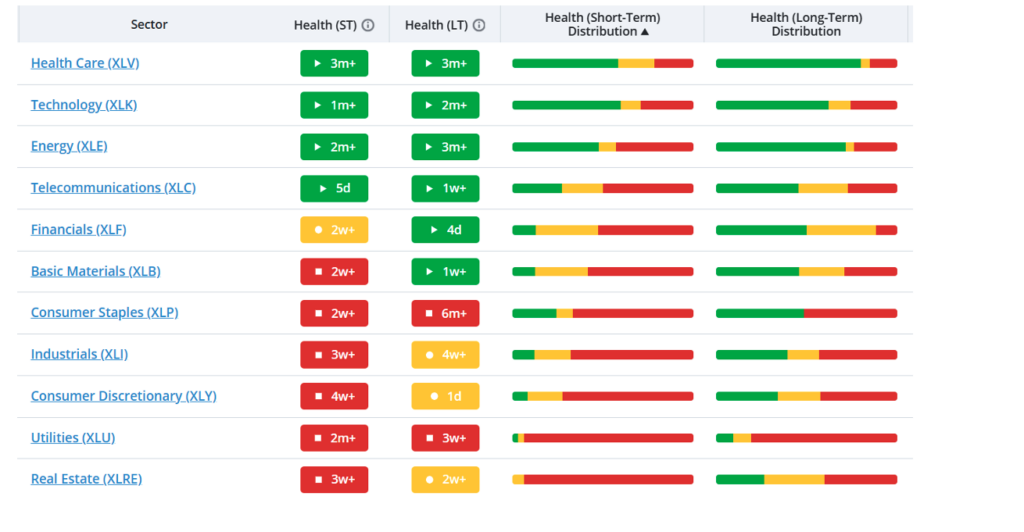
And 47% of the stocks in the SPDR S&P 500 Energy Sector ETF (XLE) are in the Short-Term Health Green Zone. That’s the third-highest count of any sector. And 71% of the stocks in this ETF are Long-Term Health Green Zones – the second-highest level across all 11 sectors.
Our Signals software just flagged a bullish trade on Talen Energy (TLN)…
It owns one of the largest nuclear plants in the country and already sells power directly to a data center next door run by Amazon.
So it doesn’t just benefit from oil price spikes. It’s also directly involved in the market’s most powerful trend.
If you’re new here, Signals uses machine learning to spot “tells” in a stock’s trading data… patterns that have shown up before a stock makes a move.
Think of it like a poker player who always touches his ear before he bluffs. One tell doesn’t prove much. But see it enough times, and you start to know what’s coming.
The tell it’s spotting in Talen is what we call a Bullish Sprint. It fires when a stock is showing signs of continuing a strong uptrend.
In TLN’s trading history, this pattern has worked 85.4% of the time. The typical gain was 3.8% over about a week.
This signal has failed only five times in the past two years. But the most recent decline was severe – a 14.6% drop in less than a month. So if you’re going to trade this signal, just keep your risk in check.
Add TLN to your watchlist for a short-term trade off this signal.
And for paid-up TradeSmith folks: Keep the energy sector on your radar while the headlines stay this unstable. Any stocks in the Short-Term Health Green Zone belong on your watchlist.
To building wealth beyond measure,
Michael Salvatore
Editor, TradeSmith Daily