Bitcoin’s Bad Week Could Be an Early Buy Signal
Listen to the audio version of this article (generated by AI).
In This Digest:
- History shows this overbought software stock is still a good buy
- Bitcoin might be near a bottom, and this signal shift is worth watching
- Why this oil major is lighting up on our Social Heat Score
Software stocks are springing back to life…
In January, Wall Street decided software was finished.
The fear was that artificial intelligence could do the work these programs do – so who would keep paying for them? In a single day, investors erased $285 billion from software stocks. It was the sector’s worst day since the depths of the Covid crash.
The damage kept coming. Salesforce fell about 30%. Some of the most trusted names in tech lost a third of their value. All told, more than a trillion dollars vanished over the following weeks.
Then Wall Street changed its mind. It turned out AI was helping these companies, not replacing them. The stocks that got dumped came roaring back.
One of the biggest winners is Datadog (DDOG). It fell by nearly half during the panic – and has since doubled off its lows.
Datadog is a digital security guard for giant corporate computer networks…
Companies like Netflix (NFLX) and Airbnb (ABNB) use thousands of different servers, databases, and code pipelines. It is impossible for human engineers to watch all of them at once.
Datadog acts as a central dashboard that monitors everything to make sure the software runs smoothly and safely.
And investors have been bidding up the stock recently – it’s up more than 109% this year.
After a recent earnings report, the stock surged to an 85 on its 14-day Relative Strength Index (RSI).
The RSI is a widely used indicator that measures overbought or oversold conditions. The higher it goes on a 0-100 scale, the more overbought the stock.
And history shows, this kind of buying frenzy is actually a great time to trade this stock.
There have been five prior times when DDOG saw an RSI above 85. Double-digit gains followed one, three, and six months later… 100% of the time.
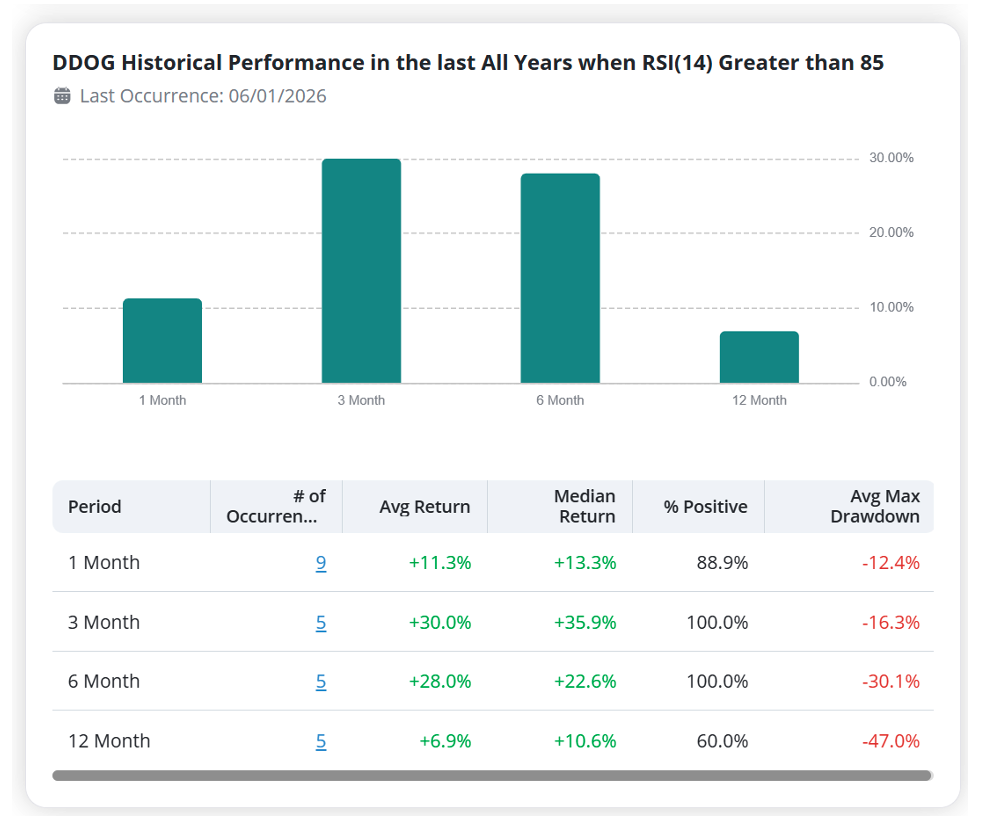
DDOG has had even more cases of a strong move after a one-month period, with an average return of 11.3% going back to 2020.
So, if you’re looking for a way to trade the software bounce, DDOG is one for your radar.
Bitcoin just had its worst week of headlines in months…
We haven’t checked in on the King of Cryptocurrencies lately – and for good reason. Bitcoin has gone nowhere but down this year, losing 27% of its value in 2026.
Even next to that, it’s been a rough week for bitcoin holders.
First, hackers exploited a flaw in hardware wallets – supposedly one of the safest ways to store bitcoin. They’ve drained more than 1,700 bitcoins from thousands of wallets since July 30 – worth about $110 million – and counting.
Then Strategy (MSTR) – the software company that converted into a Bitcoin Treasury company by Bitcoin evangelist Michael Saylor – revealed it had sold 1,637 bitcoins last week.
If you’re a bitcoin bull, it’s hard to keep the faith in times like this.
But these are also the kinds of headlines that come near market bottoms.
Take summer 2022, during the last Bitcoin bear market. Back then, crypto hedge fund Three Arrows Capital collapsed. The ripple effect spread, causing other bankruptcies in crypto custodians like Celsius, BlockFi, and others.
But about six months later, Bitcoin began a run that took it 600% higher by Summer 2025.
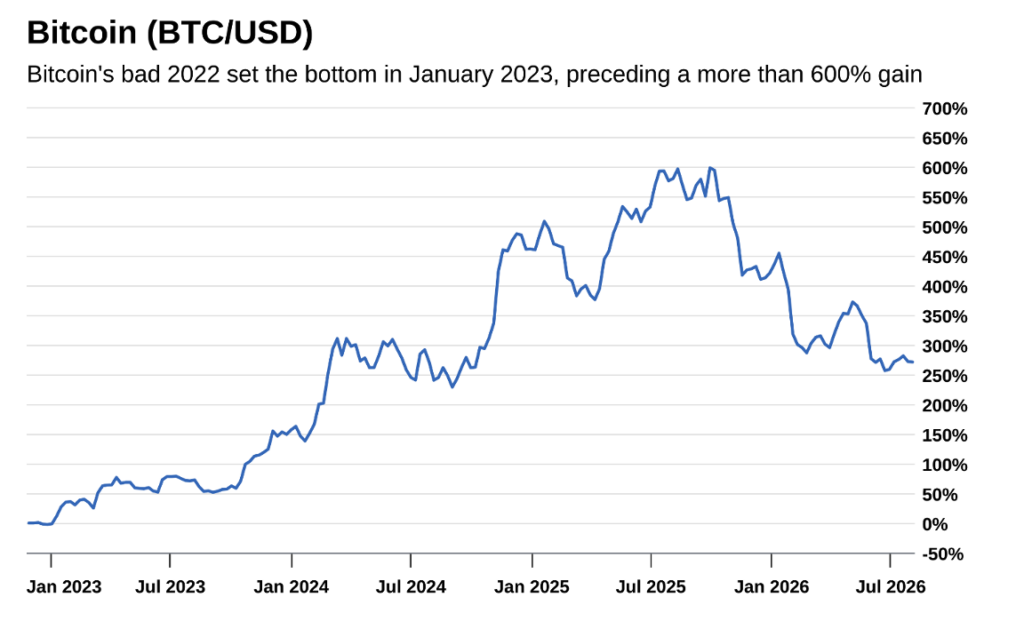
Bad streaks of news like these tend to mark bottoms in investor sentiment during bitcoin bear markets. Especially in the middle of bitcoin’s four-year halving cycle.
About every four years, bitcoin is programmed to reduce the reward for miners by half. This acts as a regular supply shock and a catalyst for bitcoin prices.
The last halving event was in April 2024, and bitcoin prices started climbing a full 16 months ahead of that.
The next halving will be in April 2028. And January 2027 will mark the 16-month mark before that event.
Here at TradeSmith, we don’t base our views on what the headlines say. And even this four-year cycle narrative is no guarantee.
So instead, we watch the data for proven signs that things could shift. And we’re seeing that in bitcoin now.
On Sunday, Bitcoin’s Short-Term Health flipped from Red to Yellow. That’s after several Red shifts this year that came just ahead of major drops in price.
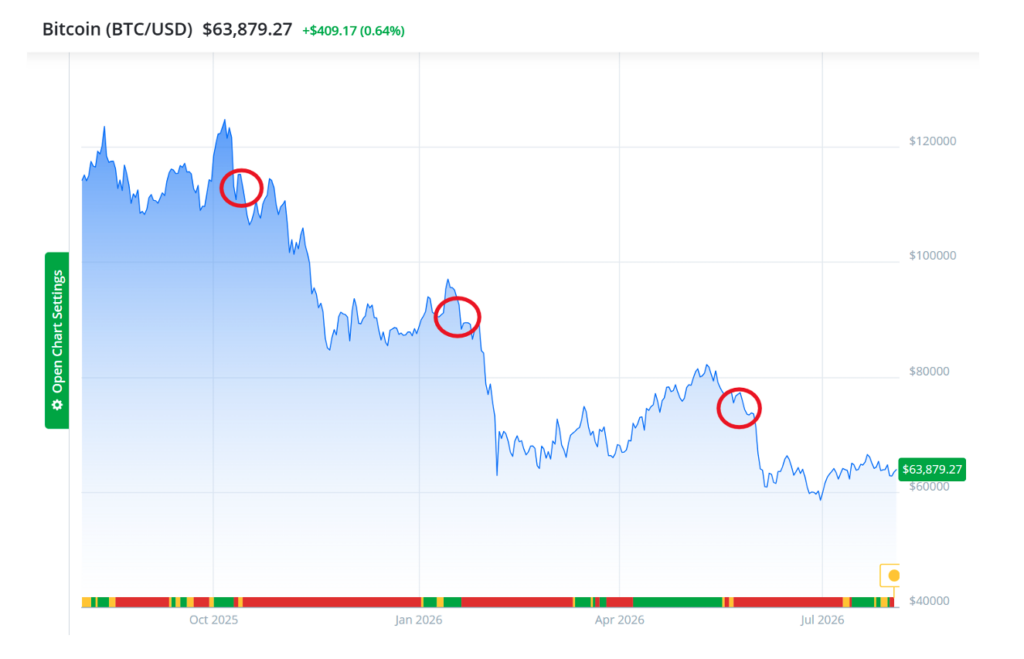
Bitcoin is shifting Yellow – and its price is holding up – amid a pile-on of bearish headlines.
That’s a sign that the bearish trend could be starting to shift.
This doesn’t guarantee that Bitcoin will enter a new Green Zone, signaling a new healthy uptrend.
But this shift plus the ugly headlines means Bitcoin should be on your radar.
The iShares Bitcoin Trust (IBIT) is the simplest way to get that exposure without touching a crypto exchange.
Chevron just flashed the same signal, too…
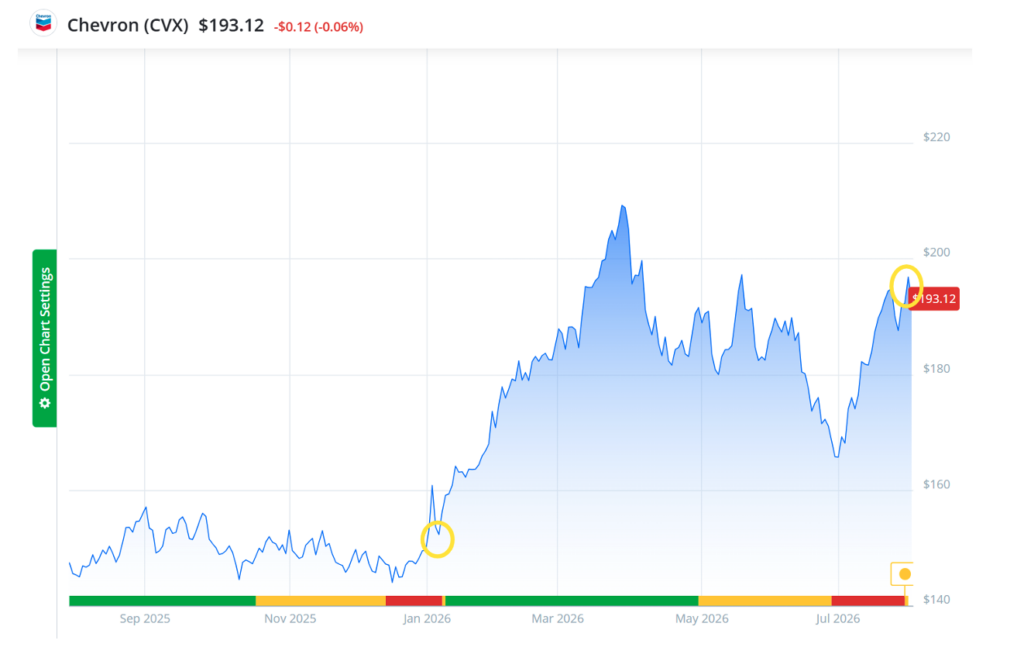
The oil major’s Short-Term Health has made the same Red-to-Yellow flip we saw in Bitcoin – twice this year.
The first one was in early January, right as the U.S. captured Venezuelan president Nicolas Maduro and began fast-tracking Chevron’s (CVX) license to pump more of the country’s oil.
That signal preceded a 35% gain by early spring.
As the Iran war started to calm down and news of a ceasefire hit the wires, CVX started to unwind. It dropped all the way below $170 in a matter of months.
But now, with things heating back up, CVX is back at $193 and near its highs for the year. And it’s flashing another Yellow signal:
There’s a second tool confirming this one, and it isn’t looking at price at all.
The Social Heat Score is built by Andy and Landon Swan, the brothers who founded LikeFolio and now run TradeSmith’s MegaTrends advisory.
It scans millions of consumer and social signals every day – posts on X and Reddit, web traffic, search trends, and more – and boils the data down to a single number from 0 (bearish) to 100 (bullish).
Think of it as a smoke detector for public attention: It doesn’t wait for the fire everyone can see. It picks up the smoke first.
Chevron’s Social Heat Score sits at 71.7 – solidly bullish, and unusual for an oil major. Energy stocks don’t typically generate this kind of consumer-level buzz.
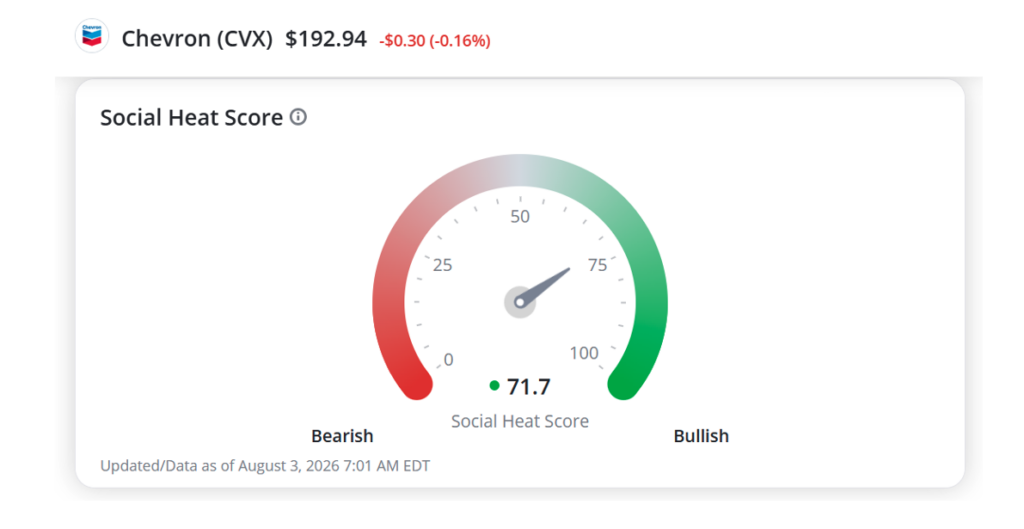
I reached out to Andy and Landon for their thoughts on why Chevron is rated so highly here, and here’s what they had to say:
CVX’s Social Heat Score has held in the 70s for months…. so it’s defending a bullish reading even through the stock’s recent run higher. That’s exactly what you want to see.
And that score is built on far more than social mentions (which, for a name like Chevron, are very light). It pulls from a deep stack of components:
- Web-visit demand
- Regional energy usage… e.g., the terawatt-hours pouring into “Data Center Valley”
- Oil and broader energy price action & volatility
- Gas-turbine and refinery buildout
- Rig count
- Investor chatter around the ticker itself… where “$CVX” runs the hottest in its sector
Venezuela alone doesn’t explain why this matters right now. The war with Iran and the Strait of Hormuz situation is still unresolved.
Chevron has two things going for it right now. If the Gulf stays tense and oil prices stay high, Chevron profits like every producer does.
But Chevron also has something that other oil majors don’t, at least for now: broad access to Venezuela.
It’s pumped its Venezuelan output up to about 280,000 barrels a day this year – one of the biggest new sources of supply the market has added while the Middle East stays choked off.
Other oil majors are exploring developments in the region, after the Treasury granted licenses to BP, Eni, Repsol, and Shell earlier this year. But Chevron has operated there nearly uninterrupted for more than 100 years and has major tie-ups with the state oil company, PDVSA.
Of all the oil majors, Chevron is the one to watch right now. If you’re subscribed to TradeSmith, keep an eye on its Health indicators for a confirmed entry.
To building wealth beyond measure,

Michael Salvatore
Editor, TradeSmith Daily
Disclaimers: Michael Salvatore held BTC and shares of CVX at the time of this writing.