How to Trade When AI “Builds Itself”
Listen to the audio version of this article (generated by AI).
In This Digest:
- The biggest tech news of the year just broke — and it points to vastly superior AI models
- We’re getting ready to launch our newest collaboration with the “King of Quants”
- Time to catch the next “AI supercycle” in pharma…
AI is building itself…
That’s according to a news release from leading AI lab Anthropic. And it’s happening faster than they expected.
Anthropic is the company behind the Claude AI model. It’s also behind Mythos — a frontier model so powerful that Anthropic decided not to release it to the public.
Instead, they launched Project Glasswing.
It’s a partnership with the organizations responsible for the infrastructure billions of people depend on — think AWS, Apple, Google, Microsoft, JPMorgan, and NVIDIA — that gives their cybersecurity teams exclusive access to Mythos to find dangerous holes in their code before attackers do.
So far, those partners have found more than 10,000 high- or critical-severity security flaws that human security auditors have missed for decades.
How can the new Claude model do this? And why is it advancing so quickly?
Because it’s now mainly responsible for its own improvements.
That’s according to a new report from Anthropic called “When AI Builds Itself.”
As of May, Claude wrote more than 80% of the code to update itself. Before Claude launched its first coding model in February 2025, that number was in the low single digits.
From Anthropic’s press release:
For most of AI’s history, humans drove every step in its development cycle. But at Anthropic, we are delegating a growing share of AI development to AI systems themselves, which is speeding up our work.
Taken far enough — and given enough computing power — that points to an AI system that can fully design and develop its own successor without any human help.
That’s why the length of tasks AI models can reliably complete on their own has been doubling every four months — up from a doubling rate of every seven months earlier.
Each generation is faster and smarter. And the rate of improvement is speeding up.
The companies that figure out how to harness this acceleration earliest will have a historic edge.
Here at TradeSmith, we’ve been building exactly for this moment.
In 2023, we launched our AI-powered trading model, Predictive Alpha.
In 2025, we launched the AI Super Portfolio – the first automated rotation strategy based on our master machine learning algorithm.
And in April, we used a proprietary AI system to find obscure signals in reams of stock market data — rare combinations of factors that have historically preceded jumps in stock prices.
Now, we’ve teamed up with a man Forbes called the “King of Quants” to bring the power of AI to one of the world’s most successful stock-picking models.
Louis Navellier has been finding growth stocks before the crowd since the 1970s…
He built his first stock model on a Wells Fargo mainframe while studying finance at California State in 1974.
As part of a project he was working on with a professor, he was asked to build a model portfolio that mimicked the S&P 500 using 320 stocks.
But Louis’ version did even better. It beat the index.
And in the process, Louis found some stocks move independently of the market and carry their own signal.
Find them early, he discovered, and the gains can be extraordinary.
That insight launched five decades of institution-grade research and his quant-based Stock Grader system.
Since Louis launched his first growth stock investing newsletter, MPT Review, in 1980. Since then, it’s identified 676 stocks that went on to double — including recommendations like Microsoft in 1987, Nike and Apple in 1988, and Nvidia in 2005 – a full 17 years before the launch of ChatGPT.
And right now, in Louis’ Growth Investor model portfolio, he holds an open return of 4,800% in Nvidia as of this writing.
None of those wins came from hunches or gut feelings. They came from the discovery Louis made with the help of that Wells Fargo mainframe in the 1970s — a systematic, data-driven process for finding stocks early in their growth curve.
Stock Grader was built to find the right stocks, and it’s proven its ability to do so. But it wasn’t designed to answer a second important question: What is the right time to buy and sell them?
That’s where TradeSmith comes in…
For the past year, our team has been helping Louis build a new layer on top of Stock Grader that adds precise, data-driven entry and exit signals to the stocks he’s already identified as the market’s strongest.
This combines new short-term market-timing tools, plus a layer of AI that further optimizes buys and sells.
In our backtests, AppFolio (APPF), one of Louis’ 2017 recommendations, delivered a 20% annualized gain following Stock Grader alone. But with the new AI-enhanced system, that same stock would have produced a 74% annualized gain.
With Nexstar Media Group (NXST), recommended in 2013, a 23% average yearly gain becomes 173%.
And our testing suggests that pairing our new system with Louis’ Stock Grader ratings could generate up to 20 times more money than following Stock Grader alone.
That’s why there’s so much excitement this week here at TradeSmith about Louis’ upcoming launch event.
This Wednesday, June 10, at 10 a.m. Eastern, he’ll be getting together with our CEO, Keith Kaplan, to walk through exactly how the system works – including an urgent buy and an urgent sell the new AI has just identified.
Before the event, you can even test-drive part of the technology for yourself. You can enter the ticker symbols of stocks you already own — or stocks you are thinking about buying — and see how the system evaluates their short-term health.
The next trillion-dollar market isn’t tech — it’s your body…
In their most recent monthly MegaTrends issue, colleagues Andy and Landon Swan make the case that longevity — the fast-growing business of helping people live longer, healthier lives — is hitting what they call “escape velocity.”
The numbers back it up:
- The global wellness economy hit $6.8 trillion last year.
- Roughly 30 million Americans are now on GLP-1 weight-loss drugs like Ozempic and Wegovy — and that number keeps rising as prices fall and Medicare coverage expands.
- The peptide therapy market — targeted treatments that tell your cells to repair, rebuild, and burn fat — crossed $164 billion this year and is on track to double by 2030.
And Washington is pushing the same direction. RFK Jr.’s “Make America Healthy Again” campaign is already pulling synthetic food dyes from the U.S. food supply and tightening rules on untested food additives.
This trend is lighting up the Social Heat Score.
If you’re new to the Swans, the Social Heat Score measures the intensity of consumer and investor interest in a stock across social media in real time. It’s designed to surface unusual demand before it shows up in the price. Anything above 60 is bullish – it means a crowd is forming before the stock has moved.
Last week, the Swans published a new special report identifying four emerging companies at the intersection of AI, drug discovery, and longevity – what they’re calling the next “AI supercycle” in pharma.
And they just ran all four through the Social Heat Score.
The one I want to call your attention to is Axsome Therapeutics (AXSM). It’s building next-generation treatments for brain health conditions, including major depression, Alzheimer’s agitation, and narcolepsy. Two of its pipeline drugs are already approved by the FDA.
Its Social Heat Score sits at 60.7, just past the Swans’ bullish threshold. That puts it in the early-signal zone – demand is building, but the crowd hasn’t fully arrived yet.
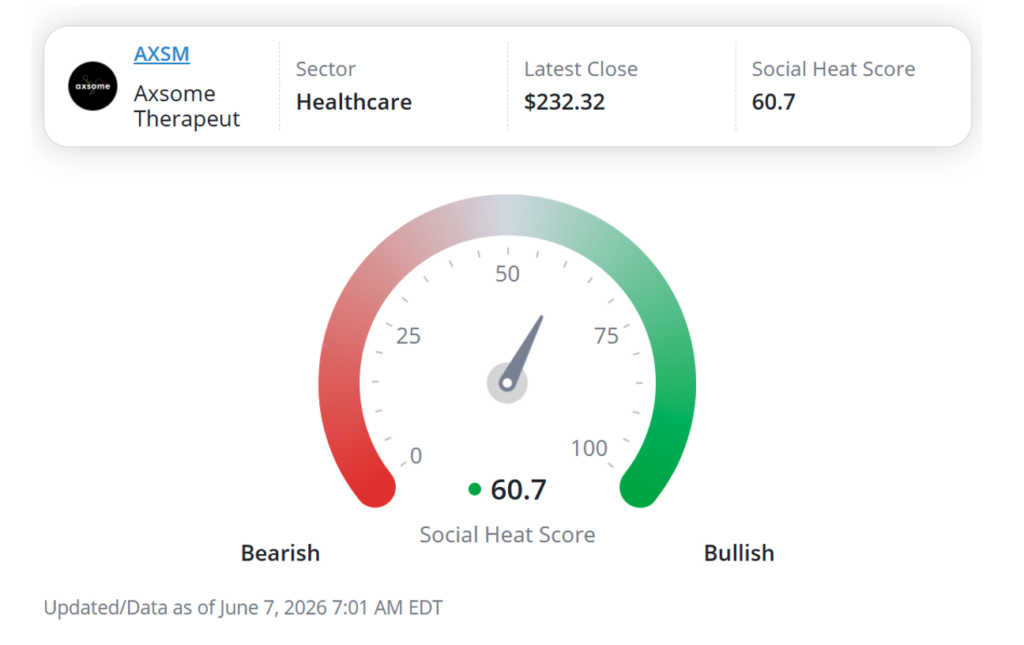
The growing momentum across longevity themes tied to biotech innovation and next-generation healthcare are exactly the trends supporting Axsome’s long-term opportunity in brain health.
To wrap, here’s a way to look at Friday’s selloff…
Friday saw the tech-filled Nasdaq 100 drop 4.8%, the biggest single-day decline since the peak of volatility after the White House’s Liberation Day tariff announcement last year.
A strong jobs report showed the U.S. economy added 172,000 jobs in May, far above expectations… giving the Federal Reserve almost no room to cut interest rates as inflation nudges up.
That’s set to weigh on stocks, especially tech stocks that benefit from cheaper borrowing rates.
But was Friday’s bloodbath a signal to sell? Not if you ask Alpha Signals editor Lucas Downey.
Better than anyone I’ve met in my 10 years in the business, Lucas knows how to cut through the noise with data.
He’s our in-house expert on signals studies. A signal study scans a stock or index’s history, identifies every past occasion when identical conditions occurred, and records what happened next.
Whenever we see an anomaly like Friday’s big Nasdaq selloff, he doesn’t guess what might happen next. He dives into the data to see what’s historically happened in similar circumstances.
This morning, he shared this chart of his latest signal study with me:
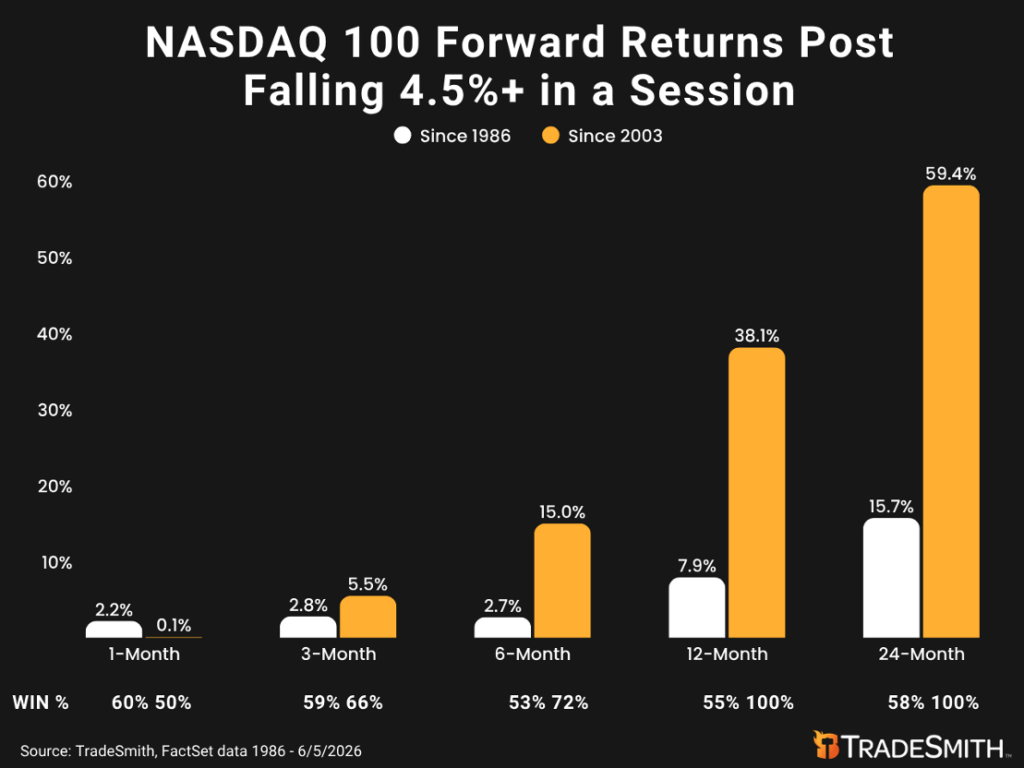
This shows the average of what’s happened whenever the Nasdaq 100 has fallen more than 4.5% in a single session. We’ve seen this happen 100 times since the Nasdaq 100 was founded in 1986.
In short, the Nasdaq 100 tends to recover over the long term. From 1 month out to 24 months, returns are positive across the board.
But note the yellow bars especially – those are the returns over the past 23 years since the worst days of the dot-com bust. On average, the Nasdaq 100 has been positive 100% of the time for an average return of 38.1% after 1 year… and 59.4% after two years.
Smackdowns like Friday’s are painful, but the data shows that more often than not, they prove to be buying opportunities down the line.
To building wealth beyond measure,
Michael Salvatore
Editor, TradeSmith Daily