It’s Too Early to Call the Top… and Too Early to Sound the All-Clear
Listen to the audio version of this article (generated by AI).
In This Digest:
- These four shocks have shaken the AI trade to its core
- Why you need to pay attention to tech’s Yellow Zone
- These two chip stocks are bucking the bearish trend
It was the mother of all momentum unwinds…
What happened to the AI trade these past few months wasn’t your usual pullback.
It was the biggest momentum unwind since the bursting of the dot-com bubble.
Micron (MU), this year’s AI poster child after a 284% peak gain, is down 29% in just over a month. Major AI data center stock CoreWeave (CRWV) was down 55% from its May highs. And in just over a month, the VanEck Semiconductor ETF (SMH) – a basket of the world’s leading chip stocks and the key proxy for the AI boom – fell nearly 25% from its June high.
As our CEO Keith Kaplan laid out on X, four shocks hit the AI trade at once.
- First, Chinese AI lab Moonshot AI released a model that closed much of the gap with America’s best – at a fraction of the cost.
- Second, oil surged above $100 a barrel as fighting flared with Iran.
- Third, the Federal Reserve held rates steady on inflation worries, and new chairman Kevin Warsh committed to communicating less – adding uncertainty right when markets had none to spare.
- Finally, leveraged single-stock ETFs blew up in Asia. These funds have to trade constantly to keep pace with a stock’s daily move – so when chip prices fell, funds tracking chipmakers like SK Hynix were forced to sell into the drop, pushing prices lower still.
Goldman Sachs said systematic funds – funds that use algorithms to trade market trends – have given back a quarter of their year-to-date gains.
Is this a reason to run for the exits? No. But to stay invested in this market, and capture any future upside, you’ll need to stay quick on your feet.
Longtime TradeSmith readers know we’ve been calling this market a “Mega Melt-Up” since early 2024.
That’s when a transformative technology, easy market access, and abundant credit collide at once, foretelling both the biggest gains and the ugliest crashes in market history.
AI, zero-commission trading apps, and record consumer credit are today’s version.
We also saw it before with the internet, online brokerages, and home equity loans in the dot-com bubble.
And we saw it back in the 1920s, with electrification, the first retail margin loans, and a broadening of consumer credit – right before the 1929 crash.
We don’t know when this melt-up will become a meltdown…
Those four factors Keith laid out certainly have a lot of traders feeling skittish right now.
But despite the selloff, the tech-heavy Nasdaq 100 is still up 12% year to date. And the VanEck Semiconductor ETF (SMH) – is up almost 46%.
Plus, the market’s biggest AI-spending question just got an answer.
On Wednesday, Microsoft’s (MSFT) cloud unit, Azure, grew revenue 43% – its fastest pace since early 2022 – while capital spending plans held steady.
Investors responded by adding roughly $450 billion to Microsoft’s market cap in a single day, the largest one-day gain for any company in U.S. stock market history.
Amazon (AMZN) followed Thursday: Its cloud division, AWS, grew 37%, its fastest pace in 18 quarters, and the stock ripped higher by double digits.
Finally, SMH jumped more than 10% in last Thursday’s trading – its biggest upside move since April 2025, when stocks were recovering from the Liberation Day crash.
That’s often what a short-term bottom looks like. The market’s biggest fear gets answered, and the selling pressure abates.
It’s not a guarantee the selling is over. But it’s why we’re not writing off the AI trade – and why the next place to look is what our data is showing on the Nasdaq 100.
On Monday, the tech-filled Nasdaq 100 entered a Yellow Zone…
That’s going by the latest Short-Term Health reading for the Invesco QQQ (QQQ) ETF that tracks the index.
Regular readers know Short-Term Health is our most sensitive trend indicator. It compares a stock’s recent price moves to its typical trading range to determine if it’s in a healthy uptrend (Green Zone), a caution zone (Yellow Zone), or a downtrend (Red Zone).
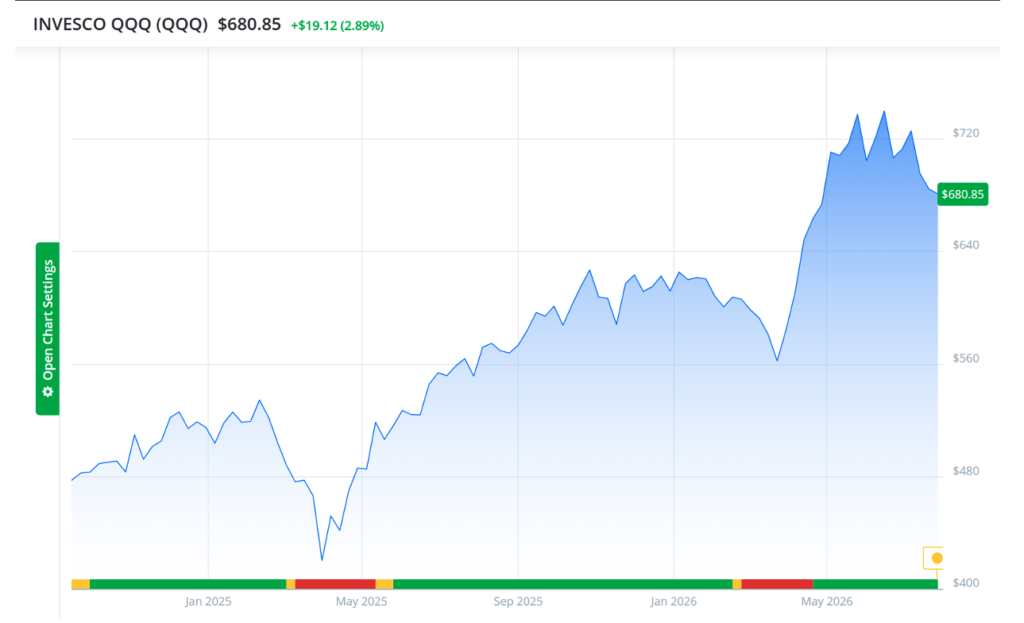
The chart above tracks the Nasdaq 100’s Short-Term Health going back to the start of 2025.
Look back, and you’ll see why that matters. Since the start of last year, each time QQQ entered a Yellow Zone, it’s signaled trouble.
A move back into a Green Zone is still a possibility. Yellow flashed in late summer 2023, then again twice in 2024, during otherwise healthy stretches of this AI-driven bull market. Each time, the index turned back to Green and kept climbing.
It’s too early to call the top of this bull market and too early to sound the all-clear.
So here’s what to do: Stay invested if you already are, but hold off on adding new AI-trade exposure until the index confirms the bounce with a move back to Green. And if it turns Red instead, then that’s your cue to take even more chips off the table.
Two chip stocks are doing something almost no peer managed this summer…
This month’s chip selloff, Nvidia’s early warning, and the Nasdaq’s own caution flag all point to a sector under pressure.
But when we ran our full list of semiconductor and semiconductor-services stocks through a different lens, two stocks stood out – for the opposite reason.
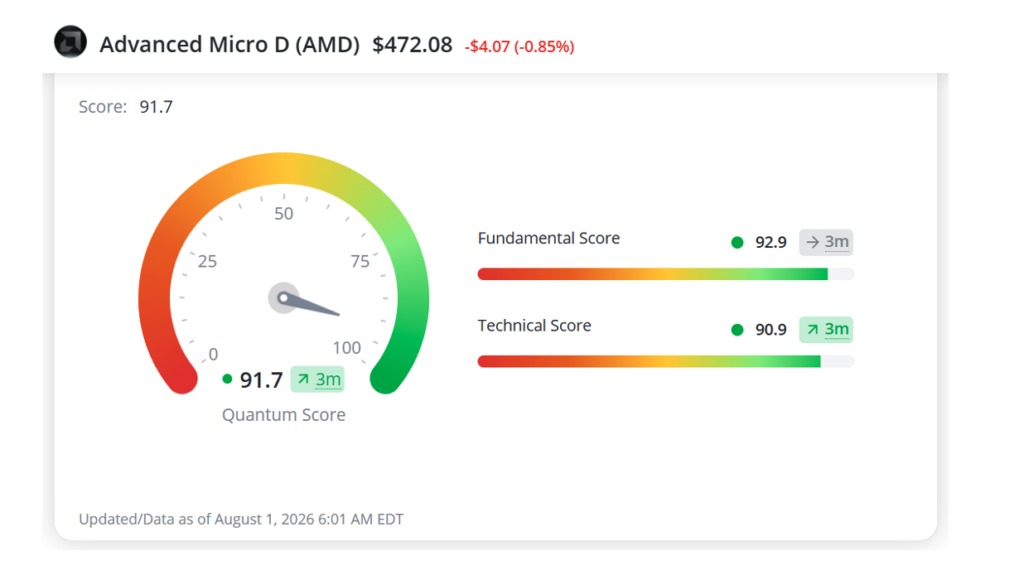
Every stock we track gets a Quantum Score, a 0-to-100 read that combines fundamental strength (earnings, revenue, and margin growth) with technical momentum (price action and unusually large institutional buying). Anything above 70 is a buy.
The score is built to track where strong businesses and real money flows are lining up – not where the headlines are pointing.
Right now, only two stocks in the semiconductor sector carry a Quantum Score above 90.
The first is Advanced Micro Devices (AMD), Nvidia’s closest competitor in the AI chip market. It scores 91.
The second is Monolithic Power Systems (MPWR). It designs the chips that control how electricity flows inside a device – everything from data center servers to cars to phones.
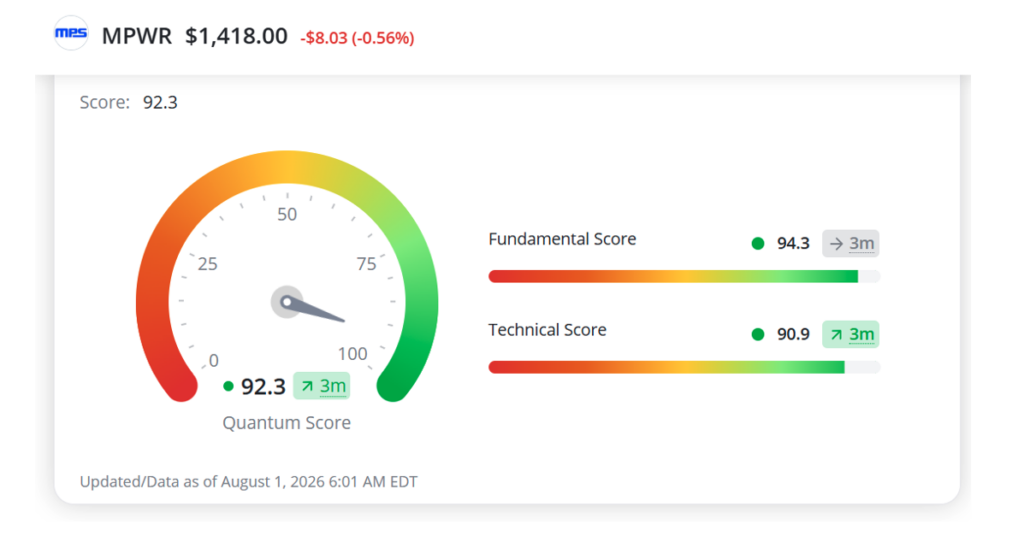
The scores are moving in the right direction, too. Both stocks’ technical scores have improved over the past three months, even as the chip sector took a beating.
Keep these two chip stocks on your watchlist as potential outperformers if the market recovers from here.
And keep in mind: These are far from the only stocks showing bullish momentum alongside healthy balance sheets right now.
Our Quantum Score uncovers opportunities across the market – not just in AI – for companies with all the market-beating qualities you want to hold for years.
Our growth investing expert and one of the original architects of the system, Lucas Downey, recently laid out how it works in a new research presentation.
In that same presentation, Lucas is sharing why the best buying opportunity might come later this month. According to Lucas, this year’s volatility isn’t done – but it’s close. Click here to learn why.
To building wealth beyond measure,

Michael Salvatore
Editor, TradeSmith Daily