OpenAI’s Chip Beat Nvidia’s – But Our Data Says Don’t Sell
Listen to the audio version of this article (generated by AI).
In This Digest:
- The headlines may be bad for Nvidia, but the data doesn’t lie
- Two stocks to buy for the semiconductor sector bounce
- This AI memory stock is a top Smart Money Edge trade
Competition is heating up for Nvidia…
On Tuesday, OpenAI – the company behind ChatGPT – showed off the first test results for its new AI chip.
In the lab, Jalapeño did more AI work while using less electricity than Nvidia’s chips. It also allowed ChatGPT to answer questions faster.
If you own Nvidia, that might make you nervous. And if you own an index fund or a technology fund in your retirement account, you probably own more Nvidia than you realize.
And Jalapeño isn’t the only chip nipping at Nvidia’s heels. Google has its own, called a Tensor Processing Unit. Along with OpenAI’s new chip, this points to a real shift in the semiconductor industry.
Think of it like a classroom. Training chips – Nvidia’s specialty – are the teacher. They feed an AI model everything it needs to know. Inference chips, like Jalapeño, are the student taking the test. Their job is to give fast, accurate answers once the learning is done.
For years, Nvidia ruled both. Now OpenAI and other AI labs are building their own inference chips to step out of Nvidia’s shadow.
That may sound like bad news for Nvidia. After all, if these labs make their own chips, they won’t be buying as many of Nvidia’s.
But OpenAI’s the lab test also stacked Jalapeño against Nvidia’s older Blackwell chip, not its newest one. And the results came from OpenAI, not an outside referee.
Most telling of all: OpenAI keeps buying Nvidia. Last fall, it agreed to fill its next wave of data centers with Nvidia’s newest systems, with the first batch going live this year. When the company building a rival chip is still one of your biggest customers, demand isn’t drying up. It’s exploding.
And if the market is bearish on Nvidia, it’s not showing up in our data. Contrary to the scary headline, our indicators show that dips are to be bought, not sold.
First, Nvidia’s short-term momentum is bullish…
It’s all in this chart of our most sensitive momentum indicator, Short-Term Health:
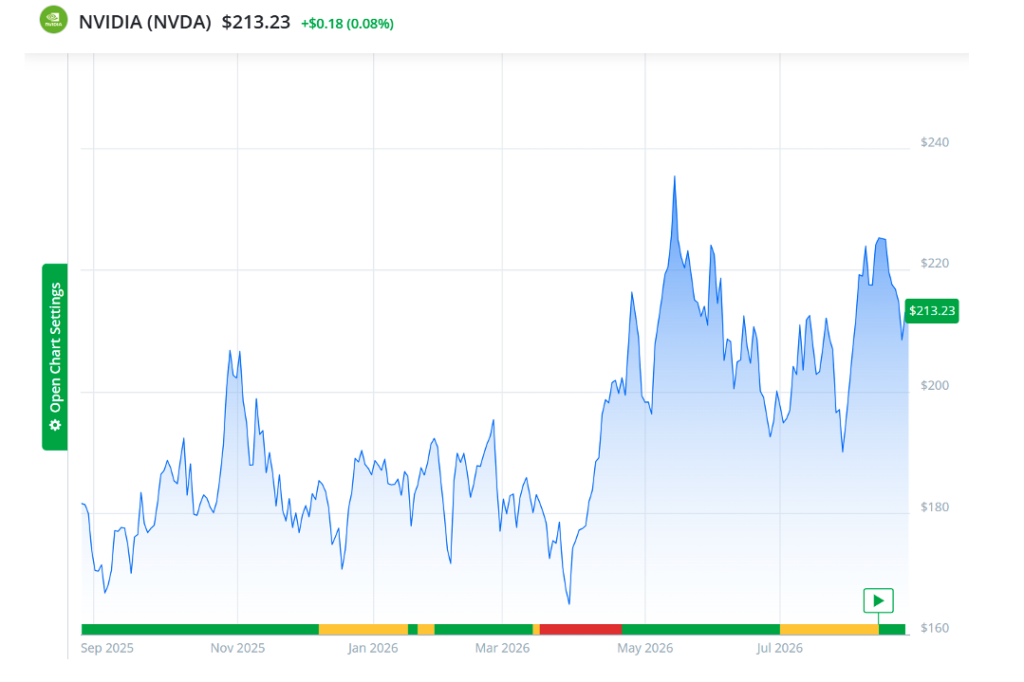
Short-Term Health looks at how a stock has been trading recently and flags when it starts trading outside its normal range. A Green Zone means it’s in a healthy uptrend. A Yellow Zone signals a possible shift. And a Red Zone means the uptrend has broken down. For an investment you plan to hold for months, not years, that’s your signal to sell.
Nvidia entered a Short-Term Health Green Zone on Aug. 13, after spending the start of July in a Yellow “caution” zone.
What’s more, Nvidia is the only stock in the VanEck Semiconductor ETF (SMH) sitting in a Green Zone right now. Every other stock in that fund is yellow or red.
It’s trading strongly bullish, even when the rest of the sector is in the doldrums.
Nvidia is also trading in a healthy long-term pattern…
Nvidia has also held a Long-Term Health Green Zone since February 2023 – with just one short dip into Yellow in Spring 2025.
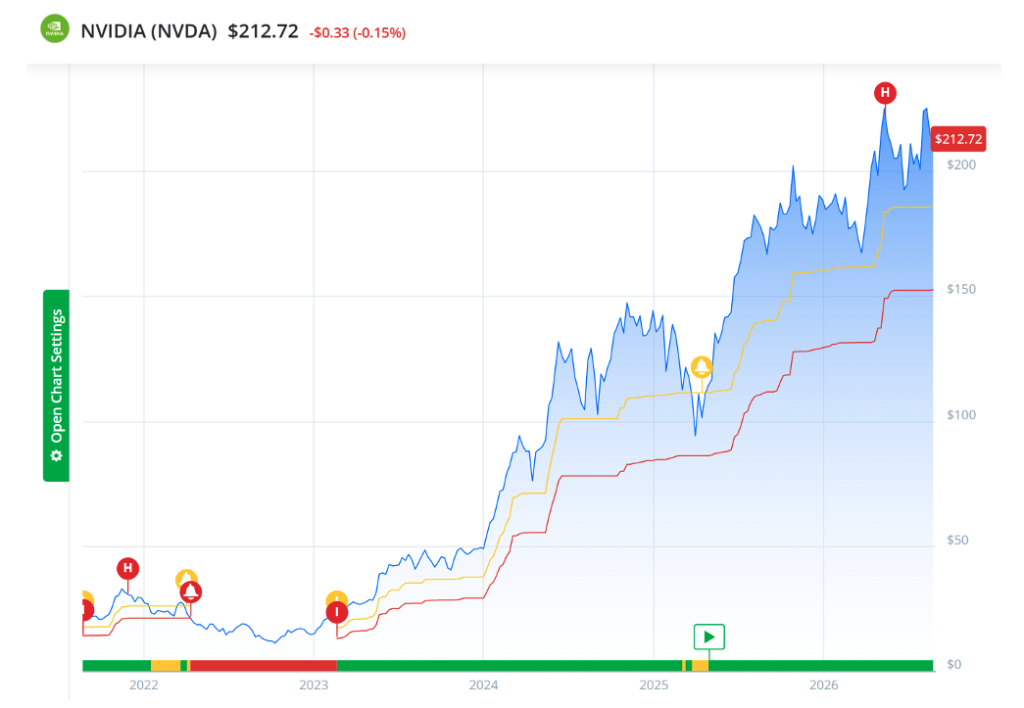
That’s the longest-running Long-Term Health Green signal of any stock in the SMH ETF. Since it exited its last Red Zone, the stock is up 807%.
So don’t let the headlines scare you into selling. Any pullback in Nvidia after tonight’s earnings report looks like a buying opportunity – not a reason to run.
Nvidia isn’t the only chip stock worth flagging this week…
When I ran Predictive Alpha’s forecasts across the rest of the stocks in the chipmaker ETF, two stood out: Micron (MU), the largest U.S. memory chipmaker, and TSMC (TSM), the world’s largest contract chip manufacturer.
Predictive Alpha is our AI-powered forecasting engine, trained on more than 100 billion data points of market history.
Think of it like ChatGPT, but for numbers. Instead of forecasting the next word in a sentence, it forecasts the next move in a stock’s price – up to 21 trading days out.
Here are the most bullish forecasts for semiconductor stocks:
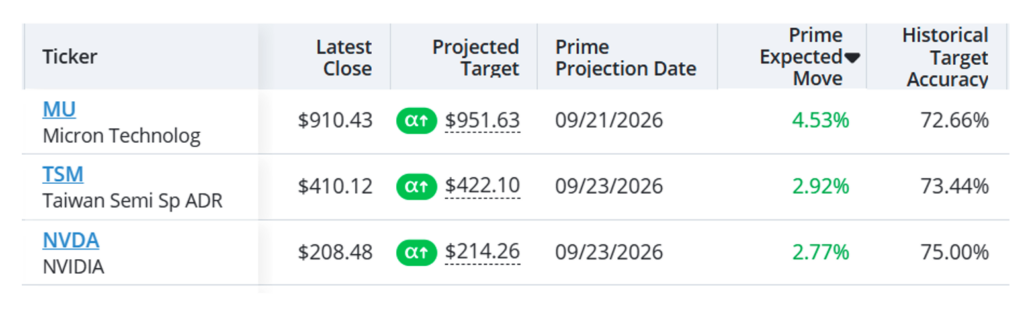
- Micron is projected to climb 4.5% by Sept. 21, with a historical accuracy rate of 72.7%.
- TSMC is projected to climb 2.9% by Sept. 23, with a 73.4% accuracy rate.
- Nvidia is projected to climb 2.8% by Sept. 23, with a 75% accuracy rate.
If you’re looking for other short-term trading opportunities in the chip sector, put these at the top of your watchlist.
Now, here’s how to see what Wall Street’s smart money is buying…
If you tuned in yesterday for Keith’s 30-Day Wealth Accelerator event, you know we’ve built a way to see which stocks the biggest, best-connected investors on Wall Street are taking large stakes in – in near-real time.
We do it by scanning for anomalies in the options market.
I know for a lot of folks, options can be off-putting. But last year, more than 15 billion options contracts changed hands in the U.S. – a sixth-straight record year. And buried inside all that activity are clues about where some of the world’s wealthiest investors are putting their money.
No person could ever sift through that much data by hand. But AI can. We put the same kind of pattern-spotting technology that powers Predictive Alpha to work on the options market.
It sweeps through all that trading in seconds and picks out the handful of bets that don’t fit the usual pattern – the ones that hint someone with deep pockets is quietly making a move.
We call it Smart Money Edge.
It’s an AI-powered scanner that watches the options market, flags unusual activity across thousands of stocks, and checks whether what it’s seeing is a real signal or just noise.
Think of it as radar for hedge-fund money. It can’t tell you what they know, but it can tell you what they’re doing with their money.
In backtesting from February 2022 through April 2024, Smart Money Edge flagged a winning trade three out of every four times with an average return of 13.7%.
Smart Money Edge is now part of Options360, our options-trading software suite.
Today, Smart Money Edge is flagging this setup in Western Digital (WDC).
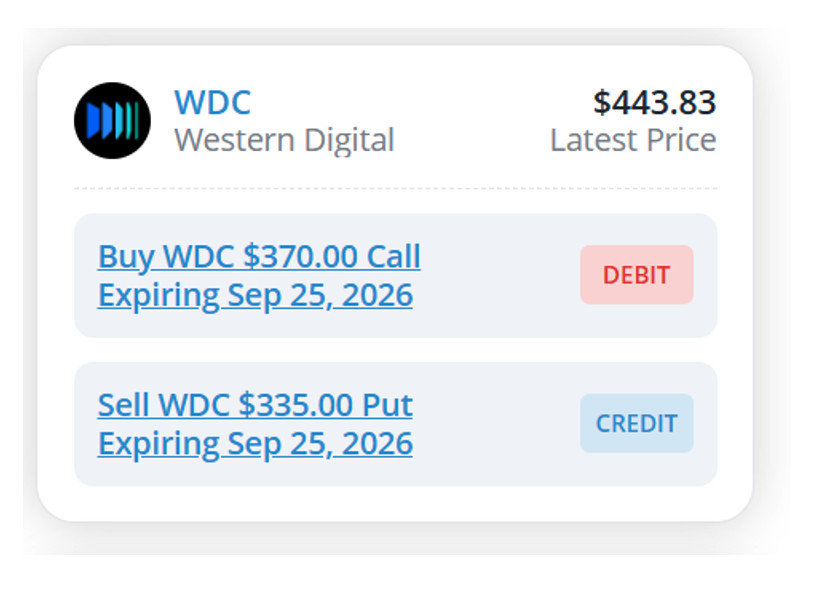
That fits with the bullish Predictive Alpha forecast for Micron we just looked at. Western Digital is a big maker of data-storage gear, and it’s closely tied to the AI boom.
If you’re an experienced options trader, you’ll notice these options setups are “in the money.”
With each one, you’re making a high-odds bet that a stock will either rise (in the case of buying calls) or won’t fall much (for selling puts) from its current price between now and its expiration date.
And that’s a high-odds trade given that this stock has a high level of smart money buying behind it.
To catch up on how this new system works and the three stocks it’s flagging now, watch the replay of yesterday’s 30-Day Wealth Accelerator event.
If you missed it, the replay is still up.
Watching it gets you the same three stocks Keith revealed live, as well as a full walkthrough of how the Smart Money Edge system works.
To building wealth beyond measure,

Michael Salvatore
Editor, TradeSmith Daily