Our AI Signals Trader Likes This “Bitcoin Pivot”
In This Digest:
- Tell the news to take a hike — and let our signals do the heavy lifting
- Small caps are crushing it in 2026 (and why that matters)
- This top small-cap signal points to a major AI trend
If you’re trying to trade the news headlines, good luck…
Here’s a sample of some of the big financial headlines from over the weekend…
- Apple’s Tim Cook is handing the CEO reins to hardware chief John Ternus.
- China is blocking Meta Platforms’ $2 billion acquisition of AI startup Manus.
- The DOJ dropped its investigation of Fed Chair Jerome Powell to clear the path for Kevin Warsh’s confirmation as the new Fed leader.
- And yet another plan floated to reopen the Strait of Hormuz – the latest in a string of Sunday-night peace proposals that have yet to produce a lasting deal.
These news stories might be informative. They might even be interesting.
But none of them help you know what to trade.
We’ve all been there – scanning headlines on a Sunday night, trying to figure out what Monday will bring.
But by the time a story reaches the headlines, whatever implications it had for stocks has already been priced in.
The news, by definition, tells you what has already happened. It doesn’t tell you what’s likely to happen next.
If you want to know the answer to that question, you have to think about the world, as we do here at TradeSmith, through the lens of data.
It’s that lens that allowed us to create Signals, our most advanced trading system to date.
Instead of focusing on the news, it looks for unique signals – obscure, repeatable patterns buried in reams of market data that flag high-probability trade setups.
The kind of high-probability setups that, in a six-year backtesting period, beat the S&P 500 3-to-1.
More than 1,600 new subscribers are now trading these signals…
If you’re not familiar with the term, a signal study is a way to look at an individual stock’s history and ask a simple question: When this exact pattern showed up in the past, what happened next?
With the help of AI, our new software scans every stock in the S&P 500 – plus thousands more – every trading day.
It runs each one through almost 200 different entry rules and dozens of exit rules – many of them discovered by machine learning algorithms. It adds up to more than 10 million potential trade evaluations a day.
From that ocean of data, it surfaces only the signals with the strongest historical track records – the specific combinations that have reliably preceded moves in a given stock.
Think of how AI language models predict the next word in a sentence based on patterns in billions of pages of text.
Signals is similar, except it predicts the next probable move in a stock based on patterns covering a decade or more of market data.
At a glance, you can see:
- Each signal’s historical accuracy rate
- How much money it’s made on average as well as its top gain
- How long the signal has historically taken to play out
- How well a signal matches today’s market environment
As I write, the top three stocks at the top of the Signals dashboard have historical win rates of 96%, 93.9%, and 91.3%. Their average gains range from 3.7% to 5.0% over holding times of one to two weeks.
During last Wednesday’s launch of this breakthrough new system, our CEO, Keith Kaplan, demoed how the system worked and what it’s flagging right now.
The replay is still up. But it comes down tomorrow. So I’d encourage you to watch it before then.
Small caps are 2026’s stealth winners – and our system has flagged one worth watching…
While the headlines have been dominated by Iran, AI, and Big Tech, small-cap stocks have been running circles around the rest of the market.
Year to date, the small-cap S&P 600 index is up 12%. Meanwhile, the S&P 500 is up 4.5% and the tech-heavy Nasdaq 100 is up 8.3%.
Read those numbers again. Small caps are outperforming the S&P 500 by nearly 3-to-1 and beating even the tech-heavy Nasdaq 100.
We’ve been banging this drum for weeks now. In late March, we walked you through why profitable small caps were holding up better than the broader market.
Over the past week, the S&P 600 and S&P 400 mid-cap index also fired new Short-Term Health Green Zone signals. Using a simple traffic-light system, it tells you whether short-term momentum is bullish (Green), cautious (Yellow), or bearish (Red).
Now, what’s the best small-cap stock to buy right now?
Signals can help us narrow it down.
One feature of the new Signals software is the ability to filter for both certain types of stocks and even types of Signals.
With that, we can look for Sprint signals in small caps. Sprint signals capture stocks with strong recent momentum.
One name that lit up was Bitcoin miner Core Scientific (CORZ):
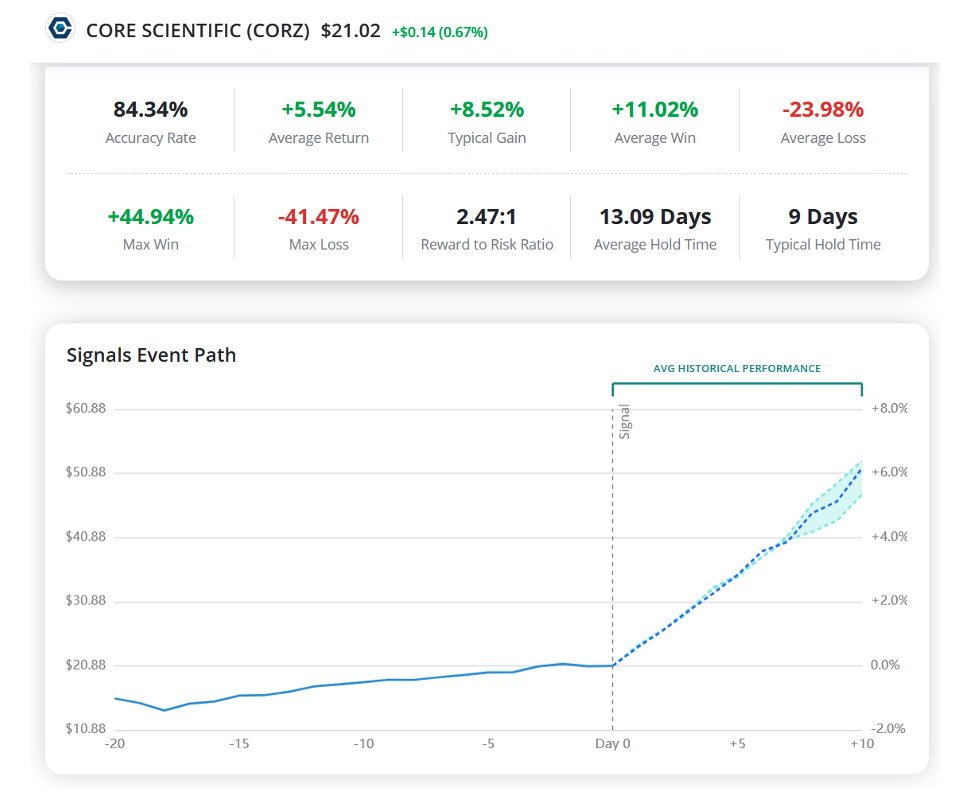
It just triggered a Bullish Sprint signal with a top-tier Quality Score of 99.9.
The Quality Score is our way of pinpointing the best potential trade setups for right now.
It’s the result of two separate machine learning models working together in real time. The first model looks backward. It grades a signal’s full historical track record — win rate, average gain, how many times the signal has fired in the past.
The second model evaluates current market conditions and asks whether those conditions match the ones under which this signal has historically performed best.
A signal with a 100% historical win rate can score lower than one with an 80% win rate — if today’s conditions don’t support it. And a signal with a modest track record can score very high if the conditions are ideal.
A 99.9 Quality Score is about as strong as it gets.
The signal’s 10-year track record shows an 84.3% accuracy rate, a 5.5% average return, and a typical holding time of just nine days. And the biggest return we’ve seen with this signal is close to 45%.
Just mind that average loss, too – when this signal doesn’t work, the stock’s average loss has been nearly 24%. That’s a risk to keep in mind – and a reason to have a clear exit strategy if you’re taking this trade. Consider a tight stop-loss – which will sell the position if it falls below a certain amount.
Also keep in mind if you’re diving in: This signal’s exit rule is to sell after an 8% gain or better as of market close, or after 21 trading days. (Our Signals subscribers can set alerts to receive emails when it’s time to exit.)
There’s also an interesting layer beneath the signal.
Core Scientific is one of a growing number of former Bitcoin mining companies that are pivoting to become AI data center operators. Hut 8 (HUT), TeraWulf (WULF), IREN (IREN), and MARA Holdings (MARA) are all doing the same thing.
These companies already have the computational hardware and server infrastructure – they’re just redirecting it from mining cryptocurrency to powering AI workloads.
This is an interesting investment theme that we’re keeping an eye on. Though, remember: Fundamentals don’t factor into a signals trade.
The system spotted the CORZ trade setups because the specific technical and statistical conditions that have historically preceded winning trades in this stock are present right now.
If you’re already a Signals subscriber, CORZ is worth pulling up on your dashboard today.
If you’re looking for small-cap exposure in a market where smaller stocks are leading, Signals gives you a systematic way to find the specific names with the highest-probability setups – without relying on headlines or hunches.
Keith’s Signals launch presentation included a detailed walkthrough of how the system works, plus a specific stock to buy, one to avoid, and one trade to make right now. The replay is available until Tuesday at midnight.
I’d advise you to watch it before it comes down.
To building wealth beyond measure,
Michael Salvatore
Editor, TradeSmith Daily