Our Last Space Trade More Than Doubled – Here’s the Next Big Winner
Listen to the audio version of this article (generated by AI).
Our last space trade soared 143% in less than four months.
That was Redwire (RDW) – a small space infrastructure company that makes the hardware that goes onto satellites and spacecraft. Think solar panels, robotic arms, and docking systems.
Redwire’s hardware was already headed to NASA’s Lunar Gateway – the space station the U.S. is building in orbit around the Moon as a steppingstone to Mars.
And the company sat at the heart of nearly every major space mission on the launchpad. Yet it was trading for under $10 a share.
But here’s what really caught our attention…
Our Social Heat Score – a 0 to 100 measure of real consumer and professional demand built from millions of data points across the web – had just crossed 74.5 on RDW and was heading higher.
Scores above 60 are bullish. So Redwire was well into bullish territory. But its stock had been falling. Take a look…
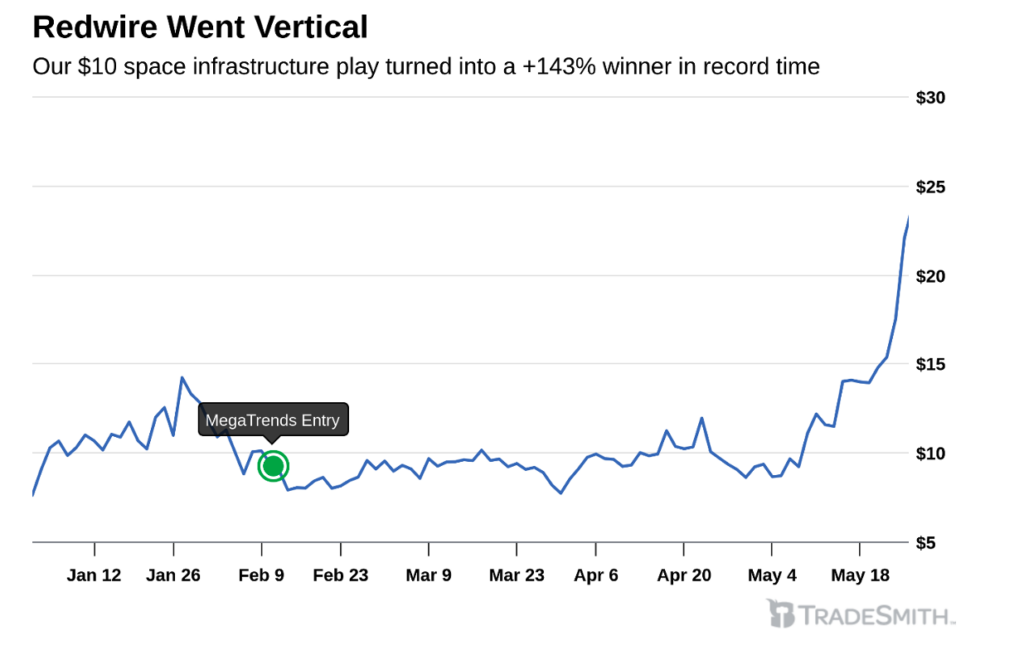
A lot of people run a mile when a stock is falling. But we love to see bullish Social Heat Scores on falling stocks. It tells us that real-world interest is building, but Wall Street hasn’t caught on yet.
We added RDW to our MegaTrends model portfolio in February at $9.99. Less than four months later, we gave subscribers the chance to close out that trade for a 143% gain.
Last Friday, Elon Musk’s rocket and space technology company, SpaceX (SPCX), went public – and now everybody is talking about this investing theme.
But the SpaceX IPO didn’t make us believers – we were already in.
We’ve been pounding the table on this sector since we released our “21st Century Space Race” report to subscribers in October 2025. That’s back when space stocks were still a niche conversation, and most investors were focused elsewhere.
Now the crowd has caught on. The sector is on every investor’s radar. And the question we’re asking: Where does the money go next?
Here’s what our data is telling us.
The Stock Our Data Is Flagging Now
While all eyes are on SpaceX, our Social Heat Score crossed deep into bullish territory on a drone defense company most people have never heard of: Kratos Defense (KTOS).
Kratos builds autonomous drones for the U.S. military. The kind that fly alongside military fighter jets as robotic wingmen – unmanned aircraft that can think, react, and engage alongside a human pilot at combat speed.

Last year, the market for these autonomous defense systems was valued at $18.5 billion. By 2034, it’s projected to hit $62.4 billion. That’s annual growth at nearly 15% a year as AI and advanced sensors reshape how militaries fight across land, sea, and air.
Kratos is already pulling in $1.3 billion in annual sales – on its way to a forecasted $1.7 billion this year. And orders are piling up faster than the company can fill them. It took $605 million in new bookings in the first quarter alone and a total backlog of $2 billion.
The White House has made drone development a priority. And the Pentagon’s proposed budget for next year reflects that. It allocates more than $70 billion for military drones and counter-drone systems.
The Pentagon’s entire drone budget in 2025 was roughly $300 million. So, that’s a 237-fold increase in a single year.
It’s no surprise. As we’ve seen on battlefields from Ukraine to the Persian Gulf, cheap drones can cause havoc for traditional air defense systems.
The math is brutal. A drone that costs anywhere from $1,000 to $20,000 can force defenders to expend interceptor missiles worth hundreds of thousands – sometimes millions. Launch enough of them at once, and even the most advanced air defense systems get overwhelmed.
The same cheap drones that overwhelm air defenses can threaten naval vessels worth billions.
That’s the new reality of modern warfare. Now, Washington is scrambling to catch up.
And here’s what’s really interesting: Space, drones, and defense used to be three separate conversations. They aren’t anymore. Satellites collect the data. Drones act on it. AI connects them. Kratos sits right at that intersection.
Kratos Is Deep in Bullish Territory
Our Social Heat Score on KTOS is deep in bullish territory – a 75 out of 100 – while the stock is down 25% year to date.
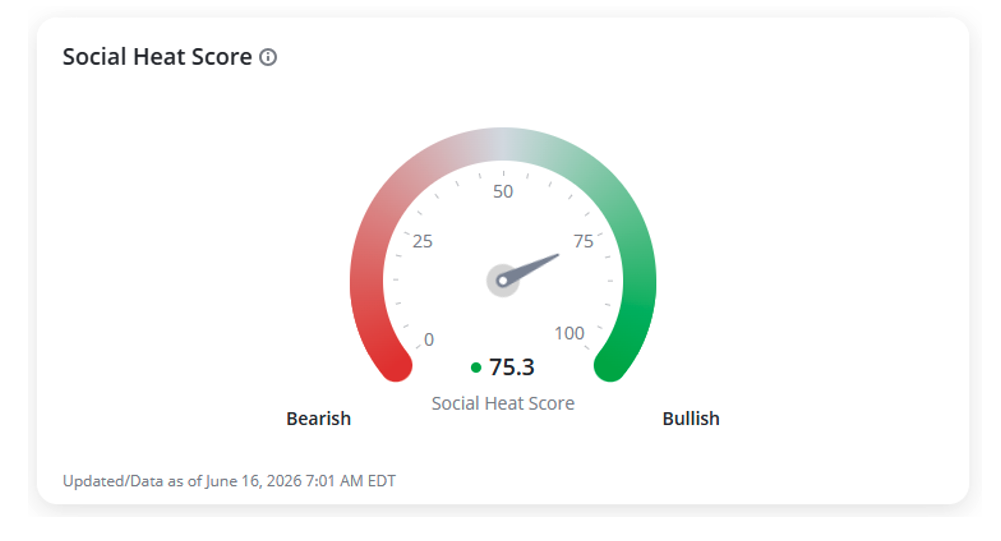
That gap between what our signal sees and what the stock price reflects is exactly the setup we look for.
We saw it on Redwire before 143%. We’re seeing it on KTOS now.
We’re not ready to make this an official buy recommendation today – we want to see the score push through 80 and hold. But a climbing Social Heat Score, a stock that hasn’t caught up yet, and a space-adjacent market projected to nearly quadruple by 2034?
That combination gets our attention.
The Bottom Line
Eight months ago, we showed our subscribers why space was an emerging theme that was going to take off.
Now SpaceX is one of the world’s largest stocks, and the people are paying attention.
Which means our job is the same as it’s always been – find the next move before the crowd does. And Kratos is at the top of our watchlist.
If you’re not already a MegaTrends subscriber, you’re missing out. Every time our data spots a setup like this, our subscribers get a full research report, a specific entry price, and a clear trade recommendation.
The next wave of the space boom is already forming. We’d rather you be early than late.
To join our growing subscriber community, go here now.
Until next time,

Andy Swan
Founder, LikeFolio